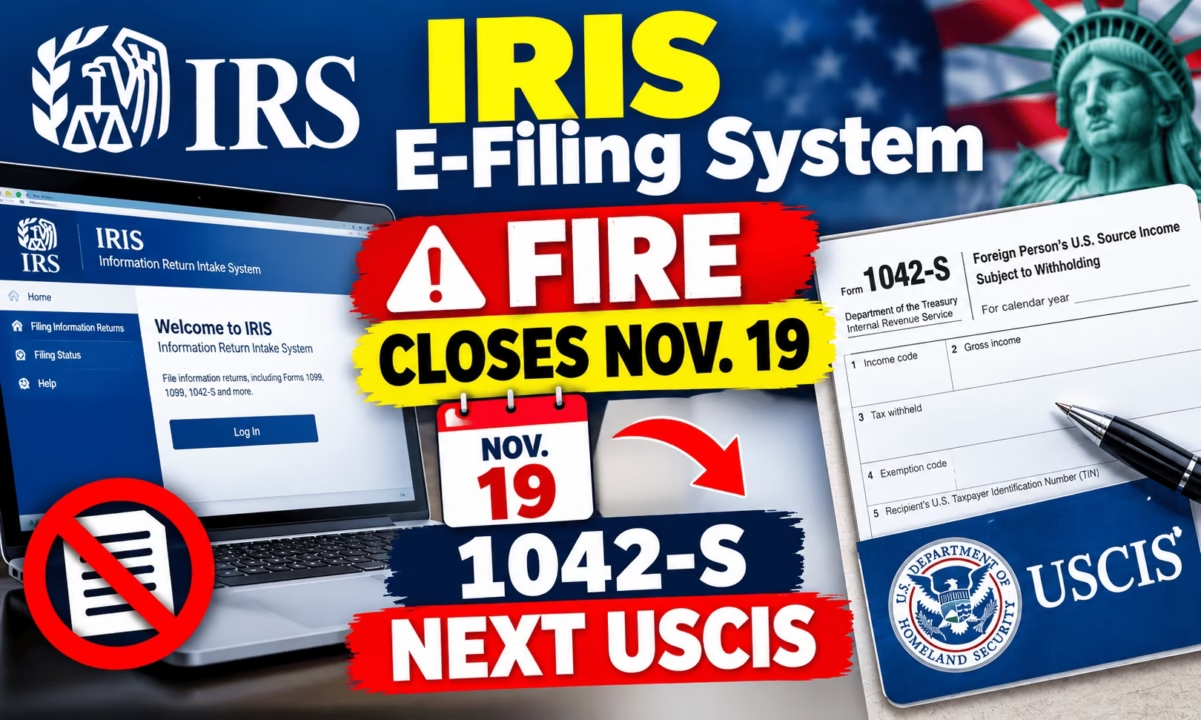
The IRIS e-filing system is about to become the only way to file Form 1042-S electronically, and the clock is short. The IRS confirmed in its August 24 reminder, IR-2026-99, that the old Filing Information Returns Electronically system, known as FIRE, will stop accepting submissions after 3 p.m. Eastern on November 19, 2026. That is 20 days from today. The FIRE test system closes even sooner, on November 1, and November 9 is the last day to change an application for a Transmitter Control Code. Tax year 2026 information returns, including Form 1042-S due on March 15, 2027, must go through the Information Returns Intake System, or IRIS, with no option to use FIRE at all. We’ll be updating this article monthly as the IRS releases new guidance.
The change reaches well beyond large banks. Universities paying foreign scholars, brokerages, partnerships, payroll providers, and any business that sends 10 or more information returns in total must file electronically, and that count adds up Forms 1099, W-2 and 1042-S together. Many of them have relied on FIRE for decades. Filer guidance says old FIRE codes do not carry over, so each filer needs a new IRIS code, and the IRS has not published a processing time for it, although its filing page has warned that applications can take up to 45 days. This guide covers every date that matters, the steps to get set up, how IRIS handles Form 1042-S, what rejections to expect, what late or paper filing can cost, and a free estimator to plan your timeline.
IRIS E-Filing System Key Dates
| Date | What happens | Why it matters |
|---|---|---|
| January 1, 2026 | IRIS opens for tax year 2025 Forms 1042-S | First season where 1042-S could go through IRIS |
| March 15, 2026 | Deadline for tax year 2025 Forms 1042-S | FIRE and IRIS were both allowed for this season |
| August 24, 2026 | IRS issues reminder IR-2026-99 | Confirms FIRE shutdown timeline |
| November 1, 2026 | FIRE test system closes | No more test files through FIRE |
| November 9, 2026 | Last day to change FIRE TCC applications | Applications become locked after this date |
| November 19, 2026, 3 p.m. ET | Last day to file through FIRE | Includes late and corrected returns for earlier years |
| January 1, 2027 | IRIS is the only e-file system | Covers current year, prior year and corrections |
| March 15, 2027 | Tax year 2026 Form 1042-S and Form 1042 due | First mandatory IRIS deadline for 1042-S |
IRIS E-Filing System Key Highlights
| Feature | What to know |
|---|---|
| Two ways to file | IRIS Taxpayer Portal for manual or CSV entry, and Application to Application for software and large volumes |
| Cost | The Taxpayer Portal is free to use |
| Taxpayer Portal upload size | Up to 100 records at a time, according to filer guidance |
| A2A upload size | Up to 100 megabytes per submission |
| E-file requirement | 10 or more information returns in total across all form types |
| Forms covered | The 1099 series, 1042-S, 1098, W-2G, 3921, 3922, 5498 and others |
| Scale of use | More than 139 million records were received in the 2025 filing season, according to the IRS |
| Login | An IRIS Transmitter Control Code, plus secure sign-in through the IRS e-Services options |
Why the IRS Is Replacing FIRE With IRIS?
FIRE dates back to the 1980s and 1990s, and it was built around fixed-width text files that modern software no longer handles easily. IRIS uses XML, checks data as it comes in, and lets filers fix errors inside the same system rather than resending a whole file. The agency says IRIS became available in 2023 as part of a phased move of forms off FIRE, and from 2027 every form that FIRE supported will be available in IRIS.
The IRS has also made clear that IRIS is where new forms start. The digital asset form, Form 1099-DA, was built only for IRIS and was never supported by FIRE. Form 1042-S was added for tax year 2025, and the agency’s own working group notes show it planned to retire FIRE once that move was complete.
Earlier working group material pointed to the end of December 2026 as a target for retirement. The later August reminder set the earlier November 19 cutoff, which means anyone who planned around the end of the year has less time than they thought. The IRS also told filers in that reminder that it had no plan to extend the date, and several tax software providers have repeated that point to their clients.
Government Shutdown 2026 Update: Stopgap Bill Signed Into Law, Federal Funding Runs to December 11
Form 1042-S and IRIS: What Withholding Agents Need to Know
Form 1042-S reports income paid to foreign persons that is subject to U.S. withholding, such as scholarship payments, royalties, dividends, interest and other fixed or determinable income. Each form goes to the foreign recipient and a copy goes to the IRS, along with the annual Form 1042 that summarizes the withholding.
For tax year 2025, U.S. filers could use either FIRE or IRIS. IRS bulletins at the time said that foreign financial institutions and other foreign filers were not yet eligible to use IRIS for that season, and that returns for tax year 2024 and earlier still had to go through FIRE. That is why many withholding agents have kept both systems running in 2026.
For tax year 2026, the rules change. The 2026 Form 1042-S instructions state that IRIS must be used to e-file the forms due March 15, 2027. Late or corrected returns for older years are also moving, and IRS guidance says that after the new year, IRIS covers prior years and corrections too. Withholding agents who have old corrections pending should finish them through FIRE before November 19 or plan to make them in IRIS.
One more point catches people off guard. Form 1042-S has its own e-file route, but the annual Form 1042 does not go through IRIS. It is filed through a separate modernized e-file system, so a withholding agent who sends both forms needs to keep the two setups straight.
How to Apply for an IRIS TCC and Start Filing?
Getting started takes several steps, and the first one is the longest, so begin now.
Step one: decide how you will file. You can use the free IRIS Taxpayer Portal, a software provider that connects through A2A, or a service provider or transmitter that files for you. If you hire a provider, ask whether they file under their own IRIS code and what fees they charge.
Step two: set up secure access. IRS e-Services offers sign-in through Login.gov or ID.me, and you will need to complete identity verification for your account.
Step three: complete the IRIS Application for a Transmitter Control Code. This five character code identifies your business when you file. The IRS tutorial for this application is Publication 5911.
Step four: wait for the IRS to approve the application. The agency’s e-file page has said processing can take up to 45 days, so applying by mid December leaves little room for the March 15 deadline. Waiting until the new year is a risk.
Step five: if you file through A2A, software developers must apply for the right credentials and pass the IRIS Assurance Testing System. Filers who use the Taxpayer Portal skip this step.
Step six: test your files, then file. Use the schema and business rules published by the IRS, and check the CSV formatting guidelines in the Taxpayer Portal for Form 1042-S.
Processing Time: How Long Does IRIS Take to Approve and Accept Filings?
The slowest part is the TCC. The IRS has said an application can take up to 45 days, though it has not published a firm figure in its latest reminder, and tax professionals have noted that the notice also leaves open whether an existing FIRE code carries over. Filer guidance says it does not, so treat the application as new.
After you file, IRIS gives a status for each submission. In most cases a clean file is accepted quickly, while one with errors is rejected and returned with messages. Because IRIS checks data against its business rules more strictly than FIRE did, some tax lawyers have warned that minor mistakes once overlooked can now trigger rejections, and filers should leave extra days before March 15 to fix them.
A real example from the 2026 season shows why. IRS working group notes in the spring listed schema problems for Form 1042-S, including a rule that wrongly demanded an employer identification number on one line when an intermediary was listed, with a temporary workaround offered. Filers should check the latest IRIS notes before they build their files, since fixes may have been released since.
Payment Schedule: What Is Due, When, and What Late Filing Costs
IRIS itself does not collect tax. The withholding you report on Form 1042-S is paid separately, and the annual return and any balance are due March 15, 2027 for calendar year filers. Deposit rules for withheld tax are covered in Publication 515 and the Form 1042 instructions, so check them for your payment dates.
What does cost money is getting the filing wrong. The IRS can charge a penalty for each Form 1042-S that is late, incorrect or missing, and the amount rises the longer the problem goes on. For forms due in 2026, the IRS lists a penalty of up to $340 per return for filing after August 1 or not filing at all, and a separate penalty of the same size can apply for failing to give the recipient a correct copy. Smaller amounts apply if you fix the problem quickly, starting at $60 per return for filings up to 30 days late. Intentional disregard carries a much higher penalty with no annual cap. Amounts are adjusted for inflation, so confirm the figure for returns due in 2027 on the IRS penalty page.
There is also a separate penalty if you are required to file electronically and do not, unless you can show reasonable cause or hold an approved waiver. It applies separately to original and corrected returns. The free estimator below lets you plug in current amounts and see how the numbers add up.
IRIS E-Filing Estimator for Form 1042-S Filers
Use the tool below to count your days to the key deadlines and estimate the penalty exposure if forms are late. Enter the number of Forms 1042-S you expect to file, the total number of information returns across all types, and how late you think you might be. Penalty amounts are editable, so you can update them with the figures on the IRS penalty page.
IRIS Form 1042-S Filing Estimator
Count days to key IRS dates and estimate penalty exposure. Planning tool only, not tax advice.
Penalty per return (edit to match the IRS penalty page)
Defaults are starting values. Confirm the amounts for returns due in 2027 at irs.gov.
Common Mistakes That Cause IRIS Rejections
Most rejections come from a few repeat problems. The first is using a FIRE style file. Old text files do not work in IRIS, so filers must use XML for A2A or the CSV and manual entry options in the Taxpayer Portal. Some software vendors convert old files, but you should confirm that before relying on it.
The second is mismatched identification numbers. Foreign recipients may have a foreign tax identifying number, a U.S. tax identification number or neither, and each choice triggers different rules. Check the form instructions for the exceptions that apply to each income code and recipient type.
The third is incomplete intermediary information. When income passes through an intermediary or flow through entity, additional fields are required, and that is the area where the schema issue described above came up.
The fourth is waiting too long to test. The FIRE test system closes on November 1, and the IRIS Assurance Testing System is available to software developers. Anyone who builds files in house should test early.
The fifth is forgetting corrections. A return first filed in FIRE should be corrected before November 19, while a return filed in IRIS is corrected in IRIS. Keep a log of what was filed where.
Average Social Security Check in January 2027: $2,170 (Retired Worker)
Who Must File Electronically and Who Can Still File on Paper
Since tax year 2023, a filer with 10 or more information returns in total across all form types must file them electronically. That means 6 Forms 1042-S and 4 Forms 1099 count as 10. Withholding agents with fewer than 10 can still file on paper, although many choose the free Taxpayer Portal because it gives faster confirmation and avoids mailing delays.
A filer who cannot meet the e-file requirement may apply for a waiver, but the process for 1042-S differs from the one for other forms, and the 2026 instructions explain which form to use and the deadline. Do not assume a waiver will be approved, and do not wait until the last week to ask.
What Tax Teams, Universities and Small Businesses Should Do This Week
Check whether you have a FIRE code today and who in your company holds the login. Ask your payroll vendor or tax software provider if they will file under their own IRIS code. Apply for your own IRIS code if you file directly. Move every late or corrected 1042-S return you can through FIRE before November 19. Subscribe to IRIS QuickAlerts so you hear about system changes and maintenance. Mark March 15, 2027 on your calendar, but work backward and set an internal date in early February to leave room for rejections.
Universities and nonprofits that pay foreign nationals should also review their data collection. IRIS rejects what FIRE sometimes accepted, so missing tax identification numbers, incomplete addresses and wrong income codes are best fixed now. Small businesses that use an outside accountant should ask for a written plan that names the system, the code and the filing date.
Official Resources and Links
| Resource | What you can do there | Link |
|---|---|---|
| IRS newsroom reminder IR-2026-99 | Read the official FIRE retirement dates | https://www.irs.gov/newsroom |
| E-file information returns with IRIS | Apply, sign in and file through the Taxpayer Portal or A2A | https://www.irs.gov/filing/e-file-information-returns-with-iris |
| E-file information returns | Compare IRS e-file options and TCC rules | https://www.irs.gov/filing/e-file-information-returns |
| IRIS working group meetings and notes | Check the latest schema fixes and Q and A | https://www.irs.gov/e-file-providers/iris-working-group-meetings-and-notes |
| IRIS schemas and business rules | Download schemas for developers | https://www.irs.gov/e-file-providers/iris-schemas-and-business-rules |
| Form 1042-S instructions | Read filing rules and due dates | https://www.irs.gov/instructions/i1042s |
| Publication 515 | Withholding on nonresident aliens and foreign entities | https://www.irs.gov/publications/p515 |
| Penalties related to Form 1042-S | Check current penalty amounts | https://www.irs.gov/individuals/international-taxpayers/penalties-related-to-form-1042-s |
| IRS e-Services sign in | Create or sign in to your account | https://www.irs.gov/e-services |
IRIS E-Filing System FAQs
What is the IRIS e-filing system?
IRIS, the Information Returns Intake System, is the IRS platform for e-filing information returns such as Forms 1099 and 1042-S. It replaces FIRE.
When does FIRE shut down?
FIRE stops accepting submissions after 3 p.m. Eastern on November 19, 2026, according to IRS reminder IR-2026-99.
Is IRIS mandatory for Form 1042-S?
Yes, for tax year 2026 forms due March 15, 2027, according to the 2026 Form 1042-S instructions.
Does IRIS cost money?
The Taxpayer Portal is free. Software providers and service companies may charge fees.
Do I need a new TCC for IRIS?
Filer guidance says FIRE codes do not carry over, so you need to apply for an IRIS Transmitter Control Code.
How long does the TCC application take?
The IRS has said up to 45 days, and it has not given a firm timeline in its latest reminder.
Can I still file on paper?
Only if you file fewer than 10 information returns in total or have an approved waiver.
Does IRIS handle the annual Form 1042?
No. Form 1042 uses a separate modernized e-file system.
What replaces the IRS FIRE system?
IRIS replaces it, and it becomes the only e-file system for information returns from January 1, 2027.
What happens if I miss the November 19 FIRE deadline?
FIRE will not accept filings after that time, so late and corrected returns must wait for IRIS.
How do I file Form 1042-S electronically in 2027?
Get an IRIS TCC, then file through the Taxpayer Portal or software that connects through A2A.
Is the IRIS Taxpayer Portal free?
Yes, the IRS offers it at no charge, and it accepts manual entry and CSV uploads.
Who has to e-file information returns?
Anyone filing 10 or more information returns in total across all form types.
What is a Transmitter Control Code?
It is a five character code the IRS assigns to identify the business or provider that e-files returns.
What is the penalty for filing Form 1042-S late?
For forms due in 2026, it ranges from $60 per return for quick fixes up to $340 per return after August 1.
Can a payroll provider file through IRIS for me?
Yes. Many providers file under their own code, but you should confirm that they support 1042-S.
Does IRIS accept corrections?
Yes. From 2027, corrections and prior year returns are filed through IRIS as well.
Conclusion
The IRIS e-filing system is no longer a future project. FIRE closes on November 19, IRIS becomes the only channel on January 1, and the first mandatory season for Form 1042-S ends on March 15, 2027. The safest path is simple: confirm who files for you, apply for an IRIS code now, test your files early, and finish any late or corrected FIRE returns before the cutoff. Waiting until the new year leaves almost no margin if approval takes weeks or a file is rejected. Check the IRS pages in the resources table for the latest notices, since details such as eligibility for foreign filers and schema fixes may change. This article is general information and not tax advice.
Full Social Security at 60: Who Qualifies Under the New Blue Collar Bill