
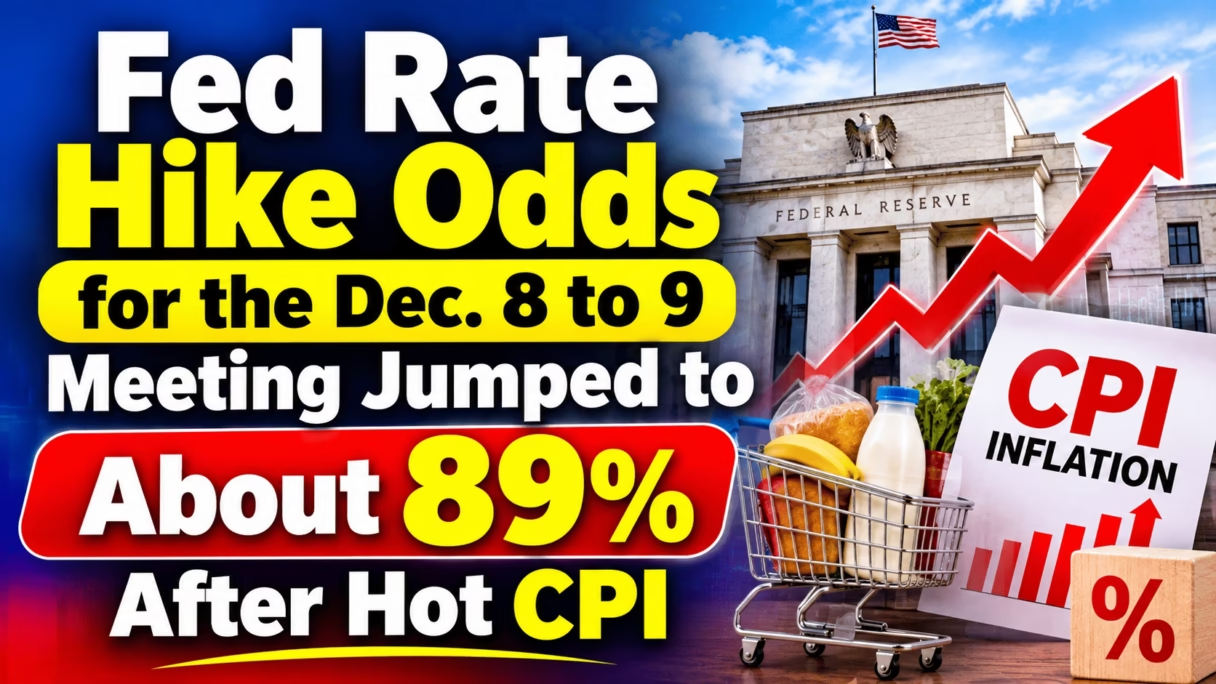
A Fed rate hike on December 9 now looks close to certain, and the size of it has suddenly become a debate. After October consumer prices rose 0.4% and core prices climbed 0.3% for a third straight month, futures traders moved to roughly an 89% chance of a quarter-point increase and about an 11% chance of a half-point move, according to CME Group’s FedWatch tool as reported on November 10. Federal Reserve Governor Christopher Waller added to the pressure the same day, saying he would support a 25 basis point increase in December and that a 50 basis point move deserves a serious look if inflation stays hot. The central bank lifted its target range to 3.75% to 4.00% in September, its first increase since 2023, then held steady in October on a 10 to 2 vote. For households, the next Fed rate hike will reach credit card bills, home equity lines and savings accounts within weeks. We’ll be updating this article monthly.
The timing matters because the economic data swung hawkish in the span of a few days. Employers added 165,000 jobs in October, nearly triple the 59,000 economists expected, and unemployment slipped to 4.1%. Two-year Treasury yields jumped as much as 17 basis points on the day of the inflation report, reaching 4.71%, while the 30-year fixed mortgage averaged 7.18% in Freddie Mac’s November 5 survey, almost a full point above a year earlier. Below you will find the key dates, a free Fed rate hike calculator that estimates what a 25, 50 or 75 basis point increase could do to your own balances, and a plain explanation of how long each change takes to show up in your bills.
Fed Rate Hike Timeline and Key Dates
The table below puts the latest policy moves and data releases in order, so you can see how the case for another increase was built.
| Date | Event | What happened |
|---|---|---|
| September 16, 2026 | FOMC decision | Fed raised the target range by 0.25 points to 3.75% to 4.00%, the first hike since 2023 |
| October 28, 2026 | FOMC decision | Rates held at 3.75% to 4.00% on a 10 to 2 vote; Lisa Cook and Beth Hammack wanted a hike |
| November 5, 2026 | Freddie Mac survey | 30-year fixed mortgage averaged 7.18%, down from 7.24% the week before |
| November 6, 2026 | Jobs report | Payrolls rose 165,000 in October and unemployment fell to 4.1% |
| November 10, 2026 | October CPI and Waller speech | Prices rose 0.4% on the month, core 0.3%; December hike odds moved to roughly 85% to 89% |
| December 8 to 9, 2026 | Next FOMC meeting | Decision due December 9 with a fresh set of economic projections |
Fed Rate Hike Key Highlights
| Indicator | Latest figure | Why it matters |
|---|---|---|
| Federal funds target range | 3.75% to 4.00% | Sets the base for short-term borrowing costs |
| Prime rate (typical bank convention) | 7.00% | Most banks set prime three points above the top of the range; it drives card and credit line rates |
| December 25 basis point odds | About 89% | CME FedWatch reading after the October CPI release |
| December 50 basis point odds | About 11% | Raised by Waller’s comments and core CPI at 0.3% |
| September PCE inflation | 3.7% overall, 3.1% core | The Fed’s preferred gauge, well above its 2% goal |
| 10-year Treasury yield | About 4.87% (November 6) | Closest guide for mortgage pricing |
| 2-year Treasury yield | 4.52% (November 6) | Reflects expected Fed moves |
| 30-year fixed mortgage | 7.18% (November 5) | Up from 6.22% a year earlier |
| Fed chair | Kevin Warsh | Has kept the door open to more increases |
Fed Rate Hike Calculator: Estimate Your Cost in Seconds
Use this free tool to see how a quarter-point, half-point or three-quarter-point increase could change what you pay and what you earn. It is an estimate built on simple math, so treat the output as a starting point for a conversation with your lender or bank.
Fed Rate Hike Calculator: Estimate Your Cost in Seconds
See how a 25, 50 or 75 basis point Fed rate hike could change your debt costs and savings earnings.
| Hike size | New Fed range | Extra debt cost per year | Extra savings per year | Net per year |
|---|
Estimates only. Card and credit line math uses simple interest on the balance shown. Actual changes depend on your agreement, billing cycle and lender. This is not financial advice.
Why the Fed Raised Rates in September
The Fed spent late 2025 cutting rates three times, then parked the target range at 3.50% to 3.75% through its January, March, April, June and July meetings. That pause ended on September 16, when policymakers raised the range by a quarter point to 3.75% to 4.00% without a dissent. The committee’s statement said inflation remained elevated and that the move would support a faster return to its 2% goal.
Three forces keep showing up in analyst commentary. Vanguard senior economist Josh Hirt pointed to tariffs, energy prices and demand tied to artificial intelligence as the outsized shocks behind core inflation. Energy was the loudest of them in September, when the energy index in the consumer price report jumped 5.2%. Waller has also cited the AI construction boom and elevated energy costs as pressures that are unlikely to fade quickly.
The surprise for many borrowers is that the Fed moved up at all. Markets had spent much of the spring and early summer pricing in rate cuts, and in March the Fed’s own projections still pointed to a pair of cuts across 2026 and 2027. Inflation that refused to cool turned that script upside down, which is why this Fed rate hike cycle has felt abrupt even though the total move so far is only 0.25 points.
What Happened at the October Fed Meeting
On October 28 the Federal Open Market Committee kept the range at 3.75% to 4.00%, but the vote was far from comfortable. Governor Lisa Cook and Cleveland Fed President Beth Hammack voted against the decision because they wanted another quarter-point increase right away. The committee also repeated that it will keep ample reserves in the banking system.
Fed Chair Kevin Warsh described the central bank’s job as keeping price jumps in a few sectors from spreading across the economy while keeping inflation expectations anchored. In a speech on November 10, Waller defended the hold by arguing that forward guidance had already tightened financial conditions, but only as long as the Fed follows through. If markets decide the promised increases will not arrive, he warned, yields would fall and policy would loosen in an unwanted way. That argument is the heart of the current Fed rate hike debate: timing may be flexible, but credibility is not.
Other officials are leaning the same direction. Dallas Fed President Lorie Logan has called for at least two more quarter-point increases, and the committee’s hawkish wing is clearly growing.
October CPI Report: The Numbers Behind the Fed Rate Hike Case
The Bureau of Labor Statistics said the consumer price index rose 0.4% in October on a seasonally adjusted basis, above the 0.3% consensus of economists. Core inflation, which leaves out food and energy, rose 0.3% against a 0.2% forecast. That was the third monthly core reading in a row at 0.3%, the exact threshold Waller had flagged hours earlier as the point where a larger hike would need to be considered.
Inside the report, shelter rose 0.3% and supplied more than 30% of the monthly gain. Energy rose 0.7% after September’s large jump, and food climbed 0.5%, helped by a 0.9% increase in beef prices. One quirk limits the headline: the BLS did not publish an annual October rate because the 2025 government shutdown left a gap in the prior-year data, so comparisons rely on monthly changes and on the PCE series.
That PCE series is not comforting. September PCE inflation ran at 3.7% over twelve months, with core PCE at 3.1%. More than 70% of core services components showed twelve-month gains above 3%, which is the breadth Waller says worries him. Federal Reserve staff research, he noted, suggests energy shocks may now feed into core prices more persistently than before the pandemic.
October Jobs Report: Strong Hiring Gives the Fed Room
If inflation made the case, the labor market removed the excuse for waiting. October payrolls rose 165,000 compared with a forecast of 59,000, and unemployment fell to 4.1% from an expected 4.2%. Average hourly earnings rose 0.4% for the month and 3.1% over the year. Revisions helped too: August hiring was lifted to 186,000, and September was revised from 29,000 to 60,000, which had given the Fed cover to hold in October.
Professional and business services led with 70,000 new jobs. Health care added 42,000, transportation and warehousing added 25,000, and manufacturing added 19,000. Jeff Schulze of Franklin Templeton Institute said lower unemployment leaves the committee free to focus mostly on restoring price stability, which is another way of saying the Fed no longer has to choose between its two goals at this meeting.
Fed Rate Hike Odds for December: How CME FedWatch Moved
CME FedWatch converts fed funds futures prices into probabilities. It does not poll economists, and the numbers can change by the hour, so the readings below reflect specific moments reported by news outlets.
| Date | Trigger | December hike odds reported |
|---|---|---|
| October 14 | Hot September CPI; Citi calls for a December hike | About 94% |
| October 27 | Day before the October FOMC | About 78% |
| October 29 | After the October hold | About 85% |
| November 6 | Strong October jobs report | About 77% |
| November 10 | Hot October CPI and Waller speech | 85% to 89% for 25 bps, about 11% for 50 bps |
Notice that odds dipped after the jobs report even though the data was strong. Traders priced only one more hike beyond December at that point, and expectations for 2027 tightening had cooled earlier in the week after the midterm elections and a sharp technology selloff that pushed the Nasdaq into a correction. Then inflation reversed the mood. Bank of America has warned of a run of consecutive increases, and the two-year Treasury yield, which tracks expected policy, climbed again. A Fed rate hike in December is no longer the question for most traders. The question is whether it is 25 basis points or 50.
How a Fed Rate Hike Affects Mortgage Rates
The Fed does not set mortgage rates. Lenders price 30-year loans off the 10-year Treasury yield, which was about 4.87% on November 6, plus a spread that reflects risk and demand. That is why mortgage rates have actually eased in recent weeks even as the Fed raised its policy rate. Freddie Mac’s survey showed the 30-year fixed average at 7.32% on October 22, 7.24% on October 29 and 7.18% on November 5, a third straight weekly decline. A year ago the same survey stood at 6.22%.
The pain is in the comparison. Mortgage Bankers Association data showed purchase applications down 19% from a year earlier and refinancing down 60% for the week ending October 30. Industry trade data also showed adjustable-rate mortgages reaching a record share of applications while October rate locks fell 19%, a sign that buyers are searching for lower initial payments.
Here is a simple example. On a $350,000 loan over 30 years, a rate of 7.18% means a principal and interest payment of about $2,371. If the next Fed rate hike pushes the mortgage rate up by 0.10 points, the payment rises to about $2,395, roughly $24 more each month. If the rate moves 0.25 points, it rises by about $59 a month. The calculator above lets you set how much of the hike reaches your rate, since the pass-through is never one for one.
If you already hold a fixed-rate mortgage, nothing changes. If you have an adjustable-rate loan, your next reset will depend on the index named in your contract, so read the note from your servicer. If you are shopping, ask lenders about a rate lock and a float-down option, because rates can move fast around meeting days.
Credit Cards, HELOCs and the Prime Rate After a Hike
Variable-rate products are where a Fed rate hike lands first. Banks set the prime rate at three points above the top of the target range, which puts it at 7.00% today. A 25 basis point increase would take it to 7.25%, and a 50 basis point increase would take it to 7.50%. Credit card APRs and home equity lines of credit are usually written as prime plus a margin, so they rise by the same amount.
On an $8,000 balance carried for a full year, a quarter-point increase adds about $20 in interest and a half-point increase adds about $40. The amounts look small, but they stack on top of an already high rate, and they grow with the balance. Anyone carrying debt across several cards should consider a fixed-rate personal loan or a 0% transfer offer before the next change takes effect, then compare fees carefully.
Savings Accounts, CDs and Treasury Yields
Savers benefit, but unevenly. Large banks often move savings rates slowly, while online banks and credit unions tend to react faster to a Fed rate hike. The 2-year Treasury yield at 4.52% on November 6 shows that the market already expects the policy rate to stay elevated, so locking in a CD or a Treasury note can make sense if you do not need the cash. Compare the bank’s annual percentage yield with current Treasury yields before choosing.
The FDIC publishes national average deposit rates, and TreasuryDirect lets you buy Treasury bills, notes and bonds directly. Both are listed in the resources table below. Keep balances within the deposit insurance limit at each institution.
Auto Loans, Student Loans and Businesses
Most auto loans carry fixed rates, so only new loans reflect the higher environment, and they follow Treasury yields and lender competition as much as the Fed. Federal student loans are fixed for the life of the loan and are set each year from a Treasury auction, so a December hike does not change existing federal balances. Private student loans with variable rates are different, and they can move with benchmark rates.
Businesses face a mixed picture. Credit lines and floating-rate term loans become more expensive immediately, while strong hiring and growth give some firms room to absorb it. One investment strategist cited gross domestic product growth of 3.4% and corporate earnings up more than 25% from a year ago as evidence that the economy can handle higher rates, while also admitting there is a limit to how high they can go.
How to Use the Fed Rate Hike Calculator
- Leave the Fed range at 4.00% unless the Fed has already acted when you read this.
- Pick a hike size: 0.25 for the most likely outcome, 0.50 for the stress case.
- Enter your card or credit line balance and APR from your latest statement.
- Enter your mortgage amount, rate and remaining term, and adjust the pass-through if you have an adjustable loan.
- Enter your savings balance and the share of a hike your bank typically passes on, then read the net yearly effect.
How Long Before a Fed Rate Hike Shows Up in Your Rates
Processing time depends on the product. Prime moves almost immediately, usually the next business day after the Fed announces its decision. Variable APRs then adjust according to the terms of your agreement, often within one or two billing cycles, and your card issuer must give notice of changes. Savings rates are at the bank’s discretion, so changes can appear within days or take weeks. Mortgage quotes move with the bond market, which often reacts before the meeting and again after the statement.
Payment Schedule: When Each Bill or Earning Changes
| Product | When it can change after December 9 | Who decides |
|---|---|---|
| Credit card with variable APR | Next billing cycle or two | Your card agreement |
| Home equity line of credit | Next statement or reset date | Your credit line agreement |
| Adjustable-rate mortgage | Next scheduled adjustment date | Your loan note and index |
| Fixed-rate mortgage | No change for existing loans | Fixed in your contract |
| New mortgage quote | Daily, with Treasury yields | Your lender |
| Auto loan, fixed | No change for existing loans | Fixed in your contract |
| Private variable student loan | Next rate reset | Your servicer |
| Savings account | Days to weeks | Your bank |
Official Fed Rate Hike Resources and Links
| Resource | What you can check | Link |
|---|---|---|
| Federal Reserve FOMC calendar and statements | Meeting dates, policy statements, minutes, projections | federalreserve.gov/monetarypolicy/fomccalendars.htm |
| CME FedWatch Tool | Live probabilities for each FOMC meeting | cmegroup.com/markets/interest-rates/cme-fedwatch-tool.html |
| BLS Consumer Price Index | Monthly CPI releases and schedules | bls.gov/cpi |
| BLS Employment Situation | Jobs, unemployment and wage data | bls.gov/news.release/empsit.nr0.htm |
| BEA PCE price index | The Fed’s preferred inflation gauge | bea.gov/data/personal-consumption-expenditures-price-index |
| Freddie Mac mortgage survey | Weekly 30-year and 15-year averages | freddiemac.com/pmms |
| FRED federal funds rate | Historical effective rate chart and data | fred.stlouisfed.org/series/FEDFUNDS |
| US Treasury interest rate statistics | Daily Treasury yield curve | home.treasury.gov interest rate statistics |
| TreasuryDirect | Open an account to buy Treasury securities and savings bonds | treasurydirect.gov |
| FDIC national deposit rates | Average savings and CD rates | fdic.gov national rates |
| Consumer Financial Protection Bureau | Mortgage, card and loan guidance, complaint filing | consumerfinance.gov |
| Federal Student Aid | Federal loan rates and servicer information | studentaid.gov |
Fed Rate Hike FAQs
Will the Fed raise rates in December?
Markets say yes. After the October CPI report, CME FedWatch showed roughly an 85% to 89% chance of a 25 basis point increase and about 11% for a 50 basis point increase at the December 8 to 9 meeting. The decision comes on December 9. Nothing is final until the committee votes.
What is the federal funds rate right now?
The target range is 3.75% to 4.00%, set in September and left unchanged on October 28. The effective rate trades inside that range.
Does a Fed rate hike make mortgage rates go up?
Not directly. Mortgage rates follow the 10-year Treasury yield, which reflects growth, inflation and expected Fed policy. They can rise or fall around a hike. Freddie Mac’s 30-year average fell for three straight weeks to 7.18% even after the September increase.
How does a Fed rate hike affect credit card interest?
Most cards have variable APRs tied to prime, so a quarter-point hike raises the APR by about 0.25 points, usually within one or two billing cycles. Fixed-rate cards and promotional 0% offers do not change until their terms end.
Should I lock my mortgage rate before December 9?
That depends on your closing timeline and risk tolerance. Hot data can lift Treasury yields quickly, so many brokers suggest asking about a rate lock with a float-down option. Compare quotes from at least two or three lenders, because your personal rate differs from any national average.
Will my savings rate go up after a Fed rate hike?
Probably, but the pace is up to your bank. Online banks and credit unions often pass on increases faster than large branch banks. Check the FDIC national averages to see whether your rate is competitive.
When is the next Fed meeting after December?
The Fed publishes its full calendar on federalreserve.gov. The December 8 to 9 meeting is the last of 2026, and it includes updated economic projections.
Is the Fed rate hike calculator accurate?
It is accurate for the arithmetic you enter, but it relies on assumptions such as simple interest and a fixed pass-through. Use it to compare scenarios, not to predict an exact bill.
Who benefits when the Fed raises interest rates?
Savers, retirees with cash holdings and buyers of new Treasury securities benefit from higher yields. Borrowers with variable-rate debt, and buyers who need a mortgage, usually pay more.
Why is the Fed raising rates when mortgage rates are already above 7%?
The Fed targets inflation and jobs, not mortgage rates. Core inflation has run at 0.3% a month for three months, and September PCE inflation was 3.7%, so policymakers see the risk of waiting as larger than the cost to housing.
How many times will the Fed raise rates?
No one knows. Futures traders expect one increase in December and roughly one more beyond it, while Dallas Fed President Lorie Logan has called for at least two more. The path depends on inflation and jobs data.
What is a basis point?
A basis point is one hundredth of a percentage point. A 25 basis point hike is 0.25 points, and a 50 basis point hike is 0.50 points.
Does a rate hike cause a recession?
Not automatically. Higher rates slow borrowing and spending, which can cool growth, but the economy added jobs and grew at a 3.4% pace by one investor’s citation. The risk grows if rates stay high for long.
Is now a good time to buy a house?
It depends on your finances and local market. Rates near 7.2% make payments higher than a year ago, so run the numbers at several rates, keep an emergency fund and consider how long you plan to stay.
What happens to stocks after a Fed rate hike?
Reactions vary. Stocks often fall when hikes are a surprise and recover when they are expected. The Nasdaq entered a correction in early November, partly on AI concerns, so volatility is already elevated.
What is the prime rate today?
By the usual bank convention, prime is 7.00%, three points above the top of the Fed’s 3.75% to 4.00% range.
Conclusion: What to Do Before the Next Fed Rate Hike
The next Fed rate hike is likely to arrive on December 9, and the debate has shifted from whether to how much. A strong jobs report, a hot inflation print and a hawkish speech from a sitting governor have pushed expectations higher in a single week, even as mortgage rates drifted lower for three weeks. For most households, the practical steps are simple: know which of your debts are variable, run the calculator with a 25 and a 50 basis point scenario, shop savings and CD rates, and ask your lender about a lock if you are buying. Watch the November inflation data and the committee’s new projections, because they will shape the path into 2027. We’ll keep this guide current as new data arrives.