The US forced labour tariff became final reality today, July 24, 2026, when U.S. Trade Representative Jamieson Greer announced the U.S. government’s final action under Section 301 of the Trade Act of 1974, imposing new duties on 60 economies including India for failing to adequately ban or enforce prohibitions on imports made with forced labour. In a significant last-minute development, India’s rate was reduced from the initially proposed 12.5% to 10%, after New Delhi’s Directorate General of Foreign Trade (DGFT) issued a formal notification on July 13, 2026, explicitly prohibiting the import of goods produced using forced labour a move that appears to have satisfied USTR’s baseline criteria just in time.
This tariff arrives on top of an already complex 2026 U.S. tariff landscape, replacing the expiring 10% global Section 122 tariff that was itself a workaround after the U.S. Supreme Court ruled in February 2026 that the Trump administration’s earlier IEEPA-based tariffs were unlawful. For Indian exporters — particularly in man-made fibres, textiles, and petrochemical-linked products — this guide explains exactly what the US forced labour tariff means for India: the legal basis under Section 301, India’s formal objections at the July 8 USTR hearing, the tariff-stacking risk for specific sectors, and what happens next as trade negotiators shift the dispute toward the ongoing India-US bilateral trade talks. We’ll be updating this article monthly as USTR issues further implementation guidance.
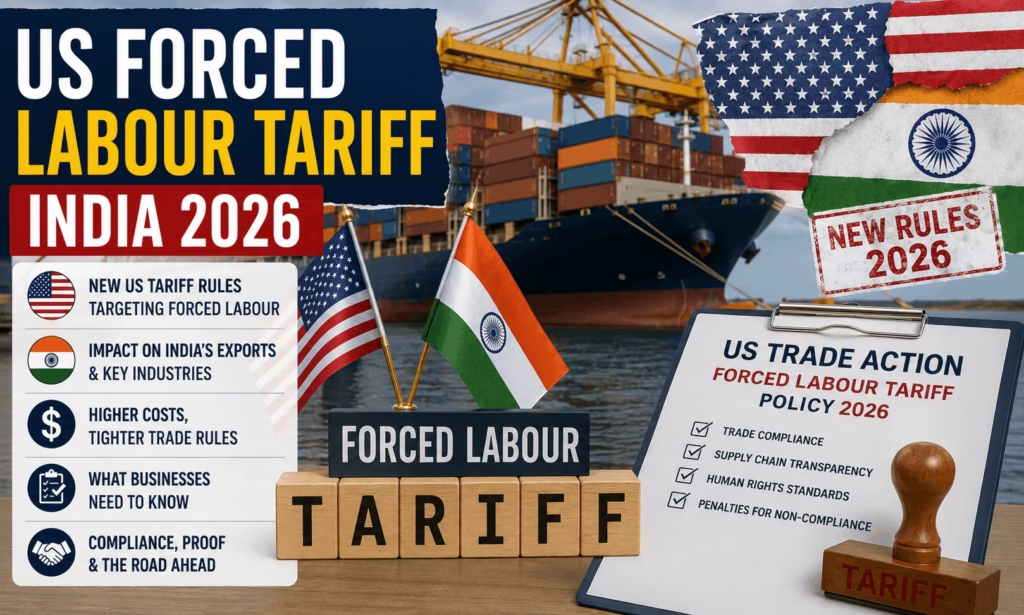
US Forced Labour Tariff India 2026 Key Highlights
| Detail | Information |
|---|---|
| Legal Authority | Section 301, Trade Act of 1974 |
| Investigation Launched | March 12, 2026 |
| USTR Preliminary Findings | June 2, 2026 |
| India’s Public Hearing Submission | July 8, 2026 |
| India’s DGFT Forced Labour Import Ban | Notified July 13, 2026 |
| Final USTR Action Announced | July 24, 2026 |
| Total Economies Investigated | 60 (India among them) |
| India’s Original Proposed Rate | 12.5% |
| India’s Final Confirmed Rate | 10% (reduced after DGFT ban notification) |
| Rate for Non-Compliant Economies | Higher tariff (up to 15%+ for those without any prohibition) |
| Replaces | Expiring 10% global Section 122 tariff (expired July 24, 2026) |
| Stacked Rate on Indian PSF/PET Resin | 30–40% (per Reliance Industries submission) |
| Underlying US Law on Forced Labour Imports | Section 307, Tariff Act of 1930 |
| Official Source | ustr.gov |
What Is the US Forced Labour Tariff, Exactly?
To understand this tariff, it helps to separate two distinct but related U.S. legal tools:
- Section 307 of the Tariff Act of 1930 is nearly a century old and simply bans the import of any product made “wholly or in part” by forced or indentured labour, including forced child labour. U.S. Customs and Border Protection (CBP) enforces this through Withhold Release Orders (WROs) and formal Findings — as of early 2026, CBP was enforcing 55 active WROs and 8 Findings globally, a dramatic expansion from just three decades ago.
- Section 301 of the Trade Act of 1974 is the newer, more aggressive tool actually driving this month’s headlines. It lets the U.S. Trade Representative unilaterally investigate and tariff a trading partner’s “unreasonable” trade practices — without going through the WTO dispute settlement process at all. This is precisely the mechanism now being used against India and 59 other economies, not because of any specific forced-labour finding tied to Indian goods, but because of India’s policy framework — or lack thereof, in USTR’s original assessment — around banning forced-labour imports domestically.
Why This Tariff Exists: The Supreme Court Connection
This tariff didn’t emerge in isolation — it’s a direct consequence of a major legal defeat for the Trump administration earlier in 2026. In February 2026, the U.S. Supreme Court ruled that the administration’s broad IEEPA-based tariffs were unlawful, forcing the government to refund duties already collected from importers. In response, the administration first imposed a stopgap 10% global tariff under Section 122 of the Trade Act, which by law could only remain in effect for 150 days — expiring precisely on July 24, 2026, the same day this new forced labour tariff took final effect. The Section 301 forced labour action is widely understood as part of a broader strategy to rebuild lost tariff revenue and leverage through a different, more legally defensible statutory authority.
Timeline: How the India Forced Labour Tariff Story Unfolded
| Date | Development |
|---|---|
| March 12, 2026 | USTR initiates Section 301 investigations into 60 economies, including India |
| April 28–29, 2026 | First round of public hearings held |
| June 2, 2026 | USTR issues preliminary determination: all 60 economies found “unreasonable,” proposes 10% or 12.5% tariffs |
| July 6, 2026 | Deadline for written public comments (USTR received 1,600+) |
| July 7–9, 2026 | Second round of public hearings; 100+ witnesses testify |
| July 8, 2026 | India’s Department of Commerce formally objects at USTR hearing |
| July 13, 2026 | India’s DGFT notifies a formal domestic forced labour import ban |
| July 24, 2026 | USTR announces final action — India’s rate confirmed at 10% |
India’s Formal Objections: What New Delhi Actually Argued
At the July 8 public hearing, Joint Secretary Brij Mohan Mishra of India’s Department of Commerce raised a specific and pointed legal objection: USTR’s investigation clubbed 46 economies into a single undifferentiated category, without presenting any country-specific or sector-specific evidence directly linking Indian exports to forced labour practices. India’s core argument centered on Section 301(d) of the U.S. Trade Act itself — contending that the mere absence of a domestic forced-labour import ban does not, on its own, meet the legal threshold required to label a trading partner’s practice “unreasonable.”
India requested that USTR issue a negative determination and terminate the investigation entirely, while stating it remained willing to engage constructively with Washington. Critically, New Delhi also asked that any resulting dispute be resolved through the ongoing India-US bilateral trade negotiation, rather than through a unilateral USTR order — a request that reflects India’s broader preference for negotiated outcomes over unilateral tariff mechanisms that bypass the WTO framework entirely.
Corporate Submissions: Reliance Industries and APEDA Weigh In
Beyond the government’s formal position, major Indian industry stakeholders filed their own submissions during the comment period:
- Reliance Industries Limited (RIL) argued that its key inputs — crude oil and ethane — are sourced from low-risk origins, including the United States itself, and are subject to ESG audits, making them far removed from the agricultural sectors where state-imposed forced labour is typically documented globally. RIL further warned that stacking the new duty onto existing tariffs on Indian Polyester Staple Fibre (PSF) and PET resin would “kill the remaining small portion of the textile industry that exists in the US” by raising input costs for American downstream manufacturers who rely on these Indian inputs.
- APEDA (Agricultural and Processed Food Products Export Development Authority), through India’s Washington embassy, focused specifically on rice exports — arguing that the value of rice India imports is less than 3% of the value of rice it exports to the US, a data point meant to undercut any claim of significant competitive harm to US producers. APEDA also noted that Indian rice exports to the US flow exclusively through agriculture ministry-registered rice mills, a traceable and regulated channel.
The Tariff-Stacking Problem: Why 10% Becomes 30–40% for Some Sectors
The single most consequential technical issue raised by Indian industry is tariff stacking — where a new duty layers on top of pre-existing tariffs rather than replacing them, compounding the total burden facing exporters.
For India’s man-made fibre chain specifically, existing US duties on Indian PSF and PET resin already sit in the mid-teens to high-twenties percentage range. Layering the new forced-labour Section 301 duty on top pushes the effective combined rate into a 30–40% band — a level that risks making Indian synthetic fibre exports uncompetitive against alternative global suppliers, even after the rate reduction from 12.5% to 10%.
| Product Category | Existing US Duty Range | Stacked Rate After New Tariff |
|---|---|---|
| Indian PSF (Polyester Staple Fibre) | Mid-teens to high-20s% | ~30–40% |
| Indian PET Resin | Mid-teens to high-20s% | ~30–40% |
| Rice (via registered mills) | Lower baseline | Comparatively limited exposure per APEDA |
Why India’s Rate Dropped From 12.5% to 10%
This is the most important recent development for Indian exporters, and it directly rewards India’s late-stage policy response. USTR’s final framework, announced July 24, established a two-tier rate structure:
- 10% tariff applies to economies that already impose a forced labour import prohibition, or have formally committed to imposing and enforcing one going forward.
- A higher tariff (reported above 10%, closer to or at the originally proposed 12.5% or beyond for the least-compliant economies) applies to economies that have neither adopted nor enforced any such prohibition.
Because India’s DGFT issued its formal forced-labour import ban notification on July 13, 2026 — just 11 days before the final USTR determination — India qualified for the lower 10% tier rather than remaining at the originally proposed 12.5% rate. This illustrates a broader pattern USTR has confirmed: several countries that tightened their forced-labour enforcement frameworks after the initial June 2 proposal succeeded in securing reduced final tariff rates.
How the US Forced Labour Tariff Fits Into India’s Broader 2026 Tariff Picture
Indian exporters are currently navigating multiple, overlapping U.S. tariff tracks simultaneously, which is part of why this specific tariff is so difficult to assess in isolation:
- The now-expired Section 122 global tariff (10%, expired July 24, 2026) — the baseline rate this new action effectively replaces.
- The February 2026 US-India bilateral trade deal, which had separately reduced India’s reciprocal tariff rate to 18% on a range of goods.
- This new Section 301 forced labour tariff — 10% for India, layered according to product-specific rules USTR has not yet fully clarified in relation to the bilateral deal.
- A separate, still-pending Section 301 “excess capacity” investigation, covering 16 economies including India, China, the EU, and Japan, examining structural manufacturing overcapacity in sectors like electronics, semiconductors, automotive components, and batteries — this could produce an additional round of tariffs later in 2026, stacking on top of everything above.
As of this update, USTR has not fully clarified how the forced-labour tariff interacts with the existing bilateral 18% rate for products that fall under both frameworks — a genuine open question that trade lawyers and Indian exporters are actively monitoring.
What Happens Next for Indian Exporters?
- Confirm your specific product’s HS code status under the final USTR notice, since certain raw materials and inputs may qualify for exemptions where domestic US supply would otherwise be threatened.
- Watch for the proposed “textile mechanism” — USTR’s June 2 notice floated allowing a certain volume of apparel and textile imports from affected economies to enter at a reduced Section 301 rate; final details of this mechanism should be confirmed in the implementing Federal Register notice.
- Monitor the India-US bilateral trade talks closely — India has explicitly pushed to route this dispute through that channel rather than accept the unilateral USTR order as final.
- Track the pending excess capacity investigation — a second wave of Section 301 tariffs affecting India remains possible later in 2026, independent of how this forced-labour tariff plays out.
- Review supply chain documentation and ESG audit trails — given USTR’s evidentiary framework, companies with clear, auditable sourcing records (as Reliance argued in its own submission) are better positioned to contest product-specific claims if disputes arise at the border.
Official Resources
| USTR Official Section 301 Forced Labour Action: | ustr.gov |
| USTR Fact Sheet (Final Action, July 2026): | ustr.gov/about/policy-offices/press-office/fact-sheets |
| US CBP Forced Labor Enforcement: | cbp.gov/trade/forced-labor |
| India DGFT Official Notifications: | dgft.gov.in |
| India Ministry of Commerce and Industry: | commerce.gov.in |
| Home Page | https://govtschemes.org/ |
FAQs US Forced Labour Tariff 2026
What is the US forced labour tariff on India in 2026?
As of July 24, 2026, India’s finalized Section 301 forced labour tariff rate is 10%, reduced from an initially proposed 12.5% after India’s DGFT issued a formal forced-labour import ban notification on July 13, 2026.
Why is the US imposing this tariff on India?
USTR determined that India, along with 59 other economies, had failed to adequately impose or enforce a domestic prohibition on imports made with forced labour, making the practice “unreasonable” and actionable under Section 301 of the U.S. Trade Act.
Did India accept this tariff without objection?
No. India formally objected at the July 8, 2026 USTR hearing, arguing the investigation lacked country-specific evidence and requesting a negative determination and termination of the investigation, while asking that any dispute be handled through bilateral trade talks instead.
Which Indian industries are most affected?
Man-made fibre and petrochemical-linked exporters (PSF and PET resin) face the steepest impact, with stacked tariffs potentially reaching 30–40%. Rice exporters, per APEDA’s submission, face comparatively limited exposure.
How is this different from Section 307 of the Tariff Act of 1930?
Section 307 is a longstanding, product-specific import ban enforced by CBP through Withhold Release Orders against goods directly linked to forced labour. Section 301 is a broader, country-level tariff tool used here to penalize India’s overall policy framework, not a specific proven shipment.
Will this tariff stack on top of India’s existing 18% bilateral tariff rate?
This remains unclear. USTR has not yet fully clarified the interaction between the new forced-labour tariff and the February 2026 US-India bilateral trade deal’s 18% reciprocal rate for overlapping product categories.
Could India’s tariff rate change again?
Possibly. USTR’s framework rewards continued enforcement of forced-labour import bans with lower rates, and a separate pending Section 301 excess capacity investigation covering India could introduce additional tariffs later in 2026.
Q2.
Q3.
Q4.
Q5.
Q6.
Q7.