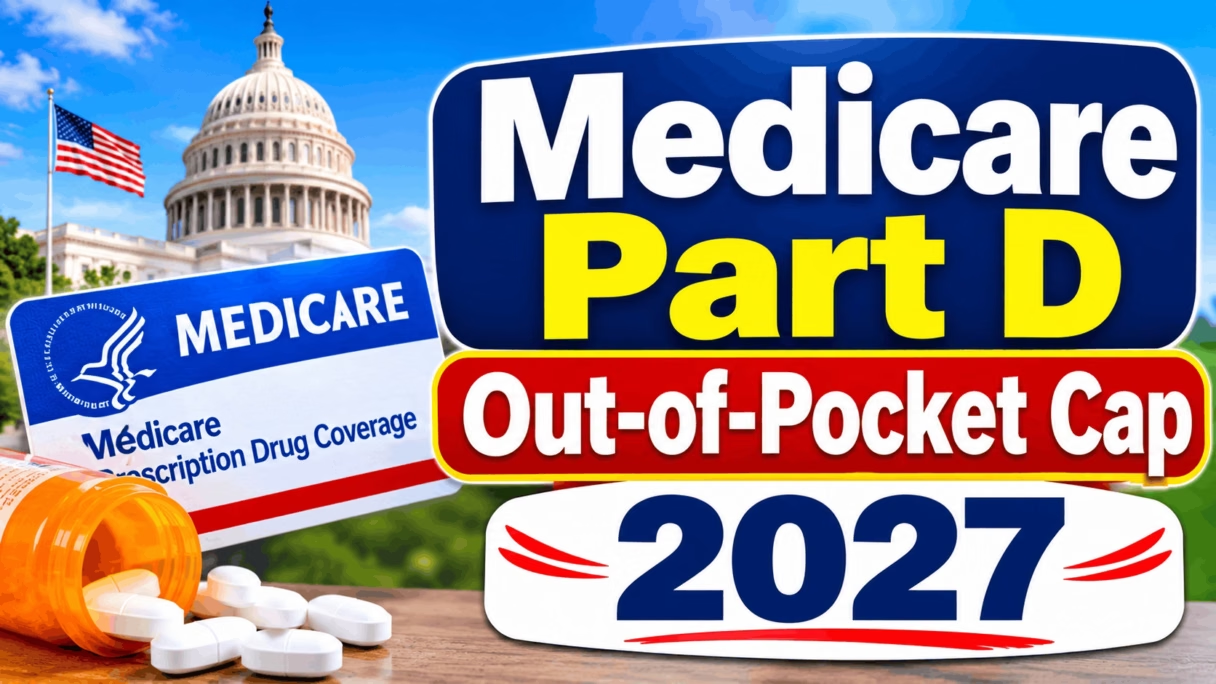
The Medicare Part D out-of-pocket cap rises from $2,100 in 2026 to $2,400 in 2027. Once you spend $2,400 on covered prescription drugs in a calendar year, you pay $0 for covered drugs for the rest of that year. The standard deductible also goes up, from $615 to $700. Your monthly premium does not count toward the cap. The Medicare open enrollment period ends on December 7, 2026, so that is your last day to switch plans for 2027.
If you take expensive prescriptions, the new Medicare Part D out-of-pocket cap is the most important number in your 2027 budget. The $300 increase is the first big jump since the cap began in 2025 at $2,000, and it comes with other changes that could affect your bill on January 1. CMS set the new threshold in April 2026 and announced a higher base premium of $41.33 in July. A temporary program that held down standalone plan premiums ends after 2026. Fifteen more drugs also get Medicare-negotiated prices in 2027. With only a couple of weeks left to compare plans, many people are checking whether their current coverage still fits.
Here is the part that gets lost in the headlines. A higher cap does not mean everyone pays $300 more. It means the most you can be asked to pay for covered drugs goes up by $300. If your yearly drug costs are modest, you may never reach it, and your bill depends mostly on your plan’s deductible, copays and premium. If you take a costly brand-name medicine, you are more likely to hit the cap, and the extra $300 matters. This guide explains how the cap works, what counts toward it, how the standard benefit adds up, how to enroll or switch, when changes take effect and how to spread payments across the year. A free calculator is included below.
Medicare Part D Out-of-Pocket Cap Key Highlights
| Item | 2026 | 2027 |
|---|---|---|
| Annual out-of-pocket cap | $2,100 | $2,400 |
| Maximum standard deductible | $615 | $700 |
| Coinsurance after deductible (standard benefit) | 25% | 25% |
| Cost of covered drugs after reaching the cap | $0 | $0 |
| Base beneficiary premium | $38.99 per month | $41.33 per month |
| Premium Stabilization Demonstration | In effect | Ends after 2026 |
| Drugs with negotiated prices | First 10 | 15 more added |
| Insulin copay cap | $35 per month | $35 per month |
| Annual enrollment period | Oct. 15 to Dec. 7, 2025 | Oct. 15 to Dec. 7, 2026 |
| New coverage starts | Jan. 1, 2026 | Jan. 1, 2027 |
What Is the Medicare Part D Out-of-Pocket Cap?
The Medicare Part D out-of-pocket cap is a yearly limit on what you pay for covered prescription drugs. It was created by the Inflation Reduction Act and replaced the old system that included a “donut hole” and an open-ended catastrophic stage. Before the change, a person with very high drug costs could pay thousands of dollars more each year. Now, once your qualifying spending reaches the cap, your cost for covered drugs drops to zero until the calendar year ends.
The cap started at $2,000 in 2025, rose to $2,100 in 2026 and moves to $2,400 in 2027. It is adjusted every year using growth in Part D drug spending and is rounded to the nearest $50. CMS published the 2027 figure in its Calendar Year 2027 Rate Announcement on April 6, 2026. Plans have known it since spring, so the number is final.
The cap applies to people in standalone Part D prescription drug plans and to those who get drug coverage through a Medicare Advantage plan. It is not tied to the Extra Help program, and it is not going away. If you saw a post claiming Part D protection is ending, that claim is wrong. What is ending is a temporary premium program, which is a separate matter.
New Jersey LIHEAP 2026-27: Bill Credits Now Up to $200 a Month & How to Apply
What Counts Toward the $2,400 Cap, and What Does Not
Counting correctly matters, because many people expect the premium to count and it does not.
| Counts toward the cap | Does not count |
|---|---|
| Your deductible payments for covered drugs | Monthly plan premiums |
| Copays and coinsurance for covered drugs | Drugs not on your plan’s formulary |
| Payments made by Extra Help for you | Medicare Part B drugs, such as many drugs given in a doctor’s office |
| Certain payments by others on your behalf, such as some assistance programs | Extra Part B premium amounts such as IRMAA |
| Manufacturer discounts that apply under the program | Drugs that Medicare does not cover |
Keep an eye on your Explanation of Benefits from your plan. It tracks your out-of-pocket total through the year, so you can see how close you are to the cap.
How the Standard Part D Benefit Works in 2027
Medicare publishes a standard benefit design, and many real plans use something close to it or a version that costs the same or less. The standard design has three steps.
First, you pay the full cost of covered drugs until you reach the deductible, which can be as high as $700 in 2027. Some plans charge less and some charge nothing on certain drug tiers.
Second, after the deductible, you pay 25% coinsurance for each covered drug. This continues until your total out-of-pocket spending reaches $2,400.
Third, once you hit $2,400, your cost for covered drugs is $0 for the rest of the year.
The math is easy to check. You pay $700 for the deductible. Then you pay 25% of the next amount until your total reaches $2,400, which means another $1,700 in coinsurance. That 25% share corresponds to $6,800 in drug costs. So the cap is reached when total drug costs hit about $7,500 in a standard-benefit plan. Manufacturer discounts and plan payments fill in the rest, so you are not responsible for the portion that others pay.
Most plans do not use the exact standard design. Many use copays instead of coinsurance, some waive the deductible for lower-cost drugs, and tiers vary. The cap, however, applies to all of them.
Latest Update: Premiums, Demonstration Ending and Negotiated Drug Prices
Three changes sit alongside the new cap.
First, the base beneficiary premium rises to $41.33 per month for 2027, up from $38.99 in 2026. This is a benchmark figure used in the premium formula, not what each person pays. Your actual premium depends on the plan you choose and your income.
Second, the Premium Stabilization Demonstration ends after 2026. That temporary program was created to soften premium increases for standalone drug plans. Without it, some plans may raise premiums more than they did in recent years. CMS projections cited in recent coverage put the average standalone premium at about $36 in 2027, compared with about $35 in 2026, but your own plan’s price may move differently. Always check your plan’s notice and compare options.
Third, Medicare-negotiated prices expand. A second group of 15 drugs, which includes several well-known diabetes, cancer and respiratory medicines, gets lower negotiated prices starting January 1, 2027. The first group of 10 took effect in 2026. Lower prices can reduce what you pay, especially if you are in the coinsurance stage, because 25% of a lower price is smaller.
Who Is Most Affected by the Higher Cap?
The increase matters most for people with high prescription costs who reach the cap each year. For them, the extra $300 is real. People who take several brand-name medicines, specialty drugs for cancer, multiple sclerosis or rheumatoid arthritis, or newer diabetes drugs are the most likely to hit it.
People with lower drug costs may see little difference. They rarely reach the cap, so the deductible, copays and premium matter more.
Another group to consider is people who use the Medicare Prescription Payment Plan. This program does not lower your costs, but it lets you spread out-of-pocket drug costs across the year instead of paying at the pharmacy counter all at once. It can ease cash flow if you hit the deductible early.
How to Apply: How to Enroll in or Switch Medicare Part D for 2027
If you want to change plans for 2027, here is what to do.
- Check the deadline. The annual enrollment period runs from October 15 to December 7, 2026. Changes made during this window take effect on January 1, 2027.
- Gather your medication list. Include the exact drug names, strengths and how often you take them, plus your preferred pharmacy.
- Use the Medicare Plan Finder. Enter your drugs and pharmacy to see estimated costs for each plan in your area, including premiums, deductibles and expected yearly spending.
- Check the formulary. Make sure every drug you take is covered and see which tier it falls in. Look for prior authorization or step therapy rules.
- Compare more than the premium. A low-premium plan can cost more overall if your drugs are priced high or your pharmacy is out of network.
- Enroll. You can enroll through the Medicare Plan Finder, by calling 1-800-MEDICARE or by contacting the plan directly.
- Keep the confirmation. Save your confirmation number and the date you enrolled.
If you have trouble comparing, free counseling is available through your State Health Insurance Assistance Program.
If you do nothing and your plan is still available, you will generally stay in it for 2027. That can be costly if the plan raised prices or changed its drug list, so reviewing your Annual Notice of Change is worth the time.
Visa and Mastercard ATM Fee Settlement: How to Claim Up to 19 Years of Fees
Processing Time: When Do Changes Take Effect?
If you enroll or switch during the annual enrollment period, your new coverage starts on January 1, 2027. The plan will typically send you a welcome packet and a member ID card before the new year, though timing can vary. If your card has not arrived by the end of December, contact the plan and ask for a temporary proof of coverage.
People already in a Medicare Advantage plan have another chance. The Medicare Advantage Open Enrollment Period runs from January 1 to March 31 each year and lets you switch Advantage plans or return to Original Medicare, with some limits on adding standalone drug coverage. Special enrollment periods may also apply if you move, lose other coverage or qualify for Extra Help.
Because the cap resets on January 1, your out-of-pocket total starts over at zero each calendar year. If you change plans mid-year, spending that counted under the old plan generally carries over to the cap.
Payment Schedule: Premiums, Pharmacy Costs and the Payment Plan
Part D costs show up in three ways. You pay your monthly premium to the plan or have it deducted from your Social Security payment. You pay deductible, copays or coinsurance at the pharmacy. And, if you choose, you can use the Medicare Prescription Payment Plan to spread those pharmacy costs into monthly bills.
Under the payment plan, you pay nothing at the pharmacy counter for covered drugs. Instead, your plan sends a monthly bill. In the first month, the plan divides what you still owe up to the cap by the months left in the year. If you start the year with no spending, a simple approximation is $2,400 divided by 12, or about $200 per month, though the exact amount depends on your actual drug costs and when you join. Your total for the year is still limited by the cap.
You can sign up with your plan at any time, and the plan can explain how to join. The program is optional, and it is most useful if you expect high costs early in the year.
How Much Could You Pay in 2027?
Consider a person in a standard-design plan with a $700 deductible. If their covered drugs cost $5,000 for the year, they pay $700 plus 25% of the remaining $4,300, which is $1,075, for a total of $1,775 in drug costs. Add premiums on top of that. If their covered drugs cost $12,000, they hit the cap. They pay $2,400, and the plan and manufacturers cover the rest. Add premiums, and the total is higher.
Free Calculator: Estimate Your 2027 Part D Drug Costs
This tool estimates your yearly cost under the standard benefit and compares 2026 with 2027. Real plans differ, so treat the result as a guide rather than a quote.
Medicare Part D Cost Estimator: 2026 vs 2027
Official Medicare Part D Resources and Links
Use the official sites below. Medicare never charges to compare or enroll, and you should never share your Medicare number with unknown callers.
| Resource | Link |
|---|---|
| Medicare.gov, sign in to your account | medicare.gov/account/login |
| Medicare Plan Finder | medicare.gov/plan-compare |
| Medicare Prescription Payment Plan | medicare.gov/prescription-payment-plan |
| Extra Help (Low-Income Subsidy) application | ssa.gov/medicare/part-d-extra-help |
| Social Security Medicare information | ssa.gov/medicare |
| CMS, rate announcements and Part D policy | cms.gov |
| State Health Insurance Assistance Program (free counseling) | shiphelp.org |
| Phone help | 1-800-MEDICARE (1-800-633-4227) |
| Application and enrollment status check | Sign in to your Medicare.gov account or call 1-800-MEDICARE |
FAQs About the Medicare Part D Out-of-Pocket Cap
What is the Medicare Part D out-of-pocket cap for 2027?
It is $2,400, up from $2,100 in 2026. After you reach it, covered drugs cost $0 for the rest of the year.
What is the Part D deductible in 2027?
The maximum standard deductible is $700, up from $615. Some plans charge less.
Do premiums count toward the $2,400 cap?
No. Monthly premiums do not count.
Does the cap apply to Medicare Advantage plans?
Yes. Plans that include drug coverage must follow the same cap.
Is Medicare Part D ending in 2027?
No. Part D continues. A temporary premium stabilization program ends after 2026, but the drug benefit and the cap remain in place.
When is the deadline to change plans?
December 7, 2026 for coverage that starts January 1, 2027.
Can I pay my drug costs monthly instead of at the pharmacy?
Yes, through the Medicare Prescription Payment Plan. You pay the same total, just spread out.
Does the cap include drugs my plan does not cover?
No. Only covered drugs count.
How much is the Part D out-of-pocket maximum in 2027?
$2,400 per year for covered drugs.
Why did the Part D cap increase from $2,100 to $2,400?
The cap is adjusted every year based on growth in Part D drug spending, and CMS applied a 13.65% increase for 2027 before rounding.
How do I know when I have reached the cap?
Your plan sends an Explanation of Benefits that shows your year-to-date out-of-pocket total. Your pharmacy may also tell you once you reach it.
What happens after I hit the Part D cap?
You pay $0 for covered Part D drugs until the end of the calendar year.
Is insulin still $35 a month?
Yes. The monthly cap on covered insulin remains $35.
What is the Medicare Prescription Payment Plan?
It is a program that spreads your out-of-pocket drug costs over monthly payments rather than charging you at the pharmacy.
Can I change my Part D plan after December 7?
Only if you qualify for a special enrollment period, or if you are in Medicare Advantage and use the January to March window.
Will my Part D premium go up in 2027?
It depends on your plan. The base beneficiary premium rises to $41.33, and the end of the premium stabilization program may push some plan premiums higher.
Conclusion
The Medicare Part D out-of-pocket cap rising to $2,400 in 2027 is a real change, but it is also a limit that protects you from runaway drug bills. If you take costly medicines, expect to hit it. If your costs are lower, focus on your plan’s premium, deductible and drug list. With the open enrollment period closing on December 7, 2026, now is the time to review your Annual Notice of Change, run your drugs through the Medicare Plan Finder and decide whether to stay or switch. Use the calculator, keep your confirmation number and call 1-800-MEDICARE or your State Health Insurance Assistance Program if you need help. This article is general information and not medical, legal or financial advice.