The Visa and Mastercard ATM fee settlement is a $167.5 million class action deal for people who paid a surcharge at a non-bank ATM in the United States between October 24, 2007 and August 14, 2026 and were not fully refunded by their bank. You can file a free claim online at NonbankATMSurchargeSettlement.com until February 10, 2027. No receipts are needed to file, but the form is signed under penalty of perjury. The judge has not given final approval, so no money has been paid yet.
If you have ever paid a few dollars to pull cash out of a machine at a gas station, bar or corner store, this settlement may be for you. The claim window opened on September 11, 2026, and it covers nearly 19 years of fees, which makes it one of the longest look-back periods in a consumer banking case. The money comes from two payment giants, with Visa contributing $88.775 million and Mastercard $78.725 million. Both companies deny doing anything wrong, and a federal judge in Washington, D.C. is still reviewing the deal. Several dates are close. Class counsel’s request for attorneys’ fees is due on November 27, 2026, and the deadline to opt out or object is December 11, 2026.
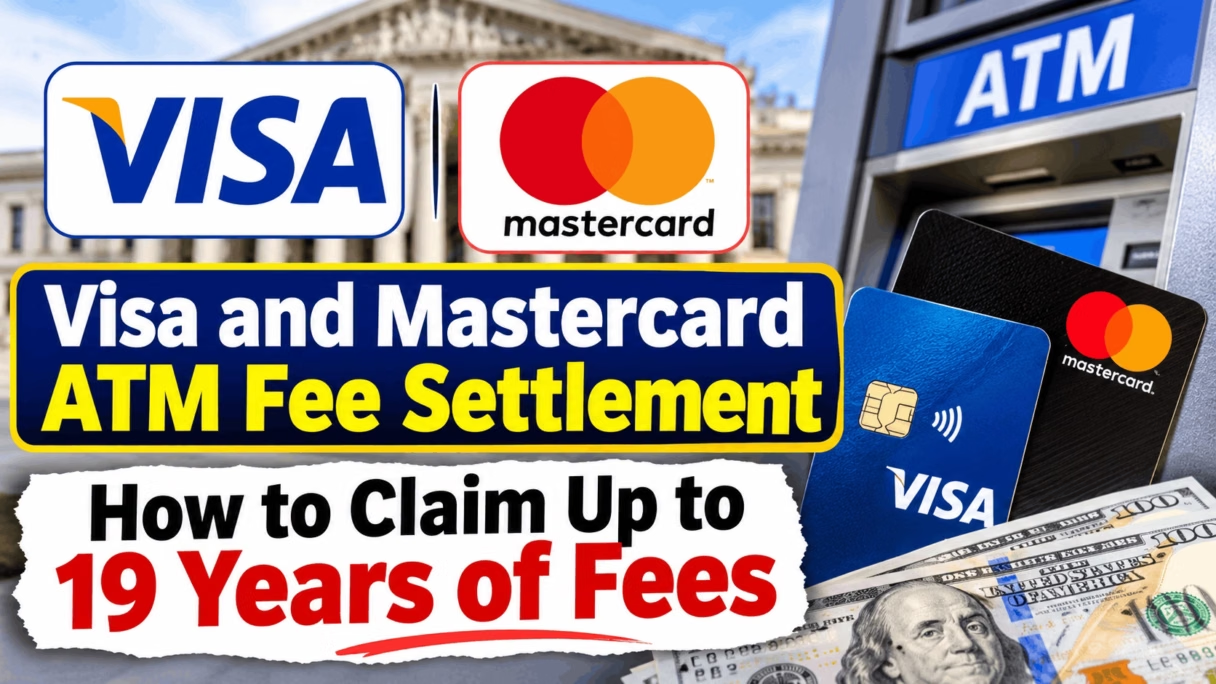
The lawsuit behind the Visa and Mastercard ATM fee settlement was filed in 2011, which means it has taken about 15 years to reach this point. The workers at the center of it are everyday cardholders, not businesses. The plaintiffs argued that Visa and Mastercard network rules stopped independent ATM owners from lowering their fees, even when a cheaper network could have handled the transaction. As a result, they say, people paid more than they should have. This guide explains who qualifies, what to put on the claim form, which transactions are excluded, how long the process may take and when money could arrive. There is also a free calculator below to help you estimate your fee count and see how different participation levels could change the payout.
Visa and Mastercard ATM Fee Settlement Key Dates and Facts
| Item | Detail |
|---|---|
| Total settlement fund | $167,500,000 |
| Visa contribution | $88,775,000 |
| Mastercard contribution | $78,725,000 |
| Case | Burke v. Visa Inc., No. 1:11-cv-01882, U.S. District Court for the District of Columbia |
| Judge | Richard J. Leon |
| Class period | October 24, 2007 to August 14, 2026 |
| Preliminary approval | August 14, 2026 |
| Claim period opened | September 11, 2026 |
| Attorneys’ fee motion due | November 27, 2026 |
| Opt-out and objection deadline | December 11, 2026 |
| Claim deadline | February 10, 2027 |
| Final approval hearing | February 17, 2027 at 4:00 p.m. |
| Expected payment timing | Within about six months of final approval if there are no appeals |
| Payment amount | Not known, because it is divided pro rata among approved claims |
| Documents needed to file | None at first, but the administrator may ask later |
What Is the Visa and Mastercard ATM Fee Settlement About?
Most people know two kinds of ATM fees. One is charged by your own bank when you use another bank’s machine. The other is the surcharge posted on the machine itself. This case is about the second kind at independent ATMs, which are machines not owned by a bank, Visa or Mastercard. You usually find them in convenience stores, bars, hotels and gas stations.
The plaintiffs claim that the payment networks wrote rules that blocked independent ATM operators from charging a lower fee when a cheaper network could process the transaction. Without that freedom, they argue, operators had little reason to route transactions to lower-cost networks and cardholders never saw a discount. The claims rely on federal antitrust law and on antitrust laws in four states.
Visa and Mastercard deny the allegations. The court has not ruled for either side. The settlement was reached through mediation, and it ends the claims without a trial or a finding of fault.
Latest Update: What Happened Since August
The big step came on August 14, 2026, when Judge Leon granted preliminary approval. That order told the administrator to send notice to the class, temporarily certified a nationwide class and four state classes, appointed A.B. Data as the claims administrator and paused the underlying case. It also stops class members from suing separately over the same claims while the deal is being reviewed.
Claims opened on September 11. Two more milestones are coming in the next few weeks. On November 27, class counsel must file a request for attorneys’ fees, costs and service awards. The notice says counsel will ask for up to 30% of the fund. That filing will be posted on the case website, so anyone thinking about objecting can read the actual request before deciding. On December 11, the window closes for opting out or objecting.
Nothing is final. The judge will decide at the February 17, 2027 hearing whether the deal is fair, reasonable and adequate.
Who Qualifies for the Visa and Mastercard ATM Settlement?
You are in the nationwide class if all of the following are true:
- You were charged an access fee for a domestic cash withdrawal.
- The withdrawal happened at an independent ATM in the United States or its territories.
- The transaction took place between October 24, 2007 and August 14, 2026.
- Your bank did not fully refund the fee.
There are also four state classes covering people who were in California, Illinois, Massachusetts or Michigan when the fee was charged. Being in a state class does not replace your place in the nationwide class. It adds to it.
The settlement excludes Visa and Mastercard and their officers, employees and affiliates, government entities, the judge and court staff, certain jurors and anyone who opts out.
Which ATM Withdrawals Do Not Count?
This part trips up a lot of people, so read it before you file.
Credit card transactions are not covered. Cash advances are not covered. Prepaid card withdrawals are not covered. Machines outside the United States and its territories are not covered. A fee your bank fully refunded does not count, because the class is limited to unreimbursed fees. And a withdrawal at a machine owned by a bank is a different matter. That belongs to a separate case, described below.
If you used a debit card or ATM card to pull cash from a store or bar machine and nobody paid you back for the surcharge, that is the kind of transaction the settlement is designed to cover.
How to Apply: How to File a Visa and Mastercard ATM Claim?
The only official place to file is the settlement website at nonbankatmsurchargesettlement.com. You can also file by mail. Here is the process, step by step.
- Gather what you know. Think about how often you used non-bank ATMs and whether your bank ever refunded the fees.
- Go to the official website. Type the address yourself or use the link in the table below, so you do not land on a copycat page.
- Open the claim form. English and Spanish versions are available.
- Enter your contact details. The form asks for your name, mailing address, mobile phone number and an email address, which you enter twice. If you received an emailed notice, you can also enter the notice ID.
- Answer the eligibility questions. You will confirm that you paid an unreimbursed surcharge at a U.S. independent ATM during the class period and that you used an ATM or debit card rather than a credit or gift card.
- Enter your best estimate. You will type in how many times you paid such a surcharge, as a whole number up to four digits.
- Sign and submit. The form is signed under penalty of perjury.
- Save your confirmation. Keep the confirmation number and a copy of what you submitted.
If you prefer paper, the form can be mailed with a postmark no later than February 10, 2027 to the Non-Bank ATM Surcharge Fee Settlement, c/o A.B. Data, Ltd., P.O. Box 173053, Milwaukee, WI 53217. The toll-free number is 1-866-893-1052.
Filing is free. Some third-party sites offer to file for you and set their own earlier cutoffs, such as early February. You do not need them, and the official deadline applies if you file directly.
How to Estimate Your Number of ATM Fees?
Almost nobody has a record of every convenience-store withdrawal since 2007, and the settlement accepts that. The claim form asks for an estimate, not a spreadsheet.
A sensible way to do it is to think in years. How many years in the class period did you regularly use non-bank ATMs? About how many times a year? Did you use a bank that reimbursed out-of-network fees for any of those years? Multiply the realistic numbers and subtract the refunded ones.
Be honest. The estimate is a sworn statement, and the administrator can ask for bank statements or other proof later. A number that you can reasonably explain is safer than a big guess. Older bank statements, card statements and app histories can help you check your estimate.
Do You Need Proof to File?
Not when you submit. The form says you do not need documents at this time. It also says the administrator may later ask for bank statements or other records to support your claim, and that you agree to provide them if asked.
That is different from a no-proof settlement. Proof is deferred, not waived. If your claim is large, or if the numbers look unusual, expect more scrutiny.
Processing Time: How Long Will the Settlement Take?
The timeline is longer than most people expect. The case began in 2011. Preliminary approval came in August 2026. Final approval is scheduled for February 17, 2027, but the notice warns that the hearing may be moved or held electronically without new notice, so check the website.
After final approval, someone could appeal. The notice says it is hard to estimate how long an appeal would take. If there is no appeal, the administrator expects to send payments within about six months. Some trackers estimate payouts in late 2027, which fits that window.
If the judge rejects the settlement, nobody is paid and the lawsuit against Visa and Mastercard continues.
Payment Schedule: When Will You Get Paid?
There is no fixed payment date. Payments only go out if the court approves the deal and any appeals are resolved. If that happens without delay, payments should arrive within about six months of final approval.
When the time comes, the administrator plans to pay digitally. That is why the form asks for an email address and a mobile number. Recipients are expected to be offered several digital options, such as PayPal or a virtual debit card, and you can ask for a paper check instead.
Keep your contact details current. If your email changes before payment, contact the administrator so your money does not get lost.
How Much Will You Get From the ATM Fee Settlement?
No one knows yet, and be careful with anyone who says they do.
The fund is $167.5 million, but not all of it goes to claimants. Attorneys’ fees of up to 30%, litigation costs, taxes, up to $3 million for notice and administration, and service awards of up to $17,500 for each class representative are paid first. What is left is split pro rata, based on how many qualifying transactions are approved. If lots of people file, each transaction is worth less. If fewer people file, each is worth more.
The calculator below lets you test a few scenarios. Treat the results as illustrations, not predictions.
Should You File, Opt Out or Object?
For most people, filing a claim is the practical choice. It costs nothing, and staying in the class keeps you eligible for money.
Opting out means you keep the right to sue Visa and Mastercard on your own, but you get no settlement payment. For a handful of small ATM fees, a separate lawsuit is rarely worth it. Your opt-out request must be received by December 11, 2026 and mailed to Non-Bank ATM Surcharge Fee Settlement, ATTN: EXCLUSIONS, P.O. Box 173001, Milwaukee, WI 53217.
Objecting is different. If you think the deal is unfair, the fee request is too high or the terms are inadequate, you can tell the court. Objections must be postmarked by December 11, 2026 and mailed to the Clerk of the U.S. District Court for the District of Columbia, 333 Constitution Avenue NW, Washington, DC 20001. You can object and still file a claim. You cannot opt out and file a claim.
If you do nothing, you remain in the class, receive no money and give up the right to sue over these claims.
Burke, Mackmin and National ATM Council: Do Not Mix Up the Cases
Three related cases were filed in 2011, and they cover different groups.
| Case | Who it covers |
|---|---|
| Burke v. Visa | Cardholders charged unreimbursed fees at independent, non-bank ATMs (this settlement) |
| Mackmin v. Visa | Cardholders charged unreimbursed fees at bank-operated ATMs, with earlier settlements approved in 2022 and 2025 |
| National ATM Council v. Visa | The businesses that own and operate independent ATMs |
You may belong to more than one class. What you do in one case does not change your rights in the others.
How to Spot a Fake Settlement Site
Settlements with big ad campaigns attract copycats. The real process does not ask for a Social Security number, a bank account number or a fee to file. The only official claim venue is the administrator’s own website or the mailing address above. If a message pushes you to pay, rush or share sensitive data, stop and go to the official site directly.
Estimate Your ATM Fee Claim
Use the tool below to estimate how many qualifying fees you might report and to see an illustrative payout under three participation scenarios. The scenarios are assumptions, not forecasts, because the final amount depends on how many claims are approved.
ATM Fee Claim Estimator
Official Visa and Mastercard ATM Settlement Resources
| Resource | Link |
|---|---|
| Official settlement website and claim form | nonbankatmsurchargesettlement.com |
| Long form notice (PDF) | Notice |
| Claim form (PDF) | Claim form |
| Preliminary approval order (PDF) | Order |
| Settlement agreement (PDF) | Agreement |
| Claims administrator phone | 1-866-893-1052 |
| Court | U.S. District Court for the District of Columbia, dcd.uscourts.gov |
| Federal class action rule (Rule 23) | law.cornell.edu |
| Claim status check | Use the contact options on the official settlement website |
FAQs
What is the Visa and Mastercard ATM fee settlement?
It is a $167.5 million class action settlement over surcharges at independent ATMs. It covers fees charged between October 24, 2007 and August 14, 2026.
How do I file a claim?
Go to nonbankatmsurchargesettlement.com, complete the claim form and submit it by February 10, 2027. You can also mail it with a postmark by that date.
Do I need receipts?
Not to file. The administrator may ask for bank statements or other proof later, so keep what you can.
What is the claim deadline?
February 10, 2027, online or postmarked.
When will payments be sent?
Only after the judge approves the deal and any appeals end. The administrator expects payments within about six months after that.
How much money will I get?
The amount is not known. It depends on how many valid transactions are approved after fees and costs are paid.
Does a credit card cash advance count?
No. Credit card transactions, cash advances and prepaid card withdrawals are excluded.
What if my bank refunded the fee?
If the bank fully refunded it, that fee does not count.
Is the Visa and Mastercard ATM settlement real?
Yes. It was granted preliminary approval by a federal judge on August 14, 2026, and it has an official website run by a court-appointed administrator.
Who is eligible for the ATM fee class action settlement?
People who paid an unreimbursed access fee at a non-bank ATM in the United States between October 24, 2007 and August 14, 2026.
What is a non-bank ATM?
It is a machine not owned by a bank, Visa or Mastercard, such as many ATMs in stores, bars and gas stations.
How much is the Visa and Mastercard ATM settlement worth per person?
There is no set figure. Each approved claim receives a share of the net fund based on the number of qualifying transactions.
Is final approval guaranteed?
No. The judge will decide after the February 17, 2027 hearing.
What happens if I opt out?
You keep the right to sue on your own but you will not receive settlement money.
Can I file if I do not remember every ATM withdrawal?
Yes. You enter a good-faith estimate, and the form is signed under penalty of perjury.
Where do I check my claim status?
Use the contact options on the official settlement website.
Conclusion
The Visa and Mastercard ATM fee settlement gives millions of cardholders a no-cost chance to recover part of the surcharges they paid at non-bank machines over almost 19 years. Filing takes only a few minutes, and no receipts are needed at the start. Still, nothing is final. The court has not granted final approval, the payment amount is unknown and the claim is signed under oath. Mark these dates: November 27, 2026 for the fee request, December 11, 2026 to opt out or object, February 10, 2027 to file and February 17, 2027 for the fairness hearing. File only through the official site, keep your confirmation number and check back as the case develops. This article is general information and not legal advice.