
SNAP Requirements: Under the 2025 federal law, most adults aged 18 to 64 who get SNAP must work, volunteer or join a training program for at least 80 hours a month, or they can lose benefits after three months in a three-year period. Parents of children 14 and older are now covered. Start dates and waivers differ by state.
Adults between 18 and 64 without dependent children must work, take part in employment and training, or volunteer at least 80 hours a month to stay eligible for SNAP. That is the core of the SNAP work requirements now in force, and the rules reach far more households than they did two years ago. Before the One Big Beautiful Bill Act, only people aged 18 to 54 were subject to the time limit. The law raised that ceiling to 64. The exception for parents and caregivers now applies only to children under 14, so a household with a 15-year-old is no longer protected on that basis alone. If you get food benefits and you are in your late fifties, or you are raising a teenager, this change was written with you in mind.
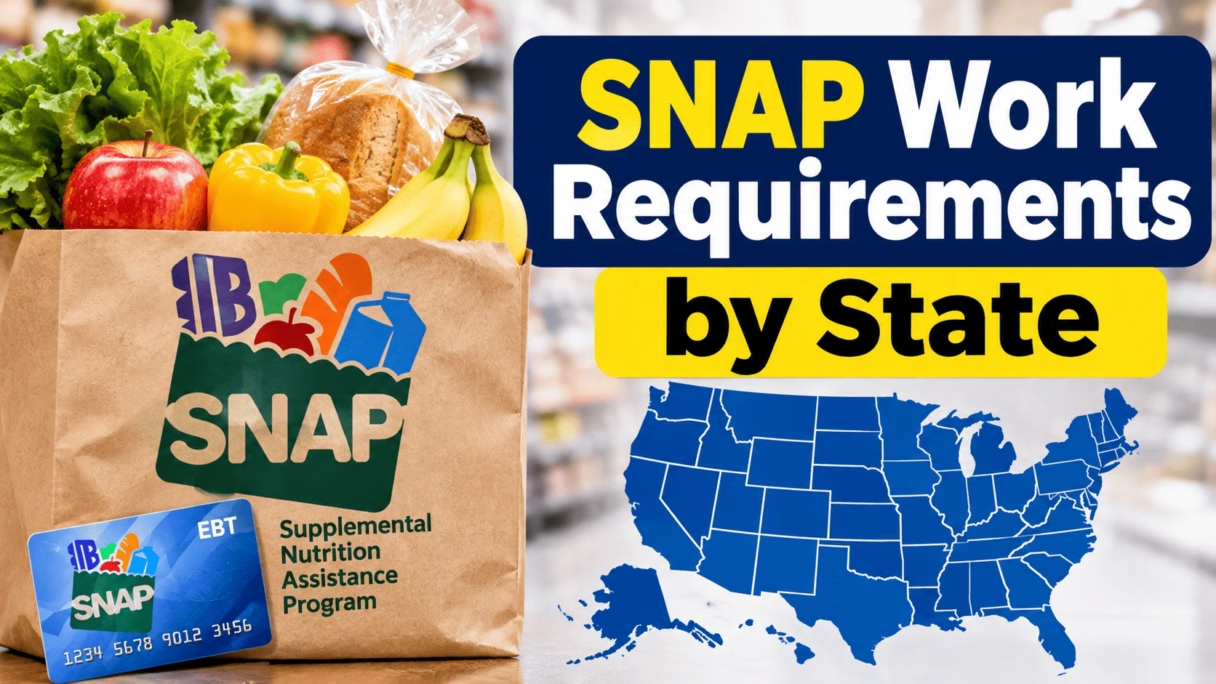
The rollout has been uneven, and that is why so many people are confused. Alaska, Colorado, Georgia and Hawaii started the three-month clock in November 2025. Illinois and Ohio followed on February 1, 2026. Some places have waivers tied to high unemployment, a court fight reshaped others, and state agencies have sent notices on different schedules. As of November 20, 2026, the question most readers ask is simple: does my state enforce the rule on me, and by when? This guide gives the national rules first, then a state-by-state snapshot, the steps to apply, and the official links you need. We’ll be updating this article monthly.
SNAP Requirements 2026 Key Dates and Highlights
| Item | What it means | Date or detail |
|---|---|---|
| Law signed | One Big Beautiful Bill Act | July 4, 2025 |
| Age range covered | Adults subject to the time limit | 18 to 64 |
| Monthly hours | Work, volunteer or training | 80 hours (about 20 a week) |
| Time limit | Benefits without meeting the rule | 3 months in 3 years |
| Child exception | Caregiver of a child | Under 14 only |
| Waiver threshold | Areas with high unemployment | Above 10% |
| Alaska and Hawaii | Special waiver rule | Through 2028 |
| USDA state memo | Exceptions guidance | October 3, 2025 |
| Court-ordered waiver reversal | 18 waivers restored | February 26, 2026 |
Who Must Meet SNAP Work Requirements Now?
The federal term is able-bodied adults without dependents, shortened to ABAWD. The label is misleading, because the 2025 law pulled in people who do have a child at home. You are generally covered if you are between 18 and 64, you are physically and mentally able to work, and no other exception applies.
The newly covered groups are worth listing clearly:
- Adults aged 55 to 64, who were outside the time limit before.
- Parents or caregivers whose youngest child is 14 to 17.
- Homeless individuals, veterans and young adults aging out of foster care, whose exemptions were repealed.
Federal estimates cited in news coverage say roughly 300,000 able-bodied adults in this age range live with children 14 or older. Kids in those households keep their own benefit even if the adult loses theirs, which is one reason caseworkers urge families to check their status early.
Full Social Security at 60: Who Qualifies Under the New Blue Collar Bill?
SNAP Work Requirement Exemptions: Who Is Not Covered?
You may be exempt if you fall into one of these groups, though each state sets its own proof rules:
- Adults 65 and older, and anyone under 18.
- Adults caring for a child under 14 in the household.
- People a medical professional certifies as unfit to work.
- Pregnant adults.
- Members of an Indian tribe.
There is a second layer that people often mix up. The general work requirement and the ABAWD time limit are different rules. People aged 60 to 64 remain exempt from the general work requirements, so states cannot force them into mandatory employment and training, even though the time limit now reaches them. If a notice from your state seems to contradict this, call the number on the notice and ask which rule is being applied to you.
What Counts Toward the 80 Hours a Month?
The rule is about activity, not only paychecks. Qualifying activities include paid employment, approved job training and volunteer work, as long as they add up to 80 hours a month. Most states average the hours over the month, so a heavy week can offset a light one
Things that usually count:
- Part-time or full-time wages, including self-employment.
- Unpaid work at a nonprofit, church, food bank or school.
- A SNAP Employment and Training program.
- A mix of the above that totals 80 hours.
Keep paper proof. Pay stubs, a signed volunteer log or an attendance letter will save you a long phone call later. Experts quoted by the Associated Press say documentation and verification are likely to matter more as states tighten enforcement.
Am I Affected? Use the SNAP Work Requirements Checker
Enter your age, your youngest child’s age and your weekly hours in the tool above. It shows whether you look exempt, covered and on track, or short of the 80-hour target. It is a quick estimate, not a ruling. Your state agency makes the final call.
Am I Affected by SNAP Work Requirements?
Quick estimate based on federal rules. It is not an official decision.
Rules vary by state, county waivers and your case. Confirm with your state SNAP office.
SNAP Work Requirements by State: What We Know
Implementation is not identical everywhere. The table below lists the states where reliable reporting gives a clear picture. Always confirm your own date with your state office.
| State | What reporting shows | Why it matters |
|---|---|---|
| Alaska | Three-month clock began November 2025 | First loss window opened early 2026 |
| Hawaii | Three-month clock began November 2025 | Special waiver rule through 2028 |
| Colorado | Three-month clock began November 2025 | Benefit losses were possible from February 2026 |
| Georgia | Three-month clock began November 2025 | Same early start as the states above |
| Illinois | Rules took effect February 1, 2026 | Benefits could stop from May 2026 |
| Ohio | Rules took effect February 1, 2026 | Work documentation due from March 2026 |
| Massachusetts | Changes effective November 1, 2025 | About 99,000 households newly covered |
| Pennsylvania | End of geographic waivers | About 132,000 recipients put at risk |
| Nevada | About 43,000 lost benefits March 1, 2026 | Restored on March 3 after USDA guidance |
| California | Waiver scheduled through January 2027 | Rules may tighten after the waiver ends |
Here is where those facts come from. Alaska, Colorado, Georgia and Hawaii began the three-month clock in November. In Illinois and Ohio, people could lose benefits in May, and Ohio asked recipients to show proof of work starting in March. Massachusetts estimated about 99,000 households were newly subject to strict rules, including adults 55 to 65 and adults with children over 14. In Pennsylvania, the end of geographic waivers put the benefits of about 132,000 recipients at risk. California’s waiver was set to stay in place until January 2027.
Nevada is the case that shows how fast things can change. About 43,000 ABAWDs lost benefits on March 1, 2026, and the state reinstated them on March 3 and paid back the missed March 1 benefits after USDA guidance arrived. Nevada then let them keep benefits through April 30.
Social Security Changes November 2026: SSA’s 3.6% COLA, Payment Dates & What Retirees Should Know
Why Waivers Matter: The Court Fight Explained
A waiver lets a state or county pause the three-month limit in an area with weak job markets. The 2025 law repealed the old “not enough jobs” basis for waivers. Now states can only request them for areas with unemployment above 10%, with exceptions for Alaska and Hawaii through 2028.
USDA announced in October 2025 that it would end 18 waivers granted under the old rules on November 2. Cities and advocacy groups sued, and a federal court in Rhode Island temporarily paused the early termination. On February 26, 2026, USDA told states those waivers would stay in effect through their original expiration dates. The practical lesson is that waiver status can change with a court order, so a rule that looked final in one month may look different in the next.
What Happens Next: Costs Shift to States
The pressure on state agencies is growing, and that affects how carefully they enforce work rules. Starting in October 2026, states are required to cover three-fourths of administrative costs, where the split used to be roughly equal.
There is a related change for older adults on Medicaid. In a report published November 18, 2026, NPR noted that work rules for Medicaid begin next year, which means some people in their fifties and early sixties will face two sets of rules at once. If you get both programs, keep one folder of proof that you can use for each.
Research adds context to the debate. A Stateline report on a new analysis found that work requirements do not boost employment but do reduce participation. Supporters of the policy disagree and argue the rules encourage self-sufficiency, so expect that argument to continue.
How to Apply for SNAP With the New Work Rules?
You apply through your state, not through a single federal website. The steps are similar everywhere:
- Find your state agency on the USDA state directory and open its online benefits portal.
- Create an account. Most states ask for your name, address, household members, income and a Social Security number for each applicant.
- Complete the application and mention any work, volunteer or training hours you already have.
- Upload proof such as pay stubs, a lease and ID, or deliver them in person.
- Complete the interview, usually by phone.
- Watch your portal and mail for notices about work requirements and any hours you must report.
For existing recipients, Massachusetts said the changes apply to new applicants and to current recipients at their next recertification. Many other states work the same way, so your recertification date is the date to circle.
SNAP Application Processing Time
Under standard federal rules, states have 30 days to process a SNAP application. Households with very low income and few resources can qualify for expedited service, which means benefits within 7 days. Your state may be faster or slower, so check the timeline on your confirmation notice. If the deadline passes with no answer, call the office and ask for the date your application was filed.
SNAP Payment Schedule
SNAP benefits load onto an EBT card once a month. Each state sets its own issuance calendar, often based on the last digit of your case number, your birth date or your last name. Your first payment is usually prorated from the day you applied. To find your date, log in to your state portal, read your approval letter or call the EBT customer service number printed on the back of your card.
One more reminder from the fall 2025 shutdown: USDA told states to hold November benefits because of a funding shortfall. That was a one-time funding event, separate from work rules, but it showed why keeping a small food buffer matters.
What to Do If You Get a Work Requirement Notice?
Do not ignore it. Notices have deadlines, and silence is often treated as non-compliance.
- Read which rule applies to you, the general work rule or the three-month time limit.
- Gather proof of hours or proof of an exemption.
- Respond before the date on the notice, by portal, phone or in person.
- If benefits stop, ask for a fair hearing. The notice must explain your right to request one.
- Ask your state about SNAP Employment and Training slots if you need hours.
Food banks, legal aid groups and volunteer programs can help you document hours. In some places, a nonprofit can sign off on volunteer time the same week.
Official SNAP Resources and Links
| Resource | Use it for | Link |
|---|---|---|
| USDA Food and Nutrition Service | Federal rules and updates | https://www.fns.usda.gov |
| USDA exceptions memo | ABAWD changes in full | https://www.fns.usda.gov/snap/obbb-abawd-exemptions-implementation |
| SNAP State Directory | Find your state office, apply, log in | https://www.fns.usda.gov/snap/state-directory |
| Benefits.gov | Eligibility screening | https://www.benefits.gov |
| Illinois ABE portal | Apply, login, status check | https://abe.illinois.gov |
| Ohio Benefits | Apply, login, status check | https://benefits.ohio.gov |
| GetCalFresh (California) | Apply for CalFresh | https://www.getcalfresh.org |
| Massachusetts DTA Connect | Apply, login, status check | https://dtaconnect.eohhs.mass.gov |
SNAP Work Requirements FAQs
What are the SNAP work requirements in 2026?
Adults aged 18 to 64 who are able to work and have no qualifying exemption must work, volunteer or train for 80 hours a month, or they are limited to three months of benefits in a three-year period.
How many hours do you need to work to keep SNAP?
The target is 80 hours a month, which is about 20 hours a week. Most states average the hours across the month.
Do SNAP work requirements apply to people over 55?
Yes, the time limit now reaches age 64. However, people aged 60 to 64 remain exempt from the general work requirements and mandatory employment and training.
Are parents of teenagers exempt from SNAP work rules?
Not anymore on that basis alone. The caregiver exception now covers only children under 14.
Are veterans exempt from SNAP work requirements?
No. The 2025 law repealed the exemptions for veterans, homeless people and young adults who aged out of foster care.
Can a state waive SNAP work requirements?
Yes, but only in areas with unemployment above 10%, with special rules for Alaska and Hawaii through 2028.
What happens if I miss the 80-hour rule?
You can lose benefits after three countable months in a three-year period. You may regain eligibility by meeting the requirement again, and your state explains how.
Does volunteering count?
Yes. Volunteer hours count toward the 80 hours if they are documented.
Which states have SNAP work requirements?
All states must follow the federal rule, but start dates and waivers differ. Some began the clock in November 2025, others on February 1, 2026, and some areas have waivers that delay enforcement.
Can you get SNAP if you don’t work?
Yes, if you are exempt, for example because you are over 64, pregnant, medically unfit or caring for a child under 14. Otherwise the three-month limit applies.
Do SNAP work requirements apply to disabled people?
People certified as unfit to work are generally exempt. Ask your state what medical proof it accepts.
How do I report my hours?
Use your state portal, phone line or local office. Report on the schedule on your notice and keep copies.
How long does SNAP take to approve?
Up to 30 days under standard rules, or 7 days if you qualify for expedited service.
Can I get my SNAP back after losing it?
Often yes. You can reapply or regain eligibility by meeting the work rule, and you may request a fair hearing if you think the decision was wrong.
Is my state’s work rule delayed by a waiver?
Check your state agency. Waivers cover certain counties or regions and have end dates.
Conclusion
The headline is clear. The SNAP work requirements now cover adults up to age 64 and many parents of teenagers, and the main safeguards are exemptions, proof of hours and local waivers. The details depend on where you live, when your state started its clock and when your recertification falls. Check your state portal today, save every pay stub and volunteer log, and answer notices before the deadline. If your situation changes, come back to this page. We’ll be updating this article monthly.
Trump $5000 Dividend Check: Latest Update on Cost, Eligibility and Payment Date