Stock Market for Beginners: The US stock market has been front and center in financial headlines through 2026, as artificial intelligence stocks continue to drive record valuations and household names like Nvidia and Apple trade places for the title of the world’s most valuable company. At the same time, the IRS has raised retirement account contribution limits for 2026, giving new investors more room to build wealth inside tax-advantaged accounts. For millions of first-time investors watching these swings from the sidelines, the natural question is simple: how do you actually get started investing in the US stock market without taking on more risk than you can handle?
This guide breaks down the entire process step by step, from opening your first brokerage account to understanding order types, diversification, and the tax rules that apply to your gains. Whether you are opening a taxable brokerage account, a Roth IRA, or contributing to a workplace 401(k), the fundamentals covered here apply across the board. This is educational information, not personalized financial advice, since every investor’s goals, income, and risk tolerance are different. We’ll be updating this article monthly to reflect new IRS limits, market developments, and platform changes.
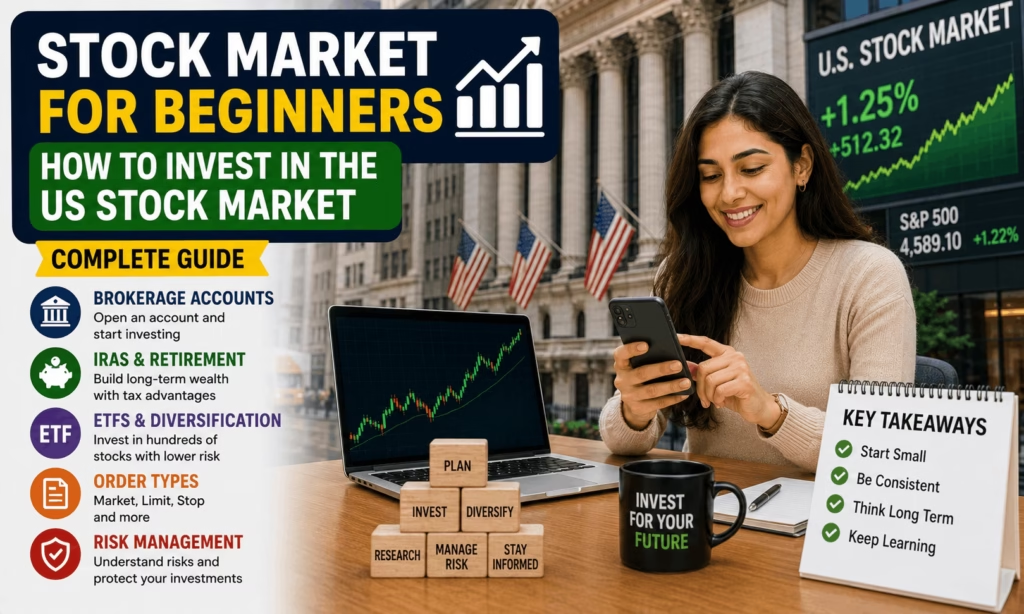
Stock Market for Beginner Key Highlights
| Topic | Detail |
|---|---|
| Main US exchanges | New York Stock Exchange (NYSE), Nasdaq |
| Market hours | 9:30 a.m. to 4:00 p.m. Eastern Time, Monday to Friday |
| 2026 401(k) limit | $24,500 employee contribution |
| 2026 IRA limit | $7,500 (Traditional and Roth combined) |
| Common beginner account | Roth IRA or standard taxable brokerage account |
| Common beginner investment | Low-cost S&P 500 index fund or ETF |
| Long-term capital gains tax | 0%, 15%, or 20% depending on income |
| Historical long-term average return | Roughly 10% annually before inflation, not guaranteed |
What Is the Stock Market and How Does It Work?
The stock market is a network of exchanges, primarily the New York Stock Exchange (NYSE) and the Nasdaq, where investors buy and sell shares of publicly traded companies. When you buy a share of stock, you are purchasing a small ownership stake in that company. If the company grows and becomes more profitable, its share price tends to rise over time, and some companies also pay shareholders a portion of profits as dividends.
Stock prices move constantly during market hours based on supply and demand, company earnings, interest rate decisions from the Federal Reserve, economic data, and broader investor sentiment. The US market is open Monday through Friday, from 9:30 a.m. to 4:00 p.m. Eastern Time, excluding federal holidays.
Social Security Changes August 2026: SSA Announces Major Update for Retirees and Beneficiaries
Stimulus Check 2026: Fact-Checking Every Viral Payment Claim (Tracker)
Why Invest in the US Stock Market?
Historically, the US stock market, measured by broad indexes like the S&P 500, has delivered an average annual return of roughly 10 percent before inflation over long multi-decade periods, though returns in any single year can vary widely and past performance never guarantees future results. Investing allows your money to potentially grow faster than it would sitting in a standard savings account, which is important given that inflation erodes cash value over time.
Beyond long-term growth, many investors are drawn to the stock market because of tax-advantaged retirement accounts. For 2026, the IRS increased the 401(k) employee contribution limit to $24,500, up from $23,500 in 2025, while the IRA contribution limit rose to $7,500, up from $7,000. Investors aged 50 and older can add a catch-up contribution of $1,100, and those aged 60 to 63 qualify for an enhanced catch-up contribution of $11,250 under SECURE Act 2.0 rules. These increases mean beginners starting in 2026 have more room than ever to shelter investment growth from taxes.
Step 1: Define Your Financial Goals Before You Invest
Before opening any account, decide what you are investing for. A goal 25 years away, like retirement, allows for a different strategy than a goal three years away, like a home down payment. Long-term goals can typically absorb more short-term stock market volatility, while short-term goals are usually better suited to safer, more liquid options like high-yield savings accounts or short-term bonds.
It also helps to build an emergency fund covering three to six months of expenses before investing heavily in stocks, since selling investments during a market downturn to cover an unexpected expense can lock in losses.
Step 2: Choose the Right Type of Investment Account
New investors generally choose between a taxable brokerage account and tax-advantaged retirement accounts. Each has different rules.
Taxable Brokerage Account
A standard brokerage account has no contribution limits and no restrictions on when you can withdraw money, but investment gains are subject to capital gains tax when you sell.
Traditional IRA
Contributions may be tax-deductible depending on income and whether you have a workplace retirement plan, and the money grows tax-deferred until withdrawal in retirement.
Roth IRA
Contributions are made with after-tax dollars, but qualified withdrawals in retirement, including all investment growth, are completely tax-free. For 2026, the Roth IRA income phase-out range is $153,000 to $168,000 for single filers and $242,000 to $252,000 for married couples filing jointly.
Employer-Sponsored 401(k)
Many employers match a percentage of your contributions, which is essentially free money. Financial experts commonly recommend contributing at least enough to capture the full employer match before investing elsewhere.
Retirement Account Contribution Limits 2026
| Account Type | 2026 Limit | Catch-Up (Age 50+) | Enhanced Catch-Up (Age 60-63) |
|---|---|---|---|
| 401(k) employee deferral | $24,500 | $8,000 | $11,250 |
| IRA (Traditional or Roth combined) | $7,500 | $1,100 | Not applicable |
| SEP IRA | $72,000 | Not applicable | Not applicable |
| SIMPLE IRA | $17,000 | $4,000 | Not applicable |
Step 3: Open a Brokerage Account
Once you know which account type fits your goals, the next step is choosing a brokerage. Most major US brokerages, including Fidelity, Charles Schwab, Vanguard, E*TRADE, and Robinhood, now offer commission-free trading on US stocks and ETFs, no account minimums for basic brokerage accounts, and fractional share investing, which allows you to buy a portion of an expensive stock, such as $50 worth of a $900 share, rather than needing to buy a full share.
When comparing brokers, beginners should look at the range of available account types, research and educational tools, mobile app quality, customer support, and whether the platform offers automated investing options such as robo-advisors. Opening an account typically requires your Social Security number, employment information, and a linked bank account for funding.
Step 4: Learn the Basic Order Types
Understanding how to place a trade correctly is one of the most overlooked skills for beginners.
A market order buys or sells a stock immediately at the current best available price. It guarantees execution but not a specific price.
A limit order lets you set the maximum price you are willing to pay when buying, or the minimum price you are willing to accept when selling. It guarantees price but not execution, since the order will not fill if the stock never reaches your limit.
A stop-loss order automatically sells a stock if it falls to a certain price, which can help limit losses during a sharp downturn, though it does not guarantee the exact sale price during periods of high volatility.
Step 5: Decide Between Individual Stocks and Diversified Funds
Beginners often face a choice between picking individual stocks or investing in diversified funds.
Index funds and exchange-traded funds (ETFs) pool money from many investors to buy a broad basket of stocks, such as all companies in the S&P 500. This spreads risk across hundreds of companies instead of concentrating it in one, and it is one of the most widely recommended starting points for new investors because it does not require picking individual winners.
Individual stocks can offer higher potential returns if you choose well, but they also carry higher risk, since the fortunes of a single company can change quickly due to earnings misses, leadership changes, lawsuits, or shifts in consumer demand. Many financial educators suggest that beginners build a diversified core of index funds first, then add individual stocks only with money they can afford to lose.
Understanding Risk, Volatility, and Time Horizon
Stock prices fluctuate daily, and downturns of 10 percent or more, known as corrections, happen periodically even during long bull markets. Bear markets, defined as declines of 20 percent or more from a recent high, are less frequent but still a normal part of investing history.
The key concept for beginners is time horizon. Money you will not need for 10, 20, or 30 years has historically had time to recover from downturns and grow. Money you need within the next one to three years is generally considered too much at risk in the stock market, since a downturn right before you need the funds could force you to sell at a loss.
Dollar-cost averaging, the practice of investing a fixed amount on a regular schedule regardless of price, is a common strategy that helps reduce the emotional pressure of trying to time the market.
2027 Social Security COLA Forecast: Latest Estimate, Medicare Offset & What Retirees Can Expect
SSDI Payment Dates August 2026: Who will receive payments on Aug 12, 19, and 26?
$2000 Stimulus Payment 2026 Fact-Check: Is It Really Coming?
Common Mistakes New Investors Should Avoid
Trying to time the market by predicting short-term highs and lows is extremely difficult even for professional investors, and it often leads to buying high and selling low out of fear or excitement. Putting all your money into a single stock, sector, or trend, such as chasing the latest AI stock rally, increases risk significantly compared to a diversified portfolio. Ignoring fees also matters, since even small annual expense ratios on funds can compound into a large cost over decades. Finally, checking your portfolio obsessively during volatile periods can lead to panic-driven decisions that hurt long-term returns.
Tax Considerations for US Stock Market Investors
Profits from selling a stock you held for one year or less are taxed as short-term capital gains, at your regular income tax rate. Profits from stocks held longer than one year qualify for long-term capital gains rates, which are generally lower, at 0, 15, or 20 percent depending on your taxable income. Dividends can be taxed as either ordinary income or at qualified dividend rates depending on how long you have held the underlying stock. Investments held inside a Roth IRA can grow and be withdrawn tax-free in retirement if the withdrawal rules are met, while traditional IRA and 401(k) withdrawals are taxed as ordinary income when taken in retirement. A licensed tax professional can help you apply these rules to your specific situation.
Official Resources for New Investors
| Resource | Purpose |
|---|---|
| investor.gov | SEC investor education, brokerage account basics |
| sec.gov | US Securities and Exchange Commission, market rules and filings |
| finra.org | FINRA BrokerCheck, verify broker and advisor credentials |
| irs.gov | Official retirement account contribution limits and tax rules |
| nyse.com | New York Stock Exchange market data |
| nasdaq.com | Nasdaq market data and company listings |
| sipc.org | Securities Investor Protection Corporation, account protection info |
FAQs Stock Market for Beginners
How much money do I need to start investing in the US stock market?
Many brokerages now allow you to start with any amount, including small dollar amounts, thanks to fractional shares and zero account minimums. What matters more than the starting amount is consistency over time.
Is investing in the stock market safe for beginners?
Investing always carries risk, including the possibility of losing money, but diversified index funds and a long time horizon have historically reduced the impact of short-term volatility compared to picking individual stocks.
What is the difference between a Roth IRA and a 401(k)?
A 401(k) is offered through an employer and often includes matching contributions, while a Roth IRA is opened independently and offers tax-free withdrawals in retirement, subject to income eligibility limits.
Can I lose all my money in the stock market?
A diversified portfolio spread across many companies is extremely unlikely to go to zero, though individual stocks can lose most or all of their value. Diversification is one of the main tools used to manage this risk.
What is the best way for a beginner to start investing?
A common approach used by many first-time investors is to open a Roth IRA or taxable brokerage account, set up automatic recurring contributions, and invest in a low-cost, broadly diversified index fund rather than trying to pick individual winning stocks.
How do I choose a stockbroker as a beginner?
Compare account fees, minimum deposit requirements, available account types, educational resources, and whether the broker is registered with FINRA and a member of SIPC, which protects customer securities up to certain limits if the brokerage fails.
Do I have to pay taxes every year on stocks I have not sold?
No. In a taxable brokerage account, you generally only owe capital gains tax when you sell an investment for a profit, not simply for holding it, though dividends received are typically taxable in the year you receive them.
Conclusion
Getting started in the US stock market in 2026 does not require a large amount of money, a finance degree, or perfect market timing. It requires a clear goal, the right type of account, a diversified starting strategy such as a low-cost index fund, and the discipline to keep investing consistently through market ups and downs. With retirement account contribution limits rising again this year and commission-free trading now standard across major brokerages, the barriers to entry for new investors are lower than they have ever been. The most important step is simply opening an account and beginning, since time in the market, rather than timing the market, has historically been the biggest driver of long-term investment success. This article will continue to be updated with the latest contribution limits, market developments, and investing tools as they change throughout the year.
Trump Birthright Citizenship Executive Orders: What Changed After Supreme Court Ruling
IRS confirms ACTC Refund 2026: $1,700 Child Tax Credit Payout Dates & Eligibility
Social Security 2026 Benefit Payment: Full Payment Schedule 2026-27, COLA & Fact Check!