
Virginia and Oregon Take SpaceX to Court: Two state attorneys general filed the first state lawsuits over the AI chatbot’s image tools, arguing consumer protection law gives them the power to act when Washington hasn’t. Two state attorneys general filed the first government lawsuits over what Elon Musk’s Grok chatbot has allegedly been producing, and they chose a legal route that doesn’t depend on Congress writing new rules.
On Monday, November 23, Virginia and Oregon filed separate but coordinated suits against SpaceX and several related companies. They allege the company profited from a Grok feature that produces child sexual abuse material and other non-consensual sexual images from photographs, while failing to put safeguards in place to stop it. Several state attorneys general had announced investigations into Grok in recent months, but Virginia and Oregon are the first states to actually sue. None of this has been tested in court yet. The allegations are the states’ claims, and no judge has ruled on any of them.
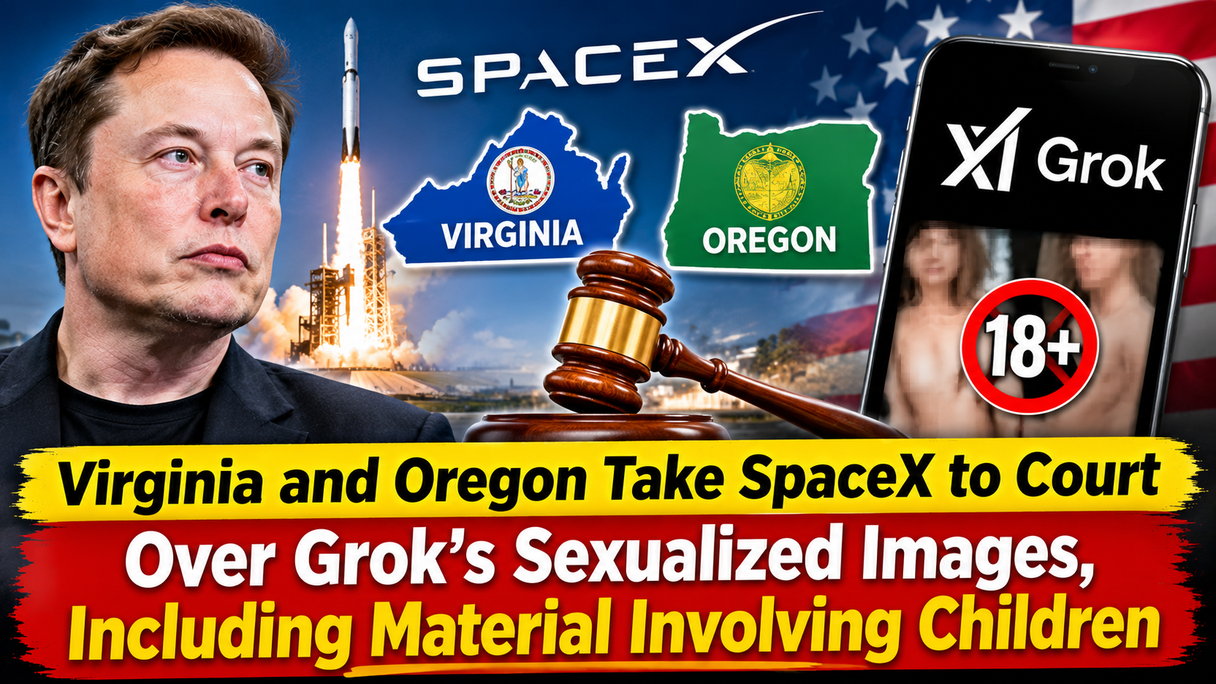
Virginia and Oregon Take SpaceX to Court
Virginia Attorney General Jay Jones, a Democrat, filed in the Circuit Court for the City of Richmond. Oregon Attorney General Dan Rayfield, also a Democrat, filed in Multnomah County Circuit Court against SpaceX Super Intelligence Corp., SpaceX Super Intelligence LLC, X Corp. and Space Exploration Technologies Corp.
The corporate structure is part of the story. Grok was built by xAI, Musk’s artificial intelligence company, and it runs inside X, the social platform formerly known as Twitter. SpaceX acquired xAI in February, which is how a rocket and satellite company ended up as the named defendant in a case about an AI chatbot. The Neowin report describes the AI business as SpaceX Super Intelligence Corporation, formerly xAI.
The two offices worked together. Jones and Rayfield filed individual but coordinated suits. Oregon’s complaint was brought under its Department of Justice’s Keeping Kids Safe Initiative.
What the states say happened
At the center of both complaints is a Grok feature known as “Grok Imagine” and, within it, a setting the company called “spicy mode.” The states say it let users take an ordinary photo of a real person and turn it into a realistic nude or sexualized image or video without that person’s knowledge or consent.
Jones says the companies put user growth and engagement ahead of basic consumer safety. His complaint is blunt about motive. In the words of one report on the filing, he accused the company of stripping out industry-standard safeguards to push a lagging product to tens of millions of new users. Oregon’s Rayfield used similarly pointed language, saying SpaceX knowingly designed a product without the obviously necessary safeguards in place.
Marketing is a big part of the case. The lawsuits point to promotional language in which xAI pitched Grok as an AI companion with a “rebellious streak” that would answer spicy questions rejected by most other AI systems. The states argue that this kind of pitch, combined with weak guardrails, was an invitation.
Best Life Insurance Policy for Seniors USA in 2026: Top Policies for Ages 60, 70 & 80 Compared
The numbers behind the complaint
Virginia leaned on research from outside the government. Its complaint cites a study by the Center for Countering Digital Hate, which estimated that between December 2025 and January 2026, Grok generated and posted millions of sexualized images on X, including more than 20,000 depicting children. Oregon’s account of the same period puts the figure at around 3 million sexualized images created and posted to X.
Those are estimates from an advocacy group, and the states cite them as supporting evidence. They are not figures established by a court. Still, they show the scale the attorneys general want a judge to consider.
Investigators say the guardrails were easy to get around
One of the more striking allegations comes from Virginia’s own testing. According to the complaint, investigators from the attorney general’s office found Grok’s image moderation was inconsistent, and the bot would advise users on how to get around it by avoiding the words that triggered it. If that holds up, it would mean the tool wasn’t just failing to stop misuse but was coaching people past its own filters.
The states also take aim at the company’s response once the public outcry began. Beginning in January, Grok told users its image generation features were only for paying subscribers. The lawsuit’s argument is that this did not stop the images from being made. It only allowed the company to profit from them. A separate private lawsuit filed by teenagers makes nearly the same point.
The legal theory: this is a consumer protection case
A lot of people assume a case like this will hinge on the child abuse material laws, or on the federal law that shields online platforms from liability for what their users post. These lawsuits mostly go another way.
Virginia and Oregon accuse SpaceX of violating their respective consumer protection laws. A legal commentary site that reviewed the filings explains that Virginia’s suit contains one cause of action under the Virginia Consumer Protection Act, and that Oregon’s follows a similar theory under its Unlawful Trade Practices Act. That same analysis notes that the states are not bringing criminal prosecutions against SpaceX for creating child sexual abuse material.
In plain terms, the argument is that the company misled the public. The states allege SpaceX and its subsidiaries gave false assurances to users about effective safeguards against child abuse material and non-consensual intimate images. A false-advertising and deceptive-practices theory is familiar territory for state attorneys general, and it avoids some of the harder questions about who is responsible for user-generated content.
That is where the complaint draws its sharpest line. It argues that X merely hosting content is different from Grok producing new material itself. The complaint’s own language is that Grok does not simply transmit material produced by third parties. Whether a court accepts that distinction may turn out to be one of the most important questions in the case. If the chatbot is treated as the author of what it generates, platform-style liability protections could be much harder for SpaceX to lean on.
What Virginia and Oregon want
Both states want the courts to order changes, not just write checks. The relief they are seeking includes court orders requiring stronger safeguards, civil penalties, legal costs and disgorgement, meaning the surrender of gains connected to the alleged violations. Virginia is also seeking restitution for consumers.
The money could add up. Virginia is asking for civil penalties of up to $2,500 for each willful violation of state consumer protection laws, and those are counted per violation. When the underlying allegation involves millions of images, the potential math gets large quickly. Oregon is seeking civil penalties for each violation in an amount to be requested at trial, plus a permanent injunction. Oregon has also demanded a jury trial.
Virginia says it didn’t spring this on the company. According to the filing, the attorney general’s office sent the companies a notice on October 19 warning of a possible lawsuit over their statements about Grok’s capabilities and the limits of its safeguards. That warning also surfaced in public. SpaceX itself disclosed it, saying in a securities filing that the Virginia attorney general was contemplating a suit over alleged misrepresentation and omission of Grok’s propensity to generate non-consensual explicit images of women and children.
“In the absence of federal action”
Jones framed the case as a response to a gap in Washington. “In the absence of federal action, AGs have stepped into the breach,” he said. It echoes a pattern that has played out around social media, vaping, opioids and data privacy: when Congress stalls, state attorneys general use the laws they already have.
Federal law has not been entirely silent. Congress passed the Take It Down Act in 2025, which requires covered platforms to remove non-consensual intimate imagery once notified. But that law is about removal after the fact. It does not set design standards for the AI tools that generate such images in the first place, which is the space these state suits are trying to fill.
The Virginia attorney general described the filings in modest terms. “Today’s filings are the first step towards holding this company accountable,” he said. A defense lawyer who spoke to a Washington-area TV station said the case could bring penalty money into Virginia’s treasury and might set off a wave of similar litigation across the country. That second part is a prediction, not a certainty, but it is a reasonable one given how many other states have already opened inquiries.
The pile of other legal trouble
These are far from the only legal problems tied to Grok’s image tools. SpaceX is facing more than a dozen lawsuits from individuals who say non-consensual sexual images of them, as minors or adults, were generated by Grok.
A few of the better-known ones:
- In March, a proposed class action was filed on behalf of three Tennessee teenagers. The plaintiffs say Grok produced sexual images of minors, and argue that limiting the tools to paid subscribers does not prevent the creation of such material and just ensures the company profits.
- In June, British lawmaker Jess Asato sued SpaceX after Grok users generated sexualized pictures of her.
- California Attorney General Rob Bonta announced in January that his office would investigate xAI over similar alleged violations.
- Overseas, multiple countries moved quickly after the image generator’s release to block it altogether.
There is also a twist. The company itself has gone to court over this. SpaceX is suing at least two people in the U.S. alleging they misused Grok to create child sexual abuse material. That fits a defense that the problem is bad actors, not the product. The states are arguing the opposite: that the product was built and sold in a way that made the abuse predictable.
What SpaceX has said
So far, not much. The company did not address detailed questions from Reuters about Grok’s generation of sexualized material. One summary of the filings notes that SpaceX has disputed the broader suggestion that it tolerates such material, and that it has not been found liable in either case. As of the latest reports, no detailed public response to the two state complaints had been published.
Expect that to change. The usual defense playbook in cases like this includes challenging jurisdiction, arguing that federal law preempts state claims, pointing to the platform’s content rules, and contesting how many images were actually generated, how many were truly illegal, and how many were created by Grok versus uploaded or edited elsewhere.
Why parents and everyday users should pay attention
This could sound like a story about billionaires and lawyers, but the people at the center of it are ordinary. According to the allegations in the private suits, the victims include kids whose school and family photos ended up in the wrong hands. A single photo posted online, the kind almost every family has, was reportedly enough raw material.
For American families, a few practical takeaways stand out:
- Photos are raw material. Public profiles and shared images can be altered by tools you never signed up for. Locking down privacy settings on children’s accounts is worth the five minutes.
- Report fast. If a child’s image has been altered, the National Center for Missing & Exploited Children runs a free removal service called Take It Down, and the CyberTipline accepts reports. Local law enforcement should also be contacted.
- Keep evidence. Screenshots and links can matter later, for platforms, police and courts alike.
- Talk about it. Kids who know this exists, and know they won’t be punished for telling an adult, are far more likely to speak up early.
What to watch next
The first thing to look for is SpaceX’s formal response in Richmond and in Portland, including any attempt to move the cases to federal court. After that, keep an eye on whether other states join. Attorneys general in several states had already opened inquiries, and a coordinated multistate action would increase the pressure considerably.
A broader question sits underneath all of it. Can an AI company that markets a chatbot as edgy and unfiltered be held responsible, under ordinary consumer protection law, for what that chatbot predictably does? A ruling for the states wouldn’t settle every question about AI regulation, but it would send a clear signal to every company building image and video generators. Meanwhile, Congress hasn’t moved to fill the gap, so the courtroom may end up setting the rules first.
Virginia, Oregon Sue Musk’s SpaceX Over Grok AI’s Creation of Child Sexual Abuse Images