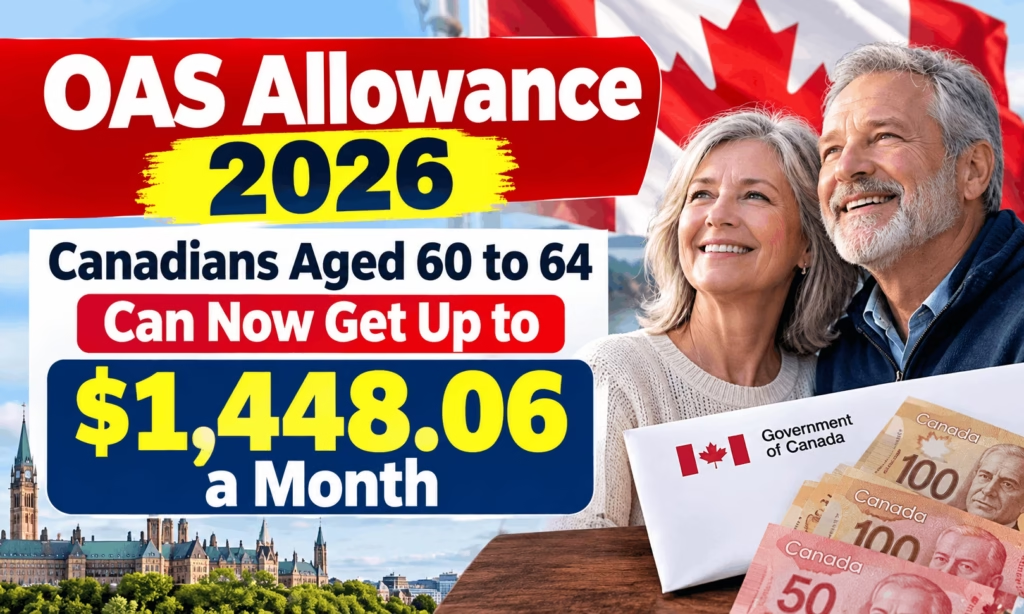
OAS Allowance 2026: Low-income Canadians aged 60 to 64 are getting a raise this month. The OAS Allowance 2026 maximum has climbed to $1,448.06 a month for the October to December quarter, according to the Government of Canada payment tables updated on September 29. The Allowance for the Survivor now tops out at $1,726.18 a month. Both benefits rose 1.4 percent with the quarterly inflation adjustment, which works out to 3.0 percent over the past year. The first payment at the new rate lands on October 28, 2026. If you are 60 to 64, married or in a common-law relationship, and your partner already receives the Guaranteed Income Supplement, this is the benefit to check before another month goes by. We’ll be updating this article monthly.
The Allowance is not automatic. You have to apply, and Service Canada says to do it six to eleven months before your 60th birthday, or right away if you are already between 60 and 64. The payment is tax free, it does not count as income for the Guaranteed Income Supplement, and it is tied to your household income, not just your own. This guide covers the new amounts, the full payment schedule for the rest of 2026, who qualifies, how the income limit really works, how long applications take and where to check your status. There is also a free OAS Allowance calculator below so you can estimate your own number before you apply.
OAS Allowance 2026 Key Dates
| Item | Latest detail (October to December 2026) |
|---|---|
| Benefit name | Allowance, part of the Old Age Security program |
| Age range | 60 to 64 |
| Maximum monthly Allowance | Up to $1,448.06 |
| Maximum monthly Allowance for the Survivor | Up to $1,726.18 |
| Combined income limit (Allowance) | Less than $42,768 for the couple |
| Income limit (Allowance for the Survivor) | Less than $31,152 |
| Latest increase | 1.4 percent, or 3.0 percent over the year |
| Next payment date | October 28, 2026 |
| Tax status | Not taxable |
| Online processing time | 14 days |
| Paper processing time | 120 days |
| Next rate review | January 2027 |
What Changed in October: The OAS Allowance Increase Explained
Old Age Security benefits are reviewed four times a year, in January, April, July and October. Each review compares the average Consumer Price Index for the latest three months with the last period that triggered an increase. For this quarter, Service Canada compared May, June and July 2026, which averaged 169.5, against February, March and April 2026, which averaged 167.1. That gap produced the 1.4 percent bump.
Two details matter for planning. First, benefit rates never go down when prices fall, so the figures can only hold steady or rise. Second, the percentage applies to every part of the Old Age Security family at once: the pension, the Guaranteed Income Supplement, the Allowance and the Allowance for the Survivor. That is why a couple with one partner on the GIS and the other drawing the Allowance sees both cheques move together.
For the Allowance, the practical change is about $20 more a month at the top of the range compared with the July to September quarter, and roughly $24 more a month for the Survivor version. Those are maximums, so your own increase will be smaller if your household income already trims your payment.
OAS Allowance Amount 2026: Maximum Monthly Payment by Benefit
The figures below come straight from the Canada.ca payment amounts page. They show the most you can receive. What you actually get depends on your income, your partner’s income and, if you have a partial pension, how long you have lived in Canada.
| Benefit | Who it is for | Maximum per month | Income must be |
|---|---|---|---|
| Allowance | Age 60 to 64, partner gets GIS and full OAS pension | $1,448.06 | Under $42,768 combined |
| Allowance for the Survivor | Age 60 to 64, surviving spouse or partner | $1,726.18 | Under $31,152 |
| OAS pension | Age 65 to 74 | $762.50 | Under $152,062 |
| OAS pension | Age 75 and over | $838.75 | Under $157,923 |
| GIS | Single, widowed or divorced, 65 and over | $1,138.90 | Under $23,112 |
| GIS | Partner gets full OAS pension | $685.56 | Under $30,528 combined |
If you lived in Canada for at least 10 years but fewer than 40 after turning 18, you receive a partial pension, and Service Canada warns that these tables should not be used to work out your payment. In that case contact the Old Age Security program directly or run your numbers through the official estimator.
OAS Allowance Payment Dates 2026: When Will the Next Deposit Arrive?
The OAS Allowance 2026 is paid on the same calendar as the Canada Pension Plan and the OAS pension. The final three deposits of the year are set, and December is earlier than usual because of the holiday closures.
| Payment month | Payment date | Rate that applies |
|---|---|---|
| October 2026 | Wednesday, October 28 | New 1.4 percent increase starts |
| November 2026 | Thursday, November 26 | October to December rate |
| December 2026 | Tuesday, December 22 | October to December rate |
| January 2027 | See the Service Canada calendar | Next quarterly review |
Banks usually post direct deposits a day before the scheduled date, but the exact timing can vary. If a deposit does not show up, check your direct deposit details in My Service Canada Account before calling. Many missed payments turn out to be an outdated bank account or an address that was never updated after a move.
Who Qualifies for the OAS Allowance 2026 at Ages 60 to 64?
The Allowance is built for couples where one partner is already 65 or older and collecting the Guaranteed Income Supplement, and the other partner is still in the 60 to 64 window. It exists so that a household does not lose income just because one spouse is not yet old enough for the OAS pension.
| Requirement | What Service Canada expects |
|---|---|
| Age | 60 to 64 years old |
| Partner | Your spouse or common-law partner receives the GIS |
| Legal status | Canadian citizen or legal resident |
| Residence | Lived in Canada at least 10 years since age 18 |
| Income | Combined annual income below $42,768 |
| Sponsorship | You or your partner are not under a sponsorship agreement |
The Allowance for the Survivor follows a different path. You qualify if your spouse or common-law partner has died, you have not remarried or entered a new common-law relationship, you are 60 to 64, you are a citizen or legal resident, you have 10 years of Canadian residence after 18 and your own income is below $31,152. Anyone already getting the Allowance when their partner dies is converted to the Survivor version automatically.
OAS Allowance Income Limit 2026: What Counts and What Does Not
Most refusals come down to income. Service Canada looks at your net income plus your partner’s, using what you report on your application and your tax return. The number is not the same as your gross pay, so it helps to know what goes in and what stays out.
Income that counts
- Canada Pension Plan and Quebec Pension Plan benefits
- Private pensions, superannuation and foreign pensions
- RRSP withdrawals
- Employment Insurance benefits
- Interest, investment income, capital gains and taxable dividends
- Net rental income and net employment or self-employment income
- Workers’ compensation and some spousal support received
Income that is exempt
- OAS, GIS, Allowance and Allowance for the Survivor payments
- Withdrawals from a Tax-Free Savings Account
- Inheritances and lottery winnings
- Other government benefits and credits, including rebates
- Retroactive CPP or QPP payments for earlier years
There is also a work incentive worth knowing about. If you or your partner earn employment or self-employment income, the first $5,000 does not reduce the benefit. Between $5,000 and $15,000 the payment drops by 50 cents for every dollar earned. Deductions such as RRSP contributions, union dues, CPP contributions and some support payments can lower the income figure that gets tested, so keep your tax slips tidy.
Social Security COLA 2027: How Much More Will You Get in January?
OAS Allowance Calculator 2026: Estimate Your Monthly Payment
This calculator uses the official October to December 2026 maximums and income cut-offs. It spreads the benefit evenly between zero income and the cut-off, so treat the result as a planning estimate. Only Service Canada can confirm your exact amount, and its own estimator is linked in the resources table further down.
This is an estimate for information only. It does not replace a decision from Service Canada.
Why the OAS Allowance 2026 Increase Matters for Couples in Their Early Sixties
A household in which one partner is 65 or older and the other is still a few years short of the OAS pension can feel squeezed. The older partner may already depend on the GIS, while the younger one has retired early, lost work or left a physically demanding job. The OAS Allowance 2026 rates are designed to close that gap. At the top of the range, a couple can receive the GIS for one partner and the Allowance for the other, which adds more than $17,000 a year of tax-free support before any other income is considered.
The October change also arrives at a useful time. Fall is when many families review budgets for winter heating, groceries and insurance renewals. Knowing that the OAS Allowance 2026 payment rises on October 28 lets you plan with real numbers instead of last quarter’s figures. If you are close to the income limit, even a small change in RRSP withdrawals or part-time earnings can shift your payment, so it is worth testing a few scenarios in the calculator below before you commit to a decision.
How to Apply for the OAS Allowance 2026: Step-by-Step
You can apply for the OAS Allowance 2026 online or on paper. Online is faster and gives you a status page, so most people should start there.
Before you start
Gather your Social Insurance Number, your partner’s Social Insurance Number and date of birth, details of any foreign income, a list of the countries where you have lived since age 18, your banking details for direct deposit, and the date any job or pension income stopped or changed, if that applies to you.
Apply online
- Register for or sign in to My Service Canada Account.
- Choose Apply for Old Age Security and manage my benefits.
- Select Your benefit(s), then Apply for benefits.
- Pick the Application for Allowance or Allowance for Survivor.
- Report your income and your partner’s income and submit.
Apply by mail
Print and complete form ISP3008, the Application for the Allowance or Allowance for the Survivor, along with form ISP3026, the statement of income. Mail them to Service Canada. If someone helps you deal with Service Canada, you can authorize them through My Service Canada Account or with form ISP-1603, although that does not let them apply for you.
Set up direct deposit while you are at it. Service Canada says to call 1-800-277-9914 once to activate notifications, then register and sign in to update your payment destination under your profile.
OAS Allowance Processing Time and Application Status Check
Service Canada lists two timelines. An online application is processed in about 14 days. A paper application takes up to 120 days. Either way the decision arrives by mail, and it tells you your monthly amount and your first payment date if you are approved, or the reason if you are not. Processing can run longer when documents are missing or Service Canada asks for more information.
| Step | What happens | Timeline |
|---|---|---|
| Apply online | Submit through My Service Canada Account | Processed in 14 days |
| Apply by mail | Send ISP3008 and ISP3026 | Processed in 120 days |
| Decision letter | Mailed with amount and first payment date | After processing |
| Check status | Updated in My Service Canada Account once decided | Ongoing |
| Disagree with the decision | Ask for a reconsideration | Within 90 days of the letter |
If you applied by mail, register for My Service Canada Account anyway. It lets you see the outcome, fix errors in your application and update your address, phone number or bank account without waiting for a letter.
Allowance vs Allowance for the Survivor vs GIS: What Is the Difference?
| Feature | Allowance | Allowance for the Survivor | GIS |
|---|---|---|---|
| Age | 60 to 64 | 60 to 64 | 65 and over |
| Marital situation | Partner receives GIS | Widowed, not remarried | Any, income tested |
| Maximum monthly (Oct to Dec 2026) | $1,448.06 | $1,726.18 | $1,138.90 single |
| Taxable | No | No | No |
| Recalculated each July | Yes | Yes | Yes |
What Happens If Alberta Votes Yes? Inside Canada’s October 19 Independence Referendum
2027 COLA Increase Announcement Date, Estimated Raise, Payment Schedule & Calculator
How Your OAS Allowance Is Reviewed?
The Allowance is not a set-and-forget cheque. Every July, Service Canada recalculates it using your net income from the previous calendar year. That means the July 2026 review used your 2025 income. If your income rose, the payment can shrink or stop. If it fell, it can go up. Filing your income tax return on time is the single best habit for avoiding gaps, because the review relies on that information.
Report big life changes early. A move out of Canada, a new job, a retirement, a change in marital status or a partner who stops receiving the GIS can all change what you are owed. Waiting for Service Canada to catch it often leads to an overpayment that has to be repaid later.
Common Mistakes That Delay or Reduce Your Allowance
- Applying too late. Service Canada recommends six to eleven months before turning 60.
- Leaving out your partner’s Social Insurance Number or foreign income details.
- Counting OAS or GIS as income, which they are not, and wrongly assuming you will not qualify.
- Skipping the tax return, which stalls the July review.
- Forgetting to update direct deposit after switching banks.
OAS Allowance Official Links
Use only Canada.ca addresses when you sign in or share personal information. Service Canada will never charge a fee to apply.
| Resource | What it is for | Link |
|---|---|---|
| My Service Canada Account | Login, registration, apply, status check, direct deposit | canada.ca/my-account |
| Allowance overview | Official program page | Allowance on Canada.ca |
| Allowance eligibility | Full list of requirements | Do you qualify |
| Apply for the Allowance | Online and paper instructions | Apply |
| After you apply | Processing times, status and reconsideration | After you apply |
| OAS payment amounts | Current maximums and income thresholds | Payment amounts |
| OAS Benefits Estimator | Official estimate of your payment | OAS estimator |
| Payment calendar | CPP and OAS payment dates | Benefits calendar |
| Allowance for the Survivor | Program page for widowed Canadians | Survivor Allowance |
| Direct deposit | Set up or change banking details | Direct deposit |
| Contact Old Age Security | Phone and mail options, 1-800-277-9914 | Contact us |
| Application forms | ISP3008, ISP3026 and others | Form catalogue |
OAS Allowance 2026 FAQs
How much is the OAS Allowance in 2026?
For October to December 2026 the maximum OAS Allowance is $1,448.06 a month when your spouse or common-law partner receives the GIS and a full OAS pension. The Allowance for the Survivor goes up to $1,726.18 a month.
Who qualifies for the OAS Allowance?
You must be 60 to 64, live in Canada, be a citizen or legal resident, have lived in Canada for at least 10 years after turning 18, have a partner who receives the GIS and have combined income below $42,768.
When is the next OAS Allowance payment?
The next deposit is October 28, 2026. After that come November 26 and December 22.
Is the OAS Allowance taxable?
No. The Allowance and the Allowance for the Survivor are not taxable income, unlike the OAS pension itself.
How long does an Allowance application take?
Service Canada lists 14 days for online applications and 120 days for paper ones. Missing documents can add time.
Can I work and still receive the Allowance?
Yes. The first $5,000 of employment or self-employment income does not reduce the benefit, and between $5,000 and $15,000 the payment falls by 50 cents per dollar.
Will the OAS Allowance go up again?
Rates are reviewed every January, April, July and October. They rise with inflation and do not fall, so the next possible change is January 2027.
Can I get Old Age Security at 60?
The OAS pension starts at 65. At 60 to 64 the Allowance or the Allowance for the Survivor may be available if you meet the income and family rules.
What is the income limit for the Allowance in 2026?
Combined income must be under $42,768 for the Allowance and under $31,152 for the Allowance for the Survivor.
Do I have to reapply for the Allowance every year?
You do not file a brand new application each year, but your entitlement is recalculated every July from the income on your tax return. If Service Canada needs more information it will send you a statement of income to complete.
What happens to the Allowance when I turn 65?
The Allowance covers ages 60 to 64. At 65 the OAS pension and, for low-income seniors, the GIS become the relevant benefits. Check My Service Canada Account around six months before your birthday to confirm your next steps.
Can I get the Allowance if my spouse does not receive the GIS?
No. A partner who receives the GIS is a core requirement of the regular Allowance. Widowed Canadians may qualify for the Allowance for the Survivor instead.
How do I check my OAS Allowance application status?
Sign in to My Service Canada Account. Once a decision is made, the status is updated there. If you cannot use the online account, contact the Old Age Security program by phone.
Conclusion: What to Do Next
The OAS Allowance 2026 update is good news for couples in their early sixties who are living on modest incomes. The maximum is now $1,448.06 a month, the Survivor version reaches $1,726.18, and the first payment at the higher rate arrives October 28. Because the benefit is not automatic, the practical steps are simple: confirm your partner receives the GIS, run your numbers through the calculator and the official estimator, gather your Social Insurance Numbers and income details, and apply through My Service Canada Account. Keep your tax return filed and your direct deposit current so July reviews do not interrupt your payments. We’ll keep this page current as the next rate review in January 2027 approaches.
2027 Social Security COLA vs Inflation: The One Thing We Already Know Before October 14
Trump $5000 Dividend Check: Is It Real, Who Would Qualify and When Could Payments Start?
NY POWER Rebate Check: Who Gets $100 to $200 and When?
Social Security Changes October 2026: 4 Updates That Could Affect Your Benefits