Andhra Pradesh’s Green Revolution 2.0: Andhra Pradesh’s agricultural transformation just earned global recognition. On June 2, 2026, the state’s flagship Andhra Pradesh Community Managed Natural Farming (APCNF) initiative won the 2026 Food Planet Prize in Båstad, Sweden widely regarded as the world’s largest environmental award for food systems. For a state once synonymous with chemical-intensive Green Revolution agriculture, this marks a striking reversal in direction, and it sits at the center of what officials and agricultural economists are now calling Green Revolution 2.0: a sweeping shift toward natural farming, climate-smart practices, and restructured farmer welfare programs.
From Chemical Inputs to Community-Led Natural Farming
Andhra Pradesh’s agricultural identity has come full circle. The state was historically one of India’s original Green Revolution states, built on high-yield seed varieties, irrigation expansion, and heavy chemical fertilizer and pesticide use starting in the 1960s. Today, it is positioning itself as a pioneer of the opposite approach. Chief Minister N. Chandrababu Naidu described the Food Planet Prize win as “a historic first for India,” and reaffirmed the state’s ambition to become a 100% natural farming state by 2047, stating the goal is to “restore resources, rejuvenate farmlands, strengthen farmers’ wellbeing, and help heal the planet.”
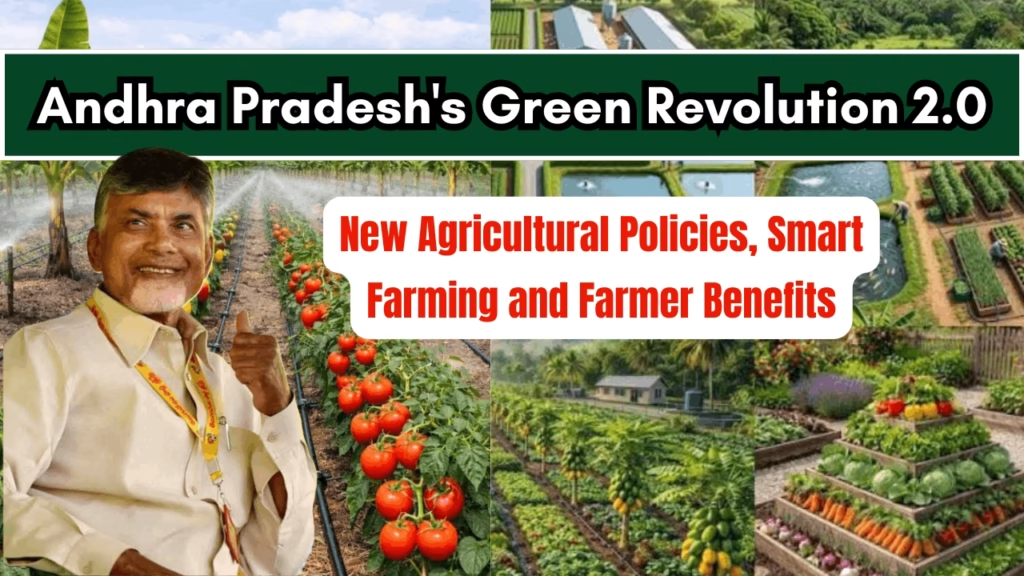
The APCNF model now reaches roughly 18 lakh farmers across Andhra Pradesh, according to Agriculture Minister Kinjarapu Atchannaidu, who credited the program’s success specifically to women farmers, self-help groups, and community resource persons who drove adoption at the grassroots level. Rythu Sadhikara Samstha (RySS) Executive Vice Chairman T. Vijay Kumar, who received the award alongside Special Chief Secretary B. Rajasekhar, put it simply: “The magic is in the women. Natural farming became possible because women farmers, self-help groups, and communities believed a different future is possible.”
What makes this transition particularly notable on a global scale is its reach beyond Andhra Pradesh’s own borders. The model is reportedly now being replicated in 22 Indian states, as well as internationally in Zambia and Sri Lanka a level of cross-border adoption rarely achieved by a single state-level agricultural program.
What “Natural Farming” Actually Means?
For readers unfamiliar with the model, natural farming (sometimes referred to by its earlier name, Zero Budget Natural Farming or ZBNF) replaces synthetic fertilizers and chemical pesticides with on-farm biological inputs, intercropping strategies, and non-pesticide pest management techniques. The underlying economic logic is that input costs for a farmer’s primary crop are offset by income generated from intercrops grown alongside it, reducing farmers’ dependence on expensive external inputs while improving long-term soil health. Supporters argue this addresses both an ecological crisis degraded soil, depleting aquifers, and chemical runoff and a financial one, since high input costs have long been cited as a major driver of farmer financial distress across India.
₹2,000 Crore Investment in North Andhra
Smart farming and natural farming methods only succeed at scale when paired with reliable water infrastructure, and Andhra Pradesh has moved aggressively on this front as well. The state government has set a target to complete 11 major irrigation projects in North Andhra within the next two years, backed by an estimated investment of ₹2,000 crore. Water Resources Minister Nimmala Ramanaidu, who reviewed the project’s progress, confirmed the initiative is expected to bring 2.69 lakh acres under new irrigation while stabilizing water supply to an additional 2.49 lakh acres a substantial expansion aimed specifically at drought-prone areas of the region.
A particularly significant milestone within this push was the official gazette notification of the Vamsadhara Tribunal Award 2021, which resolves a long-standing inter-state water-sharing dispute with Odisha. The government has emphasized cost efficiency throughout this irrigation expansion, prioritizing maximum agricultural benefit per rupee spent rather than simply maximizing total infrastructure volume.
Farmer Financial Support: From Rythu Bharosa to Annadata Sukhibhava
Alongside its farming-method transformation, Andhra Pradesh has restructured its direct financial support system for farmers. The state’s long-running YSR Rythu Bharosa scheme which had provided eligible farmer families with ₹13,500 annually, including a ₹6,000 contribution from the central government’s PM-KISAN scheme — has been officially rebranded and expanded under the new government as Annadata Sukhibhava.
Under the revised structure, eligible farmer families now receive a flat ₹20,000 per year, distributed across three installments timed to align with critical sowing and cultivation periods, again incorporating the ₹6,000 PM-KISAN component from the central government. The Andhra Pradesh budget allocated approximately ₹6,300 crore toward this restructured scheme, reflecting the scale of the state’s continued commitment to direct income support even as broader agricultural policy shifts toward natural farming methods.
Eligibility for this farmer benefit scheme extends well beyond traditional landowners. Coverage includes tenant farmers, cultivators on assigned and forest lands, and farmers working on endowment, temple, or inam lands — provided they hold valid land records or appropriately documented tenant agreements. Certain public office holders, including current and former ministers, MPs, MLAs, and MLCs, are explicitly excluded from receiving the benefit, ensuring the support reaches genuinely active cultivators rather than landholders in other professions.
Smart Farming: Drones, AI, and Digital Crop Registration
The “smart farming” component of Andhra Pradesh’s agricultural strategy increasingly relies on technology-driven tools layered on top of its natural farming push. Through Rythu Bharosa Centres, the state has been actively supporting Farmer Producer Organizations (FPOs) in purchasing agricultural drones, which are increasingly used for tasks ranging from crop monitoring to precision input application. This aligns with a broader national push: under the central government’s Sub-Mission on Agricultural Mechanization (SMAM), individual small and marginal farmers, along with women farmers specifically, are eligible for a 50% subsidy of up to ₹5 lakh toward drone purchases.
Digital recordkeeping has also become a foundational element of the state’s agricultural administration. Farmers seeking to access benefits under Annadata Sukhibhava and related programs are generally required to complete E-Crop registration, a digital system that documents cultivated crops and land use, helping the state verify eligibility, track agricultural output, and target support more precisely than older paper-based systems allowed.
Why This Matters Beyond Andhra Pradesh
Agricultural economists and policy researchers increasingly frame what’s happening in Andhra Pradesh as a test case for a broader national concept now widely referred to as Green Revolution 2.0 a deliberate shift in priority from the original Green Revolution’s singular focus on yield toward a more holistic framework prioritizing soil health, nutritional diversity, and climate resilience. Where the first Green Revolution emphasized high-yield variety seeds, heavy irrigation, and chemical inputs concentrated primarily in already-prosperous regions like Punjab and parts of Andhra Pradesh itself, this second wave explicitly aims to reduce dependence on chemical fertilizers and pesticides, encourage crop diversification beyond rice and wheat, and reward farmers and states for adopting outcomes-based sustainable practices rather than simply subsidizing inputs.
Andhra Pradesh’s two-decade history of agroecology-focused government programs predating APCNF itself has given the state an unusually deep institutional foundation for this transition compared to states attempting similar shifts from a standing start. That accumulated human and social capital, built through farmer federations and community-led extension work, is part of why agricultural researchers point to Andhra Pradesh as a genuine proof-of-concept rather than a purely aspirational policy announcement.
What Farmers Should Know?
For Andhra Pradesh farmers navigating this transition, a few practical realities are worth understanding. First, financial support under Annadata Sukhibhava requires active E-Crop registration and verified land or tenancy documentation, so farmers who haven’t updated their records risk delays in receiving their installments. Second, drone and mechanization subsidies are generally accessed through Rythu Bharosa Centres and FPO channels rather than individual direct applications, making FPO membership increasingly valuable for farmers hoping to access modern equipment affordably. Third, the state’s natural farming transition, while incentivized, is not mandatory overnight farmers interested in transitioning should connect with RySS-affiliated community resource persons in their district, since peer-to-peer training has been central to the program’s documented success so far.
This article is intended for general informational purposes only. Scheme names, benefit amounts, and eligibility criteria in Andhra Pradesh’s agricultural programs have changed multiple times in recent years and may continue to evolve, so farmers should confirm current details directly through official Andhra Pradesh government agriculture department resources or their local Rythu Bharosa Centre before making decisions based on this information.