
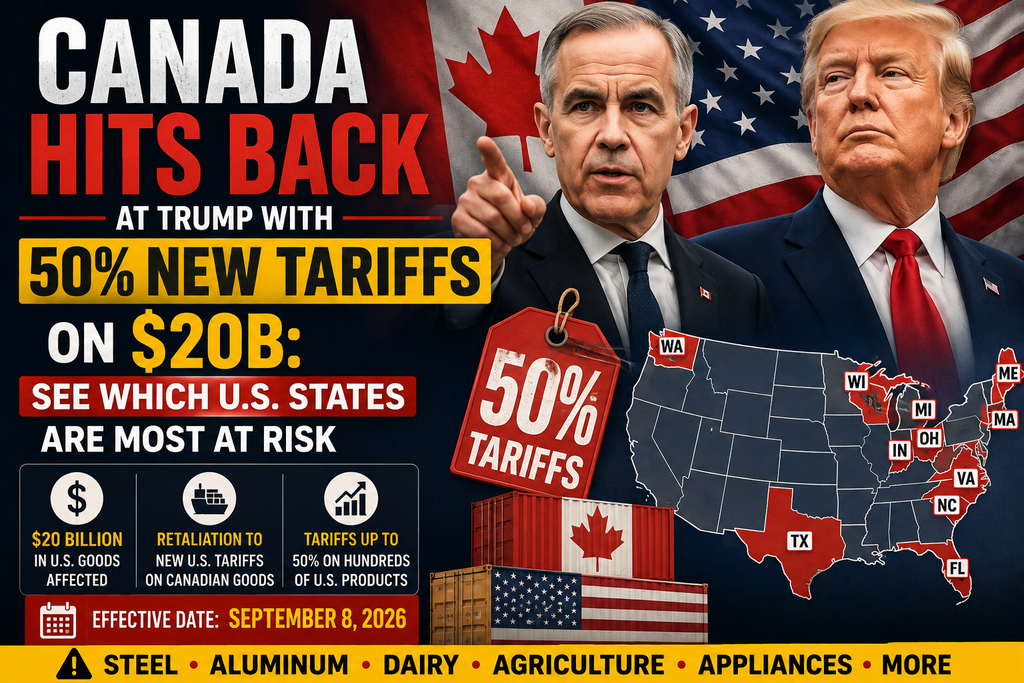
Canada Hits Back at Trump With 50% New Tariffs on $20B: Canada is moving ahead with a major retaliation against President Donald Trump’s latest tariffs, escalating the trade fight between the two North American neighbors. The Canadian government announced on August 25 that it will impose new counter-tariffs on C$27.6 billion worth of U.S. imports, matching the latest American tariffs dollar for dollar and rate for rate. The new Canadian measures will take effect at 12:01 a.m. on September 8, 2026.
The tariffs will range from 15% to 50%, depending on the product. Canada’s official list covers hundreds of U.S. products, with particularly heavy exposure for industries including steel and aluminum, dairy, appliances, agricultural equipment, pulp and paper, plastics and electronics.
But there is another important element to Canada’s response. Canadian Industry Minister Mélanie Joly said the government deliberately selected products that would affect particular U.S. states, creating political pressure on the Trump administration ahead of the November midterm elections. That means the latest round of tariffs is not simply an economic response. It is also a strategically designed political message.
Why Did Canada Impose New Tariffs on U.S. Goods?
The latest retaliation follows the collapse of U.S.-Canada trade negotiations.
The Trump administration imposed a new 50% tariff on $27.6 billion of Canadian goods effective August 22. Canada subsequently announced that it would match those tariffs on selected U.S. products. Canadian officials said negotiations had been conducted intensively, but Ottawa rejected new U.S. terms that it considered economically unacceptable.
Canada’s government said its countermeasures are intended to protect Canadian workers, producers and manufacturers affected by the U.S. tariffs and give Canadian businesses a more competitive position against American imports. The latest measures therefore represent a direct dollar-for-dollar retaliation rather than a blanket tariff on all U.S. imports.
When Will Canada’s New Tariffs Start?
The new Canadian tariffs are scheduled to begin on: September 8, 2026, at 12:01 a.m. The tariffs apply to qualifying U.S.-origin goods imported into Canada. Canada’s official tariff list states that the new countermeasures cover C$27.6 billion of U.S. imports and will use tariff rates of 15%, 25% and 50%. U.S. goods already in transit to Canada on the day the measures take effect are not subject to the new countermeasures under the announced rules.
Social Security Payment September 2026: Five Confirmed Dates You Need to Know
Canada Pension Plan Payment September 2026: Who Will Receive CPP Benefits and How Much?
Canada Tariffs on U.S. Goods at a Glance
| Detail | Latest information |
|---|---|
| Total U.S. imports targeted | C$27.6 billion |
| Approximate U.S. dollar value | About US$20 billion |
| Tariff rates | 15%, 25% and 50% |
| Effective date | September 8, 2026 |
| Effective time | 12:01 a.m. |
| Products | Hundreds of U.S. goods |
| Main sectors | Steel, aluminum, dairy, appliances, agricultural equipment, pulp and paper, plastics, electronics |
| Strategy | Match applicable U.S. tariffs |
| Existing auto counter-tariffs | Remain in place |
Which U.S. Products Are Being Targeted?
Canada’s official list is extensive and includes products from numerous industries. The government says the measures focus on sectors most affected by U.S. tariffs.
Steel and Aluminum
Some steel and aluminum products will face tariffs of 50%. Canada says certain existing counter-tariffs on these products will rise from 25% to 50% to match the U.S. rate. This is significant because the two countries have deeply integrated industrial supply chains.
Dairy Products
Dairy products, including cheese, are among the goods subject to new Canadian tariffs. Many cheese categories in Canada’s official tariff list carry a 25% tariff, while certain milk and cream products are listed at 50%. That puts U.S. dairy exporters in several states in the crosshairs.
Appliances
American-made appliances are also included in the Canadian response. This could affect manufacturers and suppliers whose products move across the border into Canada’s consumer market.
Agricultural Equipment
Canada is also targeting certain agricultural machinery and equipment. The sector is particularly important politically because American farm-equipment manufacturers depend on Canadian buyers and the two countries have highly integrated agricultural economies.
Electronics
Certain electronic equipment is included in the Canadian tariff list. That means the impact goes beyond traditional commodities such as steel, dairy and agricultural products.
Furniture and Clothing
Canada is imposing 50% tariffs on certain furniture and clothing and apparel products. These categories can affect American manufacturers, wholesalers and retailers selling into Canada.
Pulp, Paper and Plastics
Canada’s official materials also identify pulp and paper and plastics among the targeted sectors. The broad range of products demonstrates how Ottawa has attempted to distribute the economic pressure across multiple industries.
Which U.S. States Could Be Hit Hardest?
Canada has not published an official state-by-state target list. That distinction is important. The Canadian government’s official documents identify products, tariff rates and sectors, rather than saying that a particular state is formally subject to a separate tariff. However, Canadian Industry Minister Mélanie Joly explicitly said the government selected products that would target U.S. states as part of its political strategy. Based on the products covered and the states that export those goods to Canada, several states could face greater exposure.
Maine
Maine stands out because of its seafood industry. Canada’s new tariff list includes fresh and frozen fish, crustaceans and other seafood.That matters particularly for Maine’s lobster industry. CBS News reported that Canada’s 25% tariff on U.S. lobster could have a concentrated impact on Maine, where lobster is a major and politically important industry.
The timing also adds a political dimension because Maine’s 2026 Senate race is closely watched. Canada has not formally announced “a Maine tariff.” Instead, the tariff applies to covered U.S. products regardless of their state of origin.
Wisconsin
Wisconsin could be exposed through its dairy industry and manufacturing sector. Canada’s new tariffs cover cheese and other dairy products, and Wisconsin is one of the country’s major dairy-producing states. The state also has manufacturing and automotive-related exports that could be affected by Canada’s broader product list. CBS News identified Wisconsin as one of the states likely to experience significant exposure from the countermeasures.
Michigan
Michigan is particularly important because of its highly integrated manufacturing relationship with Canada. The state is deeply connected to Ontario through automotive production and cross-border supply chains. Canada’s new measures cover machinery, electrical equipment, certain automotive-related products and other industrial goods. Trade experts cited by CBS News said Michigan could be particularly vulnerable because parts and vehicles move back and forth between Michigan and Ontario.
Michigan’s importance goes beyond tariffs on individual finished products. A tariff imposed on one component can affect a much larger supply chain when the same product crosses the border multiple times.
Indiana
Indiana is another manufacturing-heavy state that could face pressure. Canada’s tariffs cover industrial goods, appliances, machinery, tools and other manufactured products. Because Indiana exports manufactured goods to Canada, the state’s producers could face higher costs or weaker demand if Canadian buyers shift toward domestic or alternative suppliers. CBS News identified Indiana alongside Michigan as one of the Midwestern states likely to feel a larger effect.
Ohio
Ohio is also exposed through manufacturing and automotive-related trade. Canadian tariffs cover a wide variety of industrial products, including equipment and certain transportation-related goods. CBS News reported that Ohio exports significant quantities of auto parts and vehicles to Canada, making the state vulnerable to disruptions in cross-border trade.
Vermont
Vermont’s dairy industry could also be affected. Canada’s tariffs on dairy products, including cheese, could create additional costs for Vermont exporters. The state is particularly exposed because Canada is an important destination for some Vermont dairy exports. CBS News cited Canadian demand for Vermont cheese and milk exports when discussing the potential impact.
Alaska, Florida and Massachusetts
Seafood-producing states are another group to watch. Canada’s counter-tariff list includes fish, crustaceans, molluscs and other seafood products. CBS News identified Alaska, Florida and Massachusetts among states that export seafood products to Canada covered by the retaliatory measures. The effect will vary significantly depending on the product, exporter and Canadian market exposure.
OAS Payment Increase September 2026: Confirmed Amounts, Payment Date, and the Annual GIS Reset !
Social Security Changes September 2026: SSA Announces Major Update for Retirees and Beneficiaries
Why Is Canada Targeting U.S. States?
The strategy is partly political. Canada’s Industry Minister said the government intentionally selected products that could target U.S. states and create political pressure. The timing is significant. The new Canadian tariffs are scheduled to take effect on September 8, less than two months before the November 2026 general election.
That creates a potential political incentive for lawmakers and candidates in affected states to push Washington toward a negotiated solution. However, the tariffs are not formally imposed on states. They are imposed on specific products entering Canada. That means the actual effect depends on which states produce or export the affected goods.
Why Michigan and Indiana Are Particularly Important
Michigan and Indiana illustrate how Canada’s strategy can affect politically important manufacturing centers. Both states have large industrial sectors and substantial cross-border trade. The White House has also specifically highlighted Michigan and Indiana when defending the Trump administration’s trade policy.
CBS News quoted White House spokesman Kush Desai saying those states had been among those affected by what the administration described as unfair foreign trade practices. This creates an unusual dynamic. The same states that Washington says need protection from foreign trade practices may now be among those exposed to Canada’s retaliation.
What About North Dakota?
North Dakota has a different exposure profile. CBS News reported that Canada is the largest export customer for 27 U.S. states and that North Dakota is particularly dependent on Canadian trade when fuel products are excluded. But a major part of North Dakota’s exports to Canada consists of agricultural products such as soybeans and wheat, which are not among the products covered by the latest Canadian counter-tariffs.
This illustrates an important point:
A state can be highly dependent on Canada for trade without necessarily being one of the states most exposed to these particular tariffs. The type of product matters just as much as the total value of trade.
How Much Are the Canadian Tariffs?
The new tariffs come in three main rates.
15% Tariffs
Some products face a 15% rate under Canada’s matching approach.
25% Tariffs
A number of products, including certain dairy products, seafood and steel and aluminum derivatives, face a 25% tariff.
50% Tariffs
The highest rate applies to selected products, including certain steel and aluminum products, furniture, clothing and specified dairy products. Canada says the individual rate is designed to match the applicable U.S. tariff rate for the corresponding goods.
Will American Consumers Pay More?
Canadian tariffs are paid by Canadian importers, not directly by American consumers. However, tariffs can affect businesses and prices indirectly. A Canadian importer purchasing an American product must account for the additional tariff when bringing the product into Canada. The importer may absorb the cost, negotiate lower prices with the U.S. supplier or pass some or all of the additional expense on to Canadian customers.
As a result, Canadian consumers could see higher prices for some U.S.-made products. For American producers, the bigger concern is that Canadian buyers could look for alternative suppliers. That could reduce demand for some U.S. exports.
Canada Is Also Trying to Encourage Canadians to Buy Domestic Products
Canada’s response goes beyond tariffs. Canadian officials have encouraged consumers to purchase Canadian-made products rather than imported American goods. The government says the purpose is partly to protect Canadian jobs and businesses affected by the U.S. tariffs.
This creates a second layer of pressure on American exporters. Even if a U.S. company continues selling into Canada, Canadian consumers may become more willing to choose domestic alternatives because of higher prices or political considerations.
Canada Announces $7.5 Billion Support Package
Ottawa is also trying to reduce the economic damage from the trade conflict inside Canada. The government announced a C$7.5 billion package of new and enhanced measures to support workers and businesses affected by U.S. tariffs. The package includes additional funding through the Regional Tariff Response Initiative and other measures intended to help businesses manage liquidity pressures and retain workers.
Canada says these programs build on nearly C$25 billion in support already provided since the implementation of earlier U.S. tariffs. The objective is to give Canadian businesses time to adjust while the trade dispute continues.
Could the Trade War Get Worse?
That remains one of the biggest uncertainties. The latest Canadian tariffs are scheduled to begin September 8. But the two countries could still negotiate before then. Canada has said its measures are intended to defend Canadian interests and create leverage. The U.S. administration, meanwhile, has continued to argue that Canada’s trade policies disadvantage American producers.
The situation could therefore move in several directions:
- New negotiations could reduce or delay tariffs.
- Both countries could proceed with the announced tariffs.
- Additional products could be targeted.
- Existing tariffs could be increased.
- Businesses could reorganize supply chains.
- Consumers could shift toward domestic or alternative products.
For companies operating across the border, the uncertainty itself can be costly.
What Does This Mean for the U.S.-Canada Trade Relationship?
The economic relationship between the United States and Canada is unusually integrated. Businesses in both countries rely on cross-border supply chains involving manufacturing, agriculture, energy, transportation and consumer products. That means tariffs can have effects beyond the company that directly pays them.
A component manufactured in one country can cross the border several times before a finished product reaches the consumer. Automotive manufacturing is one of the clearest examples. A tariff on a particular component can increase costs throughout the supply chain rather than simply affecting one exporter.
What Happens to USMCA?
The latest dispute also adds uncertainty to the future of the broader U.S.-Mexico-Canada trade relationship. The current tariff confrontation is occurring alongside negotiations and disagreements over the future of the North American trade framework. That makes the latest measures more consequential than a short-term tariff dispute. Companies planning investments in factories, equipment and supply chains need to consider whether the tariff environment could remain unstable.
Canada Tariffs on U.S. Goods: Key Facts
| Issue | What is happening |
|---|---|
| Canadian retaliation | New counter-tariffs on U.S. goods |
| Value covered | C$27.6 billion |
| Rates | 15%, 25% and 50% |
| Start date | September 8, 2026 |
| Main targets | Steel, aluminum, dairy, appliances, agricultural equipment, pulp and paper, plastics, electronics |
| States potentially exposed | Maine, Wisconsin, Michigan, Indiana, Ohio, Vermont, Alaska, Florida and Massachusetts, among others |
| Political objective | Apply pressure to Washington |
| Existing auto tariffs | Remain in place |
| Canadian business support | C$7.5 billion new/enhanced package |
The state names above describe areas identified by recent trade analysis as particularly exposed to the targeted products. Canada itself has published a product-based tariff list rather than a state-by-state tariff schedule.
What Should U.S. Businesses Do Now?
American companies selling products covered by Canada’s new tariffs should review their Canadian sales and supply chains before September 8.
Businesses may want to determine:
- Whether their products appear on Canada’s official tariff list.
- Which tariff rate applies.
- Whether the product qualifies as U.S.-origin under the Canadian rules.
- How much Canadian sales contribute to overall revenue.
- Whether alternative markets are available.
- Whether Canadian customers can absorb higher prices.
- Whether supply-chain changes could reduce the tariff exposure.
The Canadian government says its official product list is the authoritative source for the covered tariff items and effective dates. Companies should therefore check the actual tariff classification of their products rather than relying solely on broad descriptions such as “electronics” or “machinery.”
Canada is no longer simply warning that it will retaliate against Trump’s trade policies.
It has now announced a detailed package of counter-tariffs covering C$27.6 billion of U.S. imports, with rates ranging from 15% to 50% beginning September 8, 2026.
The targets include steel and aluminum, dairy products, appliances, agricultural equipment, pulp and paper, plastics, electronics, furniture, clothing and numerous other products.
The political strategy is equally important.
Canadian Industry Minister Mélanie Joly acknowledged that product selection was designed in part to put pressure on particular U.S. states.
States with significant exposure include Maine’s seafood industry, Wisconsin and Vermont’s dairy sectors, and manufacturing-heavy states such as Michigan, Indiana and Ohio. Alaska, Florida and Massachusetts also have seafood exports that could be affected.
Still, Canada has not formally assigned tariffs to individual states. The tariffs apply to specific products entering Canada.
That distinction is important for businesses and consumers trying to understand the real impact.
The next major date is September 8, 2026, when Canada’s new counter-tariffs are scheduled to take effect.
Until then, the possibility of another round of negotiations remains open. But if no agreement is reached, American exporters in the targeted industries will face a significantly more difficult Canadian market just as the U.S. midterm elections approach.
FAQ’s
What tariffs is Canada imposing on the U.S. in 2026?
Canada is imposing new counter-tariffs of 15%, 25% and 50% on U.S. products covering approximately C$27.6 billion in imports. The measures take effect September 8, 2026.
Why is Canada imposing tariffs on U.S. goods?
Canada says it is responding to new U.S. tariffs imposed on Canadian goods after trade negotiations failed. Ottawa says its response is intended to protect Canadian workers, producers and businesses affected by U.S. tariffs.
Which U.S. products are targeted by Canada’s tariffs?
The list includes products from steel and aluminum, dairy, appliances, agricultural equipment, pulp and paper, plastics, electronics, furniture, clothing and other industries.
Which U.S. states are being targeted by Canada?
Canada has not published an official state-by-state target list. However, Canadian officials have said product selection was designed to put pressure on particular U.S. states. Recent trade analysis identifies Maine, Wisconsin, Vermont, Michigan, Indiana, Ohio, Alaska, Florida and Massachusetts, among others, as potentially exposed based on the products they export to Canada.
Is Maine being targeted by Canada’s tariffs?
Maine is particularly exposed because Canada’s new tariffs include certain seafood products, including lobster. The tariff applies to covered U.S. products rather than being imposed specifically on Maine.
Will Wisconsin be affected by Canada’s tariffs?
Wisconsin could be affected through its dairy and manufacturing industries because Canadian tariffs cover products such as cheese and certain industrial goods.
When do Canada’s retaliatory tariffs begin?
The new counter-tariffs take effect at 12:01 a.m. on September 8, 2026.
How much are Canada’s new tariffs?
The new tariff rates are 15%, 25% and 50%, depending on the product. Certain steel and aluminum products, furniture and clothing are among the goods facing the highest rate.
Is Canada imposing tariffs on all U.S. imports?
No. The new measures cover specific products representing approximately C$27.6 billion in U.S. imports. They do not constitute a blanket tariff on every American product entering Canada.
Will Canadian consumers pay more because of the tariffs?
They could. Canadian importers will face the additional tariff on covered U.S. goods, and businesses may pass some of those costs through to consumers or switch to alternative suppliers.
What is Canada doing to help businesses affected by the trade war?
Canada announced C$7.5 billion in new and enhanced support measures for workers and businesses affected by U.S. tariffs.
Could Canada and the U.S. still reach a deal?
Yes. The announced tariffs are scheduled to take effect September 8, leaving room for further negotiations before implementation. However, whether the two governments reach an agreement remains uncertain.
Official Sources
- Government of Canada — Complete List of U.S. Products Subject to Counter-Tariffs
- U.S. Census Bureau — State Trade Data
- U.S. Census Bureau — U.S.-Canada Trade Data
The Canadian government’s official material provides the authoritative product-level tariff list. The identification of individual U.S. states above is based on which states are exposed to those products and recent trade analysis; Canada has not published a formal state-by-state tariff schedule.