OAS Payment Increase September 2026: Old Age Security recipients will see their next confirmed deposit land on Friday, September 25, 2026, carrying the same 1.2% quarterly increase that first appeared back in July, the largest quarterly OAS bump of the entire year. The maximum monthly pension sits at $751.97 for seniors aged 65 to 74 and $827.17 for those 75 and older, figures that have now held steady across three consecutive payments. We’ll be updating this article monthly as Service Canada confirms new rate-card figures and as the October quarterly adjustment takes effect.
What makes this month worth a closer look is not a new increase, since OAS only adjusts quarterly rather than monthly, but rather the lingering effect of the annual GIS reset that took place with the July payment. That reset, based on each recipient’s completed 2025 tax return rather than 2024, continues to shape this month’s combined OAS and GIS deposit for anyone receiving both benefits, and it works differently from the guaranteed 1.2% increase everyone else receives automatically. Here is the complete breakdown of this month’s confirmed OAS payment increase, exactly how the GIS reset interacts with it, and what changes once the next quarterly adjustment lands in October.
OAS Payment Increase Confirmed for This Deposit
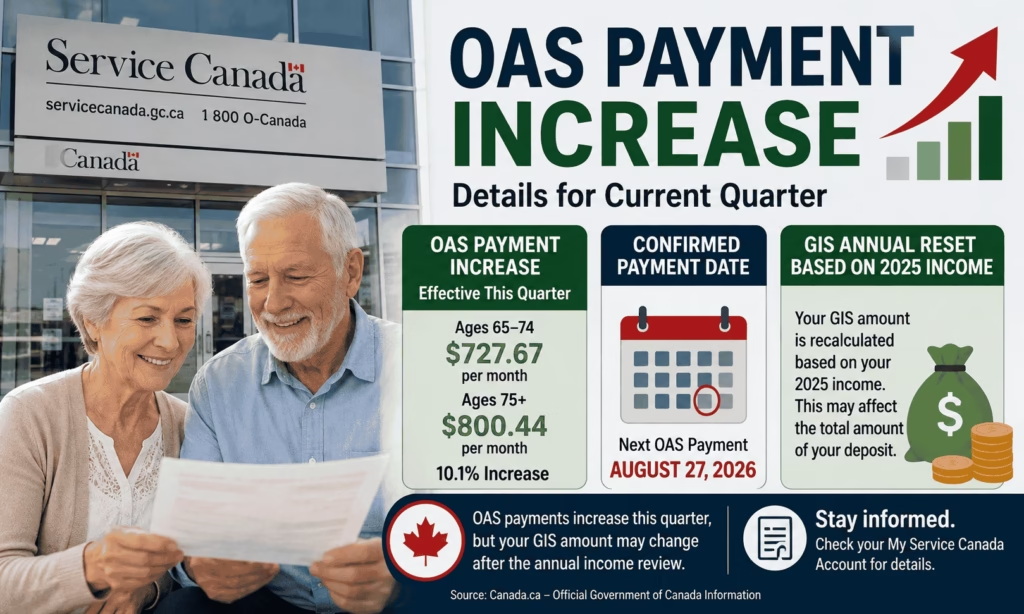
Service Canada confirmed the 1.2% quarterly increase for the July-to-September 2026 period, and this month’s September 25 payment carries that same confirmed rate forward unchanged. Old Age Security benefit amounts are reviewed every quarter, in January, April, July, and October, based on movements in the Consumer Price Index. The 1.2% adjustment applied this quarter was notably larger than the two adjustments earlier in the year, a 0.3% increase in January and just a 0.1% increase in April, making this the most significant single quarterly jump seniors have seen so far in 2026.
OAS Payment Increase September 2026 Key Highlights
| Item | Detail |
|---|---|
| Confirmed payment date | Friday, September 25, 2026 |
| Current quarterly OAS increase | 1.2%, effective July to September 2026 |
| Maximum OAS, ages 65-74 | $751.97 per month |
| Maximum OAS, ages 75+ | $827.17 per month |
| Previous quarter maximum, ages 65-74 | $743.05 per month |
| Previous quarter maximum, ages 75+ | $817.36 per month |
| GIS annual reset basis | Recipient’s completed 2025 tax return |
| GIS reset first applied | July 29, 2026 payment |
| OAS clawback threshold, ages 65-74 | $95,323 to $155,109 net world income |
| OAS clawback threshold, ages 75+ | Up to $161,088 net world income |
| Next confirmed quarterly increase | 1.4%, effective October to December 2026 |
| Remaining 2026 OAS payment dates | October 28, November 26, December 22 |
How OAS Benefit Amounts Actually Get Set Each Quarter
Old Age Security is funded through general tax revenue rather than individual contributions, which means every eligible senior receives the same base pension amount for their age group, unlike CPP, which depends entirely on an individual’s own earnings and contribution history. Because OAS is reviewed quarterly against the Consumer Price Index, the amount can only ever increase or hold steady from one quarter to the next. The Old Age Security Act specifically guarantees that benefits never decrease even if the CPI itself declines, meaning a senior’s pension is protected against any downward cost-of-living adjustment, even during a quarter with falling inflation.
This structure explains why the 1.2% increase confirmed for July through September 2026 applies identically to every OAS recipient in that age bracket, regardless of income, location, or how long they’ve been receiving the pension. The only variable that affects an individual senior’s exact OAS amount, aside from age, is how many years they lived in Canada after turning 18, since a minimum residency period of 40 years is required for the full pension, with a partial pension available after just 10 years of residency, prorated based on actual years lived in the country.
CPP, OAS & GIS September 2026 Payment: New Amounts, 1.2% Increase & Full Payment Details
CalFresh Payment September 2026: Here’s When Your Food Stamps Will Be Loaded
Why the GIS Reset Works Completely Differently From the OAS Increase
This is the part of the payment that catches many recipients off guard every year. Unlike the OAS pension itself, which increases by the same guaranteed percentage for everyone in a given age bracket, the Guaranteed Income Supplement undergoes an individual, income-based recalculation once a year, timed to align with the July quarterly payment. For the current benefit year, that recalculation used each recipient’s completed 2025 tax return rather than their 2024 return, and the effects of that recalculation are still fully in place for this month’s September payment, since GIS amounts remain fixed for the full benefit year until the next annual reset occurs in July 2027.
Two entirely separate things happened to GIS recipients’ deposits back in July, and both remain true for this month’s payment. First, every GIS recipient received the same guaranteed 1.2% quarterly increase that applied to OAS. Second, on top of that guaranteed increase, each recipient’s actual GIS amount was individually recalculated based on how their 2025 income compared to their 2024 income. A senior whose 2025 income dropped, perhaps due to retirement or reduced RRIF withdrawals, could see their GIS rise by considerably more than the standard 1.2%. A senior whose 2025 income rose instead could see their GIS shrink, even while their base OAS pension increased at the same guaranteed rate as everyone else’s.
What a Combined OAS and GIS Payment Looks Like This Month
For a single senior with no other income beyond OAS and GIS, the combined deposit landing this month can reach approximately $1,875 per month, reflecting both the maximum OAS pension and the maximum GIS amount for a single, widowed, or divorced pensioner under the current quarter’s figures. This combined total has remained consistent across the July, August, and September payments, since both the OAS quarterly rate and the GIS annual recalculation were locked in together back in July and carry through the full quarter unchanged.
Seniors receiving both benefits should understand that this combined figure only applies to recipients at or near the maximum GIS threshold, meaning those with very low or no additional income beyond these two federal benefits. Anyone with meaningful outside income, such as CPP, workplace pension income, or investment income, will see a lower GIS portion specifically, since GIS phases out as outside income rises, while the base OAS amount remains the same regardless of income level, aside from the separate clawback that applies only at much higher income thresholds.
H-1B Crackdown Employer Warning Now Covers OPT, PERM and J-1 Hiring Practices
Meta Safety Changes on Instagram and Facebook: What Teens and Parents Need to Know Right Now
OAS Clawback Threshold Also Rolled Forward This Year
Alongside the GIS reset, the OAS recovery tax threshold, commonly called the clawback, also rolled forward to reflect 2025 income for the new repayment year running from July 2026 through June 2027. That threshold currently sits at $95,323 in net world income for seniors aged 65 to 74, with the repayment range extending up to $155,109 before OAS is fully clawed back for that age group. Seniors aged 75 and older have a higher upper threshold of $161,088, reflecting the higher base pension amount that age group receives.
Once the Canada Revenue Agency determines that a recipient’s 2025 net income exceeded the applicable threshold, deductions begin with the July 2026 OAS payment and continue through the June 2027 payment, resetting again the following July based on the recipient’s 2026 tax return. A clawback calculation for an already-finalized recovery period generally cannot be changed retroactively, even if a recipient’s income later turns out to have been temporarily inflated by a one-time event such as a large capital gain, which makes proactive income planning considerably more valuable than trying to correct the calculation after the fact.
Filing Your Taxes on Time Remains the Single Biggest Factor
Every source of guidance on this topic converges on the same point: filing your income tax return on time is the single most consequential action any GIS, Allowance, or Allowance for the Survivor recipient can take. Because Service Canada calculates all three of these income-tested benefits directly from a recipient’s most recently filed tax return, a late filing can suspend payments entirely, not just delay a small adjustment. Anyone who filed their 2025 tax return after the April 30, 2026 deadline should confirm directly with Service Canada that their file has been updated and that payments have resumed at the correct amount, rather than assuming a delayed filing simply corrected itself automatically.
How to Apply for OAS and Have GIS Calculated Correctly?
- Confirm whether you were automatically enrolled in OAS, which many seniors are based on information Service Canada already has on file, typically confirmed through a notification letter sent shortly before turning 65.
- If not automatically enrolled, apply through your My Service Canada Account online or by submitting a paper application, ideally at least six months before you want your pension to begin.
- File your income tax return every year without exception, since both GIS eligibility and the OAS clawback calculation depend entirely on having an accurate, timely tax return on record with the Canada Revenue Agency.
- If your income dropped significantly compared to the prior year, for example due to retirement, contact Service Canada to request an income estimate based on your current-year situation rather than your prior tax return, which can prevent a temporary income spike from unfairly reducing your GIS.
- Set up direct deposit through My Service Canada Account so that both your OAS and GIS amounts arrive together automatically once approved, rather than relying on mailed cheques that can take additional business days to arrive.
- Review your notice of determination each July, since this is the document that confirms your new GIS amount following the annual reset, and flag any discrepancy with Service Canada promptly rather than waiting for the following year’s reset to correct itself.
Processing Time for OAS and GIS Applications
Standard OAS applications submitted online through My Service Canada Account are typically processed within a matter of weeks, though Service Canada continues to recommend applying at least six months ahead of a desired start date to avoid any gap between eligibility and the first payment. GIS applications submitted manually, rather than through automatic enrollment following an OAS approval, can take longer to process, particularly if the applicant’s most recent tax return has not yet been fully processed by the Canada Revenue Agency, since the GIS calculation cannot be finalized without that income data. Seniors who filed their taxes close to the deadline should expect their GIS-related processing, including any annual reset adjustment, to take longer than for those who filed earlier in the tax season.
Payment Schedule Through the End of 2026
OAS, GIS, and the related Allowance benefits share the same payment calendar. Following this month’s September 25 deposit, the remaining confirmed 2026 payment dates are October 28, November 26, and December 22. The October 28 payment is particularly significant, since it will be the first payment reflecting the newly confirmed 1.4% quarterly increase for the October-to-December 2026 period, a larger adjustment than the 1.2% currently in effect. Recipients relying on mailed cheques rather than direct deposit should allow several additional business days beyond the scheduled date before contacting Service Canada about a missing payment.
H-1B Visa Ban Texas Schools: Abbott Wants Exactly Zero Foreign Workers, What Indians Should Know
Social Security Compassionate Allowances List: 14 Conditions Added
Official Resources and Status Check Links
| Resource | Purpose | Official Link |
|---|---|---|
| My Service Canada Account | Apply for OAS, check GIS status, set up direct deposit | canada.ca (My Service Canada Account) |
| Old Age Security Overview | Eligibility rules and current payment amounts | canada.ca/en/services/benefits/publicpensions/cpp/old-age-security |
| Guaranteed Income Supplement Page | GIS eligibility, income thresholds, and reset details | canada.ca (Guaranteed Income Supplement page) |
| OAS Recovery Tax Information | Clawback thresholds and repayment calculation details | canada.ca (OAS recovery tax page) |
| CRA My Account | File taxes and confirm return status affecting GIS | canada.ca (CRA My Account) |
| Service Canada General Inquiries | Phone support for payment and application questions | 1-800-277-9914 |
The Allowance and Allowance for the Survivor Follow the Same Rules
Two related benefits, the Allowance and the Allowance for the Survivor, operate under the same combined mechanism as GIS: they receive the guaranteed quarterly OAS-linked percentage increase, and they also underwent the same individual annual reset in July based on 2025 income. The Allowance is available to lower-income spouses or common-law partners aged 60 to 64 whose partner receives GIS, while the Allowance for the Survivor serves widowed individuals in that same 60 to 64 age range who have not remarried or entered a new common-law relationship.
Both benefits carry maximum monthly amounts that were confirmed alongside the July 2026 quarterly adjustment and remain unchanged through this September payment. Neither the Allowance nor the Allowance for the Survivor requires any Canadian work history, unlike CPP, since eligibility is based purely on age, residency, marital or widowed status, and income, mirroring the structure of GIS itself. Recipients of either benefit stop receiving it the month after they turn 65, at which point they typically transition into receiving the OAS pension directly, along with GIS if their income still qualifies at that point. Anyone approaching that transition age should apply for OAS in advance rather than assuming the switch happens automatically, since a gap between the Allowance ending and OAS beginning can occur if the OAS application is not submitted with enough lead time.
FAQs
Is this month’s OAS payment a new increase from last month?
No. The confirmed 1.2% increase took effect with the July 29, 2026 payment and has carried through unchanged for both the August and September deposits, since OAS adjusts quarterly rather than monthly.
What is the GIS annual reset and when does it happen?
The GIS annual reset is an individual income-based recalculation that occurs once a year, aligned with the July quarterly OAS payment, using each recipient’s most recently completed tax return rather than the standard quarterly cost-of-living increase everyone receives.
Did my GIS change again for the September payment?
No. The GIS amount set during the July annual reset remains fixed through the full benefit year, meaning your September GIS amount matches what you received in July and August unless your circumstances specifically required a mid-year adjustment.
What is the maximum combined OAS and GIS payment for a single senior right now?
A single senior with no other income can receive combined OAS and GIS payments of approximately $1,875 per month under the current quarter’s confirmed maximum amounts.
How does the OAS clawback threshold work this year?
For the July 2026 through June 2027 repayment period, seniors aged 65 to 74 with net world income above $95,323 begin losing part of their OAS pension, with full repayment required once income reaches $155,109, while seniors 75 and older have a higher $161,088 upper threshold.
What happens if I filed my 2025 taxes late?
Late filing can suspend income-tested payments including GIS, the Allowance, and the Allowance for the Survivor, since Service Canada requires a completed, processed tax return to calculate these amounts accurately.
When will OAS increase again after this payment?
The Government of Canada has already confirmed a 1.4% increase for the October-to-December 2026 quarter, which will first appear in the October 28, 2026 payment.
People Also Ask
Why did my GIS go up more than the OAS increase this year?
If your 2025 income dropped compared to 2024, for example due to retirement or reduced retirement account withdrawals, your individual GIS recalculation could add more to your payment than the standard guaranteed quarterly percentage increase applied to OAS alone.
Can I ask Service Canada to use my current income instead of last year’s for GIS?
Yes. If your income decreased due to retirement or the loss of pension income, you can request that Service Canada estimate your current-year income rather than relying on your most recently filed tax return, which can prevent a temporary GIS reduction.
Does deferring OAS increase the payment amount?
Yes. Deferring OAS from age 65 to age 70 permanently increases the monthly benefit by 0.6 percent for each month of delay, up to a maximum increase of 36 percent for life if deferred the full five years.
Is GIS taxable like the OAS pension?
No. GIS, along with the Allowance and the Allowance for the Survivor, is entirely non-taxable and does not count toward the OAS clawback calculation, unlike the OAS pension itself, which is fully taxable income.
Conclusion
This month’s confirmed OAS payment increase reflects the same 1.2% quarterly rate that has now applied consistently across three consecutive deposits, but the more important story for many seniors is the annual GIS reset that quietly reshaped their combined payment back in July and continues carrying through this September deposit unchanged. Recipients who saw their GIS rise or fall by more than the standard percentage should understand that difference as the individual income-based recalculation working as designed, not an error, provided their 2025 tax return was filed accurately and on time. With a larger 1.4% increase already confirmed for October, the next real change to these numbers is only a few weeks away, making this a good moment to confirm your tax filing status and review your My Service Canada Account before the next quarterly adjustment lands.
2027 Social Security COLA: 3.6% Estimate Beats Medicare Hike
IRS Notice 2026-28: New Paid Family Leave Employer Credit Rules