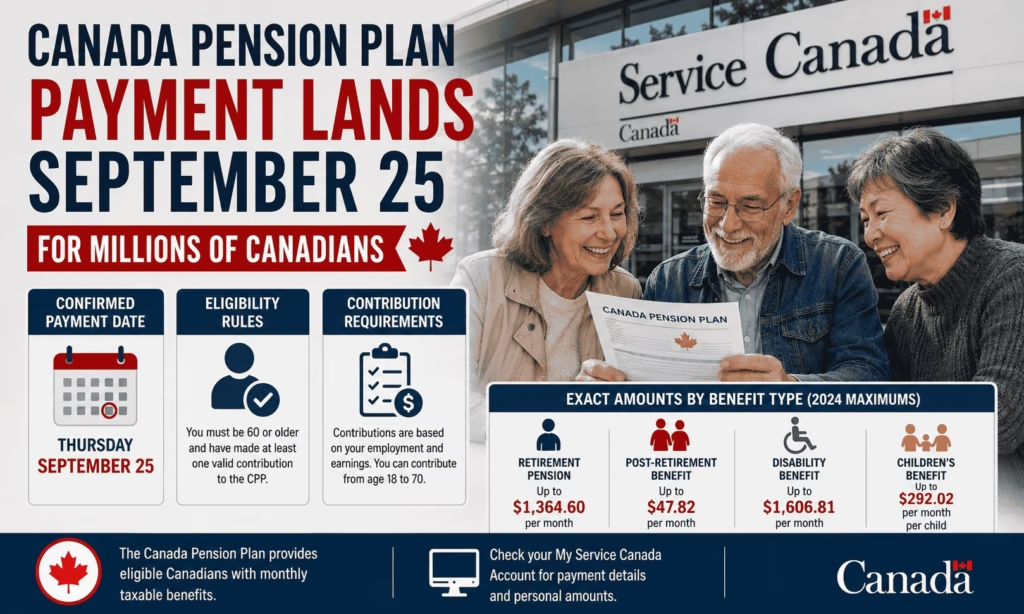
Canada Pension Plan Payment September 2026: Service Canada has confirmed Friday, September 25, 2026 as the payment date for this month’s Canada Pension Plan deposit, sending retirement, disability, survivor, and children’s benefits to millions of Canadians on the same shared schedule. Whether you receive the average retirement pension of just under $1,000, the maximum benefit above $1,500, or one of CPP’s lesser-known categories, the eligibility rules determining who gets paid, and how much, follow a specific structure that catches many first-time applicants off guard. We’ll be updating this article monthly as Service Canada confirms new payment dates and as contribution ceilings adjust for the coming year.
Unlike Old Age Security, which pays a flat amount based on residency alone, the Canada Pension Plan is entirely contribution-based, meaning your payment depends on how much you paid into the system, for how many years, and at what age you start collecting. That structure means two Canadians the same age can receive dramatically different monthly amounts, and it also means CPP covers far more than just retirement, extending to disability, survivor, and dependent children’s benefits that many contributors don’t realize they or their families may already qualify for. Here is the complete breakdown of who qualifies for this month’s Canada Pension Plan payment, exactly how much each benefit category pays, and what determines your specific amount.
Canada Pension Plan Payment Date This Month
CPP is paid on the same date each month according to the federal benefits payment calendar, typically during the last week of the month, and this month that date is September 25, 2026. This date applies uniformly across every CPP benefit category, meaning retirement pension recipients, disability benefit recipients, survivors, and children of deceased or disabled contributors all receive their deposit on this same shared date, regardless of which specific benefit they collect. Recipients enrolled in direct deposit generally see funds available early on the scheduled date, while those still receiving payment by mailed cheque should expect delivery to take several additional business days.
Canada Pension Plan Payment September 2026 Key Highlights
| Item | Detail |
|---|---|
| September 2026 payment date | Friday, September 25, 2026 |
| Minimum qualifying age | 60 years old |
| Core eligibility requirement | At least one valid CPP contribution during working years |
| Maximum monthly retirement pension (new, age 65) | $1,507.65 |
| Average new retirement pension (age 65) | $925.35 |
| 2026 earnings ceiling (YMPE) | $74,600 |
| 2026 basic exemption amount | $3,500 |
| Maximum employee/employer contribution (2026) | $4,230.45 each |
| Maximum self-employed contribution (2026) | $8,460.90 |
| Early pension reduction (per month before 65) | 0.6% |
| Deferred pension increase (per month after 65) | 0.7% |
| CPP disability benefit maximum | $1,741.20 per month |
| Remaining 2026 payment dates | October 28, November 26, December 22 |
Who Actually Qualifies for a CPP Payment
The core eligibility test for any CPP retirement benefit comes down to two straightforward requirements. First, you must be at least 60 years old. Second, you must have made at least one valid contribution to the CPP during your working years. A valid contribution is defined as any contribution made on earnings from employment or self-employment in Canada, outside Quebec, that exceeded the Year’s Basic Exemption of $3,500 and fell at or below the Year’s Maximum Pensionable Earnings, set at $74,600 for 2026. Contributions received through credit splitting after a divorce or separation from a former spouse or common-law partner also count toward meeting this requirement, even for individuals who never worked directly in Canada themselves.
This structure means CPP eligibility is fundamentally different from OAS, which is based purely on Canadian residency rather than contributions. A newcomer to Canada who worked and contributed for even a short period, but has not lived in Canada long enough to qualify for a full OAS pension, may still be entitled to a partial CPP retirement pension based on that limited contribution history. Canadians who worked in both Quebec and another province or territory fall under a coordination arrangement between CPP and the Quebec Pension Plan, since Quebec operates its own separate program administered by Retraite Québec rather than participating in the federal CPP system.
OAS Payment Increase September 2026: Confirmed Amounts, Payment Date, and the Annual GIS Reset !
CPP, OAS & GIS September 2026 Payment: New Amounts, 1.2% Increase & Full Payment Details
How Your Contribution History Determines Your Payment Amount
Once basic eligibility is established, the amount you actually receive depends on several factors working together: your total earnings during your working years, how much you contributed to CPP based on those earnings, how many years you contributed, and critically, the age at which you choose to start receiving payments. For 2026, the contribution rate sits at 11.9% of pensionable earnings, split evenly between employee and employer at 5.95% each, while self-employed individuals must cover the full 11.9% themselves. This results in a maximum 2026 contribution of $4,230.45 for employees and employers each, or $8,460.90 for self-employed contributors covering both portions.
Service Canada also applies several automatic provisions designed to protect your final pension amount from unfairly low-earning periods. The general dropout provision automatically excludes up to eight years of your lowest-income months from the calculation, compensating for any stretch of reduced earnings across your working life. The child-rearing provision separately protects parents by excluding months where earnings dropped specifically because they were caring for a child under age 7. A third protection, the disability dropout, covers any months during which you received a CPP disability pension, ensuring that period doesn’t drag down your eventual retirement pension calculation.
The Age Decision: Starting at 60, 65, or Deferring to 70
Because CPP allows contributors to begin collecting as early as 60 or as late as 70, the age decision has a direct and permanent effect on the monthly amount received. Starting your pension before age 65 reduces the amount by 0.6% for every month prior to your 65th birthday, which works out to a full 36% reduction if you start at exactly age 60. Conversely, deferring your pension past 65 increases the amount by 0.7% for every month of delay, up to a maximum 42% increase if you wait until age 70. This means the exact same contribution history can produce meaningfully different monthly payments purely based on the start date a recipient chooses, making this one of the most consequential decisions in the entire CPP application process.
Working while collecting CPP does not reduce your existing pension amount. In fact, contributors between ages 60 and 70 who continue working while receiving CPP may also qualify for the Post-Retirement Benefit, an additional amount added automatically the following year based on continued contributions. Contributions toward this benefit become optional at age 65 and stop entirely at age 70, even for contributors who remain employed past that age.
Beyond Retirement: Disability, Survivor, and Children’s Benefits
CPP extends well past the standard retirement pension most Canadians associate with the program, and several related benefits pay out on this same September 25 schedule. The Canada Pension Plan disability benefit provides up to $1,741.20 per month for contributors with a severe and prolonged medical condition that prevents them from working regularly. This benefit combines a flat-rate portion, paid identically to every approved recipient, with an additional earnings-related component calculated from the individual’s specific contribution history, meaning two disability recipients can receive different total amounts even while sharing the same flat-rate base.
The survivor’s pension provides ongoing support to a deceased contributor’s surviving spouse or common-law partner, with the amount varying depending on whether the survivor is younger or older than 65 at the time payments begin. A separate children’s benefit provides monthly payments to the dependent children of a deceased or disabled contributor, whether the child is under 18 or a full-time student, continuing to support the household even after the contributing parent can no longer work or has passed away.
CalFresh Payment September 2026: Here’s When Your Food Stamps Will Be Loaded
2027 Social Security COLA: 3.6% Estimate Beats Medicare Hike
CPP Pension Sharing and Credit Splitting for Couples
Two related provisions allow couples to redistribute CPP amounts between partners, though they work in entirely different circumstances. CPP pension sharing is available to couples who are still together, provided both partners are at least 60 years old, both are currently living together, and at least one is already receiving a CPP retirement pension. There is no income test for this arrangement, and the amount that can be shared is based on the overlapping cohabitation period relative to each partner’s total contributory period, effectively allowing higher-earning and lower-earning spouses to balance out their combined tax position.
Credit splitting, by contrast, applies specifically after a separation or divorce, dividing the CPP contribution credits earned during the period of cohabitation between former partners, regardless of whether either party has started collecting a pension yet. This is an entirely different mechanism from pension sharing, since credit splitting permanently reassigns contribution history itself rather than simply redirecting an existing monthly payment, and it can be requested by either former partner even years after a separation occurred.
How to Apply for CPP
- Confirm your basic eligibility, meaning you are at least 60 years old and have made at least one valid CPP contribution during your working years.
- Log into your My Service Canada Account to view your Statement of Contributions, which shows your full CPP contribution history and provides a personalized benefit estimate under “View my benefit estimates.”
- Decide on your intended start date, factoring in the permanent reduction for starting before 65 or the permanent increase for deferring past 65.
- Submit your application through My Service Canada Account or by paper application, since CPP retirement benefits are never paid automatically and must be actively applied for.
- Apply well in advance of your desired start date, since Service Canada recommends submitting your application early enough to avoid any gap between your intended start date and your first actual payment.
- If applicable, request credit splitting following a separation or divorce, or apply for pension sharing with a current spouse or common-law partner, using the specific forms Service Canada provides for each arrangement.
Processing Time for CPP Applications
CPP retirement pension applications submitted online through My Service Canada Account are generally processed within a matter of weeks, though Service Canada continues to advise applying well ahead of your intended start date to avoid any interruption in payments. Applications involving more complex circumstances, such as credit splitting following a separation, pension sharing between spouses, or disability benefit applications requiring medical documentation, typically take longer to process than a standard retirement pension application, since additional verification and, in the case of disability claims, medical adjudication is required before a decision can be issued.
Payment Schedule for the Rest of 2026
Following this month’s September 25 deposit, the remaining confirmed CPP payment dates for 2026 are October 28, November 26, and December 22. These dates apply identically across every CPP benefit category, from standard retirement pensions through disability, survivor, and children’s benefits, since Service Canada issues all CPP payment types on the same shared monthly schedule. Recipients relying on mailed cheques rather than direct deposit should allow several additional business days beyond each scheduled date before contacting Service Canada about a payment that has not yet arrived.
Social Security Compassionate Allowances List: 14 Conditions Added
IRS Notice 2026-28: New Paid Family Leave Employer Credit Rules
Official Resources and Status Check Links
| Resource | Purpose | Official Link |
|---|---|---|
| My Service Canada Account | Apply for CPP, view Statement of Contributions, check benefit estimates | canada.ca (My Service Canada Account) |
| CPP Retirement Pension Overview | Full eligibility rules and application details | canada.ca/en/services/benefits/publicpensions/cpp |
| CPP Disability Benefit Page | Eligibility and application process for disability benefits | canada.ca (CPP disability benefit page) |
| CPP Survivor’s Pension Information | Eligibility rules for surviving spouses and common-law partners | canada.ca (CPP survivor’s pension page) |
| Canadian Retirement Income Calculator | Estimate total retirement income across CPP, OAS, and savings | canada.ca (CRIC tool) |
| Service Canada General Inquiries | Phone support for payment and application questions | 1-800-277-9914 |
| Retraite Québec | For contributors covered under the Quebec Pension Plan instead of CPP | retraitequebec.gouv.qc.ca |
CPP for Canadians Who Worked Abroad
Contributors who spent part of their career working outside Canada should be aware that Canada has social security agreements with numerous other countries specifically designed to help fill gaps in eligibility. These agreements generally allow periods of contribution or residence in a partner country to count toward meeting the minimum requirements for both CPP and OAS, even though the actual benefit payment amount is still calculated based only on the contributions made within Canada. This matters most for immigrants who arrived in Canada later in their working life, or for Canadians who spent years working overseas before returning, since without this coordination some contributors could otherwise fall short of qualifying for a benefit despite having made valid contributions during their time in Canada. Anyone in this situation should specifically ask Service Canada whether a relevant international agreement applies to their circumstances when submitting a CPP application, since this detail is not always surfaced automatically during a standard online application.
The Post-Retirement Benefit Explained
For contributors who continue working after starting their CPP retirement pension, the Post-Retirement Benefit adds a meaningful, if often overlooked, layer of additional income. Each year a valid contribution is made while already receiving a CPP retirement pension generates a separate Post-Retirement Benefit, paid automatically starting in January of the following year, without requiring a new application. Because this benefit accumulates annually, a contributor who works and contributes for several years after starting CPP can build up multiple stacked Post-Retirement Benefit amounts over time, each one added on top of the base retirement pension. Contributions toward this benefit become optional once a recipient turns 65, giving working retirees the choice to opt out and stop contributing, while contributions stop entirely and automatically once a recipient reaches age 70, regardless of continued employment.
FAQs About Canada Pension Plan Payment September 2026
When is the Canada Pension Plan payment date this month?
Service Canada confirmed Friday, September 25, 2026 as this month’s CPP payment date, applying to retirement, disability, survivor, and children’s benefits alike.
Who is eligible to receive CPP?
Anyone at least 60 years old who has made at least one valid CPP contribution during their working years, either through employment or self-employment earnings, or through credits received via credit splitting after a separation or divorce, qualifies for CPP.
How much is the maximum CPP payment in 2026?
The maximum new CPP retirement pension for someone starting at age 65 in 2026 is $1,507.65 per month, though the average new retirement pension is considerably lower at $925.35 per month.
Does starting CPP at 60 permanently reduce my payment?
Yes. Starting CPP before age 65 reduces the monthly amount by 0.6% for every month prior to 65, resulting in a 36% permanent reduction if started at exactly age 60.
Can I still work while receiving CPP?
Yes. Working while receiving CPP does not reduce your existing pension, and contributors between 60 and 70 who keep working may qualify for an additional Post-Retirement Benefit added automatically the following year.
What is the difference between CPP pension sharing and credit splitting?
Pension sharing applies to couples who are still together and redirects an existing monthly payment between partners, while credit splitting applies after a separation or divorce and permanently divides the underlying contribution credits themselves.
Do I need to apply for CPP, or is it automatic?
You must actively apply for CPP retirement benefits through My Service Canada Account or by paper application, since CPP retirement pensions are never paid out automatically, unlike some OAS enrollments.
People Also Ask
Is CPP the same across all of Canada?
No. CPP applies in every province and territory except Quebec, which operates its own separate but coordinated program called the Quebec Pension Plan, administered by Retraite Québec rather than the federal government.
How many years do I need to contribute to CPP to get the maximum amount?
Reaching the maximum CPP retirement pension generally requires contributing at or above the Year’s Maximum Pensionable Earnings for at least 39 years between ages 18 and 65.
What happens to my CPP contributions if I never claim the pension?
CPP contributions are never lost, since even a single valid contribution establishes eligibility, and the pension amount simply reflects however much was contributed over a working lifetime, however brief.
Can a surviving spouse receive both their own CPP and a survivor’s pension?
Yes, a surviving spouse who has their own CPP retirement pension can also receive a survivor’s pension, though combined amounts are subject to a maximum limit set by Service Canada rather than being added together without restriction.
Conclusion
This month’s Canada Pension Plan payment on September 25 reaches millions of Canadians across retirement, disability, survivor, and children’s benefit categories, but the amount each person receives ultimately traces back to a highly individual contribution history rather than a flat, guaranteed figure. Understanding the core eligibility rule, at least 60 years old with one valid contribution, is only the starting point; the real determinant of your monthly payment is how much and how long you contributed, combined with the age at which you choose to start collecting. Anyone unsure of their own numbers should check their Statement of Contributions through My Service Canada Account well before applying, since that single step provides the clearest picture of what to actually expect on your own CPP payment date.
Also Read :-
Social Security SSI Payment Date September 2026 Confirmed by SSA- Check Full Schedule here!
Trump Accounts Dell $250 Grant: Check State & ZIP Code Eligibility
Canada 50% Tariff 2026: 700 US Goods Hit With Tariffs Up to 50% From September 8