Diesel Prices Impact on Food Stamps: Diesel prices crossed $6 a gallon nationally on Friday for the first time in U.S. history, and while that milestone has mostly been framed as a trucking and gas-pump story, it’s quietly becoming a food stamps problem too. The Supplemental Nutrition Assistance Program sets a fixed maximum benefit $994 a month for a family of four in fiscal year 2026 — that doesn’t move when diesel spikes. But the groceries that $994 is meant to buy are getting more expensive specifically because of diesel, since the fuel powers the trucks, trains, and farm equipment behind nearly everything on a grocery shelf. The result is a diesel prices impact on food stamps squeeze that’s arriving quietly, through slowly rising price tags, rather than through any single dramatic cut.
According to AAA, the national average for diesel hit $6.05 a gallon on Friday, up from $5.85 a week earlier and roughly $3.71 at this time last year an increase of more than 60% since the U.S.-Iran war began in late February 2026. The Independent Grocers Alliance, representing 7,500 supermarkets globally, estimates that fuel accounts for roughly 15% to 30% of the total cost of food, meaning a sustained diesel spike this large doesn’t stay confined to the trucking industry it works its way directly into the grocery bill that SNAP dollars are meant to cover. For the roughly 42 million Americans who rely on SNAP, a benefit amount that looked adequate in February may already be buying noticeably less by the time diesel-driven food inflation fully works through the supply chain. We’ll be updating this article monthly as diesel prices, food inflation data, and SNAP benefit levels continue to develop.
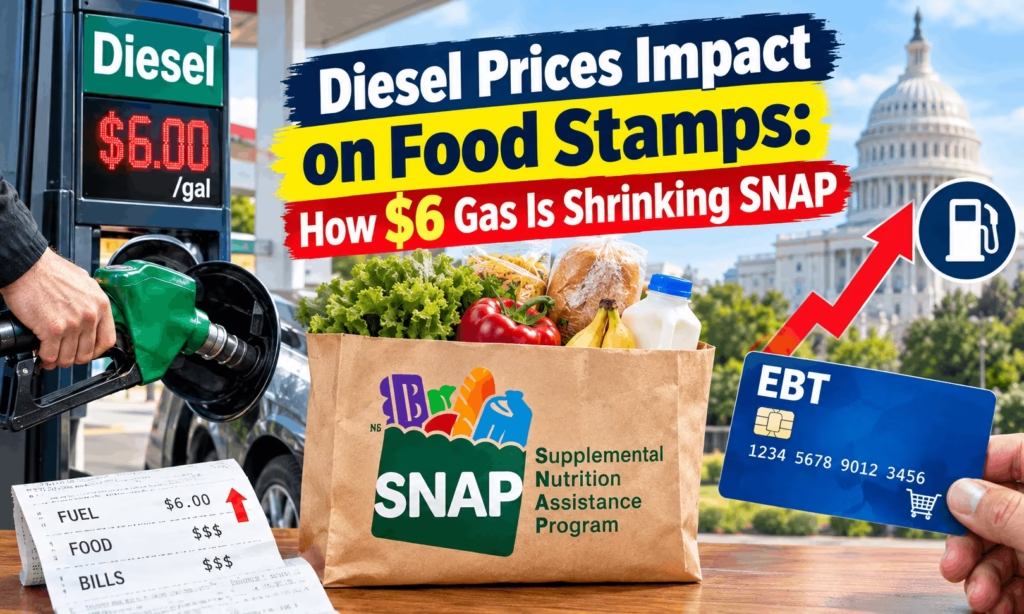
Diesel Prices Impact on Food Stamps: Why the Connection Is So Direct
Diesel isn’t a fuel most SNAP households pump into their own cars, but it’s the fuel that moves almost everything they buy at the grocery store. Tractors and combines run on diesel to plant and harvest crops. Refrigerated trucks run on diesel to haul perishables from farms and processing plants to distribution centers. Freight trains and cargo ships, which move a large share of the country’s packaged and imported food, also depend heavily on diesel. Michigan State University food economist David Ortega has explained that because the majority of food transported within the U.S. moves by truck, higher diesel costs translate into higher costs throughout the entire supply chain, eventually reaching the consumer at the checkout counter.
USDA data shows that energy, transportation, and storage costs together account for more than 7% of total food costs nationally a figure that rises sharply for perishable items requiring refrigeration and frequent restocking. That’s exactly the category SNAP households depend on most for balanced nutrition: fresh produce, meat, dairy, and seafood. Because these goods move quickly through the supply chain and can’t be stockpiled the way shelf-stable goods can, they tend to be among the first to show diesel-driven price increases at the register.
Diesel Prices Impact on Food Stamps Key Highlights
| Detail | Information |
|---|---|
| National average diesel price | $6.05–$6.06 a gallon (as of September 11–12, 2026) |
| Diesel price one week earlier | $5.85 a gallon |
| Diesel price one year earlier | Approximately $3.71 a gallon |
| Diesel price increase since Iran war began (Feb 2026) | More than 60% |
| Fuel’s share of total food cost | 15%–30% (Independent Grocers Alliance) |
| Energy/transport/storage share of food costs | Over 7% (USDA) |
| USDA “food at home” inflation forecast for 2026 | 3.1% (nearly double the earlier-year projection) |
| Seafood price increase (year-over-year, July 2026) | +7% |
| Fresh fruit price increase (year-over-year, July 2026) | +4.9% |
| Overall grocery inflation (year-over-year, July 2026) | +2.7% |
| SNAP maximum benefit, family of four (FY2026) | $994/month — a fixed amount that doesn’t adjust for short-term fuel or food inflation spikes |
SNAP Maximum Benefit 2026 Family of Four: Full $994 Payment Chart
Social Security Government Shutdown 2026: Will Your Check Still Arrive?
Which Grocery Items Are Most Exposed to Rising Diesel Costs
Not every item on a grocery shelf reacts to diesel prices the same way. Purdue University food economist Bernhard Dalheimer has noted that goods requiring extensive refrigeration and long transport routes — vegetables, meat, and dairy — are the most exposed to diesel-driven cost increases, since those items require both fuel-intensive cold-chain logistics and frequent restocking. Shelf-stable, packaged goods tend to feel the effect more slowly, since they can be shipped in bulk and stored longer before diesel surcharges get built into pricing.
That distinction matters enormously for SNAP households specifically, since the program is designed to help families afford a nutritionally balanced diet built around exactly those perishable categories — fresh produce, meat, dairy, and seafood — rather than shelf-stable staples alone. If those categories are the ones absorbing the steepest diesel-driven increases, SNAP recipients may feel a proportionally larger squeeze than households buying a different overall mix of groceries.
Grocery Categories Most Exposed to Diesel Price Increases
| Category | Why It’s Exposed | Recent Price Trend |
|---|---|---|
| Fresh produce | Frequent restocking, refrigerated transport, diesel-powered harvesting equipment | Fresh fruit up 4.9% year-over-year (July 2026) |
| Seafood | Long refrigerated transport routes, fishing boats also run on diesel | Up 7% year-over-year (July 2026) |
| Meat and dairy | Cold-chain logistics, frequent delivery cycles | Rising faster than shelf-stable goods |
| Packaged/shelf-stable goods | Can be shipped in bulk, stored longer | Slower to reflect diesel cost increases |
Why the Price Increases Take Time to Reach the Register
One reason the full effect of $6 diesel hasn’t hit every grocery bill immediately is that much of the initial cost gets absorbed elsewhere in the supply chain before it reaches consumers. According to Ortega, early cost increases are typically absorbed through existing freight contracts and retailer profit margins rather than passed straight through to shoppers. But as those contracts come up for renewal and fuel surcharges take hold, a larger share of the increase begins showing up on store shelves — meaning the grocery price effects of today’s record diesel prices may still be building even weeks or months from now, well after this news cycle fades.
That lag creates a particular risk for SNAP households: because the program’s maximum benefit is set once per federal fiscal year based on the Thrifty Food Plan’s cost estimate at the time, it doesn’t automatically adjust mid-year if diesel-driven food inflation accelerates faster than expected after the annual figure is locked in. The $994 maximum for a family of four was set based on food cost data collected before this diesel spike reached its current record levels, meaning the real purchasing power of that fixed dollar amount could continue eroding for months before the next scheduled COLA adjustment in October 2026.
How Much Weaker Is $994 Getting in Real Terms?
USDA’s own forecast illustrates the scale of the problem. The department’s latest projection puts 2026 “food at home” inflation at 3.1%, nearly double the roughly 1.6% pace it had projected at the start of the year — a revision driven in significant part by the war-related spike in oil and diesel prices. If grocery costs rise 3.1% over the course of a year while a household’s SNAP allotment stays fixed at $994, that household is effectively losing roughly $30 a month in real purchasing power by year’s end, even though the dollar figure on their EBT card hasn’t changed at all.
For households buying a diet weighted more heavily toward the categories seeing the steepest increases — seafood at 7% and fresh fruit at nearly 5% — the real-world erosion in purchasing power could be considerably steeper than the 3.1% headline figure suggests, since those two categories alone are running well above the broader grocery inflation average.
Federal Employees Back Pay Shutdown 2026: Are You Guaranteed to Get Paid?
SNAP Purchasing Power Calculator
Because SNAP’s maximum benefit doesn’t automatically adjust for a mid-year spike in diesel-driven food inflation, it helps to see exactly how much real purchasing power a fixed benefit loses as grocery prices climb. Use this calculator to estimate how far your SNAP benefit is falling behind rising food costs. This is a planning estimate only, not an official benefit calculation.
What’s Driving the Diesel Spike Behind This Squeeze
The diesel price surge tracing back to this food-cost pressure stems from a combination of two major disruptions hitting the global fuel supply at once. The ongoing war between the U.S., Israel, and Iran has bottlenecked tanker traffic through the Strait of Hormuz, a critical Middle East oil shipping route, cutting into global crude supply. At the same time, Ukrainian strikes on Russian oil refineries have nearly halted a major source of the world’s refined fuel exports. With both a key export route and a major refining hub disrupted simultaneously, diesel — which was already running on thin global inventories before the war began — has been squeezed from two directions at once, pushing it up faster than gasoline, which stood at $4.29 a gallon on the same day diesel crossed $6.
Could SNAP Benefits Be Adjusted to Account for This?
Under current rules, SNAP’s maximum benefit is recalculated once per federal fiscal year using the Thrifty Food Plan, a USDA-calculated estimate of the cost of a nutritionally adequate diet. That annual cycle isn’t designed to respond quickly to a sudden, war-driven fuel price spike happening mid-year — the next scheduled adjustment won’t take effect until October 1, 2026, when FY2027 amounts raise the family-of-four maximum to $1,023. Whether that scheduled increase will be enough to offset the accumulated effects of this year’s diesel-driven food inflation is an open question, since the FY2027 figure was calculated using food cost data that may not fully capture the extent of the fuel spike that unfolded through the summer and into September.
Advocacy groups and some lawmakers have previously called for more responsive, mid-year benefit adjustments during periods of unusually rapid food inflation, though no such emergency adjustment mechanism currently exists in SNAP’s standard structure. Barring new legislation, SNAP households are likely to feel the accumulated effects of this diesel spike for the remainder of the current fiscal year before any benefit adjustment takes effect.
How SNAP Households Can Stretch Their Benefit Further
While the maximum benefit amount itself is fixed, there are a few practical strategies SNAP households can use to reduce the impact of rising diesel-driven food costs. Buying shelf-stable staples in bulk when on sale can help avoid some of the price volatility hitting frequently-restocked perishables, since packaged goods tend to reflect fuel cost increases more slowly. Shopping at stores that source produce regionally, where transport distances and diesel exposure are lower, can also reduce exposure to the steepest price increases. Food banks and local nonprofit food assistance programs can help supplement a stretched grocery budget, particularly for perishable categories like fresh produce and dairy that are seeing some of the sharpest increases.
Republican Convention 2026: Trump’s Biggest Asset or Obstacle for the GOP?
Government Shutdown October 2026 Averted — Funding Runs to Dec 11
Official Resources for SNAP and Food Cost Information
| Resource | Purpose | Link |
|---|---|---|
| USDA Food and Nutrition Service | Official SNAP benefit levels and program updates | https://www.fns.usda.gov/snap |
| State SNAP Office Directory | Find your state’s SNAP application and login portal | https://www.fns.usda.gov/snap/state-directory |
| USDA Economic Research Service | Food price outlook and inflation forecasts | https://www.ers.usda.gov/data-products/food-price-outlook |
| U.S. Energy Information Administration | Track current diesel and gasoline prices | https://www.eia.gov/petroleum/gasdiesel |
| Feeding America | Locate a food bank near you | https://www.feedingamerica.org |
FAQs About Diesel Prices Impact on Food Stamps
How do diesel prices affect food stamps and SNAP benefits?
Diesel prices don’t change the dollar amount of a SNAP benefit directly, but they raise the cost of the groceries that benefit is meant to buy, since diesel powers the trucks, trains, and farm equipment behind most food transportation and production.
Why are diesel prices at a record high right now?
Diesel crossed $6 a gallon for the first time due to a combination of the U.S.-Iran war disrupting Middle East oil shipping routes and Ukrainian strikes on Russian oil refineries, both of which have tightened the global fuel supply.
Will SNAP benefits increase because of rising diesel and food prices?
Not automatically. SNAP’s maximum benefit is recalculated once per fiscal year using the Thrifty Food Plan. The next scheduled increase takes effect October 1, 2026, raising the family-of-four maximum to $1,023, though it may not fully reflect the diesel-driven food inflation seen this year.
Which groceries are most affected by rising diesel prices?
Perishable items requiring refrigeration and frequent restocking — fresh produce, meat, dairy, and seafood — tend to be the most exposed, since they depend heavily on fuel-intensive cold-chain transport.
How much has grocery inflation increased because of the diesel price spike?
USDA projects 2026 “food at home” inflation at 3.1%, nearly double its earlier forecast, with seafood up 7% and fresh fruit up nearly 5% year-over-year as of July 2026.
Is gasoline rising as fast as diesel because of the Iran war?
No. Regular gasoline was averaging $4.29 a gallon on the same day diesel crossed $6, a smaller percentage increase than diesel has seen, since diesel is more directly tied to freight, farming, and industrial transport.
What can SNAP households do if their benefit isn’t stretching as far?
Buying shelf-stable staples in bulk, shopping for regionally sourced produce, and using local food banks for perishable items can help offset some of the impact until the next scheduled SNAP benefit adjustment.
Conclusion
The diesel prices impact on food stamps may not show up as a single dramatic headline, but it’s arguably one of the more consequential effects of this year’s record fuel prices, since it hits a population that’s already budgeting every dollar of a fixed, federally set benefit. With diesel now above $6 a gallon and USDA projecting accelerating food inflation for the rest of 2026, SNAP’s $994 maximum benefit for a family of four is likely losing real purchasing power well before the next scheduled increase arrives in October. Whether that scheduled bump to $1,023 will be enough to catch up depends largely on how much further diesel prices climb — or fall — in the meantime, and on how quickly today’s fuel costs continue working their way through the supply chain and onto grocery store shelves. We’ll be updating this article monthly as diesel prices, food inflation data, and SNAP benefit levels continue to develop.
Trump Tariff Dividend Check Tracker: Is the $2000 Coming?
Trump $5000 Dividend Check: Latest Update on Cost, Eligibility and Payment Date