
Ten months after President Trump first promised a tariff dividend check of at least 2,000 dollars for most Americans, not a single household has received one, no bill authorizing it has passed either chamber of Congress, and the tariff program that was supposed to pay for it has already been struck down once by the Supreme Court and expired a second time by statute. That is not a partisan talking point, it is the plain paper trail, and this week marks a fitting moment to lay it out in full, since the Section 122 tariff that briefly replaced the president’s original tariff authority is now gone too, leaving the funding question murkier than it has been at any point since the promise was first made. We’ll be updating this article monthly as new legislation, court rulings, or Treasury announcements move this story forward.
The $2,000 tariff dividend has survived roughly ten months of shifting explanations, three separate pieces of legislation stuck in committee, a 6-3 Supreme Court defeat for the underlying tariffs, and a prediction market that now puts its odds of happening this year at effectively zero. Yet the promise itself has never been formally withdrawn, and the president has continued to reference it as recently as this year’s cabinet meetings. This tracker lays out, promise by promise and date by date, exactly what was said, what has actually happened, and what remains only a proposal, drawing a clear line between the one dividend payment that was genuinely delivered and the household check that, as of this week, still does not exist in any form Treasury or the IRS could act on.
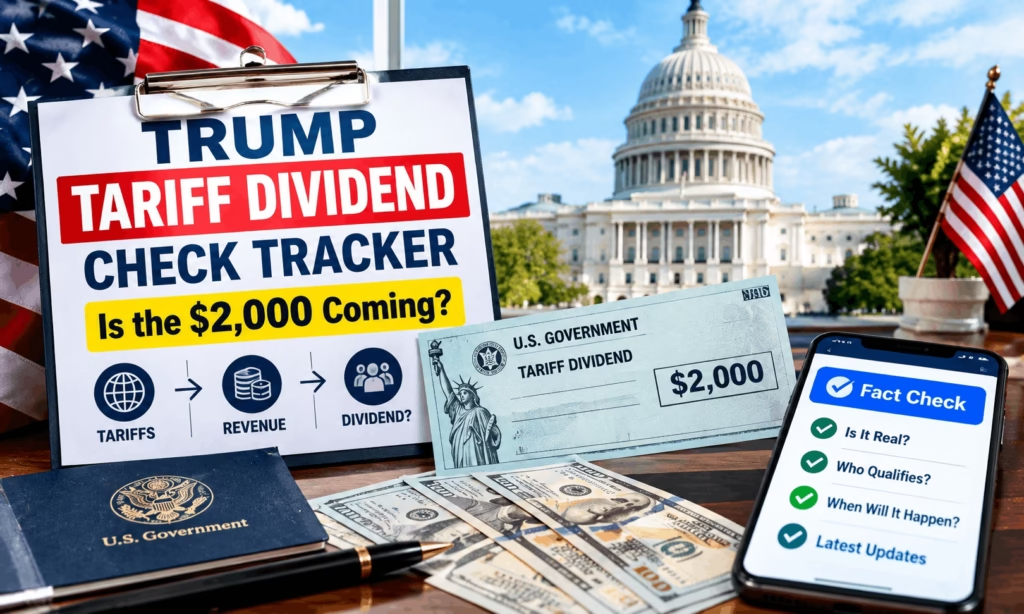
Key Highlights: Tariff Dividend Promise Tracker
| Promise or Milestone | Date Made or Occurred | Current Status |
|---|---|---|
| Original $2,000 dividend promise | November 9, 2025, via Truth Social | Not delivered, no legislation passed |
| “Warrior Dividend” of $1,776 to service members | Announced December 18, 2025 | Delivered, funded by the Defense Department |
| Hassett says proposal coming to Congress | December 21, 2025, on Face the Nation | Proposal never formally introduced by the administration |
| Supreme Court strikes down IEEPA tariffs | February 20, 2026, 6-3 ruling | Original tariff funding source eliminated |
| Section 122 replacement tariff imposed | February 24, 2026 | Expired by statute July 24, 2026 |
| American Worker Rebate Act (Hawley) | Introduced July 2025 | Still in Senate Finance Committee |
| Tariff Refunds for Working Families Act (Heinrich) | Introduced March 2026 | Still in committee |
| Trump Tariff Rebate Act (House) | Introduced 2026 | Still in committee, no floor vote |
| Prediction market odds of dividend in 2026 | Polymarket, checked this year | Fell to roughly 3 percent |
How the Tariff Dividend Promise Started
The promise traces back to a pair of Truth Social posts on November 9, 2025. Responding to criticism of his tariff policy, President Trump wrote that “people that are against Tariffs are FOOLS” and pointed to record stock market levels and low inflation as evidence his trade agenda was working. In the same string of posts, he added the line that would define the next ten months of coverage: “A dividend of at least $2000 a person (not including high income people!) will be paid to everyone.” Hours later that same day, Treasury Secretary Scott Bessent was asked about the idea on ABC’s “This Week” and said he had not yet spoken with the president about it directly, though he noted it “could come in lots of forms,” including possibly as tax reductions rather than a direct check.
The promise gained more specificity a few weeks later. At a cabinet meeting on December 2, 2025, Trump told reporters that “next year is projected to be the largest tax refund season ever, and we’re going to be giving back refunds out of the tariffs, as we have taken in literally trillions of dollars.” He added that the government would be “giving a nice dividend to the people in addition to reducing debt.” At the same meeting, he dismissed skepticism about the plan’s feasibility as a “Democrat scam.”
How The 2026 Midterms Could Affect Your SNAP, Medicaid & Social Security Benefits
H-1B Families Leaving US Homes and Cars Behind to Return to India? See Viral Post
The One Dividend That Actually Shipped
Before any household tariff dividend materialized, the administration did deliver a related but narrower payment. On December 18, 2025, Trump announced that 1.45 million active-duty service members would receive a one-time 1,776 dollar payment, branded the “Warrior Dividend,” before Christmas. Unlike the proposed household tariff dividend, this payment did not require new congressional appropriation. The Pentagon confirmed the Defense Department supplied the funding directly, meaning it moved through existing military budget authority rather than the tariff revenue stream Trump had described for the broader public payment. This is the only dividend-branded payment from this entire saga that reached actual bank accounts, and it is worth separating clearly from the $2,000 tariff dividend, since the two are frequently conflated in social media discussion despite being funded through completely different mechanisms.
Why the Household Tariff Dividend Has Not Happened
The Legal Foundation Collapsed
The most consequential setback came from the courts rather than Congress. On February 20, 2026, the Supreme Court ruled 6-3 in a case brought against the administration’s tariff authority, finding that the International Emergency Economic Powers Act, or IEEPA, does not authorize a president to impose tariffs the way the administration had used it throughout 2025. Chief Justice Roberts wrote that reading the law’s power to “regulate” imports as including a taxing power would render the statute unconstitutional. Customs and Border Protection stopped collecting IEEPA tariffs within hours of the ruling, and roughly 166 billion dollars in previously collected IEEPA duties became legally entangled in an active refund process, the opposite of new revenue that could fund a household check.
Within days, on February 24, 2026, the administration pivoted to a different legal authority, imposing a flat 10 percent global tariff surcharge under Section 122 of the Trade Act of 1974, a statute last used by President Nixon in 1971. But Section 122 carries a hard statutory limit of 150 days unless Congress votes to extend it, and Congress did not. The surcharge expired automatically at 12:01 a.m. Eastern on July 24, 2026, and a narrower Section 301 tariff structure, applying a 10 to 12.5 percent rate to roughly 60 countries, took its place the same day. That newer tariff stream was never part of the original dividend proposal and generates meaningfully less revenue than the tariffs Trump originally cited when he floated the 2,000 dollar figure.
The Math Never Actually Worked
Independent of the legal turmoil, the numbers behind the promise were disputed from the start. The Yale Budget Lab estimated that a one-time 2,000 dollar rebate for individuals earning under 100,000 dollars a year would cost roughly 450 billion dollars, close to double the total tariff revenue the administration was projected to collect in 2026 under the tariffs that existed at the time. Separately, the Congress’s Joint Economic Committee minority estimated that tariffs were already costing the average household closer to 2,500 dollars a year in higher prices, a figure critics have pointed to as evidence that any dividend check would functionally just be returning money households had already paid out through higher costs at the register, rather than representing new found revenue.
No Bill Has Actually Passed
Three separate pieces of legislation touching on the tariff dividend concept have been introduced in Congress, and all three remain stuck in committee as of this week. Senator Josh Hawley introduced the American Worker Rebate Act in July 2025, proposing 600 dollars per adult and dependent, up to 2,400 dollars for a family of four, a considerably smaller figure than Trump’s original 2,000 dollar per person promise. Senator Martin Heinrich introduced the Tariff Refunds for Working Families Act in March 2026, proposing 1,200 dollars for joint filers earning under 180,000 dollars plus 600 dollars per dependent child, again smaller and narrower than the original pledge. A House version, referred to as the Trump Tariff Rebate Act, has also been introduced but has not advanced to a floor vote in either chamber. None of the three bills would deliver the exact 2,000 dollar per person, no strings attached figure the president originally promised, and none has moved beyond committee review.
White House National Economic Council Director Kevin Hassett laid out the actual legal requirement clearly in a December 21, 2025 appearance on CBS News’ “Face the Nation.” Asked how the dividend would work, Hassett said, “we collect taxes, we collect tariffs, we collect revenue from lots of places, and then Congress decides what to do with the money. That’s an appropriation, and this would have to be approved by Congress.” He said he expected the president would bring forth a formal proposal to Congress in early 2026. As of this update, no such formal administration-drafted proposal has been introduced as standalone legislation, and the three bills that do exist all originated from individual senators or House members rather than the White House itself.
Gas Tax Holiday 2026: Which States Are Giving Drivers Relief Right Now
Where Things Actually Stand This Week
Heading into fall, the funding picture behind the dividend promise has gotten weaker rather than stronger. The Section 122 tariff that briefly generated the revenue Trump pointed to has lapsed, the Section 301 tariffs that replaced it were never part of the original proposal, and the Supreme Court’s ruling on IEEPA remains the operative legal precedent limiting how far executive tariff authority can stretch without congressional approval. Treasury and the IRS have not announced a payment schedule, an application process, or an eligibility list for any household tariff dividend, because none of those administrative structures currently exist for a program that has no underlying law. Financial analysts who were skeptical from the beginning have grown more confident in that skepticism over time. Bankrate’s Stephen Kates, who called the tariff dividend “a long shot from the beginning,” told CNBC earlier this year that “the odds of this policy moving forward is now effectively zero.”
That said, the promise has never been formally withdrawn by the president or the White House, and Trump has continued to reference the idea of returning tariff money to Americans in public remarks through the year, including tying it at various points to expanded health savings accounts and to paying down the national debt as alternative uses for the same revenue. That inconsistency, three different destinations floated for the same pool of money within a matter of weeks, is itself part of why independent analysts have struggled to treat the promise as a concrete policy proposal rather than a recurring talking point.
How to Check Your Own Status
How to Verify If You Are Eligible
There is currently no eligibility list to check against, since no household tariff dividend program has been enacted into law. The only verified way to confirm your status is to check whether any of the three pending bills, the American Worker Rebate Act, the Tariff Refunds for Working Families Act, or the Trump Tariff Rebate Act, have been signed into law, since eligibility criteria differ meaningfully between them.
Processing Time If a Bill Eventually Passes
Based on how past federal rebate programs have worked, including the pandemic-era stimulus payments authorized through the CARES Act, a tariff dividend would likely take Treasury and the IRS several weeks to months to stand up after any bill is signed into law, since it would require building new payment infrastructure, verifying income eligibility through tax records, and coordinating direct deposit and paper check distribution at a scale of well over 100 million households.
Payment Schedule If Legislation Passes
No payment schedule exists because no legislation has passed. If a bill does eventually clear Congress, past rebate programs suggest payments would likely arrive in waves based on how the IRS has taxpayer banking information on file, with direct deposit recipients typically receiving funds well ahead of those relying on mailed paper checks.
Watch Out for Scams
As this story has stayed in the news for nearly a year without an actual payment materializing, state consumer protection officials have separately warned about a rise in scam text messages and emails promising “tariff rebate” checks in exchange for personal information or upfront fees. No legitimate government tariff dividend program currently exists in any form, so any message asking for payment, banking details, or personal information in connection with a tariff dividend should be treated as fraudulent.
US Diesel Prices $6 a Gallon: Iran War Squeezes Fuel Supply to a Record High
25th Anniversary of 9/11 Attacks: How America Is Marking ‘Moments That Divide Time’
FAQs
Is the $2,000 tariff dividend check real?
It remains a proposal only. President Trump first promised it in November 2025, but no legislation authorizing a household tariff dividend has passed either chamber of Congress as of this update, and no payment schedule or eligibility list exists.
Did anyone actually receive a tariff dividend payment?
Not in the form originally promised. The administration did send a separate 1,776 dollar “Warrior Dividend” to 1.45 million service members in December 2025, funded by the Defense Department, but this is a different, smaller, and already-completed program from the household tariff dividend Trump described for the general public.
Why hasn’t the tariff dividend check been sent yet?
Three main obstacles remain. The Supreme Court struck down the original IEEPA tariffs that were meant to fund it in February 2026. The replacement Section 122 tariff expired by statute in July 2026. And no bill authorizing a direct household payment has passed Congress, which is legally required before Treasury could issue any such check.
What is the difference between a tariff refund and a tariff dividend?
A tariff refund typically goes to the businesses and importers who actually paid a tariff that was later ruled unlawful, such as the roughly 166 billion dollars tied up in the IEEPA refund process. A tariff dividend, as Trump described it, would be a new direct payment to individual households, funded by tariff revenue rather than returned to the businesses that paid it.
Which bills in Congress relate to the tariff dividend?
Three bills are pending: the American Worker Rebate Act from Senator Josh Hawley, the Tariff Refunds for Working Families Act from Senator Martin Heinrich, and the Trump Tariff Rebate Act in the House. All three remain in committee and propose smaller amounts than the original 2,000 dollar per person figure Trump promised.
Will the tariff dividend still happen in 2027?
There is no way to know with certainty. The underlying tariff revenue picture has grown less favorable since the Section 122 tariff expired, and prediction markets have assigned the idea very low odds of happening within 2026, but the president has not formally withdrawn the promise and could still direct a new proposal to Congress at any point.
Is Trump still promising the $2000 tariff check?
The president has not formally withdrawn the promise and referenced returning tariff revenue to Americans at points throughout 2026, though no concrete administration-authored bill has been introduced to Congress specifically to deliver it.
How much tariff revenue has the government actually collected?
Estimates have varied significantly as tariff authorities shifted throughout 2025 and 2026, and a large portion of what was collected under the now-invalidated IEEPA tariffs, roughly 166 billion dollars, is currently tied up in a refund process rather than available as usable revenue.
Can the president send tariff dividend checks without Congress?
According to National Economic Council Director Kevin Hassett, no. He stated directly on CBS News that any such payment would be an appropriation requiring congressional approval, since tariff revenue collected by the federal government becomes general funds that Congress, not the president alone, controls how to spend.
What happened to Trump’s tariffs after the Supreme Court ruling?
The Supreme Court’s February 2026 ruling eliminated the administration’s use of IEEPA to impose tariffs. The administration replaced them with a Section 122 tariff that itself expired by statute in July 2026, and a narrower Section 301 tariff structure is now in place on roughly 60 countries.
Official Resources
| Resource | What It Covers | Official Link |
|---|---|---|
| Congress.gov, American Worker Rebate Act of 2025 (S. 2475) | Full bill text and committee status | https://www.congress.gov/bill/119th-congress/senate-bill/2475 |
| Congress.gov, Search Tariff Refunds for Working Families Act | Bill text and committee status | https://www.congress.gov |
| U.S. Department of the Treasury | Official statements on tariff revenue and appropriations | https://home.treasury.gov |
| Internal Revenue Service | Where any future rebate payment guidance would be published | https://www.irs.gov |
| U.S. Customs and Border Protection, Tariff Information | Current tariff rates and collection status | https://www.cbp.gov/trade |
| Supreme Court of the United States, Opinions | Full text of the IEEPA tariff ruling | https://www.supremecourt.gov/opinions/opinions.aspx |
| Federal Trade Commission, Scam Alerts | Report a suspected tariff rebate scam | https://reportfraud.ftc.gov |
Conclusion
Judged strictly against what was promised in November 2025, a 2,000 dollar direct payment to most Americans funded by tariff revenue, the tariff dividend check has not been delivered, and the legal and financial foundation it was originally meant to stand on no longer exists in its original form. The only payment that actually reached anyone’s bank account was the far smaller, separately funded Warrior Dividend sent to service members, a program built on entirely different legal authority than the one the president cited for the broader household check. Three bills in Congress keep the underlying idea alive on paper, but all three propose smaller amounts than originally promised and remain stuck in committee nearly a year after the pledge was first made. Whether this ends in an eventual watered-down rebate, a full policy abandonment, or a renewed push once the current tariff and legal landscape settles, the honest answer as of this week is that the checks the president promised in November 2025 have not shipped, and no law currently exists that would allow them to. This page will be updated monthly as new legislation, court rulings, or Treasury guidance change that status.