
Last Updated on November 18, 2026
December Fed Rate Hike 2026: If you spent the early part of 2026 waiting for borrowing costs to come down, I’m sorry. It’s going the other way. The Federal Reserve raised interest rates in September for the first time since 2023, and with another meeting coming December 8 to 9, traders are treating a second hike as close to a done deal. As of this morning, the CME Group’s FedWatch tool put the odds of a quarter-point increase at roughly 96 percent.
A year ago, the talk was about how many cuts we’d get. So what changed, and what does it do to your credit card, mortgage, savings and paycheck? Let’s go through it.
December Fed Rate Hike 2026
The federal funds rate sits at 3.75% to 4%. The Fed’s rate-setting committee voted to lift it by a quarter point on September 16, and the minutes from that meeting show every participant backed the move. Most of them also said another increase would probably be appropriate by the end of the year.
Then came October 28. The Fed held steady, but not quietly. The vote was 10 to 2, and the two dissenters, Governor Lisa Cook and Cleveland Fed President Beth Hammack, wanted to hike right then. The statement itself was blunt. It described economic activity as expanding at a strong pace, noted that job gains had kept up with the workforce, and said inflation “remains elevated.” You don’t need to be a Fed watcher to read that. When two members vote against holding, and the official language says inflation is still a problem, the next move is rarely a cut.
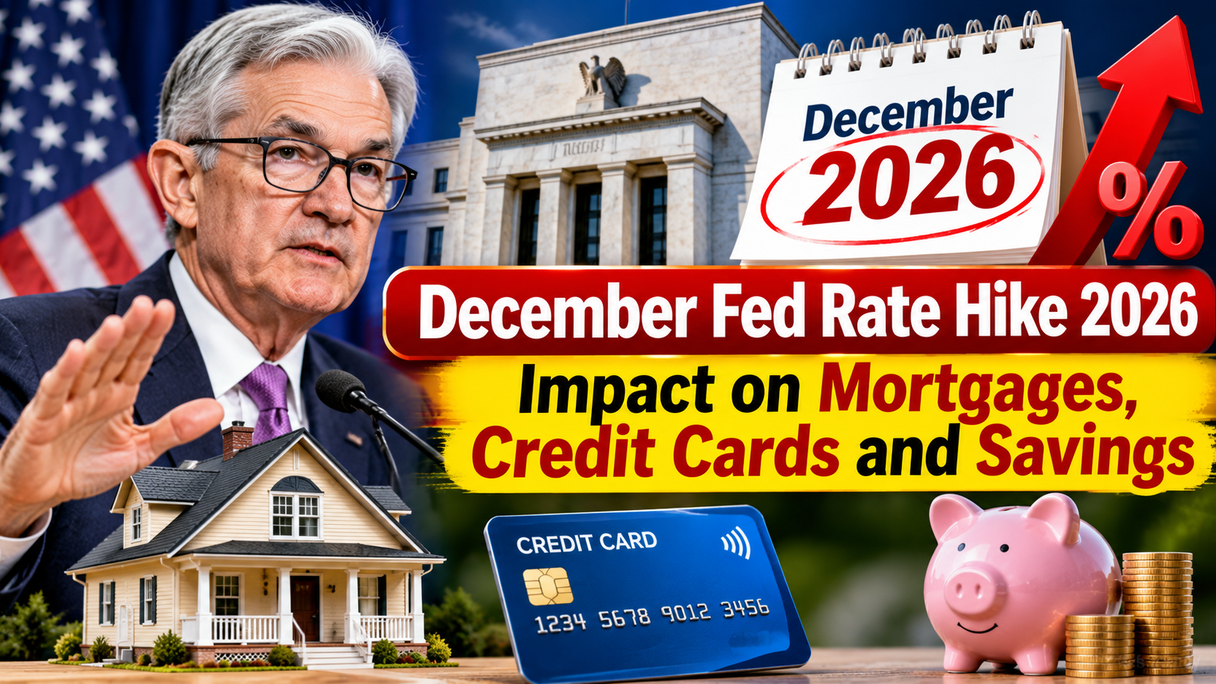
If the Fed does hike on December 9, the target range goes to 4% to 4.25%. Chair Kevin Warsh will hold a press conference afterward, and the committee will release a fresh set of economic projections. Those projections, especially the so-called dot plot showing where officials see rates heading, may matter more to markets than the hike itself. Futures pricing also points to roughly two-in-three odds of another increase in January, according to CME data cited by TheStreet this week.
What the October inflation report actually said
The Bureau of Labor Statistics released the October Consumer Price Index on November 10. Prices rose 0.4 percent from September on a seasonally adjusted basis, after a 0.6 percent jump the month before. Core prices, which strip out food and energy, rose 0.3 percent for the third month in a row. Economists had been hoping for 0.2.
A few details worth knowing:
- Energy: The energy index rose 0.7 percent in October after surging 5.2 percent in September. Gasoline is up 37.4 percent over the past twelve months, a leftover from the oil shock tied to the conflict with Iran. Electricity climbed 0.9 percent in October alone.
- Food: Grocery prices rose 0.4 percent, and eating out rose 0.5 percent. Beef was up 0.9 percent in a single month.
- Housing: Shelter increased 0.3 percent and accounted for more than 30 percent of the monthly rise.
- Insurance: Motor vehicle insurance jumped 0.7 percent in a month.
- The bright spot: Used cars and trucks fell 1.2 percent.
Now, here’s an oddity. You won’t find the usual headline number, the year-over-year inflation rate, in this report. The 2025 government shutdown meant the BLS never collected October 2025 prices, so there’s nothing to compare against, and the agency says it won’t publish 12-month changes for October 2026 where that data is missing. The most recent official annual figure is September’s 3.7 percent for headline inflation and 2.6 percent for core. Any annual number you see quoted for October is somebody’s estimate, not an official reading.
The next CPI report, for November, lands on December 10. That’s the day after the Fed decides, so the committee will be flying without it.
Why the Fed isn’t blinking
Inflation alone doesn’t explain the hawkish mood. The job market is the other half of the story. Employers added 165,000 jobs in October, according to the BLS. Economists surveyed ahead of time expected something closer to 60,000 or 65,000. The unemployment rate slipped to 4.1 percent, and the bureau noted it has stayed in a narrow 4.1 to 4.3 percent range since March. September’s job gain was also revised up, from 29,000 to 60,000.
For the Fed, that matters because the main reason to hold off on hikes is the fear of breaking the labor market. A strong report weakens that argument. One analyst quoted by Fox Business said the payroll number “removed the traffic light” at the December intersection. After that report, FedWatch odds jumped, and by mid-November some outlets were reporting a 100 percent chance of a hike, before settling in the mid-90s.
There’s a catch, though, and it’s worth saying out loud. Average hourly earnings rose 0.4 percent in October to $38.00, but they’re only up about 3.1 percent from a year ago. The latest official inflation rate is 3.7 percent. Do the subtraction and a lot of households are still losing ground. The broader U-6 unemployment measure also ticked up, from 7.6 percent to 7.9 percent. The headline looks strong. The experience for many workers is more mixed.
Meanwhile, the voices inside the Fed have gotten louder. Governor Christopher Waller said on November 10 that he supports a hike in December and that a half-point move should be considered if core inflation came in at 0.3 percent or higher. It did. New York Fed President John Williams, who votes at every meeting, said more hikes are likely, though he gave no timing. St. Louis Fed President Alberto Musalem, who doesn’t vote this year, has gone further, talking about “several” increases before spring. Markets still price a quarter-point move as the overwhelming favorite, with only a small chance, about 4 percent, of a half-point.
What a December hike does to your wallet
Let’s get practical. The Fed doesn’t set the rate on your loan. It sets a short-term benchmark, and everything else reacts to it in different ways and at different speeds.
Credit cards
Most credit cards have variable rates tied to the prime rate, which moves in lockstep with the Fed. When the Fed raises its target by a quarter point, your card’s APR usually follows within a billing cycle or two.
The numbers are already uncomfortable. Bankrate’s survey of popular cards put the average rate at 19.71 percent in early November. The Federal Reserve’s own survey of commercial banks found that accounts actually being charged interest averaged 22.36 percent in August. Revolving credit has climbed to roughly $1.37 trillion.
On a $5,000 balance, a quarter-point hike adds about $12.50 a year in interest. That sounds like pocket change, and on its own it is. But it stacks on top of an already-high rate, and it hits people who can least afford it. If you carry a balance, this is the debt to attack first.
Mortgages
Here’s something that surprises people. Mortgage rates don’t move directly with the Fed’s decision. They track the 10-year Treasury yield, which reflects what investors expect about inflation and future Fed moves. And that yield has been high for a while. It crossed 5 percent in September for the first time since 2007 and was sitting around 5.1 percent last Friday.
Freddie Mac’s survey for the week ending November 12 had the average 30-year fixed mortgage at 7.11 percent, down slightly from 7.18 percent the week before. A year ago it was 6.24 percent. The 15-year averaged 6.45 percent.
What does that gap mean in dollars? On a $400,000 loan, the principal-and-interest payment at 7.11 percent is about $2,691 a month. At last year’s 6.24 percent, it would have been roughly $2,460. That’s about $230 more every month, for 30 years, before taxes and insurance.
A December hike may not push mortgage rates much higher because the market has largely priced it in. The bigger risk is a hawkish surprise in the Fed’s projections. If officials signal a longer string of hikes, long-term yields could jump. Or they could fall, if investors decide the Fed is getting ahead of inflation. Nobody really knows, and anyone who tells you otherwise is guessing.
Adjustable-rate mortgages and home equity lines of credit are a different story. Those are tied to short-term benchmarks and will feel the hike faster.
Savings
If you have cash sitting somewhere, rising rates are the one place you win. But only if you’ve moved it. The FDIC’s national average savings rate is about 0.38 percent. Meanwhile, Bankrate’s tracking showed top high-yield savings accounts at around 4.35 percent as of mid-November, and another rate tracker found accounts near 4.40 percent. On $10,000, that’s the difference between about $38 a year and about $440. Same money, same safety, if the account is FDIC-insured. The only thing that changed is where it lives. Advertised rates can change at any time, so a high rate today isn’t a promise for next spring. Check the account’s terms and make sure you’re comparing APY.
Your job and your paycheck
Higher rates are designed to cool demand, which can eventually mean slower hiring. We’re not there yet, but if you work in housing, construction or anything rate-sensitive, keep an eye out. The Fed’s December projections will show what officials expect for unemployment next year.
Stocks and your 401(k)
Higher rates make future corporate profits worth less in today’s dollars, which is why growth and tech stocks tend to wobble when yields climb. The S&P 500’s forward price-to-earnings ratio has already slipped from about 22 at the start of the year to about 19, according to Goldman Sachs Research. That same research found that at the start of past hiking cycles, stocks dipped about 2 percent on average over three months but gained roughly 9 percent over twelve, with 2022 the notable exception.
History is a rough guide, not a guarantee, especially with oil near $100 a barrel. If you’re a long-term investor in a diversified retirement account, don’t make big moves over one Fed meeting.
What you can do before December 9
You can’t control what the Fed does. You can control how exposed you are to it. A few things worth doing now:
- Pay down variable-rate debt first. Credit cards, HELOCs, and any adjustable loans are the first to reprice. Even an extra $50 a month toward a card balance beats most investments on a risk-adjusted basis.
- Call your card issuer. A June 2026 LendingTree survey found 84 percent of cardholders who asked for a lower APR got one. It takes ten minutes. The worst they can say is no.
- Consider a balance transfer or a fixed-rate personal loan, but only if you read the fees and the promotional terms carefully, and only if you won’t run the old card back up.
- Move idle cash. If your emergency fund is earning under half a percent, a high-yield account is the easiest raise you’ll ever give yourself.
- If you’re buying a home, shop lenders. Rates vary a lot from one lender to the next, and a point of difference matters more than a quarter-point Fed move. Ask about locking your rate, and what it costs to extend the lock.
- Don’t count on refinancing. With 30-year rates above 7 percent, refinancing a recent loan rarely makes sense. If your current rate is lower, keep it.
None of this is personal financial advice, and I’m not your advisor. If you’re making a major decision such as buying a house or restructuring debt, talk to a licensed professional who can see your whole picture.
What to watch next
A few dates matter before the year ends:
- December 4: The November jobs report from the BLS.
- December 8 to 9: The Fed meeting. The decision and statement come on the 9th, along with updated projections and Warsh’s press conference.
- December 10: The November CPI report, one day after the Fed acts.
Pay attention to three things. First, the dot plot: does it show one more hike, or several? Second, whether the vote is unanimous, because dissents in either direction signal how divided the committee really is. Third, whether the Fed’s language shifts from “elevated” inflation toward something that sounds like confidence it’s cooling.
Nobody should be shocked by a December hike. It’s about as expected as a rate move gets. The bigger question is how long this lasts, and the Fed hasn’t said. For now, the smart move is boring: pay down expensive debt, make your cash earn something, and don’t react to every headline. A quarter-point change won’t wreck your finances. Ignoring the direction of travel might.
Freddie Mac, Primary Mortgage Market Survey, November 12, 2026: https://www.freddiemac.com/pmms