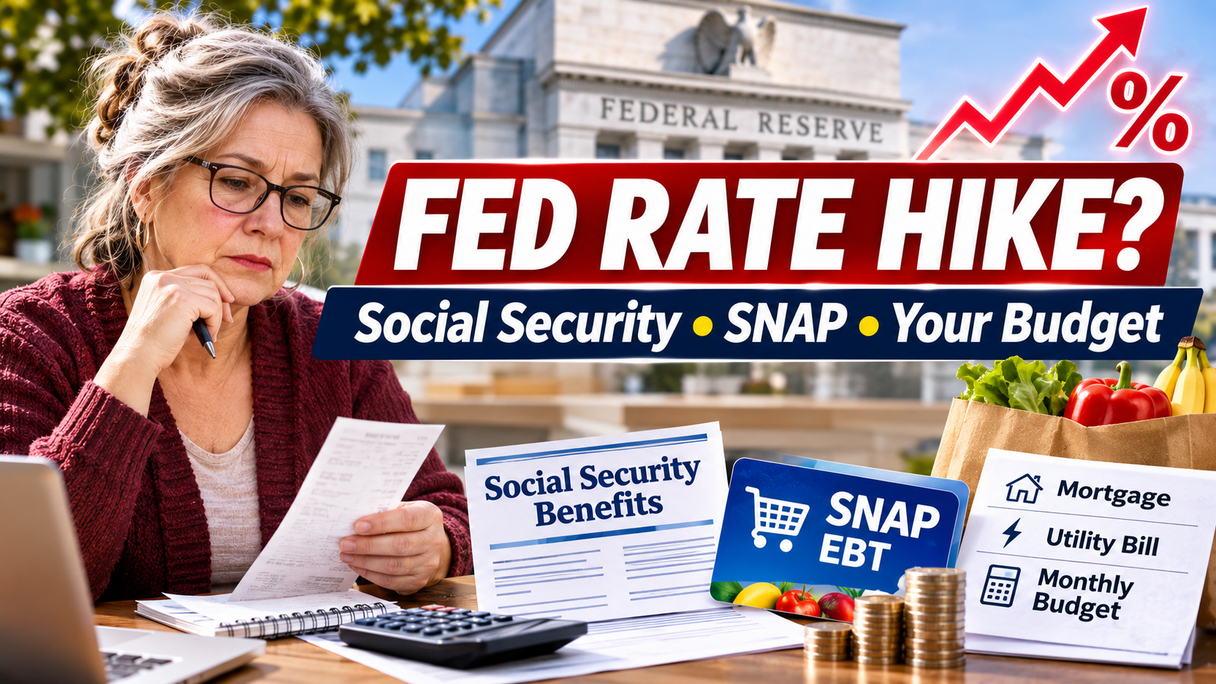
Fed Rate Hike Affect Social Security: A possible Federal Reserve interest rate hike can raise concerns for millions of Americans, particularly retirees, people living on Social Security, low-income households receiving SNAP benefits, and families already struggling with higher grocery, housing, and healthcare costs.
When the Federal Reserve changes interest rates, the effects can reach nearly every corner of the American economy. Mortgage payments, credit card interest, car loans, savings accounts, and borrowing costs may all respond. But what about government assistance programs? Could a Fed rate increase affect Social Security checks, SNAP food benefits, or other monthly payments?
The answer is more complicated than a simple yes or no. A Federal Reserve rate hike does not automatically reduce Social Security benefits or cut SNAP payments. These programs operate under separate federal laws and administrative rules. However, changes in interest rates can influence inflation, consumer borrowing costs, savings returns, and the overall cost of living. Those indirect effects can make a meaningful difference to households that depend on fixed monthly income.
For someone receiving Social Security retirement benefits, even a small increase in credit card interest or household expenses can affect the amount of money left at the end of the month. For a family receiving SNAP, higher food prices or transportation costs can make an already tight budget more difficult to manage.
Understanding the relationship between Federal Reserve policy and federal benefits is especially important as households plan their finances for the remainder of 2026 and into 2027. Here is what Americans should know about a possible Fed rate hike, Social Security, SNAP, inflation, savings, and monthly household budgets.
What Is a Federal Reserve Interest Rate Hike?
The Federal Reserve, commonly called the Fed, is the central bank of the United States. One of its main responsibilities is to promote maximum employment and stable prices while supporting the long-term stability of the financial system. One of the most important tools available to the Fed is its federal funds rate target.
The federal funds rate influences the interest rate banks charge one another for overnight lending. Although consumers do not borrow directly at this rate, changes to it can influence many other interest rates throughout the economy. When the Federal Reserve raises interest rates, borrowing generally becomes more expensive.
For example:
- Credit card companies may increase interest rates.
- Adjustable-rate mortgage payments may rise.
- New car loans may become more expensive.
- Personal loans may carry higher monthly payments.
- Businesses may face higher financing costs.
- Some savings accounts and certificates of deposit may offer better returns.
The purpose of increasing interest rates is generally to slow economic activity when inflation remains too high. More expensive borrowing can reduce consumer spending and business investment, which may help ease demand-driven price pressures. However, this process takes time. A rate increase does not immediately make groceries, electricity, rent, or healthcare cheaper.
It is also important to understand that the Federal Reserve does not control every interest rate in the economy. Mortgage rates, for example, are influenced by Treasury yields, inflation expectations, economic growth, and other market conditions. That means a Fed rate increase does not guarantee that every loan rate will rise by the same amount.
Alberta Child and Family Benefit Payment Date Nov 27, Up to $5,882
No Tax on Tips and Overtime: What to Know for Your 2026 Return (Filed in 2027)
December 11 Shutdown Deadline: SNAP, Federal Pay, Benefits
$5181 SSDI Payment 2026: Who Gets Paid Today and Who Can Really Collect?
Does a Fed Rate Hike Affect Social Security Payments?
This is one of the biggest questions among American retirees and people receiving disability or survivor benefits. The short answer is no. A Federal Reserve interest rate increase does not directly change the amount of Social Security benefits someone receives. The Social Security Administration calculates and distributes benefits under federal law. The Federal Reserve does not determine monthly retirement payments, disability benefits, or survivor benefits.
Your Social Security payment is generally based on factors such as:
- Your lifetime earnings covered by Social Security.
- The age at which you begin receiving retirement benefits.
- Your work history and eligibility.
- Your disability or survivor benefit eligibility.
- Applicable federal benefit rules and adjustments.
A Fed rate decision does not change these calculations.
Will Social Security Checks Increase After a Fed Rate Hike?
Not automatically. Social Security benefits receive an annual cost-of-living adjustment, commonly known as COLA. This adjustment is designed to help benefits keep pace with changes in consumer prices. The COLA calculation is based on the Consumer Price Index for Urban Wage Earners and Clerical Workers, known as CPI-W.
The Social Security Administration compares the average CPI-W for the third quarter of the current year with the corresponding period in the previous year. If the index increases, Social Security benefits generally receive a corresponding adjustment. The Federal Reserve does not set this percentage. For 2027, the Social Security Administration announced a 3.6% cost-of-living adjustment on October 14, 2026. The increase applies to eligible Social Security retirement, disability, and survivor benefits, as well as Supplemental Security Income.
The adjustment is separate from any Federal Reserve interest rate decision. For example, if someone receives $2,000 per month in Social Security retirement benefits before the adjustment, a 3.6% increase would add approximately $72 per month before applicable deductions. That does not mean the person will necessarily have $72 more available to spend. Medicare premiums, taxes, and other deductions can affect the final amount deposited.
Can Higher Interest Rates Reduce Social Security Benefits?
No. The Federal Reserve cannot independently reduce an individual’s Social Security retirement payment by increasing its policy rate. However, there are indirect financial considerations. If interest rates remain elevated, retirees with outstanding debt may face higher borrowing expenses. Someone carrying a credit card balance, for example, could pay more interest each month if the card’s variable APR increases.
Similarly, retirees who need to borrow money for home repairs, medical expenses, or vehicle purchases may encounter higher financing costs. The result is that their Social Security check remains unchanged, but their monthly purchasing power may decline. This distinction is important: a stable Social Security payment does not always mean a stable household budget.
What About SNAP Benefits? Can a Fed Rate Hike Reduce Food Assistance?
The Supplemental Nutrition Assistance Program, better known as SNAP, is another federal program that households may worry about when economic conditions change. SNAP provides eligible low-income individuals and families with assistance to purchase food. Benefits are generally issued through an Electronic Benefits Transfer card, or EBT card. The program is administered federally by the U.S. Department of Agriculture’s Food and Nutrition Service, with state agencies responsible for processing applications and managing benefits.
A Federal Reserve rate increase does not automatically reduce SNAP benefits. The Fed does not calculate SNAP allotments, determine household eligibility, or decide how much assistance a qualifying family receives. SNAP benefit amounts are based on program rules, household size, income, allowable deductions, and applicable maximum allotments.
What Determines SNAP Benefit Amounts?
Several factors influence how much SNAP assistance a household may receive.
These include:
1. Household size
Larger households generally qualify for higher maximum monthly allotments because they are expected to have greater food expenses.
2. Household income
SNAP calculations consider household income, including applicable earned and unearned income, under federal and state program rules.
3. Allowable deductions
Certain expenses may be deducted when calculating a household’s net income. These can include eligible shelter costs, dependent care expenses, and certain medical expenses for qualifying elderly or disabled household members.
4. Maximum monthly allotments
The USDA updates SNAP maximum allotments periodically according to applicable cost-of-living and program rules.
5. State-specific administration
States administer applications, eligibility determinations, and benefit distribution under federal requirements. Some eligibility procedures and administrative details can vary by state.
Can Inflation Increase SNAP Benefits?
Potentially, but not because the Fed raises interest rates. SNAP maximum allotments are generally adjusted annually using the applicable Thrifty Food Plan calculations and federal rules. The USDA’s Thrifty Food Plan is used to establish the cost of a nutritious, practical, and low-cost diet for different household sizes. When the applicable food-cost calculations change, maximum SNAP benefits may also change.
However, SNAP benefits do not automatically increase every time grocery prices rise. Nor does a Federal Reserve rate hike trigger an immediate adjustment to an individual’s EBT balance. Households should check official USDA and state SNAP announcements rather than relying on social media posts claiming that a new interest rate decision will produce additional food assistance.
Why a Fed Rate Hike Can Still Affect SNAP Households
Although SNAP payments are not directly controlled by interest rates, the financial circumstances of participating households can change when borrowing costs increase. Consider a family receiving $500 in monthly SNAP assistance. The family’s food benefit may remain the same after a Fed rate increase. But if the family also has a vehicle loan, credit card debt, or other variable-rate borrowing, higher financing expenses could reduce the amount of cash available for rent, utilities, transportation, and other necessities.
There is another important connection: interest rates influence economic activity. If higher rates slow business investment and hiring, some workers may experience reduced hours or difficulty finding employment. Changes in household income can affect SNAP eligibility and benefit calculations.
The relationship is not automatic, and it can work in different directions. For example, a household that loses employment income may become eligible for a higher SNAP benefit, assuming it meets the program’s other requirements. A household whose earnings increase may receive less assistance. This is why SNAP eligibility is based on individual household circumstances rather than Federal Reserve policy announcements.
How a Fed Rate Hike Could Affect Your Monthly Budget
Even when Social Security and SNAP benefits remain unchanged, a higher interest rate environment can influence household finances in several ways. The biggest effects are often felt through borrowing costs, debt payments, savings returns, and consumer spending.
1. Credit Card Payments Could Become More Expensive
Credit cards are among the financial products most sensitive to changes in interest rates. Many credit cards carry variable annual percentage rates. These rates are commonly linked to the prime rate, which generally moves in response to changes in the federal funds rate. When the Fed raises rates, credit card APRs may increase. Consider someone with a $5,000 credit card balance. If the interest rate rises, a larger share of each payment may go toward interest instead of reducing the outstanding balance.
This can be especially difficult for retirees and households living on fixed monthly income. People who carry credit card debt should consider paying more than the minimum whenever financially possible, avoiding new high-interest purchases, and comparing lower-interest repayment options. A balance transfer or personal loan may help some borrowers, but fees, eligibility requirements, and promotional terms should be reviewed carefully.
2. Mortgage Payments May Be Affected
The impact on mortgage payments depends on the type of mortgage. Homeowners with fixed-rate mortgages generally do not see their existing principal-and-interest payment change simply because the Fed raises rates. For example, someone who purchased a home with a 30-year fixed mortgage at 5% generally keeps that contractual interest rate. However, people shopping for a new home may face different borrowing conditions.
Mortgage rates can rise or fall based on broader bond market conditions and inflation expectations. They do not move in perfect alignment with the federal funds rate. Homeowners with adjustable-rate mortgages may be more directly exposed to interest rate changes, depending on their loan’s adjustment schedule and index. A rate adjustment can increase the required monthly payment, potentially placing additional pressure on household budgets.
3. Car Loans May Become More Expensive
Transportation is a major expense for many American households. A higher interest rate environment can make financing a new or used vehicle more expensive, although the final rate also depends on credit history, loan term, lender, vehicle price, and market conditions. For a household already managing groceries, utilities, insurance, and rent, even a modest increase in a car payment can make a difference.
Before purchasing a vehicle, consumers should compare the total loan cost rather than focusing only on the monthly payment. A longer loan term can lower the monthly amount while increasing the total interest paid.
4. Personal Loans and Home Equity Borrowing May Cost More
People sometimes use personal loans or home equity lines of credit to manage emergency expenses. These products may have fixed or variable rates. Borrowers using variable-rate financing can be particularly exposed to changing market conditions. Someone planning a major home repair, medical expense, or debt consolidation should compare offers and understand whether the interest rate can change during the repayment period.
5. Savings Accounts May Offer Better Returns
Higher interest rates are not necessarily bad for everyone. People who have savings in interest-bearing accounts may benefit when banks increase the rates offered on savings products. High-yield savings accounts, money market deposit accounts, and certificates of deposit may become more attractive. However, banks do not always pass every Federal Reserve rate increase to customers.
Some institutions adjust deposit rates quickly, while others move slowly or leave rates unchanged. For retirees and people holding emergency savings, comparing account yields can help improve interest income without taking unnecessary investment risks. Remember that savings account interest is generally taxable under federal tax rules, subject to applicable exceptions.
6. Rent and Housing Expenses May Remain High
A common misconception is that higher interest rates immediately reduce rent. That is not necessarily true. Higher borrowing costs can affect landlords, property developers, and housing supply. Some property owners may face increased financing expenses, which can influence their rental decisions. However, rent prices are also driven by local housing demand, available supply, wages, insurance, property taxes, and other expenses.
A Fed rate increase does not guarantee lower rent. For renters living on Social Security or fixed incomes, housing costs remain an important part of monthly budget planning.
7. Grocery and Utility Bills May Not Fall Immediately
The Federal Reserve uses interest rates to influence overall economic conditions, not to set supermarket prices or electricity bills. A rate increase may gradually reduce demand in some areas of the economy. However, grocery prices also depend on agricultural production, fuel, transportation, labor, weather, supply chains, and other factors.
Similarly, electricity and natural gas costs are influenced by regional energy markets, utility regulations, fuel prices, and infrastructure costs. Consumers should not assume that higher interest rates will immediately lower grocery or utility expenses. For households receiving SNAP, this is particularly important because food assistance may not cover every grocery purchase.
Will Higher Interest Rates Affect SSI Payments?
Supplemental Security Income, or SSI, is different from Social Security retirement insurance. SSI is a needs-based federal program that provides monthly payments to eligible people who are aged 65 or older, blind, or disabled and have limited income and resources. The Social Security Administration administers the program.
A Fed rate hike does not automatically increase or decrease the federal SSI payment amount. SSI payment standards are subject to federal law and annual cost-of-living adjustments. For 2027, the 3.6% Social Security COLA also applies to federal SSI payment standards. However, there is an important detail that SSI recipients should understand.
Interest earned on certain financial accounts can count as income under SSI rules. For example, if a person receives interest from a bank account, that interest may be considered unearned income for SSI purposes. The treatment of resources and income depends on the applicable SSI rules, exclusions, and reporting requirements. A higher savings account yield could therefore have implications for some SSI recipients, depending on the amount of interest earned and their individual circumstances.
This does not mean every SSI recipient will lose benefits when savings rates rise. People receiving SSI should report income and financial changes when required and consult the SSA’s official guidance if they are unsure how interest income affects their eligibility.
Could a Fed Rate Hike Affect Medicare and Medicaid?
Medicare and Medicaid are not directly controlled by the Federal Reserve either. Medicare is a federal health insurance program, while Medicaid is jointly funded by federal and state governments and administered by states within federal requirements. A change in the federal funds rate does not automatically increase Medicare premiums or reduce Medicaid eligibility.
Medicare Part B premiums are determined through federal law and program financing rules, not through direct Federal Reserve decisions. However, the overall economic environment can influence healthcare providers, insurers, government financing, and household costs. For Social Security recipients, Medicare Part B premiums are particularly important because many beneficiaries have their premiums deducted directly from their Social Security payments.
This means an increase in the gross Social Security benefit does not always translate into an equal increase in the amount deposited into a bank account. People should review their official Medicare and Social Security notices for actual premium and benefit changes rather than assuming that a Fed announcement will change their healthcare costs.
What Happens If the Fed Raises Rates While Inflation Remains High?
This is one of the most difficult situations for ordinary American households. Higher interest rates are intended to help control inflation over time, but consumers may experience the costs of borrowing more expensive before they see any meaningful relief in everyday prices.
Imagine a retired couple with the following monthly expenses:
- Housing and property-related costs: $1,200
- Groceries: $650
- Utilities: $250
- Transportation: $300
- Healthcare expenses: $400
- Other household expenses: $300
Their total monthly expenses are $3,100.
If their income remains unchanged while their credit card interest, insurance, or other expenses increase, their financial situation can become more difficult. Even if the Federal Reserve eventually succeeds in slowing inflation, prices do not necessarily return to their previous levels. This is an important distinction between inflation and disinflation.
Inflation slowing means prices are increasing at a slower rate. It does not necessarily mean prices are falling. For households living on Social Security or SNAP assistance, the difference can be significant. A slower rate of price increases may help stabilize future budgets, but families still have to manage the higher prices they are already paying.
Does the Fed Rate Hike Affect 2027 Social Security COLA?
No direct connection exists between the Federal Reserve’s interest rate decision and the Social Security COLA calculation. The 2027 COLA is based on the applicable CPI-W data for July, August, and September 2026 compared with the same period in 2025. The Social Security Administration announced a 3.6% increase on October 14, 2026.
The adjustment is already determined under the applicable calculation process. A later Federal Reserve rate decision cannot retroactively change that announced COLA. For eligible beneficiaries, the 2027 adjustment applies to retirement, disability, and survivor benefits. SSI payment standards also receive the applicable adjustment. The amount a person actually receives may differ because of Medicare premiums, taxes, benefit offsets, or other applicable deductions.
Who Could Feel the Biggest Impact of a Fed Rate Hike?
Not every American experiences an interest rate increase in the same way. The financial impact depends on income, debt, savings, housing arrangements, and employment circumstances. Here are some groups that may be particularly affected.
Social Security Retirees
Retirees who rely heavily on monthly Social Security payments may have limited flexibility when borrowing costs rise. Those with credit card balances, adjustable-rate loans, or other variable-rate debt may face additional expenses. Retirees with substantial savings in interest-bearing accounts may benefit from improved deposit rates, depending on their financial institution.
SNAP Recipients
SNAP households may not experience an immediate change in their EBT balances. However, families already struggling with food, housing, and transportation expenses may have less room in their budgets when borrowing costs increase.
SSI Recipients
SSI payment amounts are not automatically affected by the Fed. However, certain interest income can affect SSI calculations, making it important for recipients to understand income-reporting requirements.
Homeowners With Adjustable-Rate Mortgages
These borrowers may experience higher monthly payments when their mortgage interest rates reset. The exact impact depends on the loan agreement and adjustment schedule.
Credit Card Borrowers
Consumers with variable-rate credit card balances are among those who may notice higher borrowing costs relatively quickly.
Savers and Retirees With Cash Reserves
People with savings may receive higher interest income if their banks increase deposit rates. However, the benefit depends on the actual account rate, balance, fees, and applicable taxes.
How to Protect Your Monthly Budget if Interest Rates Rise
You cannot control Federal Reserve decisions, but you can take steps to reduce the effect of changing interest rates on your household finances.
1. Review Your Credit Card Interest Rates
Check your latest credit card statements and identify which balances carry variable APRs.
If you have multiple cards, prioritize paying down the balances with the highest interest rates, while keeping up with minimum payments on all accounts.
Avoid relying on minimum payments alone for long-term debt repayment.
2. Compare Savings Account Rates
If you have emergency savings, check whether your current bank offers a competitive interest rate.
Some banks offer higher yields than traditional savings accounts.
Before moving money, review minimum balance requirements, fees, withdrawal restrictions, and deposit insurance coverage.
For eligible bank deposits, FDIC insurance generally covers up to $250,000 per depositor, per insured bank, per ownership category.
Credit union members should review applicable NCUA insurance protections.
3. Avoid Taking on Unnecessary Variable-Rate Debt
When interest rates are uncertain, adding new variable-rate debt can increase financial risk.
If you need financing, compare fixed-rate and variable-rate options and calculate the total repayment cost.
4. Review Your Monthly Spending
Write down essential expenses such as:
- Housing
- Groceries
- Utilities
- Transportation
- Insurance
- Healthcare
- Debt payments
Separate necessary expenses from discretionary purchases.
This can help identify where small adjustments may free up money.
5. Check Your SNAP Eligibility
If your income has decreased or your household circumstances have changed, you may qualify for SNAP or a higher benefit amount.
Contact your state’s SNAP agency or use the official USDA SNAP state directory to find application information.
Do not assume that a previous denial means you cannot qualify under your current circumstances.
6. Review Your Social Security and Medicare Notices
Keep an eye on official SSA correspondence, COLA notices, and Medicare premium information.
These documents explain actual changes to your benefits and deductions.
If you believe your payment is incorrect, contact the Social Security Administration through its official channels.
7. Build an Emergency Fund When Possible
Even a small emergency reserve can help protect against unexpected expenses.
Households that cannot save large amounts can start with a modest target and gradually increase it when their budget allows.
For people receiving means-tested benefits such as SSI, it is important to understand applicable resource limits and exclusions before accumulating additional savings.
Where Can Americans Find Official Information?
With frequent online claims about stimulus checks, benefit increases, and government payments, it is important to use official sources.
The following government websites provide reliable information.
| Program or information | Official website |
|---|---|
| Federal Reserve interest rate decisions | Federal Reserve |
| Social Security benefits and COLA | Social Security Administration |
| SSI eligibility and payments | Social Security Administration |
| SNAP eligibility and benefits | USDA Food and Nutrition Service |
| Medicare premiums and coverage | Medicare.gov |
| Consumer credit and financial protection | Consumer Financial Protection Bureau |
| Bank deposit insurance | FDIC |
Consumers should be cautious of websites claiming that a Federal Reserve rate hike automatically qualifies Americans for new government checks or additional SNAP benefits. A genuine federal benefit change will be supported by official program announcements and applicable government rules.
FAQ’s about Fed Rate Hike
1. Will a Fed rate hike reduce Social Security payments?
No. The Federal Reserve does not determine Social Security benefit amounts. Retirement, disability, and survivor payments are administered under federal Social Security laws. A rate hike does not automatically reduce monthly benefits.
2. Will Social Security checks increase if the Fed raises interest rates?
No. Social Security benefits are adjusted through the annual COLA process, which uses CPI-W inflation data. The Federal Reserve’s interest rate decision does not determine the COLA percentage.
3. Can a Fed rate hike reduce SNAP benefits?
No, not directly. SNAP benefits are calculated under USDA program rules using household income, size, deductions, and applicable maximum allotments. A Fed rate increase does not automatically reduce EBT balances.
4. Could higher interest rates affect SSI recipients?
Potentially, indirectly. SSI payments are not automatically changed by Fed decisions. However, certain interest income may count as unearned income under SSI rules. Recipients should review SSA reporting requirements.
5. Will credit card payments increase after a Fed rate hike?
They may. Many credit cards have variable APRs linked to the prime rate. When the prime rate increases, credit card interest costs may also rise, depending on the card agreement.
6. Will mortgage rates increase immediately?
Not necessarily. Mortgage rates are influenced by Treasury yields, inflation expectations, economic conditions, and other market factors. Existing fixed-rate mortgage payments generally remain unchanged.
7. Can higher interest rates help people with savings accounts?
Yes. Banks may increase savings account interest rates when market rates rise. However, not every bank passes along the full increase, and account terms vary.
8. Does a Fed rate hike affect the 2027 Social Security COLA?
No. The 2027 COLA was announced at 3.6% on October 14, 2026, based on the applicable CPI-W calculation. A subsequent Fed rate decision does not change that adjustment.
9. Will higher interest rates make groceries cheaper?
Not immediately. Interest rates can influence overall economic demand over time, but grocery prices also depend on production costs, transportation, energy, weather, and supply conditions.
10. Where can I check whether my Social Security or SNAP benefits have changed?
Social Security recipients can use their official SSA accounts and contact the Social Security Administration. SNAP recipients should contact their state SNAP agency or visit the USDA Food and Nutrition Service website.
Your Benefits May Stay the Same, but Your Expenses Could Change
A Federal Reserve interest rate hike can have a meaningful effect on the financial lives of American households, but it is important to separate direct government benefit changes from indirect economic effects. Social Security retirement, disability, and survivor payments are not automatically reduced when the Fed raises interest rates. SNAP benefits are also not directly determined by Federal Reserve policy. SSI payment standards follow their own federal rules and applicable annual COLA adjustments.
However, higher borrowing costs can affect credit cards, adjustable-rate mortgages, car loans, and personal financing. At the same time, savers may have an opportunity to earn more interest if banks increase deposit rates. For retirees and families receiving federal assistance, the biggest concern may not be a change in the benefit check itself. It may be how far that check goes after paying for housing, groceries, healthcare, transportation, and debt.
The best approach is to monitor official announcements, understand your borrowing costs, review your monthly expenses, and check your eligibility for assistance when household circumstances change. A Fed rate hike does not automatically mean smaller Social Security checks or reduced SNAP benefits. But it can change the financial conditions surrounding those benefits, making careful monthly budgeting more important than ever.