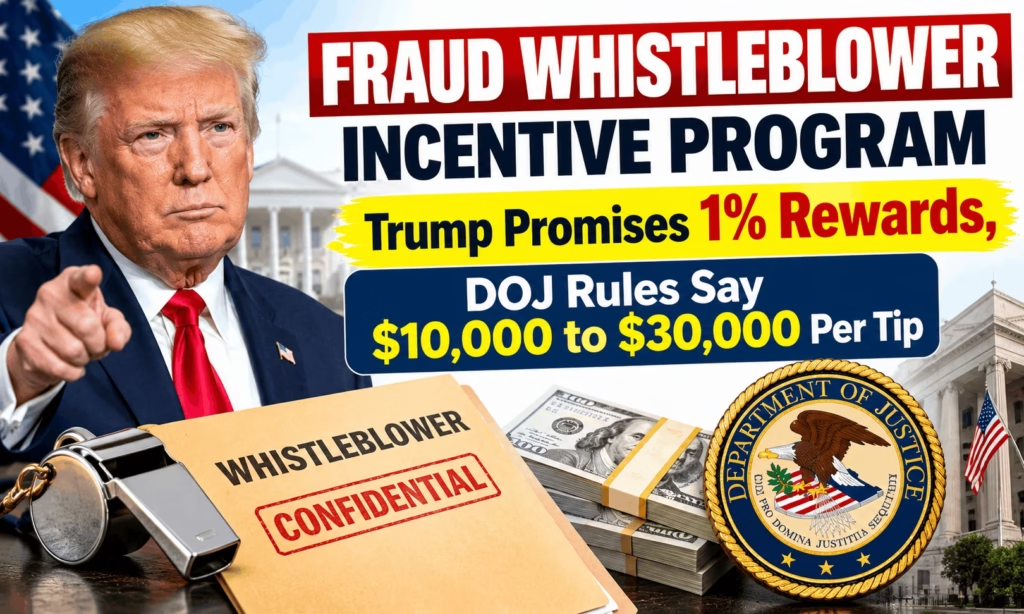
The Fraud Whistleblower Incentive Program launched on October 20, 2026, when President Donald Trump and Vice President JD Vance announced it from the Oval Office. Backed by $25 million from the Treasury Department, the program pays people who report fraud against federal programs. Trump told reporters that tipsters could collect 1% of the fraud they help expose and that there is “no limit” on the payout. The Justice Department’s published rules say something narrower: a fixed award of $10,000 to $30,000 for each distinct tip that leads to unsealed criminal charges in a list of covered areas. Tips go through the official portal at America.gov/fraud, and the Justice Department runs the program through its National Fraud Enforcement Division. We’ll be updating this article monthly.
The gap between the two versions is the most important thing for anyone thinking about filing a tip. A promise made at a podium is not the same as a rule written in a program FAQ, and the paperwork controls. Trump also said he would personally decide who gets paid when more than one person claims credit for the same tip. The first reward went to Nick Shirley, a YouTuber whose video about Minnesota child care centers drew national attention, who received a $10,000 check at the event. Critics from government watchdog groups called the program unserious. Supporters say it will bring more tips to investigators. This guide sets out what is confirmed, what is disputed, how to submit a tip, how long payment may take and what you should not assume.
Fraud Whistleblower Incentive Program Key Highlights and Dates
| Item | Details |
|---|---|
| Program name | Fraud Whistleblower Incentive Program, also called WHIP |
| Announced | October 20, 2026, Oval Office |
| Announced by | President Trump and Vice President Vance |
| Administered by | Justice Department, National Fraud Enforcement Division |
| Funding | $25 million committed by the Treasury Department |
| Program type | Three-year pilot, officially the Criminal Tip Rewards Pilot Program |
| Award in DOJ rules | $10,000 to $30,000 per distinct tip |
| Award described by Trump | 1% of the fraud, with “no limit” |
| Trigger for payment | Tip leads to unsealed criminal charges |
| Tip portal | America.gov/fraud |
| First payment | $10,000 to Nick Shirley |
| Program terms updated | October 20, 2026 |
What Is the Fraud Whistleblower Incentive Program?
The program is a cash reward system for members of the public who give investigators original information about fraud involving federal money. The Justice Department calls it the first whistleblower rewards program that pays an award at the start of a prosecution instead of after a conviction, forfeiture and appeals. Most government reward programs make tipsters wait until the case is fully resolved, which can take years. Here the payment comes after charges are unsealed.
The initiative grows out of the administration’s anti-fraud push. Trump created a task force in March to reduce fraud in federal programs and put Vance in charge. The government also runs Fraud.gov, which the White House uses to publicize fraud, waste and corruption it says it has found since January 2025. During the announcement Trump claimed his administration has uncovered about $260 billion in fraud across programs such as Medicare, Medicaid, Social Security and food assistance. That figure came from the president’s remarks and I could not tie it to a published audit, so treat it as a claim.
The legal basis is a Justice Department authority that lets the department pay rewards, in its sole discretion, in response to public advertisements for help. That phrase matters. It means the department decides each award, and nothing in the program creates a right to payment.
Trump Whistleblower Reward Program: 1% Promise vs. the DOJ Rulebook
This is where headlines have diverged. At the Oval Office event Trump said whistleblowers could receive 1% of the amount of fraud they report, even if the fraud were worth $100 billion. When a reporter asked for clarification, he said there was no limit and that criminal charges were not necessary.
The written program says otherwise. The DOJ materials set a fixed award between $10,000 and $30,000 for each distinct tip, paid only when the information leads to unsealed criminal charges. The America.gov/fraud site describes a reward of up to $30,000 tied to criminal charges. A White House description of the program referred to convictions or significant federal enforcement actions, while the Justice Department’s rules key payment to charges, and its guidelines draw a clear line between the two.
For a would-be tipster, the safe reading is to rely on the DOJ terms. An exact 1% payout is not in those rules. On a $1 million fraud, 1% would be $10,000, which falls inside the DOJ range. On a $50 million fraud it would be $500,000, far above the stated ceiling. Until the Justice Department says in writing that it will pay more, the published range is the only number you can count on. My calculator shows both figures so you can see the difference.
Trump also said he would act as the final arbitrator when two people claim the same tip, and that he would be generous. The DOJ rules say something different about duplicates: if two people submit identical information, only the first submission counts as original. That is another place where the stated process and the written one do not match, and it is worth watching in the coming weeks.
Who Is Eligible for the Fraud Whistleblower Incentive Program?
The DOJ FAQ is specific. A qualifying tipster must be an individual, although a lawyer can represent them. Companies and other entities cannot claim rewards. The information must be original, specific, truthful, complete and timely, and it must lead to unsealed criminal charges for a covered offense.
Original means it comes from your own knowledge or your own analysis of data. It cannot already be known to the Fraud Division or other law enforcement, and it cannot just repeat news reports or allegations from court filings. Voluntary means you were not already required to provide it, for example under a subpoena, a plea agreement cooperation clause or a non-compulsory Justice Department request.
| Who cannot qualify | Why |
|---|---|
| Companies and entities | Only individuals can be whistleblowers |
| DOJ or law enforcement officials, employees and contractors | Conflict of interest, and the rule covers certain close family members and household members |
| Elected or appointed foreign government officials | Excluded by program terms |
| People who meaningfully took part in the crime | Directing, planning, starting or knowingly profiting from the fraud disqualifies you |
| People who lie or hide material facts | False statements or obstruction can end eligibility |
| People who got information from an ineligible source to evade the rules | Barred unless reporting that source’s own violations |
There is one narrow exception for people who played a small role in a scheme. The department can decide, at its sole discretion, that the role was limited enough to stay eligible, and it will consider that role when setting the amount.
Which Types of Fraud Are Covered by the Whistleblower Reward Program?
The fixed award applies to two broad areas. The first is federal health care offenses, including crimes involving health care benefit programs and fraud against patients. The second is fraud on programs run by several agencies: the Department of Agriculture, including SNAP food assistance; the Department of Labor, including unemployment fraud; the Department of Health and Human Services; the Department of Housing and Urban Development; the Department of Education, including student aid fraud; the Department of Veterans Affairs; the Department of War; and the Small Business Administration.
Prosecutors say they will prioritize four areas: hospice fraud, home health care fraud, day care fraud and special services fraud. That tracks closely with the Minnesota child care allegations that put the issue in the headlines.
Not every kind of fraud is on the list. The FAQ says you should still report other fraud, because a tip about a non-covered scheme might help uncover a covered federal crime, and because you may qualify under a different reward program. It also notes that tips through Fraud.gov do not lead to investigation of non-fraud matters, so reports of other crimes should go to local police or agencies such as the FBI’s Internet Crime Complaint Center.
One detail that may surprise people: the award does not depend on the size of the loss. Because the payment is not tied to forfeiture, tips about unsuccessful schemes or small losses can still qualify, as long as they lead to charges.
How to Apply: How to Submit a Fraud Tip at America.gov/Fraud
There is no application, no account and no login. A tip is the submission. Here are the steps based on the official guidance.
- Confirm that your tip fits a covered category and that you are an eligible individual. The calculator on this page runs a quick check.
- Gather what you personally know: who is involved, what the scheme is, which program is affected, when it happened and how you learned about it.
- Go to America.gov/fraud, the official whistleblower portal. The site says reports are encrypted and go directly to the Treasury Department, and the Justice Department administers the program.
- Provide enough detail that investigators can identify the specific crime and the people involved, and explain the source of your knowledge.
- Submit the tip and keep a record of the date and what you sent.
- Wait to be contacted. Staff under the Assistant Attorney General for the Fraud Division review portal submissions, and whistleblowers may or may not be contacted for more information.
The portal is strongly encouraged, and the department can deny an award just because a tip did not come through it. Other channels may be considered case by case, but do not count on that. Because the rules reject duplicate information, speed and originality both matter. Do not post your evidence publicly first, since public information can fail the originality test.
If you are in a covered situation and worried about your own exposure, talk to a whistleblower attorney before filing. The program allows a lawyer to represent you.
Fraud Whistleblower Incentive Program Processing Time: What Happens After You Submit
The program sets no processing deadline, and a tip is not a claim that gets approved on a schedule. A tip becomes a potential reward only if investigators build a case and prosecutors obtain and unseal an indictment or criminal complaint. That depends on the strength of the evidence, the witnesses, the statute of limitations and the Justice Department’s priorities. It could take months or longer, and many tips will never produce charges.
Timeliness is a stated requirement. The department wants information early enough to preserve evidence and bring charges before limitation periods expire. If you sit on what you know, you reduce its value.
The department says submissions are reviewed by staff, and that you may not hear anything. There is no public status checker. You should not expect a tracking number or a dashboard, and none has been announced. Tips can also be treated as confidential: the department says it will not publicly disclose information that could reveal a tipster’s identity, with exceptions for legal requirements, department policy and disclosure to a defendant in a court or administrative proceeding. That last exception is worth noting, because confidentiality is not absolute.
Fraud Whistleblower Incentive Program Payment Schedule: When Do You Get Paid?
The payment timing is the feature the Justice Department is promoting. If a qualifying tip leads to an unsealed indictment or criminal complaint, the department says it will promptly decide whether you receive a reward, and eligible individuals will be contacted soon after. You do not have to wait for a guilty plea, a sentence or the end of appeals.
Trump said on stage that people would get their money immediately, though that is not a written commitment. The written rule is a prompt determination after charges become public.
| Payment question | What the DOJ terms say |
|---|---|
| Amount | $10,000 to $30,000 per distinct tip |
| Who decides the amount | The department, in its sole discretion |
| Trigger | Unsealed criminal charges |
| Multiple defendants | Still one reward per distinct tip, and DOJ decides whether tips are distinct |
| Tied to recovery | No, the fixed award is separate from forfeiture |
| Can award be denied | Yes, including for ineligibility or false statements |
| Larger awards | Tipsters stay eligible for bigger awards under other programs |
The department has not published payment method details, tax guidance or a payout calendar. Reward money is generally taxable income in the United States, so ask a tax professional how to treat it. Whether the Treasury’s $25 million could run out before every qualifying tipster is paid is also unanswered. At the top of the range, $25 million covers fewer than 850 awards. That is simple arithmetic, not an official forecast, and many awards would be smaller.
How Does This Compare With the False Claims Act and Other Whistleblower Programs?
The new program is not the only way to be paid for exposing fraud. The False Claims Act lets people file lawsuits on behalf of the government and receive a share of what is recovered. Reporting by CBS describes shares of up to 25% to 30% of proceeds, and the statute generally sets a range of 15% to 30% depending on circumstances. Those cases require a lawyer, can take years and depend on a successful recovery. Vance said on stage that about 99% of the fraud investigators are finding is not covered by that law, which is part of the administration’s argument for a new program.
The Justice Department also notes that tipsters can still go after larger awards under other programs, such as the Criminal Division’s Corporate Whistleblower Awards Pilot Program. The IRS Whistleblower Office pays awards for tax cases and the SEC pays awards for securities violations. Each has its own forms, deadlines and rules, so a tip about a company may fit one of those better than this program.
| Program | Best for | Typical timing | Payout |
|---|---|---|---|
| Fraud Whistleblower Incentive Program | Fraud on covered federal programs | Soon after charges are unsealed | $10,000 to $30,000 per tip |
| False Claims Act qui tam | Fraud on government contracts or programs | After a recovery, often years | Percentage of recovery |
| IRS Whistleblower Office | Tax evasion | After collection | Percentage of proceeds collected |
| SEC whistleblower program | Securities violations | After sanctions | Percentage of sanctions |
Fraud Whistleblower Incentive Program Reactions and Criticism
Reaction split along familiar lines. Vance framed the program as a way for ordinary Americans to share in the benefit of stopping fraud, saying the president has said the fraud must stop and that people who help should share in the rewards. Supporters argue that early payment gives tipsters a reason to come forward before evidence goes stale.
Critics raised several concerns. Joe Spielberger of the Project on Government Oversight said the program was not a serious anti-fraud or whistleblower incentive effort and would not meaningfully reduce fraud. Naomi Seligman of Whistleblower Aid said she doubted the president’s motives and suggested attention should also be turned toward officials inside the administration. Reporters noted that Trump did not explain how tips will be vetted, and that his plan to personally arbitrate disputes departs from the Justice Department’s process.
There is also the political backdrop. Trump again focused on Minnesota during the announcement and criticized the state’s Democratic officials, and Shirley’s video was part of why the issue became national. Whether the program will be applied evenly across states and political lines is a question that only the record of charges and awards will answer. Readers should judge the program by what the Justice Department actually does with tips over the next three years.
Fraud Whistleblower Incentive Program Official Website, Login, Registration and Status Check Links
There is no login, no registration page and no status portal for this program. You submit through the tip portal and wait to be contacted. Use only official .gov addresses and be wary of lookalike sites or anyone charging a fee to file for you.
| Resource | Purpose | Link |
|---|---|---|
| America.gov/fraud | Official tip submission portal | https://america.gov/fraud |
| DOJ Whistleblower Rewards Program | Full program terms, covered offenses, criteria | https://www.justice.gov/fraud/whistleblower |
| Criminal Tip Rewards Pilot Program FAQs | Eligibility, timing, confidentiality answers | https://www.justice.gov/fraud/criminal-tip-rewards-pilot-program-faqs |
| National Fraud Enforcement Division | Division home page and contact information | https://www.justice.gov/fraud |
| Fraud.gov | Government fraud reporting and the task force’s ledger | https://fraud.gov |
| FBI Internet Crime Complaint Center | Report crimes that are not fraud | https://www.ic3.gov |
| IRS Whistleblower Office | Tax-related whistleblower awards | https://www.irs.gov/compliance/whistleblower-office |
| SEC Office of the Whistleblower | Securities violation tips | https://www.sec.gov/whistleblower |
Tips Before You Report: Avoid Mistakes That Can Cost You the Reward
Do not publicize your evidence before you submit. A tip that merely repeats news or court filings is not original, and a post that tips off the target can hurt an investigation. Do not exaggerate or guess. False statements or withheld material facts can disqualify you, and they carry their own legal risk.
Stick to what you know firsthand. Describe the scheme, the people, the program and the timeline, and explain how you came by the information. Do not take or copy documents in a way that breaks your employer’s rules or the law without advice from a lawyer, since protections for whistleblowers vary by situation. Keep your own copies of what you submitted and when.
Finally, set your expectations. A tip does not guarantee charges, charges do not guarantee a reward and the amount is up to the department. If you are weighing a bigger claim, ask a whistleblower attorney whether the False Claims Act or another program fits your facts better.
PSHB Medicare Part B Requirement: Who Must Enroll, Who Is Exempt and What It Costs in 2027
Fraud Whistleblower Incentive Program FAQs
How much can you get from the Fraud Whistleblower Incentive Program?
The Justice Department’s published terms set an award of $10,000 to $30,000 per distinct tip that leads to unsealed criminal charges. Trump said at the announcement that people could receive 1% of the fraud and that there is no limit, but that figure is not in the DOJ rules.
Who can report fraud under the program?
Any individual with original, voluntary information about a covered offense can submit a tip. Companies, DOJ and law enforcement personnel and their close family members, foreign officials and people who meaningfully took part in the fraud cannot qualify.
Where do I submit a tip?
Use the official portal at America.gov/fraud. The Justice Department says it may deny an award solely because a tip did not arrive through that portal.
Do I need a conviction to get paid?
No. According to the DOJ FAQ, the award is triggered when charges are unsealed, and you do not have to wait for a plea, sentencing or appeals.
What types of fraud are covered?
Federal health care offenses and fraud on programs run by USDA, Labor, HHS, HUD, Education, Veterans Affairs, the Department of War and the SBA. Hospice, home health care, day care and special services fraud are priorities.
Is there a deadline to report?
The terms do not give a calendar deadline, but your information must be timely so that charges can be brought within the statute of limitations. The program is a three-year pilot.
Will my identity be kept secret?
The department says it will not publicly disclose information that could reveal a tipster’s identity, except as required by law or department policy, or when disclosure to a defendant is required in a court or administrative proceeding. Confidentiality is not absolute.
Can two people split a reward?
Each whistleblower must provide separate original information. If two people submit identical information, only the first counts. Trump said he would decide disputes and that people might split awards, but the written DOJ rule is first to submit original information.
Is the Trump whistleblower reward program real?
Yes. The Justice Department and Treasury announced it on October 20, 2026, and the DOJ has published program terms and an FAQ.
How much does the government pay whistleblowers for fraud?
Under this pilot, $10,000 to $30,000 per qualifying tip. Other programs can pay percentages of recoveries, such as the False Claims Act, the IRS program and the SEC program.
How do I report government fraud and get a reward?
Submit a tip at America.gov/fraud with original, specific and truthful information about a covered offense, then wait to be contacted if charges follow.
Can I report fraud anonymously?
The materials discuss confidentiality protections for tipsters, but do not promise anonymity. A lawyer can represent you, which may help you manage how your identity is handled.
Does the whistleblower have to be a U.S. citizen?
The published eligibility criteria I reviewed do not set a citizenship requirement. They bar foreign government officials and require the tipster to be an individual. Check the full terms at justice.gov/fraud/whistleblower before filing.
Who gets the 1% commission Trump mentioned?
No written rule I found establishes a 1% commission. The 1% figure came from Trump’s remarks, while the DOJ terms describe a fixed range of $10,000 to $30,000.
Can DOJ employees or government workers claim a reward?
DOJ and law enforcement officials, employees and contractors, along with certain family and household members, are excluded.
How long does it take to get a whistleblower reward?
There is no set timeline. Payment comes after charges are unsealed, and the time to charges depends on the investigation.
Is whistleblower reward money taxable?
Rewards are generally treated as taxable income in the United States, but the program has not issued tax guidance. Consult a tax professional.
Conclusion
The Fraud Whistleblower Incentive Program is real, funded and open for tips, but the version described in speeches differs from the version written in the Justice Department’s rules. The dependable terms are a fixed $10,000 to $30,000 award per distinct tip, paid after criminal charges are unsealed for covered fraud involving health care and major federal benefit programs. Trump’s 1% promise, his plan to personally decide disputes and his comment that charges are not necessary are not reflected in the DOJ materials. If you have firsthand knowledge of fraud, submit through America.gov/fraud, keep your information original and accurate and do not assume a payment. Watch the DOJ pages for changes to the terms, the first batch of charged cases and any answers on how disputes will be handled. We’ll be updating this article monthly as the program develops.