Student Loan Forgiveness 2026: As of October 22, 2026, SAVE is gone, the Repayment Assistance Plan (RAP) is live, and the forgiveness routes that remain are narrower, slower and, for most borrowers, taxable again, with Public Service Loan Forgiveness (PSLF) as the strongest exception.
What happened to SAVE?
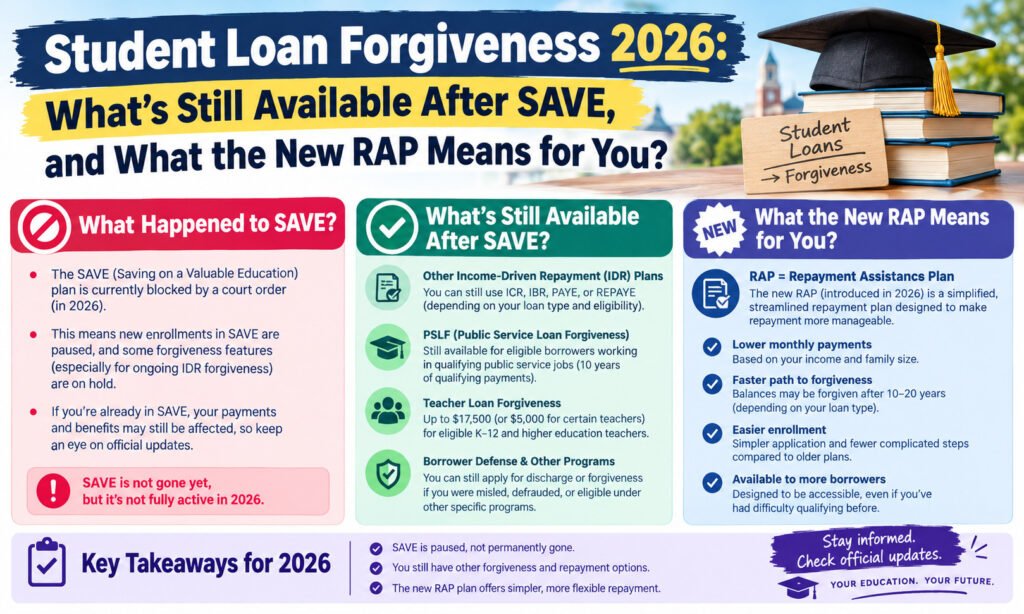
SAVE ended in the courts, not in Congress. The Eighth Circuit reversed an earlier dismissal, and the SAVE rule was formally vacated on March 10, 2026. More than 7 million borrowers were still enrolled when the wind-down began, many of them sitting in an administrative forbearance with no required payments.
Under a court settlement, servicers started emailing every SAVE borrower on July 1, 2026. Each borrower got 90 days to pick a new plan. Those who missed the window are now getting one final 30-day notice, according to updated guidance on StudentAid.gov in October 2026. A borrower whose servicer sent the notice late can end up with a last day to choose that falls around October 30, so check your own notice rather than assuming a single national date.
If you ignore both notices, you do not simply stay put. Borrowers with no loans disbursed on or after July 1, 2026 move to the 10-year Standard Repayment Plan. Borrowers with newer loans move to the new Tiered Standard plan. Payments then become due, and missing them leads toward delinquency and default.
The options for most SAVE borrowers are the Standard plan, Income-Based Repayment (IBR), and the new RAP. IBR sets payments at 10% to 15% of discretionary income depending on when you borrowed, and it is the most durable of the older income-driven plans because it is written into the law and is not being phased out.
The new RAP: how it works and who it hits
The Repayment Assistance Plan was created by the One Big Beautiful Bill Act, signed July 4, 2025, and opened for applications on July 1, 2026. The Education Department said nearly 46,000 borrowers applied on day one. It is the only income-driven plan for anyone who takes out a new federal loan on or after July 1, 2026.
How the payment is calculated. RAP uses your full adjusted gross income (AGI), not discretionary income, so no slice of income is shielded the way older plans did it. The percentage rises by one point for each $10,000 of AGI:
| AGI | Share of AGI paid per year |
| $10,000 or less | Flat $120 ($10 a month) |
| $10,001 to $20,000 | 1% |
| $20,001 to $30,000 | 2% |
| $30,001 to $40,000 | 3% |
| $40,001 to $50,000 | 4% |
| $50,001 to $60,000 | 5% |
| Rising 1 point per $10,000 | Up to 9% |
| Above $100,000 | 10% |
Divide the annual figure by 12, then subtract $50 per dependent you claim. The floor is $10 a month, so the old $0 payment is gone. Married borrowers filing jointly use combined household AGI; those filing separately use only their own.
The protections. If your payment does not cover the monthly interest, the unpaid interest is waived. If your payment cuts principal by less than $50, the government adds a match of up to $50 so the balance falls every month. Loan balance does not affect the payment at all.
The catch. Forgiveness comes after 360 qualifying payments, a flat 30 years. SAVE, PAYE and ICR offered 20 or 25 years. Financial aid experts quoted by Quartz warn that RAP can make payments unaffordable for some because it does not protect any income. The Congressional Budget Office projected federal savings of about $270.5 billion over FY2025 to FY2034, partly because it expects more borrowers to repay under RAP.
Who has to move. Borrowers with only older loans who take no new federal loans can stay on a legacy plan or switch to RAP. ICR and PAYE are being phased out through July 2028, leaving IBR as the only old plan. Take out even one new federal loan after July 1, 2026, and RAP or Tiered Standard becomes your only choice for every loan you hold, old ones included. Parent PLUS loans are not eligible for RAP, and new Parent PLUS loans are limited to Tiered Standard. Time spent in RAP does not carry back to IBR, ICR or PAYE forgiveness clocks, so switching back loses that progress.
Forgiveness that is still available
Broad one-time cancellation is off the table: the Biden-era efforts were stopped by courts. What remains is a set of earned or conditional routes.
| Route | Who it fits | Time to forgiveness | Federal tax on forgiven amount (2026) |
| PSLF | Full-time government or 501(c)(3) nonprofit workers | 120 qualifying payments, about 10 years | None |
| IBR | Borrowers who want a durable, law-backed income-driven plan | 20 or 25 years | Yes, taxable |
| RAP | Anyone with new loans; optional for older borrowers | 30 years (360 payments) | Yes, taxable |
| ICR and PAYE | Existing borrowers, until phased out by July 2028 | 20 to 25 years | Yes, taxable |
| Teacher Loan Forgiveness | Qualifying teachers in eligible schools | After required service | None |
| Borrower defense | Students defrauded by their school | On approval | None |
| Total and Permanent Disability discharge | Borrowers with qualifying disability | On approval | None federally; some states may tax it |
Two points make this table less simple than it looks. First, PSLF counts payments made under RAP, so RAP is effectively the main income-driven route for new borrowers who want PSLF, because the Standard plan does not qualify. Second, the Tiered Standard plan, with terms of 10 to 25 years based on balance, is not PSLF-eligible, so a new borrower who lets the default happen earns no forgiveness credit.
PSLF: the latest, including this week
The employer rule is dead, for now. In October 2025 the Education Department finalized a rule letting the Secretary disqualify an employer found to have a “substantial illegal purpose”, effective July 1, 2026. Federal courts vacated it on June 30, 2026, the day before it took effect, so no employer was ever disqualified under it. On October 21, 2026, the Justice Department dropped its two appeals in single-sentence agreements, with each side bearing its own fees and no explanation given. Student Defense called it a significant victory. The Department could still write a new rule, but today the test is the one PSLF has always had: government agencies and 501(c)(3) nonprofits qualify.
Credit reversals. The Department has confirmed it is reducing PSLF payment counts for some borrowers because of coding errors that gave credit to months that should not have counted, including some months on extended or graduated plans. It has not said how many borrowers are affected. If you are close to 120 payments, check your count on StudentAid.gov and keep copies of every past employment certification.
Buyback backlog. PSLF Buyback lets you pay for months spent in eligible forbearance or deferment so they count toward the 120. This matters most to former SAVE borrowers, because the SAVE forbearance months do not count automatically. A reported backlog of roughly 82,000 applications in early October 2026 has left borrowers waiting many months, and the Department changed how buyback is calculated for SAVE borrowers on March 31, 2026, which raises the cost for many. New borrowers on RAP or Tiered Standard are effectively cut off from buyback.
Practical rule. If you are pursuing PSLF, move to an income-driven plan that counts, certify your employment now, and do not leave months uncounted in a forbearance.
The tax bomb is back
The American Rescue Plan Act of 2021 made most student loan forgiveness tax-free through December 31, 2025. Congress did not extend it, so income-driven forgiveness granted on or after January 1, 2026 is generally taxable federal income again. A report from Protect Borrowers, covered on October 19, 2026, estimates that 2 million to 3 million people could face a tax bill over the next decade. It puts the average balance canceled through income-driven plans at $49,697, and says nearly 13 million Americans are enrolled in such plans.
The extra income can push a borrower into a higher bracket and can reduce credits such as the earned income tax credit and the child tax credit. If your forgiveness lands in 2026, you will report it on the return you file in April 2027. The Department has said that if you met the criteria for forgiveness in 2025, it will treat the forgiveness as occurring in 2025 even if it posts later.
Not everything is taxed. PSLF, Teacher Loan Forgiveness, borrower defense and disability discharge remain federally tax-free, though a state can tax some of them.
Still, experts quoted in the coverage say forgiveness is usually worth taking even with a bill. A taxable event on a $30,000 balance is generally cheaper than paying the $30,000. If your debts exceed your assets at the moment of forgiveness, the IRS insolvency exclusion may cut or erase the tax. Because RAP stretches the clock to 30 years, most RAP borrowers will not see this bill until the 2050s, and the law may change before then.
Defaults, garnishment and the Treasury shift
Collections resumed in 2026 after a pause that began in March 2020. The Education Department began sending wage garnishment notices in early January 2026, starting with about 1,000 borrowers and rising monthly. Garnishment can take up to 15% of pay and can also hit federal tax refunds and some federal benefits. A borrower is generally in default after about 270 days of missed payments, and a 30-day notice comes first.
The scale is large. Analysts estimated about 5.5 million borrowers in default and about 12 million delinquent or in default, more than one in four federal borrowers. The Federal Reserve Bank of New York reported that 9.6% of federal student loans were seriously delinquent, 90 days or more late, in the fourth quarter of 2025.
On October 21, 2026, Forbes reported that the administration may move the federal student loan portfolio out of the Education Department, possibly into a new independent agency, and that Treasury is already taking over operational control of defaulted-loan collections. An Education Department spokesperson called the broader report “fake news”, so treat the full transfer as unconfirmed. Borrower groups warn that a move would not lower costs.
The practical point: getting out of default, through rehabilitation, consolidation or a repayment agreement, matters more than any forgiveness plan, because defaulted loans cannot earn forgiveness credit.
What to do now?
- Log in to StudentAid.gov, find your SAVE notice and note your exact deadline.
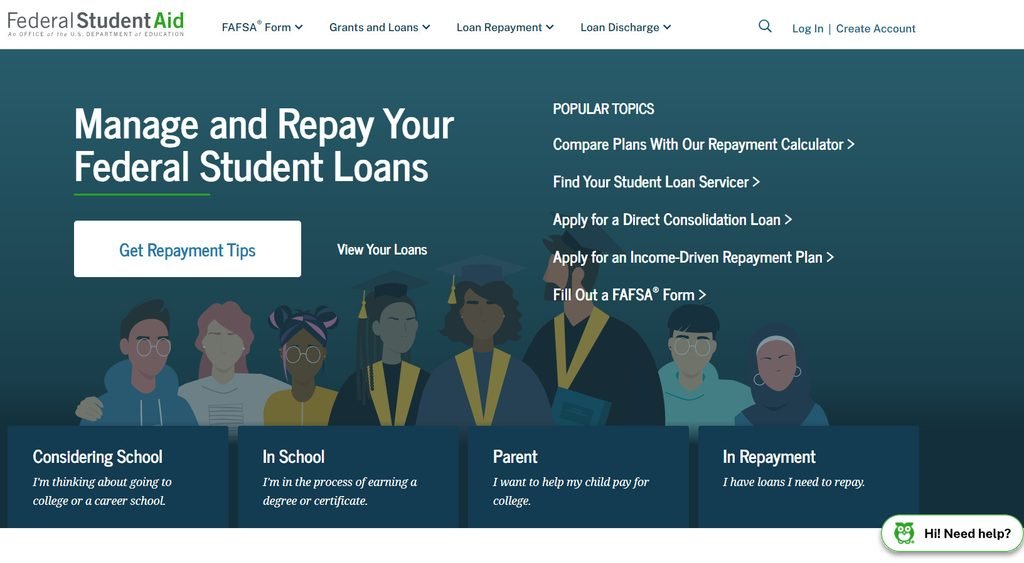
- Compare IBR, RAP and Standard with the Repayment Calculator before choosing.
- Pursuing PSLF? Pick a qualifying plan, certify employment and check your payment count.
- Avoid taking new federal loans if you want to keep access to IBR.
- Expecting IDR forgiveness in 2026 or later? Speak to a tax preparer about the bill.
- In or near default? Contact your servicer about rehabilitation or a repayment agreement.
Sources
Compiled from search results on October 22, 2026; I did not open every page in full, so verify figures against StudentAid.gov before acting.
- NerdWallet: What Is the New RAP
- NYC DCA: Key Changes in Federal Student Loan Repayment
- The College Investor: How RAP Works
- The College Investor: 46,000 RAP applications on day one
- The College Investor: SAVE final 30-day notice, Oct 15, 2026
- Newsweek: What to do if you get a Final Notice
- Quartz: RAP and your wallet
- CRS: RAP in P.L. 119-21
- Tate Law: PSLF changes
- HuffPost/AP: administration drops PSLF appeals
- Newsweek: PSLF credit reversals
- ADN: PSLF Buyback backlog
- CPA Practice Advisor: tax bomb study
- Newsweek: Protect Borrowers tax report
- NPR: wage garnishment resumes
- Forbes: loans possibly leaving Education Department
FAQ’s on Student Loan Forgiveness 2026
Is SAVE really over?
Yes. The rule was vacated on March 10, 2026, and borrowers are being moved off it. If you have not chosen a plan, you are on a final 30-day notice.
What happens if I do nothing?
You are placed on the Standard plan, or Tiered Standard if you have newer loans. Payments become due, and missed ones can lead to delinquency and default.
Should I choose RAP or IBR?
It depends on your income and timeline. IBR offers forgiveness after 20 or 25 years, while RAP takes 30 but adds interest waivers and a principal match. Run both through the Repayment Calculator.
Where should I check my own status?
Your StudentAid.gov account and your servicer. Beware of scams charging fees for help you can get free.
Can I still get PSLF?
Yes. You need 120 qualifying payments while working full-time for an eligible employer. The employer-disqualification rule was vacated, and the Justice Department dropped its appeals on October 21, 2026.
Will there be a broad cancellation?
None is scheduled. Earlier attempts were blocked in court, and the current policy direction is tighter repayment and collections, not new relief.
Does RAP cover Parent PLUS loans?
No. New Parent PLUS loans are limited to Tiered Standard, and older ones need consolidation to reach other income-driven options.
Is forgiveness taxed?
Income-driven forgiveness granted from 2026 is generally taxable federally. PSLF, Teacher Loan Forgiveness, borrower defense and disability discharge are not.