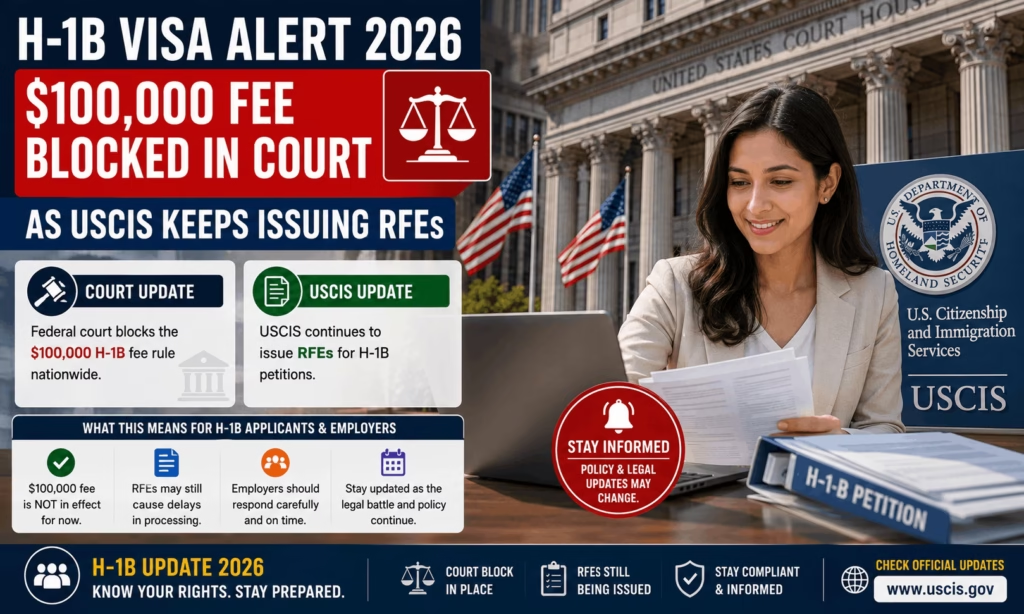
H-1B Visa Alert 2026: The H-1B $100,000 fee is currently blocked and not being collected, but the legal fight over it is far from finished, and the situation has changed multiple times in just the past few weeks. If you read an article saying the fee is “still in effect pending appeal,” that information is now outdated. On July 24, 2026, the U.S. Court of Appeals for the First Circuit denied the federal government’s request to pause a lower court ruling that struck the fee down, meaning USCIS is currently barred from assessing the $100,000 payment on H-1B petitions. This is the third distinct legal phase the fee has gone through since September 2025, and it will not be the last, since the underlying appeal is still being argued.
At the same time, a separate but connected trend is making H-1B filing genuinely harder regardless of the fee’s legal status: Requests for Evidence (RFEs) have climbed sharply, reaching roughly 23% of all H-1B petitions in fiscal year 2025, up from just 15.2% in fiscal year 2023. This article has been rebuilt with the most current confirmed court rulings and USCIS adjudication data as of late July 2026, so employers and workers are not relying on an earlier snapshot of a situation that keeps shifting. We’ll be updating this article monthly as the appeal proceeds and as new RFE data becomes available.
H-1B $100,000 Fee and RFE Status July 2026 Key Highlights
| Detail | Current Confirmed Status |
|---|---|
| Fee announced | Presidential Proclamation 10973, September 19, 2025 |
| Fee took effect | September 21, 2025, 12:01 a.m. EDT |
| Who the fee applied to | New H-1B petitions for beneficiaries outside the United States, subject to consular processing |
| Lawsuit filed by | Coalition of 20 Democratic-led state attorneys general, led by California and Massachusetts |
| Court | U.S. District Court for the District of Massachusetts |
| Judge | Leo T. Sorokin |
| District court ruling | June 8, 2026, fee vacated as an unlawful, unauthorized tax |
| Government’s stay motion filed | June 18, 2026 |
| Fee temporarily collectible again | June 12 to July 24, 2026 |
| First Circuit denies government’s stay request | July 24, 2026 |
| Fee status as of July 27, 2026 | Not in effect; USCIS barred from assessing it |
| Is the litigation finished | No, the appeal on the merits is still ongoing |
| H-1B RFE rate, FY2025 | Approximately 23% of petitions |
| H-1B RFE rate, FY2023 | 15.2% of petitions |
| Standard RFE response window | 60 to 87 days, no extensions in 2026 |
Timeline: How the H-1B $100,000 Fee Has Changed Status Since 2025
Because this policy has moved through several distinct legal stages, a simple timeline is the clearest way to understand where things stand.
- September 19, 2025: President Trump issued Presidential Proclamation 10973, imposing a $100,000 payment condition on covered new H-1B petitions for workers outside the United States.
- September 21, 2025: The fee officially took effect for qualifying petitions.
- Late 2025 into January 2026: A coalition of 20 state attorneys general, led by California and Massachusetts, filed suit in the U.S. District Court for the District of Massachusetts, arguing the administration exceeded its statutory and constitutional authority. The U.S. Chamber of Commerce filed a separate legal challenge as well.
- June 8, 2026: Judge Leo Sorokin ruled the $100,000 payment was effectively an unauthorized tax, which only Congress can impose, and vacated the implementing policy in its entirety, also citing violations of the Administrative Procedure Act.
- June 12 to July 24, 2026: The fee briefly became collectible again while a temporary administrative stay of the district court’s own ruling was in place.
- June 18, 2026: The federal government formally filed a motion asking the First Circuit Court of Appeals to stay Judge Sorokin’s ruling for the duration of the appeal.
- July 24, 2026: The First Circuit denied the government’s stay request, concluding the government had not shown a strong likelihood of winning its appeal on the merits.
- As of July 27, 2026: The fee is not in effect anywhere in the United States, though USCIS had not yet updated all public-facing guidance and Pay.gov pages to reflect the new posture, creating some practical confusion for filers.
Trump Accounts App 2026: Who Qualifies for the $1,000 Government Deposit?
State-by-State Social Security Payments 2026: Where Benefits Are Highest?
Why the Court Struck the H-1B Fee Down
The core of Judge Sorokin’s ruling rested on a straightforward constitutional principle: only Congress has the authority to impose a tax, and the court concluded the $100,000 H-1B payment functioned as exactly that, a tax, rather than a legitimate immigration processing fee tied to actual government costs. The ruling drew on reasoning from a recent Supreme Court tariff case in reaching this conclusion. The court also found the policy’s implementation violated the Administrative Procedure Act (APA), and separately found that Congress never clearly authorized the executive branch to impose a fee of this magnitude through a presidential proclamation. When the First Circuit reviewed the government’s request to pause this ruling in July 2026, it agreed that the government had not demonstrated it was likely to succeed in overturning these core findings on appeal.
Is the H-1B $100,000 Fee Still Required Right Now
As of the most recent confirmed status, no, employers do not currently have to pay the $100,000 fee on covered H-1B petitions. However, immigration attorneys are cautioning employers not to treat this as final. The appeal itself has not been decided on the merits, only the request to pause the lower court’s ruling while that appeal continues. The government is expected to keep pressing its case, and the fee’s legal status could shift again depending on further rulings from the First Circuit or a possible request to the Supreme Court. Employers preparing H-1B petitions, especially those involving a beneficiary outside the United States or consular notification, are advised to consult immigration counsel before filing rather than relying solely on the current favorable posture.
Who Was Ever Affected by the H-1B Fee
Even at the height of its enforcement, the $100,000 payment never applied to every H-1B filing. USCIS guidance confirmed the fee only ever applied to:
- New H-1B petitions filed on or after September 21, 2025
- Petitions approved for consular processing, meaning the worker was located outside the United States at the time of filing
The fee did not apply to routine H-1B extensions, transfers between employers for workers already inside the United States, or later international travel by workers who already held an approved H-1B status. This distinction is important, since some confusion has understandably persisted around whether the policy touched the broader H-1B population.
USCIS Requests for Evidence (RFEs) Are Rising Sharply in 2026
Separate from the fee litigation, a second and arguably more disruptive trend has been building throughout 2026: a steady rise in RFEs across H-1B petitions. An RFE is a formal notice USCIS issues under 8 CFR 103.2(b)(8) when an adjudicating officer determines that the initial filing does not sufficiently establish eligibility, giving the petitioner a defined window to submit additional evidence before a final decision.
RFE rates reached approximately 23% of all H-1B petitions in fiscal year 2025, a significant jump from 15.2% in fiscal year 2023. Immigration attorneys report that this trend reflects a broader shift in how USCIS is adjudicating employment-based petitions generally, not just H-1B filings, with cases that would have been approved without question a few years ago now facing extensive follow-up requests and delays.
Top Reasons USCIS Is Issuing More H-1B RFEs
According to immigration law firms tracking adjudication patterns closely in 2026, several recurring triggers stand out:
- Specialty occupation challenges remain the single most common RFE trigger for H-1B petitions this year, with USCIS scrutinising whether the role genuinely requires a specific bachelor’s degree or higher.
- Wage level scrutiny, particularly for positions classified at the lowest, Level 1 prevailing wage tier, has become one of the most frequent triggers, since officers increasingly question whether duties described as complex or specialized are consistent with an entry-level wage classification.
- Career progression gaps, where USCIS requests evidence that a position is part of a structured internal career path within the company, rather than accepting the job description at face value.
- Increased use of AI-assisted screening, with USCIS confirming in 2026 that it is using automated tools for fraud detection, pattern identification, and cross-referencing data across different petition types, which attorneys say is contributing to the overall increase in scrutiny.
- Status maintenance questions for change-of-status or extension petitions, including gaps in employment or questions about whether F-1 status was properly maintained before a transition to H-1B.
How to Respond to an H-1B RFE in 2026
Receiving an RFE is not a denial. It is USCIS asking for more evidence before making a final decision, and the majority of cases are still ultimately approved after a well-prepared response. That said, the process has become noticeably stricter in 2026:
- Read every specific request in the notice carefully. USCIS RFE notices detail exactly what evidence is required, and responses that miss a specific point are far more likely to be denied.
- Respond within the deadline, generally 60 to 87 days. USCIS has adopted a stricter no-extension posture in 2026, meaning missed deadlines are far less likely to be forgiven than in previous years.
- Build in a buffer before the actual deadline. Immigration attorneys commonly recommend targeting submission around 10 days before the true “drop dead” date to account for slow document turnaround from universities, clients, or third parties.
- Address wage level and specialty occupation questions directly, since these remain the most common RFE categories, with detailed job duty descriptions, organizational charts, and degree-requirement evidence.
- Consider experienced legal representation. Immigration attorneys report meaningfully higher approval rates for comprehensive, attorney-prepared RFE responses compared with self-filed submissions.
2027 Social Security COLA Forecast: Latest Estimate, Medicare Offset & What Retirees Can Expect
OAS Payment Increase July 2026: Confirmed Amounts, Payment Date, and the Annual GIS Reset !
Official H-1B and USCIS Resources
Always confirm the current legal status of the fee and any petition-specific requirements directly through official government channels, since the litigation is ongoing and guidance pages can lag behind court rulings.
| Purpose | Official Resource |
|---|---|
| Official H-1B program information | USCIS H-1B Specialty Occupations page (uscis.gov) |
| Check current case status | USCIS Case Status Online (egov.uscis.gov) |
| File or track an H-1B petition (Form I-129) | USCIS Form I-129 page (uscis.gov) |
| Create or log in to a USCIS online account | myaccount.uscis.gov |
| Department of Labor prevailing wage information | flcdatacenter.com and dol.gov Office of Foreign Labor Certification |
| Track official court filings on the fee litigation | U.S. Court of Appeals for the First Circuit, PACER case records |
| Original Presidential Proclamation text | Federal Register, Proclamation 10973 |
People Also Ask
Is the H-1B $100,000 fee still in effect in 2026? No, as of the most recent court ruling, the fee is not in effect. The First Circuit Court of Appeals denied the government’s request to pause a district court ruling that struck the fee down, though the underlying appeal is still ongoing.
Why did the court strike down the H-1B $100,000 fee? A federal judge ruled the payment functioned as an unauthorized tax that only Congress can impose, and also found the policy violated the Administrative Procedure Act.
Does the H-1B fee apply to all H-1B workers? No, it only ever applied to new H-1B petitions filed on or after September 21, 2025, for workers located outside the United States and subject to consular processing. Extensions, transfers, and travel by workers already holding H-1B status were not covered.
Why are H-1B RFEs increasing in 2026? Immigration attorneys point to broader USCIS scrutiny of employment-based petitions, increased use of AI-assisted screening tools, and closer examination of wage levels and specialty occupation classifications.
What should I do if I receive an H-1B RFE? Read the notice carefully, respond to every specific request within the 60 to 87 day deadline, and strongly consider working with an immigration attorney, since prepared, comprehensive responses have significantly higher approval rates.
FAQs
Q1. What is Presidential Proclamation 10973?
It is the September 19, 2025 proclamation that created the $100,000 payment requirement for certain new H-1B petitions involving workers located outside the United States.
Q2. Who sued over the H-1B $100,000 fee?
A coalition of 20 state attorneys general, led by California and Massachusetts, filed suit in the U.S. District Court for the District of Massachusetts. The U.S. Chamber of Commerce filed a separate legal challenge as well.
Q3. Could the H-1B fee come back?
Yes. The district court’s ruling vacating the fee remains in effect while the government’s appeal continues, but the appeal itself has not been decided on the merits, so the outcome could still change.
Q4. What is an H-1B RFE?
A Request for Evidence is a formal USCIS notice asking a petitioner to submit additional documentation before a final decision is made on an H-1B petition, issued when an officer finds the initial filing insufficient.
Q5. What percentage of H-1B petitions get an RFE in 2026?
RFE rates reached approximately 23% of H-1B petitions in fiscal year 2025, continuing an upward trend from 15.2% in fiscal year 2023.
Q6. Does receiving an RFE mean my H-1B petition will be denied?
No. An RFE simply means USCIS wants more evidence before deciding. The majority of H-1B petitions that receive a well-prepared response are still ultimately approved.
Conclusion
The H-1B $100,000 fee remains legally blocked as of late July 2026, following the First Circuit’s refusal to pause the district court’s ruling that struck it down, but the underlying appeal is still active and the situation has already shifted multiple times since September 2025. At the same time, the rising rate of H-1B RFEs, now affecting close to a quarter of all petitions, means employers and workers face real practical hurdles regardless of how the fee litigation ultimately resolves. Given how quickly this landscape has changed, employers should confirm the current status directly with immigration counsel and official USCIS resources before filing, and check back here for monthly updates as both the appeal and adjudication trends continue to develop.
Also Read
$2969 Social Security Benefit 2026 Eligibility, How to Apply & Fact Checked