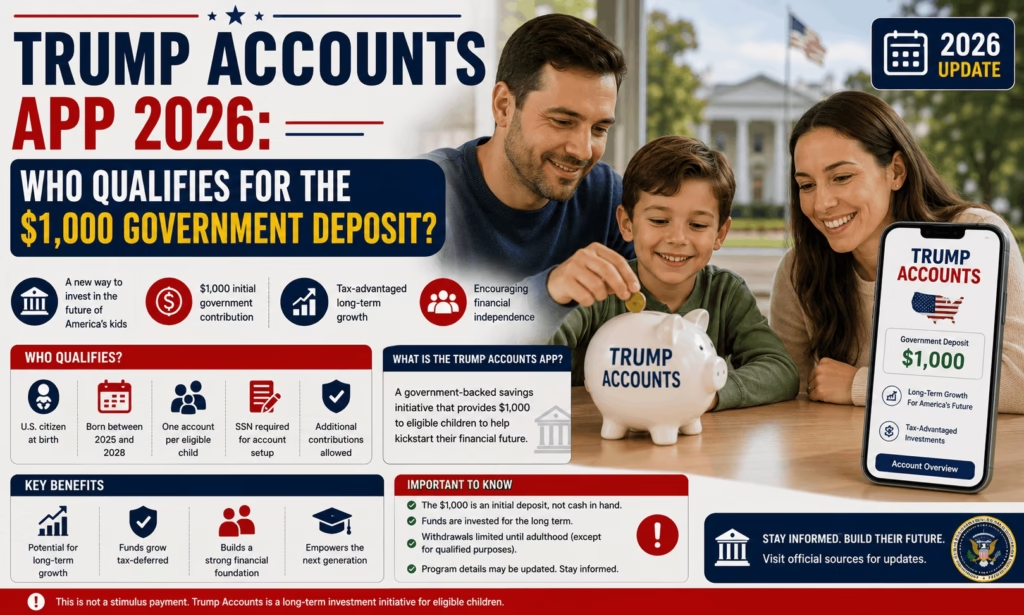
Trump Accounts App 2026: The Trump Accounts $1,000 deposit program is now live, and the rollout has moved fast enough that a lot of older coverage is already out of date. The Trump Accounts app launched on May 28, 2026, built in partnership with Bank of New York Mellon and Robinhood, giving parents and guardians a direct way to activate their children’s accounts ahead of the official program launch on July 4, 2026. If you read an earlier article that only described the program as “coming soon,” that information no longer applies. Trump Accounts are now fully operational, the $1,000 government seed deposits are being paid out, and the Social Security Administration has since added a new hospital-based enrollment option that did not exist when the program first launched.
This guide has been rebuilt using the most current Treasury and IRS data available, covering exactly who qualifies for the $1,000 deposit, how the separate $250 charitable deposit works for older children, the enrollment process through IRS Form 4547 or TrumpAccounts.gov, and the newest Social Security Administration update allowing enrollment directly at the hospital. We’ll be updating this article monthly, since enrollment numbers, eligibility guidance, and possible auto-enrollment policy are all still actively evolving as Treasury works through the rollout.
Trump Accounts 2026 Key Highlights
| Detail | Current Confirmed Information |
|---|---|
| App launch date | May 28, 2026 |
| Official program launch date | July 4, 2026 |
| Built in partnership with | Bank of New York Mellon and Robinhood |
| Who can open an account | Any U.S. child under 18 with a Social Security number |
| Who qualifies for the $1,000 government deposit | Children born between January 1, 2025 and December 31, 2028, who are U.S. citizens |
| Separate charitable deposit for older children | $250, for children age 10 or under born before January 1, 2025, in qualifying lower-income ZIP codes |
| Charitable deposit funded by | Michael & Susan Dell Foundation, $6.25 billion pledge |
| Annual family and employer contribution limit | $5,000 combined (up to $2,500 from an employer, potentially pre-tax) |
| Enrollment method | IRS Form 4547 with your 2025 tax return, or register at TrumpAccounts.gov |
| New hospital enrollment option | Enumeration at Birth (EAB) system, available from July 3, 2026 |
| Children signed up nationwide (mid-July 2026) | Over 6.5 million |
| Children confirmed eligible for the $1,000 deposit | Approximately 1.4 million |
| Total family contributions since launch (as of July 10, 2026) | Almost $125 million |
What Are Trump Accounts and How Do They Work
A Trump Account is a federally created, tax-deferred, IRA-style investment account for children under the age of 18. Unlike a 529 college savings plan, which is built around education costs, Trump Accounts are structured more like a retirement account, designed to build long-term wealth rather than pay for shorter-term expenses. Once opened, funds inside a Trump Account are invested in low-cost U.S. stock index funds and generally cannot be withdrawn before the child turns 18. At that point, the account converts into a traditional IRA and follows standard IRA withdrawal rules.
Treasury has positioned the program as a way to extend investing access to every family, not only households that already use trust funds or brokerage accounts for their children. Because the accounts grow tax-deferred, any investment gains are not taxed each year, though withdrawals later in life may still be partially taxable depending on the mix of pre-tax and after-tax contributions made along the way.
State-by-State Social Security Payments 2026: Where Benefits Are Highest?
2027 Social Security COLA Forecast: Latest Estimate, Medicare Offset & What Retirees Can Expect
Who Qualifies for the $1,000 Government Deposit
This is the detail causing the most confusion, since not every child with a Trump Account receives the $1,000 payment. Eligibility for the government-funded seed deposit is narrower than eligibility to simply open an account.
- Any U.S. child under 18 with a Social Security number can have a Trump Account opened for them.
- Only children born between January 1, 2025 and December 31, 2028, who are U.S. citizens, qualify for the one-time $1,000 deposit from the U.S. Department of the Treasury.
- Children born before January 1, 2025 do not qualify for the $1,000 government deposit, even if an account is opened for them.
This means a family can absolutely open a Trump Account for an older child, but that account will start with a zero balance unless the family or another eligible contributor adds funds themselves, or the child happens to qualify for the separate charitable deposit described below.
The Separate $250 Deposit for Older Children
For families with children who do not qualify for the Treasury’s $1,000 seed deposit, a private philanthropic program is filling part of the gap. Children age 10 or under, born before January 1, 2025, who live in a ZIP code where the median household income is $150,000 or less, may qualify for a $250 charitable deposit funded through a $6.25 billion pledge from tech entrepreneur Michael Dell and his wife Susan, via the Michael & Susan Dell Foundation. This is not a government payment and is administered separately from the Treasury’s contribution, but it uses the same Trump Account infrastructure, meaning eligible families do not need to set up a separate account to receive it.
How to Enroll and Claim the $1,000 Deposit
There are currently three main ways to enroll a child in the Trump Accounts program, depending on your situation:
- File IRS Form 4547 with your 2025 tax return. This is the standard route for most families and directly signals eligibility for the government deposit when you file.
- Register directly at TrumpAccounts.gov. Families who prefer not to wait for tax filing season can register through the official Treasury website.
- Use the new Social Security Administration hospital enrollment process. Starting July 3, 2026, parents of newborns can enroll directly through the hospital birth-registration process using the Enumeration at Birth (EAB) system, removing the need for a completely separate application in most cases.
If more than one person could open an account for the same child, such as a parent and a grandparent both attempting to enroll separately, the IRS follows a strict priority order: legal guardian first, then parent, then adult sibling, and finally grandparent. Once one eligible person makes the election and opens the account, no one else can open a duplicate account for that same child.
Trump Accounts App: How Activation Works
The Trump Accounts app, available on both the Apple App Store and Google Play, acts as the primary interface for families who have already submitted their enrollment through IRS Form 4547 or TrumpAccounts.gov. After families who have already signed up their children receive an activation email from Treasury, they can complete account setup either through the app or directly on TrumpAccounts.gov. Treasury Secretary Scott Bessent has described the app as designed to give parents and young Americans a simple, secure way to begin engaging with the program from day one.
It is worth being clear that downloading the app alone does not automatically qualify a child for the $1,000 deposit. The app is an activation and management tool; eligibility itself is determined by the child’s date of birth, citizenship status, and completed enrollment through one of the official channels above.
Contribution Rules: How Much Can Families Add
Beyond the initial government or charitable seed deposit, families and other eligible parties can continue contributing to a Trump Account each year.
- Family and employer contributions share a combined annual limit of $5,000.
- Up to $2,500 of that annual limit can come from an employer, and in some cases this can be contributed pre-tax through a workplace cafeteria plan.
- Qualifying charitable organizations and state or local governments may also contribute, and these contributions do not count toward the $5,000 family and employer limit.
- Contributions made by parents, guardians, grandparents, or others generally do not trigger a gift tax filing requirement, and count toward the standard annual gift tax exclusion, which is $19,000 per recipient for 2026.
Current Enrollment Numbers and Rollout Progress
As of mid-July 2026, Treasury figures show more than 6.5 million children have been signed up for Trump Accounts nationwide, but only around 1.4 million are confirmed eligible for the actual $1,000 government contribution, since many of those signed up were born outside the qualifying 2025 to 2028 window or enrollment paperwork is still being processed. This suggests that a majority of children who are eligible for the deposit have still not been enrolled, with early estimates suggesting only around 39% of eligible children have been signed up so far.
Because of the relatively low enrollment rate among eligible families, policy researchers, including analysts connected to organizations focused on child welfare and family policy, have publicly pushed Treasury to consider automatic enrollment for eligible newborns by default, along with a coordinated process to include children in foster care through a dedicated enrollment window after court-appointed placement. As of the most recent update, Treasury has not announced a final decision on automatic enrollment, though the new SSA hospital-based enrollment option is widely viewed as a step in that direction.
Official Trump Accounts Resources and Links
Always confirm your child’s specific eligibility and enrollment status through official government channels rather than third-party estimates.
| Purpose | Official Resource |
|---|---|
| Main program information and registration | TrumpAccounts.gov |
| Download the official Trump Accounts app | Apple App Store and Google Play (search “Trump Accounts”) |
| Enroll through your tax return | IRS Form 4547, filed with your 2025 tax return |
| Newborn hospital enrollment (from July 3, 2026) | Social Security Administration Enumeration at Birth (EAB) process, via your hospital’s birth registration |
| Official Treasury announcements | U.S. Department of the Treasury press releases (home.treasury.gov) |
| Report suspected scams related to Trump Accounts | U.S. Department of the Treasury fraud reporting guidance via TrumpAccounts.gov |
People Also Ask
Who qualifies for the $1,000 Trump Account deposit? Children born between January 1, 2025 and December 31, 2028, who are U.S. citizens with a Social Security number, qualify for the one-time $1,000 government deposit.
Can I open a Trump Account for an older child? Yes, any U.S. child under 18 with a Social Security number can have a Trump Account opened for them, but only children born from 2025 through 2028 receive the automatic $1,000 government deposit.
How do I sign up for a Trump Account? You can enroll by filing IRS Form 4547 with your 2025 tax return, registering directly at TrumpAccounts.gov, or, for newborns from July 3, 2026 onward, through the hospital’s Enumeration at Birth process.
Is the Trump Accounts app required to get the $1,000 deposit? No, the app is a management and activation tool. Eligibility for the deposit is based on your enrollment through IRS Form 4547 or TrumpAccounts.gov, and your child’s date of birth and citizenship status.
When did Trump Accounts officially launch? The Trump Accounts app launched on May 28, 2026, while the program itself, including the start of the $1,000 deposits, officially launched on July 4, 2026.
FAQs
What is a Trump Account?
A Trump Account is a federally created, tax-deferred, IRA-style investment account for children under 18, designed to build long-term savings that convert into a traditional IRA at age 18.
Do all children get the $1,000 government deposit?
No. Only children born between January 1, 2025 and December 31, 2028, who are U.S. citizens, automatically qualify for the Treasury’s $1,000 seed deposit.
What is the $250 deposit and who gets it?
It is a separate charitable contribution, funded by the Michael & Susan Dell Foundation, available to children age 10 or under born before January 1, 2025, who live in ZIP codes with a median household income of $150,000 or less.
How much can my family contribute to a Trump Account each year?
Family and employer contributions share a combined annual limit of $5,000, with up to $2,500 of that able to come from an employer, potentially pre-tax.
Will contributing to my child’s Trump Account affect my taxes?
Contributions generally do not trigger a gift tax filing requirement and count toward the standard annual gift exclusion of $19,000 per recipient in 2026, though withdrawn earnings later may be taxed as ordinary income.
Can I withdraw money from a Trump Account before my child turns 18?
Generally, no. Trump Account funds are intended to remain invested until the child turns 18, at which point the account converts into a traditional IRA under standard IRA rules.
Conclusion
The Trump Accounts $1,000 deposit program has moved from announcement to full rollout, with the app live since May 28, 2026, the official program launch on July 4, 2026, and millions of children already signed up nationwide. Eligibility for the free government deposit remains specific: only children born between 2025 and 2028 with U.S. citizenship qualify automatically, while a separate philanthropic $250 deposit fills part of the gap for younger children born earlier in qualifying ZIP codes. With enrollment still sitting well below full eligibility and possible auto-enrollment policy changes under discussion, families should confirm their status directly through TrumpAccounts.gov or the official app rather than relying on outdated information, and check back here for monthly updates as the program continues to evolve.
Also Read
$2969 Social Security Benefit 2026 Eligibility, How to Apply & Fact Checked
Social Security Benefits for Children 2026 Eligibility, Payment Amounts, and How to Apply
SNAP Maximum Monthly Benefits 2026 by State: Full Payment Chart, Eligibility & Calculator Guide