The LIHEAP application dates by state are rolling out this week and next, and the first big wave of sign ups starts Monday, November 2. Pennsylvania, New York and Ohio all open that day, Illinois has been taking applications from older adults, people with disabilities and families with young children since October 1, and New Jersey has been open since the first of the month. Most programs pay on a first come, first served basis, so the households that apply in the first days are the ones most likely to be funded before money runs low. The federal side looks steadier than it did a year ago: HHS has released the first $3.6 billion of this year’s heating aid to states, according to the American Public Power Association. We’ll be updating this article monthly.
Nothing about the money is guaranteed, though. The remaining 10 percent of the federal funds still has to be released, and the administration’s budget request again proposes eliminating the program. Meanwhile heating costs are rising: New York officials say heating oil prices are up 67 percent and kerosene up 50 percent from last year. This guide gives you the verified dates for five states, the income limits and benefit amounts, the federal funding picture, how to apply, what to do in a heating emergency, and a free screener that checks your household against each state’s limit. For states we do not cover, the official links table at the end shows where to find your own state’s dates.
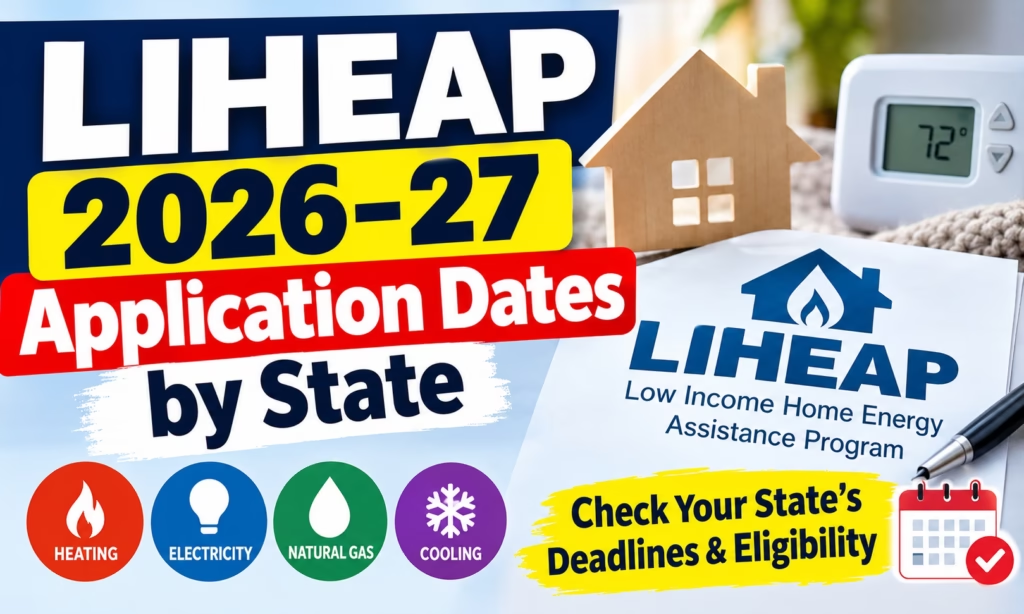
LIHEAP 2026-27 Application Dates by State Key Highlights
| State | Application opens | Closes or deadline |
|---|---|---|
| Pennsylvania | Monday, November 2 | Not announced yet. Last season ran December 3 through May 8 |
| New York | Monday, November 2 for regular HEAP | Emergency HEAP opens January 4, 2027. No regular deadline was stated |
| Ohio | Monday, November 2 | March 31, 2027 |
| Illinois | October 1 for older adults, people with disabilities, families with a child 5 or younger, and households disconnected or low on propane. November 1 for everyone else | August 13, 2027, or earlier if funds run out |
| New Jersey | October 1 | June 30, 2027, while funding lasts |
Where LIHEAP Funding Stands?
LIHEAP is a federal block grant, and the states run it. The federal funding story matters because it decides how many households can be paid.
| Item | Detail |
|---|---|
| FY 2026 appropriation | $4.015 billion in the continuing resolution that ended the November 2025 shutdown, plus $20 million added in February |
| FY 2026 release | About $3.6 billion on November 28, 2025, and the remaining 10 percent, roughly $421 million, on April 20, 2026 |
| FY 2027 first release | $3.6 billion, 90 percent of the annualized amount under the current continuing resolution, announced October 13 |
| Still pending | The remaining 10 percent for FY 2027 |
| Administration budget | The FY 2027 request again proposes eliminating LIHEAP |
| Congress | House Appropriations Chair Tom Cole has said he opposes eliminating it |
The APPA noted that the continuing resolution did not provide for early release, so the funds would normally have gone out month by month, and that it worked with the National Energy and Utility Affordability Coalition to get the bulk released. It called the next hurdle the remaining 10 percent.
There is one apparent conflict in the news this month. On October 16, Rep. Josh Riley of New York publicized a September 25 letter, signed by 116 members of Congress, urging HHS to send aid to states by the November 1 date in the federal spending law. The APPA’s October 13 report says the first 90 percent has already gone out. The letter predates that report, so the two are consistent in time, but we could not find a state level confirmation that every state has received its share. Riley’s letter also asked HHS for details about LIHEAP staffing and warned that staff shortages could slow releases. Separately, Riley signed an October 14 letter asking Congress for an additional $3 billion in emergency LIHEAP money for fiscal 2027. Congress has not approved it.
The letter cited an American Gas Association estimate that five in six eligible households do not receive aid. That is an advocacy figure, and the reason it matters for you is practical: applying early is the main thing you control.
Pennsylvania LIHEAP Application Date and Income Limits
Pennsylvania’s 2026 to 2027 season is scheduled to open on Monday, November 2, according to the state’s Department of Human Services. Households that received benefits last year will be notified to apply early. The state has not announced a closing date, and last season’s application window ran from December 3 through May 8.
| Household size | Maximum annual income |
|---|---|
| 1 | $23,940 |
| 2 | $32,460 |
| 3 | $40,980 |
| 4 | $49,500 |
| 5 | $58,020 |
| 6 | $66,540 |
| 7 | $75,060 |
| 8 | $83,580 |
| 9 | $92,100 |
| 10 | $100,620 |
Add $8,520 for each additional person. These limits are 150 percent of the federal poverty level and are effective February 1, 2026.
Standard cash grants range from $200 to $1,000 based on household size, income and fuel type. The grant is a one time payment made directly to your utility or fuel company, and it does not have to be repaid. In 2025 to 2026, more than 233,000 households received an average benefit of $282, the Philadelphia Inquirer reported. Both renters and homeowners can qualify, and you do not need to receive other assistance or have an unpaid bill.
Crisis grants are available for heating emergencies, including broken equipment, a lack of fuel or less than a 15 day supply, a shutoff of the main or secondary heating source, or the risk of utility termination. The state says eligible applicants generally receive crisis benefits within 10 business days, or sooner in life threatening situations.
To apply, use COMPASS at compass.dhs.pa.gov, check your status at trackmybenefits.pa.gov, or call the LIHEAP hotline at 1-866-857-7095 on weekdays. The Inquirer listed a different phone number, 1-866-550-4355, so we used the number on the state’s own page.
Social Security Payment October 28: Who Gets Paid on Wednesday and What Comes Next
New York HEAP 2026 to 2027: Opening Date, Benefit Amounts and Automatic Payments
New York’s Home Energy Assistance Program opens for regular applications on Monday, November 2, and emergency HEAP opens on January 4, 2027, Gov. Kathy Hochul’s office announced on October 16.
More than 1.1 million households already enrolled in programs such as SNAP or Public Assistance are set to receive automatic payments, according to the state’s Office of Temporary and Disability Assistance. Everyone else applies, and officials expect hundreds of thousands of households to do so. A household can get one regular HEAP benefit per season.
| Benefit | 2026 to 2027 amount |
|---|---|
| Delivered fuel (oil, kerosene, propane), base benefit | $990, up $90 |
| Delivered wood, pellets or coal, base benefit | $700, up $65 |
| Extra for households paying directly for heat, income at or below 130 percent of poverty | $61 |
| Extra if a member is 60 or older, under 6, or permanently disabled | $35 |
A family of four can qualify with gross income up to $6,852 a month, or $82,230 a year. Benefit amounts depend on income, household size, heating source and whether a vulnerable person lives in the home. About 1.57 million HEAP benefits were issued last season, with New York City accounting for 927,691 of them. Benefits count one per household, not per person.
Apply at ny.gov/HEAP, by mail or in person through your local department of social services. Older adults can call NY Connects at 1-800-342-9871. Eligible homeowners can also ask their local social services office about cleaning and tuning, or repair or replacement, of a primary heating system that is not working.
Ohio HEAP and Winter Crisis Program: Dates, Income Limits and Benefits
Ohio’s program for the 2026 to 2027 winter runs from November 2, 2026 through March 31, 2027, according to the state’s Office of the Consumers’ Counsel page. It provides assistance once per heating season.
Income must be at or below 175 percent of federal income guidelines for households of up to seven people, or 60 percent of State Median Income for households of eight or more. For a one person household, the 175 percent limit is $27,930 a year or $2,295.62 for the last 30 days.
| Customer type | Maximum benefit |
|---|---|
| PUCO regulated electric and natural gas customers | Up to $175 |
| Municipal utility or cooperative customers | Up to $750 |
| Bulk fuel (kerosene, propane, fuel oil) | Up to $1,200 |
| Bulk fuel (wood or coal) | Up to $650 |
| Heating unit repair or replacement | Up to $1,500, separate benefit |
Funds can also cover bulk fuel tank costs such as testing, placement, rental and gauges. Applying in Ohio is a three step process. Start the application online, schedule an appointment with your local Energy Assistance Provider or Community Action Agency, in person or remote, and bring your documents. The state’s list includes household members, income proof for each adult, recent utility bills, proof of citizenship or legal residency, dates of birth and Social Security numbers for everyone in the home, and proof of disability if relevant. For customers of regulated utilities, disconnection is delayed for 30 days after you schedule the appointment, and that delay can be used once a year.
Illinois LIHEAP: Priority Dates and Income Limits
Illinois announced on September 24 that applications open October 1 for four priority groups and November 1 for everyone else, and they close August 13, 2027 or earlier if funds run out.
| Group | Opens |
|---|---|
| Adults 60 and older | October 1 |
| People with disabilities | October 1 |
| Families with children 5 or younger | October 1 |
| Disconnected households, those with a disconnection notice, or less than 25 percent propane left | October 1 |
| All other income eligible households | November 1 |
Households earning up to twice the federal poverty level qualify. Monthly gross limits, based on 30 days of income, are $3,990 for one person, $5,410 for two, $6,830 for three, $8,250 for four, $9,670 for five and $11,090 for six.
Last year’s program, which ran from October 2025 to August 2026, helped 360,500 households with an average benefit of $676. LIHEAP pays energy providers directly in a one time payment. Apply online through the state’s Department of Commerce and Economic Opportunity or through a local partner agency, or call 1-833-711-0374 for help in 30 languages. The state also offers crisis and reconnection aid, furnace assistance subject to funding, and weatherization.
Trump Account $1000 Claim: Who Qualifies and Why Most Parents Still Have Not?
New Jersey LIHEAP and Universal Service Fund Application
New Jersey’s application has been open since October 1 and runs through June 30, 2027, first come, first served while funding is available. The same application also serves as the application for the Universal Service Fund, which helps lower natural gas and electric bills.
You must be responsible for heating or cooling costs, directly or through rent, with gross household income at or below 60 percent of State Median Income.
| Household size | Monthly limit | Annual limit |
|---|---|---|
| 1 | $4,273 | $51,273 |
| 2 | $5,587 | $67,049 |
| 3 | $6,902 | $82,825 |
| 4 | $8,217 | $98,602 |
| 5 | $9,532 | $114,378 |
| 6 | $10,846 | $130,154 |
| 7 | $11,093 | $133,112 |
| 8 | $11,339 | $136,070 |
The state’s table continues to 12 people, and for larger households it adds $2,952 a year per person. Heating benefits vary by income, household size, fuel type and region. Medically necessary cooling help is $300 this year. Apply at energyassistance.nj.gov, through your county agency, or call 1-800-510-3102. Residents 60 and older or with a disability can apply by mail or request a home visit.
Free LIHEAP Income Eligibility Screener for Five States
Choose your state, enter your household size and your yearly gross income, and the tool compares them to the limits published above. It also shows the application window and benefit range.
LIHEAP Income Eligibility Screener
A first check against the published limits for five states. Not an official eligibility decision.
| Income limit for your household size | |
| Your income compared with the limit | |
| Application window | |
| Benefit information |
Limits are taken from state announcements and news reports for the 2026 to 2027 season: Pennsylvania 150 percent of poverty, New Jersey 60 percent of State Median Income, Ohio 175 percent of federal income guidelines for up to 7 people (calculated from the published one person figure), Illinois twice the federal poverty level using 30 day gross income (your yearly income is divided by 12 here), and New York’s published example for a family of four. Where a limit was not published in our sources the tool says so. Counted income, assets and household rules vary. Confirm with your state agency.
How to Apply for LIHEAP: Documents and Steps
The steps look similar in most states.
- Find your agency. Use your state's energy assistance site or the federal directory linked below.
- Gather documents. Ohio's list is a good template: names and birth dates for everyone in the home, Social Security numbers, proof of income for each adult for the period the state counts, a recent utility or fuel bill, proof of citizenship or legal residency, and disability proof if it applies.
- Apply online, by phone, by mail or through a local agency. Seniors and people with disabilities often have extra options, such as home visits.
- Answer follow up requests quickly. Missing documents are the most common cause of delay.
- Keep your bill paid as best you can and tell your provider you have applied.
- If you run low on fuel or get a shutoff notice, ask about crisis aid immediately, since it is a separate application in many states.
You generally have to apply every year, even if you received help before. Pennsylvania's page says households must reapply each season.
LIHEAP Processing Time and Payment Schedule
There is no national processing time because each state sets its own. The numbers we can confirm are narrow. Pennsylvania says eligible crisis applicants generally get benefits within 10 business days, or sooner in life threatening cases. Ohio delays disconnection by 30 days for customers of regulated utilities after you schedule an appointment.
On payment, nearly all states pay your utility or fuel dealer directly, not you. That means the benefit shows up as a credit on your bill or as a fuel delivery. Pennsylvania's coverage says credits are applied from winter into early spring, and it has not released its billing window yet. Illinois describes a one time payment to the provider, and Pennsylvania describes a one time grant. New York's automatic payments go to enrolled households without an application.
Heating Emergency? Crisis and Emergency Help
If you have no heat or you are about to lose it, do not wait for the standard season.
| State | Crisis help |
|---|---|
| Pennsylvania | Crisis grants for broken equipment, no fuel or less than 15 days of fuel, shutoff or termination risk. Apply for regular LIHEAP first, or contact the county office if you already got benefits. Emergency help is available 24 hours a day |
| New York | Emergency HEAP opens January 4, 2027 for households at risk of running out of fuel or losing service |
| Illinois | Crisis and reconnection assistance, plus furnace help subject to funding. Households with less than 25 percent propane left are a priority group |
| Ohio | Winter Crisis Program within the November 2 to March 31 season, plus a 30 day disconnection delay for regulated utility customers |
Official LIHEAP Links: Apply, Login and Status Check
| Purpose | Official source |
|---|---|
| Federal LIHEAP overview and state contacts | https://acf.gov/ocs/low-income-home-energy-assistance-program-liheap |
| Pennsylvania apply (COMPASS) | https://www.compass.dhs.pa.gov |
| Pennsylvania status check | https://trackmybenefits.pa.gov |
| New York HEAP | https://ny.gov/HEAP |
| Ohio energy assistance | https://energyhelp.ohio.gov |
| Illinois LIHEAP | https://www.illinois.gov/dceo |
| New Jersey LIHEAP | https://energyassistance.nj.gov |
| Federal eligibility tool | https://liheapch.acf.gov/eligibility-tool |
| Phones | PA 1-866-857-7095, NJ 1-800-510-3102, IL 1-833-711-0374, NY Connects 1-800-342-9871 |
We could not open every link, so confirm each on the agency's own site. Be careful with look alike websites and with callers who ask for payment. LIHEAP applications are free, and a real agency will not ask you to pay to apply.
FAQs About LIHEAP Application Dates by State
When does LIHEAP open?
It depends on your state. Pennsylvania, New York and Ohio open on November 2, Illinois opened October 1 for priority groups and opens November 1 for everyone else, and New Jersey opened October 1.
How much does LIHEAP pay?
Pennsylvania cash grants run from $200 to $1,000, New York's base benefit for delivered fuel is $990, and Ohio's maximum depends on your fuel from $175 to $1,200. Last year's Illinois average was $676.
Do I have to be on food stamps to qualify?
No in Pennsylvania, where other assistance is not required. In New York, SNAP or Public Assistance households get automatic payments, but others can apply.
Can renters apply?
Yes. Pennsylvania says renters and homeowners both qualify, and New Jersey counts households responsible for heat through their rent.
Is LIHEAP funded this winter?
The first 90 percent of the federal fiscal 2027 money, $3.6 billion, has been released, and the remaining 10 percent is pending.
Is LIHEAP being eliminated?
The administration's fiscal 2027 budget request again proposes elimination, and Congress increased funding the last time it was proposed. Funding for this winter is flowing under the current continuing resolution, though it is not a full year appropriation.
What if I run out of fuel?
Contact your state's crisis program right away. Pennsylvania says crisis help is available 24 hours a day.
Who qualifies for LIHEAP?
Households under their state's income limit, which is often 150 percent of the poverty level or higher. Pennsylvania's limit for a family of four is $49,500.
What is the income limit for LIHEAP for a family of 4?
$49,500 in Pennsylvania, $98,602 in New Jersey and $82,230 in New York. Illinois allows $8,250 a month.
What documents do I need for LIHEAP?
Ohio lists household members, income proof, utility bills, citizenship or residency proof, birth dates and Social Security numbers.
How long does it take to get LIHEAP?
Pennsylvania crisis grants generally arrive within 10 business days. Other timelines vary by state.
Conclusion
The LIHEAP application dates by state are the most useful thing a household can know this week. The first wave opens on November 2 in Pennsylvania, New York and Ohio, priority groups in Illinois are already open, and New Jersey has been taking applications since October 1. Federal money for the year has started to flow, but the remaining 10 percent is still pending, and applications are first come, first served in most places.
Apply as soon as your state opens, gather your documents ahead of time, and use the crisis program if you are about to run out of fuel. Use only official state sites, and do not pay anyone to apply. Check back for our next update, because we revise this guide every month.
SNAP Funding Risk 2028: 41 States Topped the 6% Error Line, 35 Face a Cost Share