For millions of Americans who receive health coverage through Medicaid, a major policy change is approaching. The new Medicaid work requirements will require certain adults to demonstrate participation in work, education, job training or community service as a condition of Medicaid eligibility. The federal government calls these rules community engagement requirements, although they are commonly described as Medicaid work requirements.
The changes were created by the 2025 reconciliation law, Public Law 119-21, and the Centers for Medicare & Medicaid Services (CMS) issued an interim final rule on June 1, 2026, explaining how states must implement them. States generally must have the new requirements in place by January 1, 2027, although states can choose to begin earlier.
For people who could be affected, the most important issue is understanding that the rule does not apply to every Medicaid beneficiary. The federal requirements target a specific group of adults, while numerous exemptions and exceptions are available under federal law. Here’s what the new rules mean, who may be affected, what activities count and what beneficiaries need to know before implementation begins.
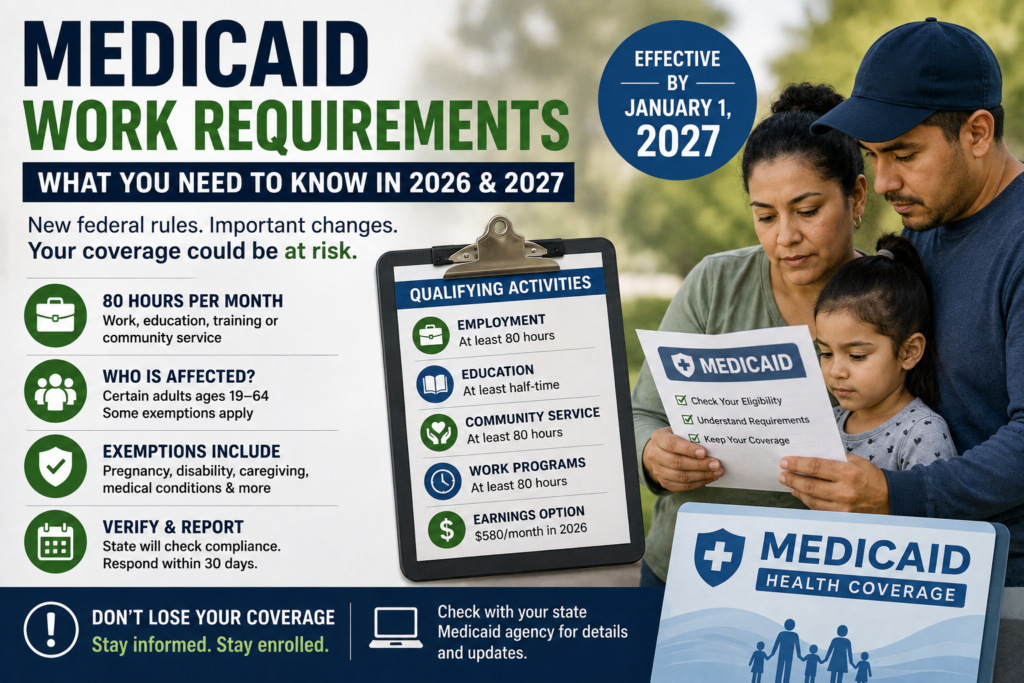
What Are Medicaid Work Requirements?
Medicaid work requirements are new eligibility conditions requiring certain adults to demonstrate that they are participating in approved activities for a specified number of hours each month. CMS refers to the policy as a community engagement requirement. Under the June 2026 CMS rule, affected adults generally must demonstrate 80 hours per month of qualifying activity. The requirement can be satisfied through employment, community service, certain work programs, qualifying education or a combination of approved activities.
A person can also satisfy the monthly requirement by having income equal to at least 80 times the federal minimum wage. In 2026, CMS identifies that amount as $580 per month. Seasonal workers have a separate calculation under the rule. The policy is designed to connect Medicaid eligibility with employment, education, training and community participation. But the practical impact depends heavily on a person’s age, Medicaid eligibility category, household circumstances, health status and state.
When Do Medicaid Work Requirements Start?
The federal implementation deadline is January 1, 2027. CMS says states must generally implement the new Medicaid work requirements no later than that date. However, states can choose to implement them earlier. That means 2026 is primarily a preparation and implementation year for many states. States must modify eligibility systems, determine who is subject to the requirements, establish methods for verifying compliance, notify affected beneficiaries and create procedures for people to demonstrate that they qualify for an exemption or exception.
CMS is also providing states with technical assistance and technology support to help them make these changes. The federal Medicaid website says implementation requires significant system, policy and operational changes at the state level.
Medicare Open Enrollment 2026-27 Dates and the New Rule Changes Behind Them
Who Will Be Subject to Medicaid Work Requirements?
The new rules apply to a specific group of adults. According to CMS, the federal Medicaid work requirements generally apply to non-pregnant adults ages 19 through 64 who are not entitled to or enrolled in Medicare and who are eligible for or enrolled in the Medicaid adult group or certain Section 1115 demonstrations providing minimum essential coverage to adults.
CMS says that 43 states and the District of Columbia provide coverage to populations covered by the new requirement and therefore will be required to implement it. U.S. territories are not subject to this law. However, being in the relevant age group does not automatically mean someone must satisfy the requirement. A person may qualify for an exemption based on pregnancy, disability, caregiving responsibilities, medical circumstances or another federally recognized category.This distinction is extremely important.
Medicaid Work Requirements Are Not a Universal Rule
A person should not assume that turning 19 or being under 65 automatically creates a new work requirement. The rule depends on the individual’s Medicaid eligibility category and whether an exemption applies. CMS specifically lists numerous categories of people who are not required to meet the new requirement.
What Counts Toward the 80-Hour Requirement?
The 80-hour Medicaid work requirement is broader than simply having a traditional full-time job.
CMS identifies several ways an affected individual can satisfy the requirement.
| Qualifying activity | How it can count |
|---|---|
| Employment | At least 80 hours in a month |
| Community service | At least 80 hours in a month |
| Qualifying work program | At least 80 hours in a month |
| Education | Enrollment in an educational program at least half-time |
| Combination of activities | Different qualifying activities can be combined to reach 80 hours |
| Earnings | Monthly income of at least $580 in 2026 |
| Seasonal work | Special income calculation applies |
CMS says people can combine qualifying activities to reach the monthly requirement. This means an individual does not necessarily need to work 80 hours at one employer. For example, qualifying community service and employment could potentially be combined if the activities meet federal and state requirements. Education can also satisfy the rule when the individual is enrolled at least half-time.
Who Is Exempt From Medicaid Work Requirements?
One of the most important parts of the new policy is the list of exemptions. CMS says certain adults will not have to meet the Medicaid work requirements.
These include:
- Pregnant individuals
- People in a qualifying postpartum period
- People who are medically frail or have special medical needs
- Parents, guardians and caretaker relatives of young children
- Certain caregivers of people with disabilities
- American Indians and Alaska Natives
- Certain veterans
- Former foster care youth
- People participating in qualifying drug or alcohol treatment programs
- People who are inmates of a public institution
- Certain people already complying with SNAP or TANF requirements
- Other individuals identified under the federal rule
The exact application of an exemption can depend on the person’s circumstances and Medicaid eligibility category. This is why beneficiaries should wait for instructions from their state Medicaid agency rather than assuming they are or are not exempt.
Student Loans and FAFSA 2026: Urgent changes every student needs to know
2027 HSA Contribution Limits Announced: IRS Confirms $4,500 and $9,000 Caps
Parents and Caregivers May Qualify for an Exemption
Caregiving is particularly important under the new rules. CMS says parents, guardians, caretaker relatives and family caregivers of a dependent child who is 13 or younger, or a disabled individual, can qualify for an exemption under the federal framework. This means a parent caring for a young child may not have to meet the 80-hour requirement. The rule also recognizes certain caregiving situations involving people with disabilities. Beneficiaries should nevertheless pay attention to state notices because states will be responsible for determining eligibility and verifying information.
What About People With Health Conditions?
Health-related exemptions are another major component of the Medicaid work requirements. CMS says people who are medically frail or have special medical needs that significantly impair their ability to comply with the requirement can be exempt. Pregnant and qualifying postpartum individuals are also excluded from the requirement. The federal rule therefore does not simply divide Medicaid recipients into “working” and “not working.”
It contains multiple categories designed to account for health and personal circumstances. However, some individuals may need to provide information or documentation to establish that an exemption applies. That makes communication from the state Medicaid agency particularly important.
Can Education Satisfy Medicaid Work Requirements?
Yes. Education can count under the new rules. CMS says an individual can meet the requirement by being enrolled in an educational program at least half-time. The federal Medicaid materials also identify education and career and technical education among the qualifying activities. For people enrolled less than half-time, the applicable rules can allow education hours to count toward the monthly requirement, depending on the circumstances and state implementation. This is important for Medicaid beneficiaries attending college, technical programs or other qualifying educational programs.
Can Community Service Satisfy the Requirement?
Yes. Community service is specifically included among the activities that can satisfy the new Medicaid work requirements. CMS allows affected adults to use qualifying community service for at least 80 hours per month, or combine it with other qualifying activities to reach the required total. This is one reason the federal government uses the term “community engagement” rather than simply “employment requirement.” The policy allows multiple types of participation.
What Happens If the State Cannot Verify Compliance?
Verification is one of the most important parts of the new system. States must verify compliance at application and renewal. They can also choose to conduct additional checks between renewal periods. If a state cannot verify that a person has met the requirement, the individual must receive a notice of noncompliance. CMS says the person must then receive 30 calendar days to demonstrate compliance or show that the requirement does not apply to them.
If the individual does not respond successfully within that process, the application could be denied or existing Medicaid coverage could be terminated. That does not necessarily mean a person permanently loses the ability to obtain Medicaid. CMS says people who are disenrolled because they did not meet the requirement may reapply, at which point the state will assess compliance under the applicable rules.
What Are Hardship Exceptions?
In addition to mandatory exemptions, states can offer certain short-term hardship exceptions. CMS identifies several circumstances that may qualify for a state-provided hardship exception. These can include:
- Receiving certain inpatient hospital or nursing-facility services
- Living in a county experiencing a qualifying emergency or disaster
- Living in a county with a sufficiently high unemployment rate
- Traveling outside the person’s community for an extended period to receive certain serious or complex medical care for themselves or a dependent
These are different from the mandatory exemptions. A hardship exception is something states may choose to provide under the federal framework. Therefore, availability can depend on state implementation.
Why Medicaid Work Requirements Matter in 2026
Although the main federal deadline is January 1, 2027, the changes are already affecting state Medicaid administration in 2026. States must prepare systems that can determine whether someone is subject to the rule, verify qualifying activities, identify exemptions and communicate with beneficiaries. CMS says states are responsible for outreach and notification before implementation and must continue outreach to affected applicants and beneficiaries afterward. The federal government is also supporting states with technology and implementation resources. CMS says it is helping states with data sourcing, system integration, notices, staff training and other implementation functions.
Why Keeping Your Medicaid Information Updated Is Important
For Medicaid beneficiaries who could be affected, outdated contact information can create a serious administrative problem. The official Medicaid outreach materials advise beneficiaries to make sure their state Medicaid agency has current information, including their address, email address and telephone number. This matters because states will send notices about the new requirements.
If someone moves and does not update their address, for example, they could miss an important notice about verification, an exemption or a renewal. The best approach is to make sure the state Medicaid agency has accurate contact information before implementation begins.
Should Medicaid Recipients Start Tracking Their Hours?
For people who believe they may be subject to the new requirement, keeping records can be useful. The official Medicaid outreach materials encourage potentially affected beneficiaries to keep track of work, community service, job training and school hours. The exact documentation process will depend on the state’s system. States are responsible for establishing the procedures used to verify compliance. Therefore, beneficiaries should follow their state’s instructions rather than relying on a general national checklist.
Will Medicaid Work Requirements Reduce Enrollment?
The Congressional Budget Office expects the new policy to reduce Medicaid enrollment. CBO’s analysis of Public Law 119-21 says some people will lose Medicaid eligibility because they do not meet the community engagement requirement or are unable to verify their status. CBO estimates that approximately 2.9 million people would lose coverage in 2034 as a result of the community engagement requirement. That is a projection, not a current enrollment count.
CBO also says most Medicaid enrollees subject to the requirement are expected either to satisfy it or qualify for an exception. The distinction matters because not everyone subject to the policy is expected to lose coverage. Some will meet the requirement. Others will qualify for exemptions. Others may move into different types of health insurance.
Could People Become Uninsured?
CBO’s broader analysis of the 2025 reconciliation law projects that Medicaid enrollment will decline as the law’s provisions take effect. CBO says most people who disenroll from Medicaid are expected to become uninsured, while some are expected to obtain coverage through employer-sponsored insurance, ACA Marketplace coverage or other sources. This does not mean every person losing Medicaid will become uninsured. The actual outcome will depend on individual circumstances and the availability of alternative coverage. However, the possibility of coverage loss is one reason the implementation of Medicaid work requirements is receiving significant attention.
More Frequent Medicaid Eligibility Reviews Are Also Coming
Work requirements are not the only Medicaid eligibility change taking effect. CBO’s July 2026 analysis says the 2025 reconciliation law also requires more frequent eligibility redeterminations for adults made eligible under the ACA Medicaid expansion or similar waiver-based expansion. Those adults will generally have their eligibility reassessed every six months.
This is important because beneficiaries may encounter both new community-engagement requirements and more frequent eligibility reviews. Keeping information current and responding to state notices can therefore become increasingly important.
Does the Rule Apply to Children?
The new federal Medicaid work requirements described here target certain adults. CMS specifies that the requirement applies to non-pregnant adults ages 19 through 64 who meet the applicable Medicaid eligibility criteria. Children are not the target population of this community-engagement requirement. Parents and caregivers can also qualify for exemptions in certain circumstances.
Therefore, families should not assume that a parent’s work requirement would automatically affect a child’s Medicaid eligibility. Medicaid eligibility is determined by eligibility category and household circumstances.
What Should Medicaid Beneficiaries Do Now?
People who may be affected do not need to guess what the new rules mean for them. Several practical steps can help.
1. Check your state Medicaid account
Make sure your contact information is accurate.
2. Watch for official notices
Pay attention to letters, emails or messages from your state Medicaid agency.
3. Learn whether an exemption applies
Health conditions, caregiving responsibilities, pregnancy, education and other circumstances can affect whether someone is subject to the rule.
4. Keep records
If you may be subject to the requirement, keep track of qualifying work, education, community service or training activities.
5. Respond to verification requests
If the state cannot verify compliance, CMS requires a notice and a 30-day opportunity to demonstrate compliance or establish that the requirement does not apply.
6. Don’t rely on social media posts
Because states can make implementation choices within the federal framework, beneficiaries should rely on their state’s Medicaid agency and official Medicaid.gov or CMS information.
Medicaid Work Requirements vs. SNAP Work Requirements
Medicaid work requirements should not be confused with SNAP work requirements. They are separate federal programs with different eligibility rules. However, the new Medicaid framework recognizes certain people who are already complying with SNAP or TANF requirements. CMS includes participation in qualifying SNAP or TANF requirements among circumstances that can establish an exemption from the Medicaid community-engagement requirement.
This creates an important connection between the programs without making their rules identical. Someone receiving both SNAP and Medicaid should therefore pay attention to notices from both programs.
What Happens After January 1, 2027?
The January 1, 2027 date marks the federal implementation deadline, but the effects will continue developing afterward. States will have to operate their verification systems, process exemptions, conduct renewals and report information to CMS. CMS says states must submit data to support monitoring and program integrity. The agency can take corrective action if states fail to meet reporting requirements or demonstrate compliance problems. The implementation process is therefore likely to continue evolving as states gain experience with the new system.
Final Takeaway
The new Medicaid work requirements represent one of the most significant changes to Medicaid eligibility in years. Beginning no later than January 1, 2027, certain adults ages 19 through 64 will generally have to demonstrate 80 hours per month of qualifying work, education, training or community service, or satisfy the requirement through the applicable income standard. States can begin earlier.
But the rules do not apply to every Medicaid recipient. Pregnant individuals, people who are medically frail or disabled, certain parents and caregivers, American Indians and Alaska Natives, certain veterans and other groups may be exempt. States can also offer certain short-term hardship exceptions.
For people who are subject to the requirement, documentation and communication will be crucial. If a state cannot verify compliance, CMS requires the state to provide a notice and give the individual 30 calendar days to demonstrate compliance or establish that the requirement does not apply. Failure to resolve the issue can lead to denial or disenrollment.
CBO projects that the community-engagement requirement will reduce Medicaid enrollment over time, with about 2.9 million people projected to lose coverage by 2034 because of the requirement. That is a projection, and CBO expects most people subject to the rule either to satisfy it or qualify for an exception. For Medicaid beneficiaries, the most important message is simple: don’t wait until a deadline arrives. Keep your contact information updated, read official notices, understand whether an exemption applies and maintain records of qualifying activities if the new requirement applies to you.
FAQ’s About Medicaid Work Requirements
What are Medicaid work requirements?
Medicaid work requirements are new federal eligibility conditions requiring certain adults to demonstrate participation in work, education, job training or community service. CMS calls them community engagement requirements.
When do Medicaid work requirements start?
States generally must implement the new requirements by January 1, 2027. States may choose to implement them earlier.
How many hours do you have to work for Medicaid in 2026?
For adults subject to the new rule, the standard is 80 hours per month of qualifying activity. Qualifying activities can include work, community service, certain work programs and education.
Can education count toward Medicaid work requirements?
Yes. Enrollment in a qualifying educational program at least half-time can satisfy the requirement. Other educational participation can also count toward the 80-hour requirement under applicable rules.
Who is exempt from Medicaid work requirements?
Federal exemptions include certain pregnant and postpartum individuals, people who are medically frail or have qualifying special medical needs, certain parents and caregivers, American Indians and Alaska Natives, certain veterans, former foster youth and other specified groups.
Can parents be exempt from Medicaid work requirements?
Yes. CMS provides an exemption for certain parents, guardians, caretaker relatives and family caregivers of young children or people with disabilities.
What happens if I don’t meet the Medicaid work requirement?
If a state cannot verify compliance, it must generally provide a notice of noncompliance and give the individual 30 calendar days to demonstrate compliance or establish that the requirement does not apply. If the issue is not resolved, the application may be denied or Medicaid coverage may be terminated.
Can I lose Medicaid because I cannot prove that I worked?
Potentially. CMS requires states to verify compliance. If compliance cannot be verified and the individual does not establish compliance or an exemption within the required process, the person could be denied or disenrolled.
Do Medicaid work requirements apply to everyone under 65?
No. The rule applies to a specific group of adults, generally ages 19 through 64 who are not entitled to or enrolled in Medicare and who fall within the applicable Medicaid eligibility categories. Numerous exemptions apply.
How can I prepare for Medicaid work requirements?
Keep your contact information current with your state Medicaid agency, watch for official notices, learn whether you qualify for an exemption and keep records of qualifying work, education, training or community-service activities if the requirement applies to you.
How many people could lose Medicaid because of the new work requirements?
The Congressional Budget Office estimates that about 2.9 million people could lose Medicaid coverage by 2034 because of the community-engagement requirement. This is a long-term projection, not a current enrollment figure.
Official Sources
- CMS — Medicaid Community Engagement Requirement
- Medicaid.gov — Community Engagement Requirements
- Medicaid.gov — Official Community Engagement Fact Sheet
- CMS — Nationwide Framework for Medicaid Work Requirements
- CBO — Supplemental Cost Estimate for Public Law 119-21
- CBO — Federal Subsidies for Health Insurance, 2026–2036