The Supplemental Nutrition Assistance Program, better known as SNAP, is going through one of the most significant periods of change in years. The program provides food assistance to eligible low-income households through electronic benefits that can be used to purchase qualifying food.
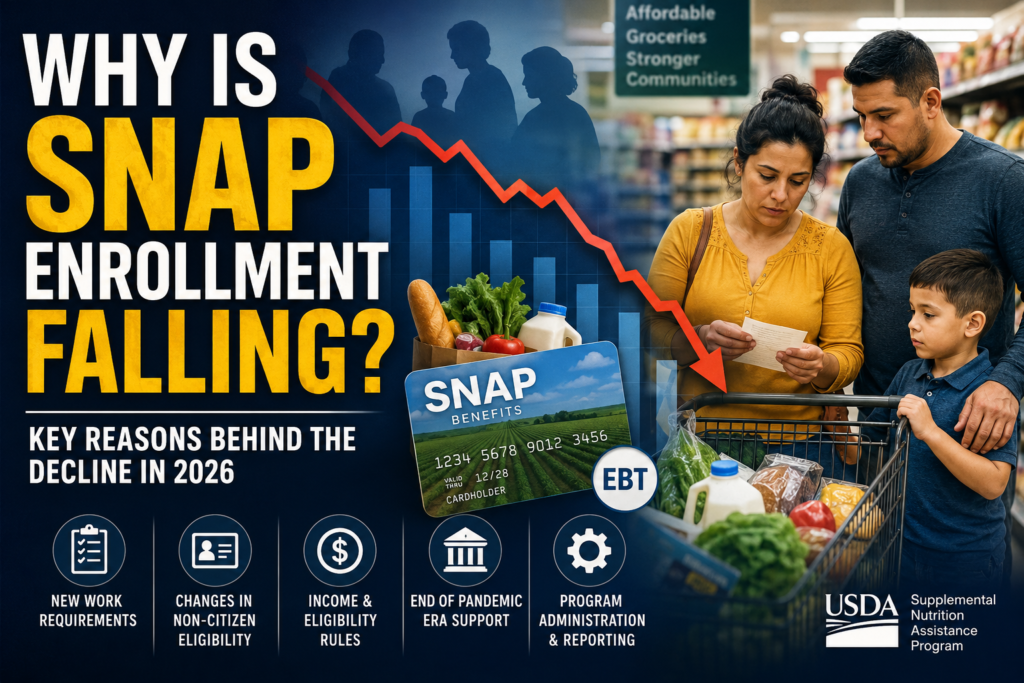
But a major question has emerged in 2026: Why is SNAP enrollment falling?
The answer is more complicated than simply saying fewer people need food assistance. Recent USDA data show that SNAP participation has been changing, while federal policy has also undergone major revisions. The One Big Beautiful Bill Act of 2025 changed several SNAP eligibility provisions, including work requirements and rules affecting some non-citizens. At the same time, states are implementing new requirements and administrative procedures.
It is also important to distinguish between SNAP enrollment, SNAP participation and the number of people who are eligible for SNAP. These are not exactly the same thing. USDA publishes participation data based on people and households actually receiving benefits, while participation-rate research measures the percentage of eligible people who take part in the program.
SNAP Enrollment Is Not Simply a Story of People No Longer Needing Help
Before looking at the reasons for the decline, there is an important point that can easily be missed.
SNAP participation does not move in only one direction. USDA’s Economic Research Service describes SNAP as a countercyclical program. In general, participation tends to increase when economic conditions weaken and decrease when economic conditions improve. USDA research also notes that unemployment and poverty are closely associated with SNAP participation.
However, the latest decline needs to be viewed against a different backdrop because federal SNAP rules changed substantially during 2025 and 2026. USDA’s official program-data system now identifies April 2026 as the latest available month of national and state-level program data. The agency cautions that the most recent numbers are preliminary and may be revised. That is important when interpreting month-to-month changes.
So, while it is accurate to discuss falling SNAP participation, it would be misleading to claim that every reduction means households have become financially secure.
1. New SNAP Work Requirements Are a Major Factor
One of the biggest changes affecting SNAP is the expansion and implementation of work requirements. The 2025 One Big Beautiful Bill Act changed SNAP work requirements for certain able-bodied adults without dependents, commonly referred to by USDA as ABAWDs. USDA has been issuing implementation guidance to states as these changes take effect.
Under SNAP rules, certain adults can be subject to a time limit if they do not meet specified work requirements or qualify for an exception. USDA explains that an ABAWD can generally receive SNAP for only three months during a three-year period if the person does not meet applicable work requirements. States can request waivers in certain areas, including areas with sufficiently high unemployment or an insufficient number of jobs.
The 2023 Fiscal Responsibility Act had already changed the rules governing ABAWDs, including exceptions, screening procedures and the number of discretionary exemptions available to states. The final rule implementing those provisions became effective in January 2025. The 2025 law then introduced additional changes. That means some people who previously qualified for SNAP may now face additional requirements to maintain eligibility.
Why work requirements can affect enrollment
A work requirement does not necessarily mean that a person has suddenly become financially independent. A person may lose benefits because they do not meet the required hours, do not report qualifying activities correctly, fail to complete required paperwork, or do not fall within an applicable exemption.
USDA’s rules therefore make screening particularly important. State agencies are required to determine whether individuals are subject to work requirements and whether they qualify for exemptions or exceptions. This is one reason the decline in SNAP participation should not automatically be interpreted as a decline in food-need.
2. SNAP Eligibility Rules for Some Non-Citizens Have Changed
Another significant factor is the change in SNAP eligibility for certain non-citizens. USDA states that the One Big Beautiful Bill Act of 2025 changed SNAP eligibility rules for non-citizens. The agency has been updating its guidance and implementation materials as these provisions take effect. This matters because SNAP eligibility is determined by federal rules as well as household circumstances.
A household can contain people with different eligibility statuses. Therefore, changes to federal eligibility rules can affect participation even if the household’s income has not changed. It is important not to oversimplify this issue. The relevant federal rules are specific, and eligibility depends on the circumstances of the household and its members. USDA’s official eligibility guidance should be used rather than assuming that every non-citizen is treated in the same way.
3. SNAP Income Rules Determine Who Qualifies
Income remains one of the central factors in SNAP eligibility.
For fiscal year 2026, USDA lists different gross and net monthly income standards depending on household size. For households in the 48 contiguous states, the District of Columbia, Guam and the U.S. Virgin Islands, a household of one has a gross monthly income limit of $1,696 and a net monthly income limit of $1,305 under the standard federal thresholds. For a household of four, the corresponding limits are $3,483 gross and $2,680 net per month.
These limits are updated annually.
SNAP also allows certain deductions when calculating net income. USDA lists deductions that can include a 20% earned-income deduction, a standard deduction, dependent-care expenses, qualifying medical expenses for elderly or disabled members, certain child-support payments and qualifying shelter expenses.
This creates an important distinction.
Someone can earn more money but still face financial pressure. Yet if their household income rises enough to exceed applicable SNAP eligibility rules, they may no longer qualify. That can reduce participation even when grocery costs remain a concern.
4. The End of Pandemic Era SNAP Policies Also Changed Participation
Another piece of the story is the gradual return from pandemic-era SNAP policies. During the COVID-19 period, SNAP participation and spending were affected by temporary policy changes and emergency benefit increases. USDA’s Economic Research Service documented substantial changes in SNAP participation and spending during and after the pandemic.
The pandemic-era emergency allotments ended in 2023. As a result, SNAP benefits returned to regular calculation rules rather than the temporary higher levels that many households had received. That transition was already influencing SNAP participation before the newest federal changes.
USDA data show that average monthly SNAP participation was 42.177 million people in FY 2023 and 41.700 million in FY 2024. The official annual data also show that participation was substantially above the pre-pandemic FY 2019 level of 35.702 million. This historical context is important because today’s numbers should not be compared only with the pandemic peak.
5. SNAP Is Closely Connected to Economic Conditions
SNAP participation is strongly influenced by the broader economy. USDA’s Economic Research Service describes SNAP as an automatic stabilizer. When unemployment rises and household incomes fall, more people may qualify for benefits. When economic conditions improve, participation can move lower.
USDA research estimates that a one-percentage-point increase in the unemployment rate is associated with approximately 2 million to 3 million additional SNAP participants. That relationship helps explain why SNAP enrollment cannot be viewed independently of employment and income.
If more households experience higher earnings, some may move above the eligibility threshold. If unemployment rises, the opposite can happen. Therefore, part of any decline in participation can be related to changes in economic circumstances, while another part can result from changes in program rules.
6. States Have a Major Role in SNAP Administration
SNAP is a federal program, but it is administered through state agencies. USDA explains that state public-assistance agencies run SNAP through local offices. States determine eligibility, process applications and administer benefits under federal requirements. This matters because implementation can influence how quickly households are processed, how recertifications are handled and how new federal requirements are applied.
USDA publishes separate information on application-processing and recertification-processing timeliness, showing that administration itself is an important part of SNAP delivery. When federal rules change, states have to modify their systems, forms, screening procedures and eligibility processes. That makes 2026 an especially important transition period.
7. Recertification and Reporting Requirements Can Affect Continued Participation
SNAP households do not simply enroll once and remain enrolled indefinitely. USDA explains that participating households must report changes in circumstances, including income, at required intervals. Depending on the household and state, recipients may also have to complete recertification procedures.
This means that a household can leave the program for several different reasons. It may become financially ineligible. It may fail to complete a required process. Its circumstances may change. Or it may become subject to a new eligibility requirement. Consequently, a fall in the number of people receiving SNAP does not tell us by itself which of these mechanisms caused the reduction.
8. SNAP Participation and SNAP Eligibility Are Not the Same
This distinction is especially important for anyone searching for the answer to “why is SNAP enrollment falling?” USDA separately publishes national SNAP participation rates. These rates estimate the percentage of people who are eligible for SNAP and actually participate in the program. Imagine that the number of eligible people stays relatively stable while the number of people receiving benefits falls.
That could mean the participation rate has fallen. But if the number of eligible people itself falls because household incomes have increased, participation could decline without indicating that eligible households are failing to enroll. The two measurements answer different questions.
Enrollment or participation: How many people are actually receiving SNAP?
Participation rate: What percentage of eligible people are receiving SNAP?
Eligibility: How many people meet the applicable requirements? Keeping these definitions separate is essential for understanding the current trend.
SNAP Participation: Important Numbers to Know
| Fiscal year | Average monthly SNAP participation |
|---|---|
| FY 2019 | 35.7 million |
| FY 2020 | 39.9 million |
| FY 2021 | 41.6 million |
| FY 2022 | 41.2 million |
| FY 2023 | 42.2 million |
| FY 2024 | 41.7 million |
| FY 2025 | About 42.1 million |
The figures above are based on USDA’s annual SNAP participation data. FY 2025 is now included in USDA’s annual data tables, while the agency’s latest monthly data extend into 2026. The most recent monthly figures are preliminary and subject to revision.
This table also reveals an important fact: SNAP participation did not decline throughout FY 2025. The annual average was higher than FY 2024. The more recent decline therefore needs to be understood as a developing 2026 trend rather than a simple multi-year collapse in SNAP participation.
What Does the 2026 SNAP Decline Mean for Families?
For families currently receiving SNAP, the most important issue is not the national enrollment number. It is whether their own eligibility has changed. Households should pay close attention to notices from their state SNAP agency, including requests for information, recertification deadlines and documentation related to work requirements or other eligibility conditions.
USDA’s official eligibility page also emphasizes that eligibility depends on household circumstances, income, resources and applicable federal rules. People should not assume that a headline about falling SNAP enrollment means they are automatically losing benefits. Eligibility remains household-specific.
Is SNAP Enrollment Falling Because Fewer Americans Need Food Assistance?
USDA research shows that SNAP participation responds to economic conditions, and participation can fall when economic conditions improve. But the 2026 decline is occurring alongside significant changes to federal SNAP eligibility and work requirements. For that reason, it would be inaccurate to attribute the entire change to one factor.
The most defensible conclusion from official information is that SNAP participation is being shaped by a combination of economic conditions, eligibility rules, work requirements, non-citizen eligibility changes, recertification and administrative implementation. As more complete 2026 data become available, researchers and policymakers will be able to better separate these effects.
What Happens Next to SNAP Enrollment?
The direction of SNAP participation will depend on how the new rules are implemented and how household economic conditions evolve. USDA continues to publish monthly SNAP data and update its implementation materials. The agency’s current program-data system identifies April 2026 as the latest available month, while noting that recent numbers are preliminary.
The coming months will therefore be important. If participation continues to decline, the key question will be whether the reduction is primarily associated with households becoming ineligible, people affected by new work requirements, changes in non-citizen eligibility, administrative changes, or some combination of these factors. That distinction matters because a lower SNAP caseload does not automatically mean lower food insecurity.
So, why is SNAP enrollment falling?
SNAP participation is affected by economic conditions, but the program is also undergoing major policy changes. The One Big Beautiful Bill Act of 2025 changed important SNAP work requirements and non-citizen eligibility rules. States are implementing those changes while continuing to process applications, recertifications and eligibility reviews.
At the same time, the end of pandemic-era benefits and normal changes in household income have already influenced SNAP participation. The official USDA data show that SNAP participation remained historically high in FY 2024 and FY 2025, even as it moved down from the FY 2023 level. The latest monthly data show that participation is now an important trend to watch in 2026, although recent figures remain preliminary.
The biggest mistake would be to treat a falling caseload as proof that fewer people need help. SNAP enrollment tells us how many people are receiving benefits. It does not, by itself, explain why people are leaving the program or whether eligible households still need assistance. That is why the next round of USDA data will be crucial for understanding the full impact of the 2025 federal policy changes.
FAQ’s About Falling SNAP Enrollment
Why is SNAP enrollment falling in 2026?
SNAP participation is being affected by several factors, including changes to federal work requirements, changes to eligibility for certain non-citizens, household income changes, recertification and administrative implementation. USDA also notes that SNAP participation generally responds to broader economic conditions.
Did SNAP enrollment fall in FY 2025?
Not on an annual-average basis. USDA’s annual data show average monthly participation of about 42.1 million people in FY 2025, compared with about 41.7 million in FY 2024.
Are SNAP work requirements changing in 2026?
Yes. The 2025 One Big Beautiful Bill Act changed SNAP work requirements, including provisions affecting able-bodied adults without dependents. USDA has published implementation resources for states.
Can higher income cause someone to lose SNAP?
Yes. SNAP eligibility is based partly on household income and applicable deductions. USDA updates federal income standards annually. Households must meet the applicable eligibility rules for their circumstances.
Have SNAP rules for non-citizens changed?
Yes. USDA states that the One Big Beautiful Bill Act of 2025 changed SNAP eligibility for non-citizens. The exact impact depends on the individual’s and household’s circumstances.
Does falling SNAP participation mean food insecurity is falling?
Not necessarily. SNAP participation and food insecurity are different measures. USDA describes SNAP participation as being influenced by economic conditions and program rules, so a decline in participation alone cannot establish that food insecurity has declined.
Where can I find official SNAP enrollment data?
USDA’s Food and Nutrition Service publishes national and state SNAP participation data, including monthly and annual information on people, households and benefits.