New Canada Air Travel Rules 2026: If your flight got delayed or cancelled this year, here is the most important update: Canada air travel rules 2026 are being rewritten to speed up flight delay compensation Canada payouts, but as of late July 2026, the new law has still not been formally introduced in Parliament. Transport Minister Steven MacKinnon confirmed on May 1, 2026, through the Spring Economic Update, that legislation would come “in the coming weeks” to clear a backlog of more than 97,000 unresolved passenger complaints sitting with the Canadian Transportation Agency (CTA). Nearly three months later, that legislation has not landed, and the Air Passenger Protection Regulations (APPR) passengers rely on today remain exactly as they were in 2022. This means the compensation amounts, deadlines, and complaint process described below are not proposals, they are the actual rules a Canadian traveller can use right now to get paid. We’ll be updating this article monthly as the new compensation regime moves through Parliament.
This article separates confirmed government announcements from rules that are still pending, so you are not misled about what you can claim today versus what is coming later. You will find the current flight cancellation compensation Canada amounts for both large and small airlines, the higher payouts for denied boarding, baggage liability limits, tarmac delay protections, and the exact steps to file a claim with an airline or escalate to the CTA. You will also find a plain breakdown of the four reforms Ottawa has promised, including a proposed $1 million fine ceiling for repeat offenders and a shift that would eventually make airlines prove a disruption was exceptional, rather than passengers proving it was the airline’s fault. Every figure here is checked against the Canadian Transportation Agency and Transport Canada directly.
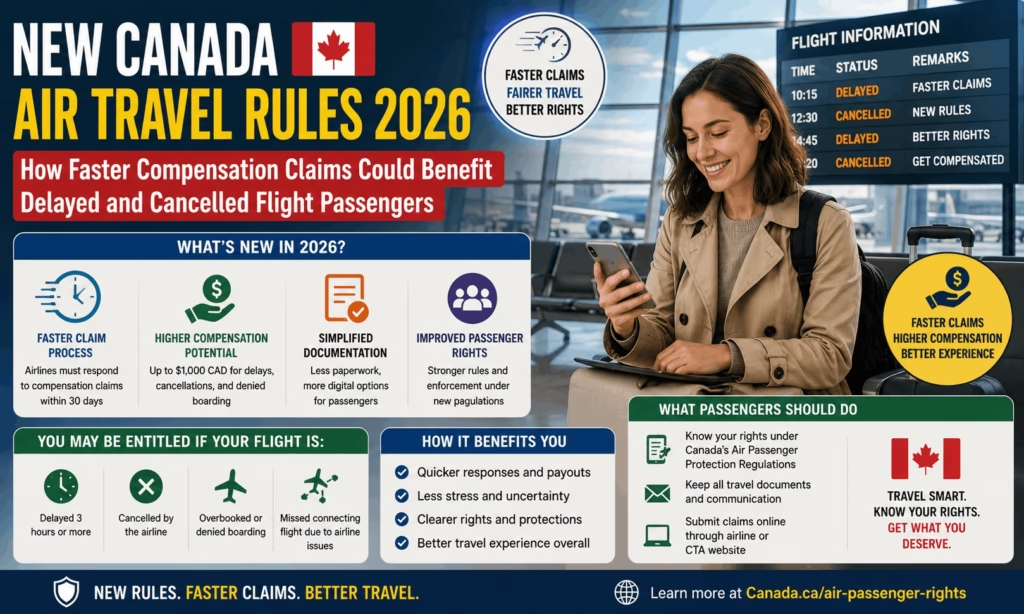
New Canada Air Travel Rules 2026 Key Highlights
| Governing law | Air Passenger Protection Regulations (APPR), SOR/2019-150 |
| Announcement of overhaul | Spring Economic Update 2026, announced May 1, 2026 |
| Legislation introduced? | Not yet, as of late July 2026 (originally promised “in coming weeks”) |
| CTA complaint backlog | More than 97,000 cases, still growing |
| Proposed maximum airline fine | Up to $1 million for systemic violations |
| Current delay compensation (large airlines) | $400 to $1,000 depending on delay length |
| Current delay compensation (small airlines) | $125 to $500 depending on delay length |
| Denied boarding compensation | $900 to $2,400 |
| Baggage liability limit | Approximately $2,350 |
| Time limit to file a claim | 1 year from the disruption |
| Airline response deadline | 30 days after receiving your claim |
| Tarmac delay limit before return to gate | 3 hours (plus a limited 45-minute exception) |
What Ottawa Announced About Canada Air Travel Rules 2026
The push behind the new Canada air travel rules 2026 came directly from the federal government’s Spring Economic Update 2026, released May 1. Transport Minister Steven MacKinnon used the same day to lay out a four-part plan for the air passenger protection regulations overhaul.
The first piece hires an independent, neutral third-party dispute resolution body to clear the existing complaint backlog using private-sector style case handling, rather than relying solely on CTA staff capacity. Airlines found at fault under this process will be required to comply and settle with affected passengers.
The second piece removes the confidentiality requirement that has historically kept individual complaint outcomes hidden from public view, a change meant to expose which airlines routinely lose disputes and which routinely deny valid claims.
The third piece raises the CTA’s enforcement power, letting the agency fine airlines up to $1 million for systemic or repeated violations, a sharp jump from current penalty levels.
The fourth piece is a rewritten regulatory framework intended to close loopholes and make flight cancellation compensation Canada claims faster and less confusing for travellers.
As of this update, the government has not yet tabled the promised legislation in the House of Commons. Parliament’s typical summer recess (roughly late June through mid-September) is a likely factor in the delay, and travellers should expect the bill to surface, if at all this year, closer to the fall sitting.
UK Minimum Wage Increase 2026: Full List of New Pay Rates From April
When Can I Claim My UK State Pension? UK State Pension Age Changes Explained (2026 Update)
Why the CTA Complaint Backlog Keeps Growing
The Air Passenger Protection Regulations first took effect in 2019, giving Canadian flyers formal compensation rights for the first time. When an airline denies a claim, a passenger’s only recourse is to escalate to the CTA, and that is exactly where the system has clogged.
According to Transport Canada, the backlog stood at roughly 42,000 complaints back in 2023, when the government first set aside $75.9 million in temporary funding to help the CTA catch up. Instead of shrinking, the backlog has more than doubled, reaching approximately 95,000 to 97,000-plus cases through 2026, with the CTA reporting its highest-ever monthly complaint total in January 2026 at 5,685 new filings in a single month.
Parliament already attempted one fix, passing amendments in June 2023 that eliminated the old three-category system for classifying disruptions. Those amendments were meant to make compensation the default outcome unless an airline could prove exceptional circumstances. However, the supporting regulations needed to actually enforce that shift were never finalized. A discussion paper went out in July 2023, draft regulations were proposed in late 2024, and public consultations wrapped up in March 2025, but the amended APPR still has not come into force as of mid-2026.
Adding to the pressure, the temporary $75.9 million backlog-clearing funding was due to expire around March 2026, and it remains unclear whether it has been renewed at the same level. A proposed $790-per-complaint cost recovery fee on airlines, meant to shift the financial burden away from taxpayers, is also still under discussion rather than in force.
Flight Delay Compensation Canada: What You Can Claim Today
Even though the overhaul is still pending, flight delay compensation Canada rules under the current APPR are fully enforceable right now, and this is the version of the law that decides your payout if you were affected this summer or any time before the new regime takes effect.
Compensation applies only when a delay or cancellation is within the airline’s control and is not required for safety. Your payout depends on how late you arrive at your final destination compared to your original ticketed arrival time, not on how late you departed.
| Arrival Delay at Destination | Large Airlines | Small Airlines |
|---|---|---|
| 3 to 6 hours | $400 | $125 |
| 6 to 9 hours | $700 | $250 |
| 9 hours or more | $1,000 | $500 |
A “large airline” under the APPR is any carrier that transported at least 2 million passengers in each of the two previous calendar years. Air Canada, WestJet, Porter, and Flair are all currently classified as large airlines for compensation purposes.
A few practical points matter here. You have a full year from the date of disruption to submit your compensation claim to the airline. Once you file, the airline has 30 days to either pay you or provide a written explanation of why it believes no compensation is owed. Airlines are allowed to offer travel vouchers instead of cash, but you always retain the right to demand cash payment, and any voucher offered must be worth more than the cash amount with no expiry date attached.
Standards of Treatment During a Delay
Separate from cash compensation, airlines owe every passenger a minimum standard of care once a delay passes two hours at departure, including food, drink, and free access to a means of communication. This obligation applies even for safety-related delays that do not trigger cash compensation. If the delay forces an overnight stay, the airline must also cover hotel accommodation and transport to and from it.
Denied Boarding Compensation Canada
Being bumped from an overbooked flight triggers the highest compensation tier under the entire APPR framework, and it applies regardless of whether you fly a large or small airline.
| Arrival Delay After Being Bumped | Compensation |
|---|---|
| 0 to 6 hours | $900 |
| 6 to 9 hours | $1,800 |
| 9 hours or more | $2,400 |
Before bumping anyone involuntarily, airlines are required to first ask for volunteers and put any agreed benefits in writing. If you are denied boarding involuntarily, compensation must be paid on the spot at the airport or within 48 hours at the latest.
Baggage Compensation and Tarmac Delay Rights
Canada air travel rules 2026 also cover what happens to your bags and to you if the plane is stuck on the runway.
Under the CTA’s current summary of the regulations, airline liability for lost or damaged baggage sits at approximately $2,350, a limit that applies to both international trips under the Montreal Convention and to domestic Canadian flights. If your bag arrives damaged, you must file a written claim within 7 days of receiving it. For delayed baggage on international trips, you have 21 days from the bag’s arrival to file. Airlines must also refund any baggage fees you paid if your bag is lost or damaged.
Tarmac delays are capped at 3 hours before the aircraft must return to the gate and allow passengers to disembark if it is safe to do so. A single 45-minute extension beyond that cap is permitted only when takeoff is genuinely imminent, and airlines must continue meeting care standards, including food, water, and working lavatories, throughout any tarmac delay.
How the Burden of Proof Is Expected to Change
This is the part of the reform most travellers have never heard of, and it is the one that would matter most once it actually takes effect.
Right now, every disruption is sorted into one of three categories: within the airline’s control, within the airline’s control but required for safety, or entirely outside the airline’s control. Only the first category currently guarantees cash compensation, and airlines themselves decide which box a disruption falls into, a setup that critics say has turned the “safety” and “outside control” categories into a routine shield against paying valid claims.
The June 2023 legislative amendments eliminated these three categories on paper, replacing them with a single default rule: compensation should be paid for any disruption unless the airline can prove the cause falls under a specific, clearly defined list of exceptional circumstances. That flips today’s burden of proof, moving it from the stranded passenger having to argue their case, to the airline having to justify why it should not pay.
The catch is that this shift only becomes enforceable once the CTA finalizes the amended regulations that spell out exactly what counts as an “exceptional circumstance.” Those regulations remain in draft form as of mid-2026, so today, the older three-category system is still what airlines apply in practice.
Louisiana SNAP Junk Food Ban 2026: What’s Banned, Effective Date, EBT Rules & Latest Status
How to File a Flight Compensation Claim in Canada
If your flight was disrupted, do not wait for the new rules, since the current ones already require payment when an airline is at fault.
Start by keeping every receipt for meals, hotel stays, and transport incurred because of the delay. File your compensation request with the airline in writing, ideally through its official passenger rights or customer relations page, and note the date you submit it, since that starts the airline’s 30-day response clock. If the airline denies your claim, refuses to respond, or offers less than the amount the APPR requires, you can escalate your complaint directly to the Canadian Transportation Agency for a formal review.
Filing now is still worthwhile even with the backlog, since your case joins the queue that the newly announced third-party resolution body is specifically being brought in to clear.
Official Resources and Useful Links
| Resource | Purpose | Link |
|---|---|---|
| Transport Canada News Release (May 1, 2026) | Official announcement of the compensation overhaul | canada.ca/en/transport-canada/news |
| Canadian Transportation Agency, APPR Overview | Full current rules and passenger rights summary | otc-cta.gc.ca/eng/air-passenger-protection-regulations |
| CTA, File an Air Travel Complaint | Online portal to submit or check a complaint status | otc-cta.gc.ca (Air Travel Complaints section) |
| CTA Forward Regulatory Plan (APPR Amendments) | Tracks the pending regulation rewrite | otc-cta.gc.ca (Forward Regulatory Plan 2024 to 2026) |
| Justice Laws Website | Full legal text of SOR/2019-150 | laws.justice.gc.ca/eng/regulations/SOR-2019-150 |
People Also Ask
Is Canada bringing in new flight compensation laws? Yes, the federal government announced plans for a new compensation and enforcement regime on May 1, 2026, but the supporting legislation had not been formally introduced in Parliament as of late July 2026.
How much compensation can I get for a delayed flight in Canada right now? Under the current APPR, large airlines owe $400 for a 3 to 6 hour delay, $700 for 6 to 9 hours, and $1,000 for 9 hours or more, provided the delay was within the airline’s control and not safety-related.
Why is Canada’s airline complaint backlog so large? The backlog grew from around 42,000 complaints in 2023 to more than 97,000 by 2026 because complaint volume kept rising faster than the CTA’s processing capacity, even after temporary federal funding was added in 2023.
Do Canadian airlines have to pay for hotels during a delay? Yes, if an eligible delay forces an overnight stay, the airline must provide reasonable hotel accommodation along with transport to and from it, separate from any cash compensation owed.
What is the maximum fine an airline can face under the new Canada rules? The government has proposed raising the maximum fine for systemic or repeated violations to up to $1 million, though this increase depends on the still-pending legislation passing into force.
FAQs
What are the new Canada air travel rules 2026?
The new Canada air travel rules are a planned overhaul of the air passenger protection system. The goal is to speed up compensation payouts, clear the backlog of complaints before the Canadian Transportation Agency, make airline obligations clearer, remove confidentiality around complaint outcomes, and raise penalties for airlines that repeatedly break the rules.
How much flight compensation can passengers get in Canada today?
Under the current Air Passenger Protection Regulations, passengers can claim up to $1,000 for delays or cancellations that are within the airline’s control and not safety-related. Large airlines owe $400 for 3 to 6 hour delays, $700 for 6 to 9 hours, and $1,000 for 9 hours or more. Small airlines owe lower amounts across the same tiers.
When will the new air passenger rules officially start in Canada?
There is no confirmed start date yet. As of late July 2026, the government had said legislation was expected “in the coming weeks” back in May, but it has not been introduced. Until it is passed and the amended regulations come into force, the current APPR continues to apply in full
How long does an airline have to pay flight compensation in Canada?
Once you submit a written compensation claim, the airline has 30 days to either pay the required amount or explain in writing why it believes compensation is not owed. You generally have 1 year from the date of the disruption to file your claim.
What should I do if an airline refuses to pay flight compensation?
File a written claim directly with the airline first and keep all receipts, boarding passes, booking confirmations, and delay notices. If the airline refuses payment or does not respond properly within 30 days, you can escalate the complaint to the Canadian Transportation Agency for a formal review.
Does the compensation amount depend on departure delay or arrival delay?
It depends on arrival delay. Compensation tiers are calculated based on how late you actually arrive at your final ticketed destination, not on how late your flight departed.
Conclusion
The Canada air travel rules 2026 overhaul is a real government commitment, backed by an official announcement, a named backlog figure, and a proposed $1 million fine ceiling, but it is still a plan and not yet law. Until Parliament passes the legislation and the CTA finalizes the amended regulations, every Canadian traveller’s rights are governed by the existing Air Passenger Protection Regulations, which already guarantee up to $1,000 for controllable delays, up to $2,400 for denied boarding, and clear baggage and tarmac delay protections. The most useful thing any passenger can do right now is treat today’s rules as fully enforceable, file claims promptly and in writing, and escalate to the CTA when an airline refuses to pay, rather than waiting on a reform timeline that remains unconfirmed. This article will be updated monthly as the legislation, if introduced, moves through Parliament.
Also Read
Kansas SNAP Junk Food Ban 2027: What’s Banned, Effective Date, EBT Rules & Latest Status
Iowa SNAP Junk Food Ban 2026: What’s Banned, Court Update, EBT Rules & Latest Status