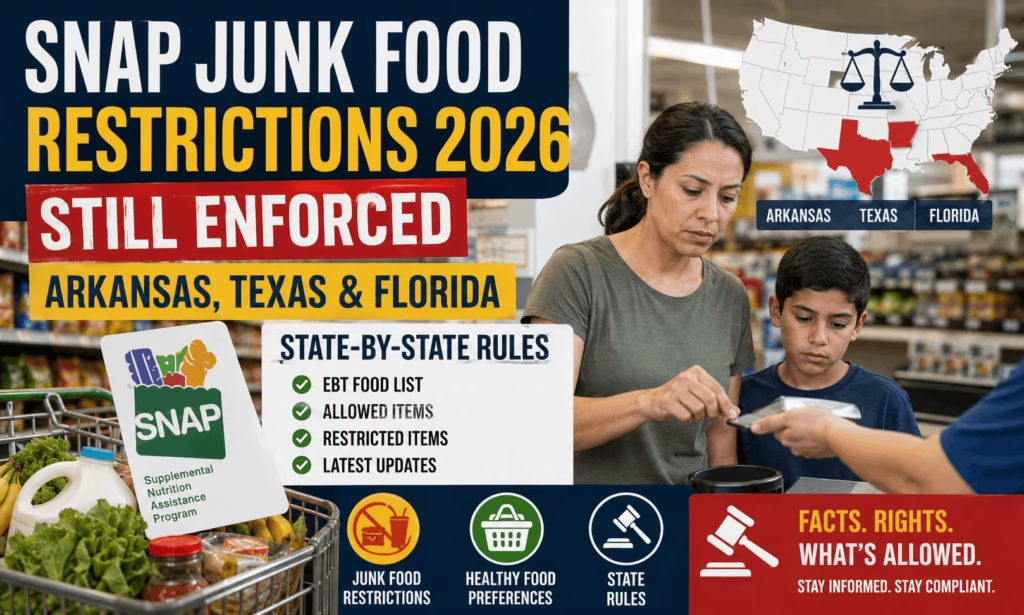
SNAP Food Restrictions Still Enforced: SNAP food restrictions aren’t just approved on paper in every state in Arkansas, Texas, and Florida, they’re actually being enforced at the checkout counter right now. While a June 2026 federal court order paused restrictions in five other states, these three states have faced no legal challenge and remain fully active, based on the latest official state guidance available. That distinction matters: “approved by USDA” and “actively enforced today” are two very different things, and mixing them up is the most common source of confusion for SNAP recipients trying to figure out what they can and can’t buy. We’ll be updating this article monthly, and we verify each state’s enforcement status against USDA and state-agency sources before publishing any “still enforced” label.
This guide walks through exactly what’s restricted in Arkansas, Texas, and Florida, what’s still fully eligible, how EBT checkout actually works under these rules, and how major retailers are implementing the changes. We’ll also cover the questions recipients ask most: does this affect my monthly benefit amount, what happens if a restricted item gets scanned, and could these rules ever be challenged in court the way Colorado’s and Tennessee’s were?
Key Highlights
| Point | Details |
|---|---|
| States covered | Arkansas, Texas, Florida |
| Enforcement status | Actively enforced in all three — no court challenge filed |
| Restricted items | Soda and candy (primary categories in all three states) |
| Arkansas effective date | July 1, 2026 |
| Texas & Florida effective date | 2026 (first-wave rollout) |
| EBT card impact | Fully functional — only restricted items are excluded at checkout |
| Monthly benefit amount | Unchanged — restrictions affect eligible purchases, not benefit size |
| Foods still allowed | Fruits, vegetables, meat, dairy, bread, rice, beans, baby food, and most standard groceries |
| Court risk | Not currently challenged, but legal landscape nationwide is still evolving (see Aragon v. Rollins in other states) |
| Last verified | Checked against USDA and state-agency guidance; updated monthly |
What Does “SNAP Food Restrictions Still Enforced” Mean?
“Still Enforced” means a state’s USDA-approved SNAP waiver has passed its effective date and restricted items are actually being excluded from SNAP-eligible purchases at retail checkout — not just approved on paper.
USDA waiver approval vs. active implementation: These are separate steps. USDA approval simply authorizes a state to move forward; a state then needs to notify retailers, update point-of-sale (POS) systems, and reach its own effective date before restrictions are truly “live.” Some approved states are still in this in-between “pending” stage.
Court-blocked vs. active states: In five states (Colorado, Iowa, Nebraska, Tennessee, West Virginia), a June 22, 2026 federal court ruling vacated the waivers, meaning restrictions are not currently enforced there. Arkansas, Texas, and Florida are unaffected by that ruling and remain in active enforcement.
Effective dates: Arkansas’s restriction became active July 1, 2026. Texas and Florida, both approved in the first 2025 wave, moved into active enforcement during 2026 as well, following their own state-specific rollout timelines.
Why Are These States Keeping SNAP Food Restrictions?
Arkansas, Texas, and Florida have each pointed to similar justifications in their USDA waiver applications and public statements:
- Public health goals — aligning SNAP purchases with broader nutrition and wellness policy
- Obesity reduction — addressing high rates of diet-related chronic disease among low-income populations
- Nutrition improvement — encouraging SNAP dollars to go toward nutrient-dense food categories
- Limiting sugary drinks and candy — targeting the specific purchase categories most frequently cited in USDA and state health data
- State-led SNAP reform — using the demonstration-waiver process as a policy tool distinct from federal legislation
Which States Still Enforce SNAP Food Restrictions?
| State | Current Status | Effective Date | Restrictions Active? | Court Status |
|---|---|---|---|---|
| Arkansas | Still Enforced | July 1, 2026 | Yes | No legal challenge filed |
| Texas | Still Enforced | 2026 (first-wave rollout) | Yes | No legal challenge filed |
| Florida | Still Enforced | 2026 (first-wave rollout) | Yes | No legal challenge filed |
State-Wise SNAP Restriction Guide
Arkansas SNAP Restrictions
Current Status: Arkansas’s SNAP food restriction is actively enforced statewide as of this update. The state was among the first 12 to receive USDA approval and moved from approval to full implementation faster than many other states.
Effective Date: July 1, 2026.
Foods Affected: Based on official state guidance, Arkansas restricts:
- Soda and other sugar-sweetened carbonated beverages
- Sugary drinks more broadly, including sweetened non-carbonated beverages
- Candy and confectionery items
Foods Still Allowed: Fruits, vegetables, milk, eggs, bread, rice, meat, fish, beans, and baby food all remain fully SNAP-eligible in Arkansas, along with the vast majority of standard grocery items.
EBT Card Impact: Your EBT card continues to work exactly as before. If a restricted item is scanned, the store’s point-of-sale system automatically excludes it from the SNAP-eligible total; you’d need another payment method (cash, debit, credit) to purchase that specific item.
Retailer Rules: Grocery stores, convenience stores, and self-checkout lanes are all required to apply the same restricted-item logic — retailers participating in SNAP had to update their systems ahead of the July 1, 2026 effective date to stay compliant.
Official Arkansas SNAP Agency: Arkansas Department of Human Services (humanservices.arkansas.gov). Check the agency’s official site for the current retailer FAQ and recipient notices, since specific product-level guidance is periodically updated.
Texas SNAP Restrictions
Current Status: Texas’s waiver, approved in the first 2025 wave, is actively enforced, with no court challenge filed against the state.
Effective Date: Texas moved into active enforcement during 2026 as part of the first group of implementing states.
Restricted Foods: Soda and candy are the primary restricted categories under Texas’s waiver, consistent with the scope described in the state’s official USDA application.
Allowed Foods: Fruits, vegetables, dairy, meat, fish, grains, beans, and baby formula remain fully eligible — Texas’s restriction applies narrowly to the soda-and-candy categories rather than broader food groups.
EBT Checkout Experience: As one of the largest SNAP caseloads in the country, Texas’s checkout experience has been closely watched. Point-of-sale systems across major grocery chains and independent retailers automatically flag restricted items, splitting a transaction between SNAP-eligible and non-eligible totals when a mixed cart includes both.
Retailer Compliance: Large chains, regional grocers, and convenience stores statewide have reported updating their systems ahead of enforcement, with no widespread compliance issues noted publicly since the restriction became active.
Frequently Asked Questions: Texas SNAP recipients most often ask whether specific branded products qualify — the state directs shoppers to check official category definitions rather than assume based on a product’s name alone, since a store’s own labeling may not always reflect current SNAP-eligibility rules.
Official Texas SNAP Agency: Texas Health and Human Services Commission (hhs.texas.gov).
Florida SNAP Restrictions
Current Rule: Florida’s SNAP waiver restricts soda and candy purchases and is actively enforced statewide, with no legal challenge filed against the state’s waiver.
Effective Date: Florida moved into active enforcement during 2026, following its approval in the first 2025 wave.
Food Categories: Sugar-sweetened beverages and candy/confectionery items are excluded from SNAP-eligible purchases; standard grocery staples remain unaffected.
EBT Usage: Florida EBT cards remain fully functional. The restriction changes which specific items are eligible for purchase, not the card’s functionality or the recipient’s monthly benefit amount.
Recipient Guidance: Florida SNAP recipients unsure about a specific item’s eligibility should check with their retailer at checkout or consult official state guidance rather than assuming eligibility based on other states’ rules, since Florida’s restricted-item definitions may differ in scope from a neighboring state.
Retailer Updates: Florida retailers, including major grocery chains and smaller independent stores, have updated point-of-sale systems to automatically apply the restriction at checkout.
Official Florida SNAP Agency: Florida Department of Children and Families (myflfamilies.com).
What Foods Are Restricted?
| Food Category | Arkansas | Texas | Florida |
|---|---|---|---|
| Soda | Restricted | Restricted | Restricted |
| Sugary Beverages | Restricted | Restricted (as part of soda category) | Restricted (as part of soda category) |
| Energy Drinks | Not separately listed in public guidance | Not separately listed in public guidance | Not separately listed in public guidance |
| Candy | Restricted | Restricted | Restricted |
| Sweet Snacks | Not separately listed in public guidance | Not separately listed in public guidance | Not separately listed in public guidance |
| Certain Desserts | Not separately listed in public guidance | Not separately listed in public guidance | Not separately listed in public guidance |
Note: Exact restricted-item definitions may differ by state and are subject to official state and USDA guidance — always confirm specifics with your state’s SNAP agency rather than assuming another state’s list applies to you.
What Foods Are Still Eligible Under SNAP?
| Food Category | Arkansas | Texas | Florida |
|---|---|---|---|
| Fruits | Eligible | Eligible | Eligible |
| Vegetables | Eligible | Eligible | Eligible |
| Eggs | Eligible | Eligible | Eligible |
| Meat | Eligible | Eligible | Eligible |
| Fish | Eligible | Eligible | Eligible |
| Bread | Eligible | Eligible | Eligible |
| Rice | Eligible | Eligible | Eligible |
| Pasta | Eligible | Eligible | Eligible |
| Milk | Eligible | Eligible | Eligible |
| Yogurt | Eligible | Eligible | Eligible |
| Baby Formula | Eligible | Eligible | Eligible |
| Frozen Vegetables | Eligible | Eligible | Eligible |
| Beans | Eligible | Eligible | Eligible |
Can You Still Use Your EBT Card Normally?
Yes. In all three states:
- Your EBT card remains fully active, with no changes to how it functions
- Your monthly benefits continue at the same amount as before
- Checkout changes only apply to officially restricted items where the rule is currently in force — the rest of your shopping experience is unchanged
What Happens at Checkout?
- Item scan: Each item is scanned as usual; the POS system checks it against the state’s SNAP-eligible category list
- EBT approval/decline: Eligible items are approved against your SNAP balance; restricted items are automatically excluded from that portion of the transaction
- Mixed purchases: If your cart includes both eligible and restricted items, the system splits the total — SNAP covers the eligible portion, and you pay separately for the rest
- Self-checkout: Restricted-item logic applies the same way at self-checkout kiosks as at staffed registers
- Cash payment for non-eligible items: You can pay for restricted items using cash, debit, credit, or another accepted payment method at the same transaction
How Retailers Are Implementing the Rules
- POS system updates — retailers reprogrammed checkout software to recognize state-specific restricted-item categories
- Barcode recognition — SNAP-eligible categorization is typically tied to product UPC/barcode data maintained by retailers and their POS vendors
- EBT software changes — EBT processing systems were updated to reflect each state’s specific restricted-food list
- Staff training — cashiers and store staff were briefed on how to handle mixed-cart transactions and customer questions about restricted items
How to Check Whether a Food Item Is Eligible
- State SNAP guidance — Arkansas, Texas, and Florida each publish official restricted-item guidance through their SNAP agency websites
- Retailer information — many grocery stores post signage or provide staff guidance on currently restricted categories
- EBT customer support — your state’s EBT customer service line can clarify eligibility questions
- SNAP eligibility tools — where available, use official state or USDA resources rather than relying on unofficial lists
Who Is Affected?
These restrictions affect all SNAP households in Arkansas, Texas, and Florida — including families with children, seniors, individuals with disabilities, and large households — in the same way: by changing which specific food categories are eligible for SNAP purchase.
It’s worth being clear about one distinction: eligibility for SNAP benefits and the size of your monthly benefit are completely separate from these purchase restrictions. A restriction changes what you can buy with your existing benefits — it does not change whether you qualify for SNAP or how much you receive.
Will Monthly SNAP Benefits Change?
No.
- Benefit amounts remain unchanged in Arkansas, Texas, and Florida because of these restrictions
- Purchase rules may change only for certain items — specifically soda and candy under each state’s current waiver
- Deposit schedule is unaffected — SNAP benefits continue to load onto EBT cards on the same monthly schedule as before
Can States Add More Restricted Foods Later?
Potentially, yes. Any expansion of restricted categories would require:
- Future USDA approval — states would need to amend their existing waiver or submit a new request
- State rulemaking — internal state processes to formalize any expanded restricted-item list
- Possible legal changes — depending on how ongoing litigation in other states (like Aragon v. Rollins) develops, states may need to adjust their approach
- Public comment process — where applicable, depending on how USDA structures future approvals in light of current legal challenges
As of this update, none of the three states has announced plans to expand their restricted-food categories beyond soda and candy.
Could These Restrictions Be Challenged in Court?
Current legal landscape: As of this update, Arkansas, Texas, and Florida have not faced a court challenge to their SNAP waivers, unlike Colorado, Iowa, Nebraska, Tennessee, and West Virginia, whose waivers were vacated by a federal court on June 22, 2026.
Ongoing litigation: The Aragon v. Rollins ruling applies specifically to the five named states and does not automatically affect Arkansas, Texas, or Florida’s waivers.
Active vs. blocked states, explained: An “active” state like these three has both USDA approval and a functioning, enforced restriction at checkout. A “blocked” state has USDA approval but a court order preventing enforcement. Because Arkansas, Texas, and Florida rely on similar USDA legal authority to the states that were challenged, it remains possible — though unconfirmed — that similar legal challenges could be filed against them in the future. We’re not predicting this outcome, only noting that the underlying legal question hasn’t been definitively resolved nationwide.
State-Wise SNAP Agency Directory
| State | SNAP Agency | Website | Customer Service |
|---|---|---|---|
| Arkansas | Department of Human Services | humanservices.arkansas.gov | See official site for current SNAP helpline and county office listings |
| Texas | Health and Human Services Commission | hhs.texas.gov | See official site for current SNAP helpline (2-1-1 Texas information line also available) |
| Florida | Department of Children and Families | myflfamilies.com | See official site for current SNAP/ACCESS Florida helpline listings |
Timeline
- State waiver request — Arkansas, Texas, and Florida each submitted formal SNAP food-restriction waiver applications to USDA
- USDA approval — all three states received approval in the first 2025 wave of approved waivers
- Implementation planning — states notified SNAP retailers and coordinated POS system updates
- Retailer updates — grocery, convenience, and big-box retailers updated checkout systems ahead of each state’s effective date
- Current enforcement — Arkansas (effective July 1, 2026), Texas and Florida (active during 2026) are all currently enforcing restrictions with no legal interruption
FAQs
Is the SNAP junk food ban active in Arkansas?
Yes. Arkansas’s restriction has been actively enforced since July 1, 2026, and has not been challenged in court.
Can I buy soda with SNAP in Texas?
No, soda is currently restricted under Texas’s active SNAP waiver.
Is candy allowed in Florida?
No, candy is currently restricted under Florida’s active SNAP waiver.
What foods are restricted?
Soda and candy are the primary restricted categories in Arkansas, Texas, and Florida — see the comparison table above for details.
Will my EBT card stop working?
No. Your EBT card remains fully functional in all three states; only the eligibility of specific restricted items changes at checkout.
Are benefits reduced?
No. These restrictions do not change your monthly SNAP benefit amount — they only affect which items you can purchase with those benefits.
How do I know if an item is eligible?
Check your state’s official SNAP agency guidance, ask retailer staff, or contact EBT customer support if you’re unsure about a specific product.
What happens if I accidentally buy a restricted item?
In practice, the point-of-sale system is designed to catch this automatically at checkout — a restricted item typically won’t be charged to your SNAP balance in the first place, and you’d be prompted to pay for it another way.
Which stores follow the rule?
All SNAP-authorized retailers in Arkansas, Texas, and Florida — including major grocery chains, big-box stores, convenience stores, and smaller independent retailers — are required to apply the state’s active restrictions.
Could the rules change again?
Possibly. While Arkansas, Texas, and Florida haven’t faced legal challenges as of this update, ongoing litigation in other states (like Aragon v. Rollins) means the broader legal landscape around these waivers is still evolving.
Q8.
Q9.