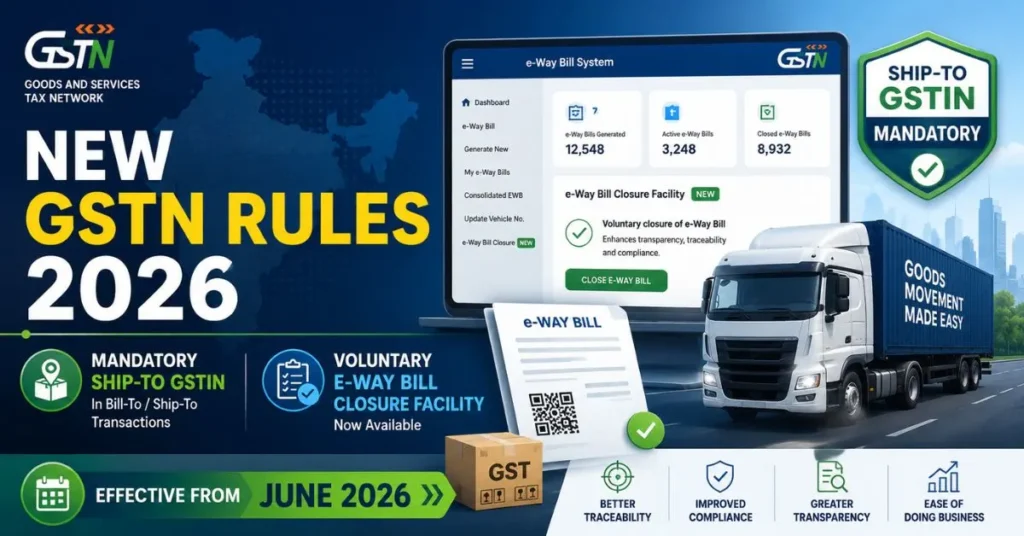
The Goods and Services Tax Network (GSTN) has announced major enhancements to the e-Way Bill (EWB) system that are set to significantly change the way businesses manage goods transportation and GST compliance in India. The latest advisory introduces two important updates — a voluntary e-Way Bill Closure Facility and mandatory capture of “Ship To GSTIN” in Bill-To Ship-To transactions.
These changes are aimed at improving transparency, strengthening invoice traceability, enhancing logistics monitoring, and reducing tax evasion risks within the GST ecosystem. Businesses, transporters, ERP providers, GST Suvidha Providers (GSPs), and taxpayers are now being advised to prepare their systems before the rollout scheduled for 15 June 2026.
What is the Latest GSTN Advisory About?
GSTN issued an advisory in May 2026 announcing new enhancements to the e-Way Bill portal. The advisory focuses on:
- Mandatory reporting of “Ship To GSTIN” in Bill-To Ship-To transactions
- Introduction of voluntary e-Way Bill Closure functionality
- API and ERP integration updates
- Improved transaction traceability and reconciliation
- Strengthening GST compliance and fraud detection systems
The move is being seen as another step toward deeper digital monitoring and automation under the GST framework.
Understanding Bill-To Ship-To Transactions
Before understanding the new rule, it is important to know what a Bill-To Ship-To transaction means.
In many business operations, the invoice is issued to one party while the goods are delivered to another location or entity.
Example
- A company’s head office places an order
- The supplier raises the invoice to the head office
- But the goods are directly shipped to a branch office, warehouse, distributor, or customer location
This is commonly used in:
- E-commerce businesses
- FMCG distribution networks
- Pharmaceutical supply chains
- Warehousing operations
- Third-party logistics models
- Drop shipment arrangements
Until now, the “Ship To GSTIN” field was not always mandatory during e-Way Bill generation, which sometimes created inconsistencies in tracking the actual recipient of goods.
Mandatory Capture of “Ship To GSTIN”
One of the biggest changes announced by GSTN is the mandatory capture of “Ship To GSTIN” during e-Way Bill generation in Bill-To Ship-To transactions.
Under the new system:
- Taxpayers must enter the GSTIN of the actual consignee
- If the consignee is unregistered, the value “URP” (Unregistered Person) must be entered
- The field will become a compulsory data element during EWB generation
This change is expected to improve recipient identification and reduce ambiguity in supply chain transactions.
Why GSTN Introduced This Rule
GST authorities are increasingly relying on analytics, invoice matching, and digital tracking to identify suspicious transactions and fake invoicing.
The mandatory Ship-To GSTIN requirement has been introduced to:
Improve Data Accuracy
The government wants more accurate information regarding where goods are actually being delivered.
Strengthen Audit Trails
Authorities will now be able to track the complete movement of goods from supplier to actual recipient.
Reduce Fake Billing
The system can help identify circular trading, duplicate invoicing, and fake movement of goods.
Improve GST Return Reconciliation
The EWB system will better match invoices filed in GST returns.
Enhance Supply Chain Transparency
Complex logistics models involving third-party warehousing and drop shipping will become more transparent.
Introduction of Voluntary e-Way Bill Closure Facility
Another major enhancement announced by GSTN is the introduction of a voluntary e-Way Bill Closure Facility.
Until now, the e-Way Bill system mainly tracked the initiation and movement of goods but lacked a formal digital mechanism to confirm successful delivery or closure of the transaction.
The new facility will allow authorized parties to close the e-Way Bill after delivery is completed.
Who Can Close an e-Way Bill?
According to the GSTN advisory, the e-Way Bill can be closed by:
- Supplier
- Recipient
- Transporter involved in the transaction
- Driver or authorized person whose mobile number is linked for closure
This makes the system more flexible and operationally convenient for businesses managing large logistics networks.
How Will the e-Way Bill Closure Facility Work?
GSTN has introduced multiple methods for closure.
Closure Methods Include:
- e-Way Bill-wise closure
- Date-wise closure for bulk operations
- Mobile number-based closure
- API-based closure for ERP systems
The mobile-based functionality is especially useful for transporters and drivers handling deliveries on the ground.
Important Features of the New Closure Facility
Same-Day or Next-Day Closure
The EWB can be closed:
- On the same day of delivery
- Or on the immediately succeeding day
Dedicated Mobile Number
A separate mobile number can be entered during EWB generation for closure purposes.
Mobile Number Updates Allowed
The linked mobile number can later be updated during:
- Vehicle updates
- Consolidated EWB operations
- Extension of validity
API Support for Businesses
GSTN has also released APIs for ERP and system integration providers. Businesses using automated systems can integrate closure functionality directly into their software.
Why the Closure Facility Matters
The new EWB closure functionality can help businesses in several ways.
Better Logistics Tracking
Businesses can now digitally confirm successful delivery of goods.
Reduced Compliance Risks
Unused or incorrect EWBs can create mismatches during audits. Closure functionality can reduce these issues.
Improved Data Integrity
GSTN databases will better reflect actual goods movement.
Stronger Fraud Detection
Authorities can identify suspicious transactions more effectively.
Better Reconciliation
Invoice-to-delivery reconciliation becomes easier for businesses and tax authorities.
Impact on Businesses and Taxpayers
The latest GSTN changes are likely to have a major impact on companies using automated logistics and ERP systems.
Businesses May Need To:
- Update ERP software
- Modify API integrations
- Improve GSTIN master data validation
- Train compliance teams
- Update logistics workflows
- Conduct system testing before implementation
Industries expected to be heavily affected include:
- FMCG
- Pharmaceuticals
- E-commerce
- Multi-location retail businesses
- Warehousing companies
- Logistics and transportation firms
Production Rollout Date
GSTN has indicated that:
- Necessary API changes have already been released in the Sandbox environment
- Production deployment is expected by 15 June 2026
Stakeholders have been advised to complete testing and configuration updates before the official rollout.
What Businesses Should Do Now
To avoid compliance issues later, businesses should immediately start preparing.
Recommended Action Points
Review Bill-To Ship-To Processes
Ensure consignee GSTIN information is correctly maintained.
Validate Customer Master Data
Incorrect GSTIN details could result in EWB rejection or compliance mismatches.
Update ERP and GST Software
Coordinate with ERP vendors and API providers.
Train Employees
Compliance teams and logistics staff should understand the new workflow.
Test API Integrations
Businesses using automated EWB systems should test changes in the Sandbox environment.
Could e-Way Bill Closure Become Mandatory in Future?
Tax experts believe that although the closure facility is currently voluntary, GSTN may eventually make it mandatory.
Experts suggest that mandatory closure could:
- Strengthen invoice reconciliation
- Improve supply chain accountability
- Reduce fake billing practices
- Enhance tax analytics
- Improve GST enforcement systems
Many professionals believe this is part of the government’s long-term plan to build a fully traceable digital GST ecosystem.
Also Read:
$11 Million CIBC Class Action Settlement 2026: Who Is Eligible and How to Claim
How Employment Changes Affect Your Taxes in Canada in 2026
Millions of Canadians Set to Receive Multiple Government Benefit Payments in June 2026