
New I-129 Form Since November 9, 2026, USCIS accepts only the 09/09/26 edition of the new I-129 form. Petitions on the 02/27/26 edition that are postmarked or e-filed on or after that date are rejected. The change covers H-1B, L-1, O-1 and every other category filed on Form I-129. The grace period is over. Employers who file work visa petitions can no longer use the February edition of the form. Since November 9, 2026, USCIS has accepted only the 09/09/26 edition of Form I-129, the Petition for a Nonimmigrant Worker. A package postmarked or submitted online on or after that date with the older 02/27/26 edition is sent back without processing. The rule applies to H-1B petitions, L-1 petitions, O-1 petitions and all other classifications that use the form.
The practical risk is lost time, not a legal penalty. A rejected filing is not a denial, but it does not hold a place in line either. For a cap-subject H-1B with a fixed start date, an extension close to expiry, or a change of status that needs to land before a worker’s authorized stay ends, even a few days of delay can create real trouble. If a package is already assembled in an old folder, the fix is to download the current form from USCIS and transfer the data.
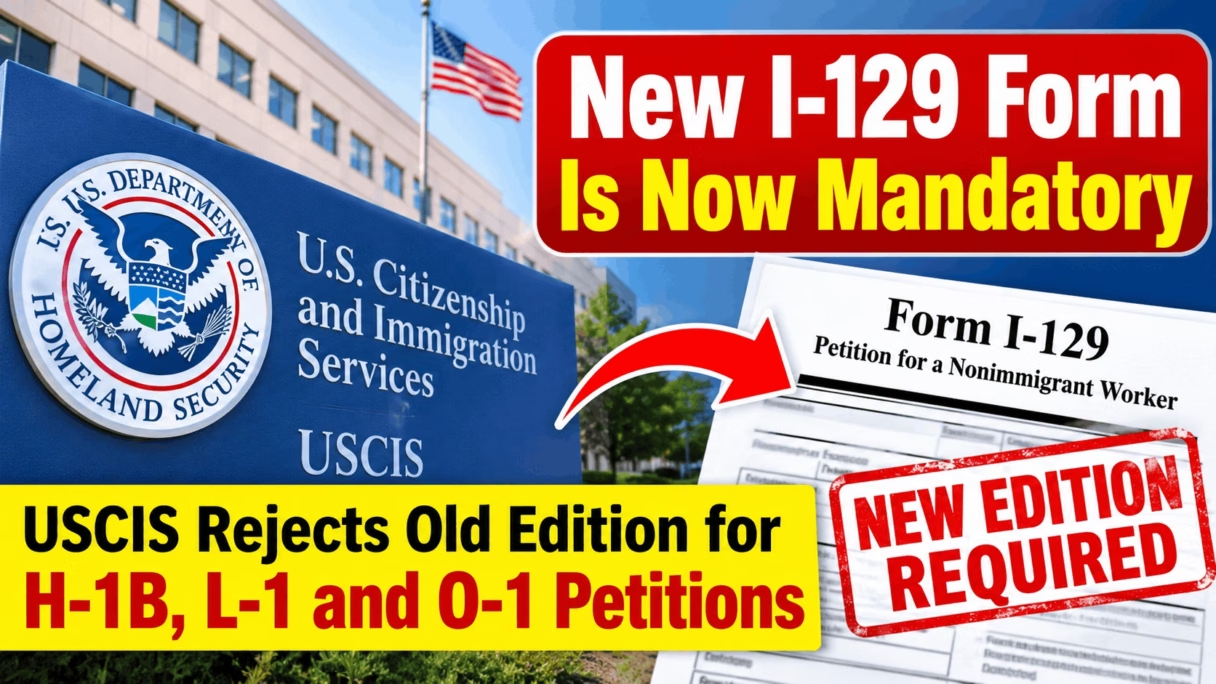
The new edition did not appear out of nowhere. USCIS published it on September 9, 2026, the same day a Department of Homeland Security final rule on the 9-11 Response and Biometric Entry-Exit Fee took effect. That rule widened who pays the fee on H-1B and L-1 extensions, and the form had to be redesigned to collect the information needed to apply it. Employers had a two-month window to use either edition. That window closed on a Monday, which caught some filers in the middle of preparing packages. USCIS also changed several Form I-129 mailing locations on October 7, 2026, so a saved address from an earlier case may now be wrong.
New I-129 Form Key Highlights
| Item | Detail |
|---|---|
| Required edition | 09/09/26 |
| Old edition | 02/27/26 (rejected if filed on or after Nov. 9, 2026) |
| New edition published | September 9, 2026 |
| Mandatory from | November 9, 2026 (postmark or electronic submission date) |
| Who is affected | Every employer filing a petition on Form I-129 |
| Linked rule | 9-11 Response and Biometric Entry-Exit Fee for H-1B and L-1 Visas |
| Rule published | August 10, 2026, effective September 9, 2026 |
| H-1B additional fee | $4,000 for covered employers |
| L-1 additional fee | $4,500 for covered employers |
| Mailing locations changed | October 7, 2026 |
What Is the New I-129 Form and Which Edition Date Should You Look For?
Form I-129 is the document a U.S. employer, or sometimes an agent, files to ask USCIS to classify a foreign worker in a temporary work category. The new version carries the edition date 09/09/26 in the bottom corner of every page. That date is the first thing a USCIS intake officer checks. If the footer says 02/27/26, the petition is returned.
USCIS also expects every page to match. A package that mixes pages from two editions can be rejected even if the first page is current. This is a common failure when a preparer reuses a few pages from a prior case. The agency says to confirm the edition date on the official I-129 page, then compare it with the footer of your printed or filled form. The form instructions also carry an edition date, and you should use the matching instructions.
Which Visa Petitions Need the New I-129 Form?
The requirement is not limited to large sponsors or to H-1B. It covers every classification that runs through the form, including:
| Category | Common use |
|---|---|
| H-1B | Specialty occupation workers, cap-subject and cap-exempt |
| H-2A and H-2B | Temporary agricultural and non-agricultural workers |
| L-1A and L-1B | Intracompany transferees |
| O-1 | Individuals with extraordinary ability |
| P, Q and R | Athletes, entertainers, cultural exchange and religious workers |
| E-1, E-2, E-3, TN | Treaty and trade-based classifications filed on the form |
| H-3 | Trainees |
So even a small business filing one O-1 petition needs the 09/09/26 edition. The fee changes are narrower than the form change, and that is where many employers get confused. Using the new form is mandatory for everyone. Paying the 9-11 biometric fee is required only for covered employers filing H-1B or L-1 petitions.
USCIS Mandatory E-Filing: Which Immigration Forms Must Be Filed Online?
New I-129 Form Deadline and Important Dates
| Date | What happened |
|---|---|
| August 7, 2026 | Final rule announced by DHS and CBP |
| August 10, 2026 | Rule published in the Federal Register |
| September 9, 2026 | Rule effective; 09/09/26 edition released |
| September 9 to November 8, 2026 | Either the 09/09/26 or 02/27/26 edition accepted |
| October 7, 2026 | USCIS changed Form I-129 mailing locations |
| November 9, 2026 | Only the 09/09/26 edition accepted |
| September 30, 2027 | Statutory sunset of the fee for petitions filed after this date, under current law |
The fee sunset date comes from the statute and the regulatory text. It could be extended by Congress, so check current guidance before relying on it for planning beyond that point.
Why Did USCIS Change Form I-129? The 9-11 Biometric Fee Explained
The main driver is the 9-11 Response and Biometric Entry-Exit Fee. Congress created it in Public Law 114-113 in December 2015. It increased the combined filing and fraud fee by $4,500 for L-1 petitions and $4,000 for H-1B petitions filed by certain employers. It doubled an earlier supplemental fee from 2010, which had expired in 2015. A portion of the money goes into an account that funds the congressionally mandated biometric entry-exit system, up to a cap of $1 billion.
DHS tried to expand the fee to all extension-of-stay petitions in a 2020 rule, but that rule was enjoined in full during unrelated litigation. DHS proposed the idea again in June 2024 and finalized it on August 10, 2026. Before the change, the fee generally applied to initial H-1B and L-1 filings and to change-of-employer petitions by covered employers. After September 9, 2026, it also applies to H-1B extension and L-1 extension petitions filed by those employers, including same-employer extensions. The fee amounts did not change. Only the number of filings that trigger them did.
A separate point deserves a clear line. The $4,000 and $4,500 amounts are not the same as the $100,000 H-1B payment measure announced in a presidential proclamation. They come from different authorities and apply to different situations. Employers should read each rule on its own terms.
Who Is a Covered Employer? H-1B and L-1 Fee Test
The fee applies to a petitioner when both conditions are true:
| Test | Requirement |
|---|---|
| Size | 50 or more employees in the United States |
| Mix | More than 50 percent of those employees are in H-1B, L-1A or L-1B status |
Full-time and part-time workers both count. A company with 100 U.S. employees and 20 of them in those statuses sits at 20 percent and is not covered. A company with 60 employees and 35 in H-1B or L-1 status sits at about 58 percent and is covered. The fee does not apply to an amended petition filed without a request to extend the worker’s stay.
If a petitioner fails either test, no extra fee is due. It must still use the 09/09/26 edition and file by the same rules as everyone else. The form now includes fields that help USCIS confirm whether the covered-employer test is met, so inaccurate headcount entries can lead to a request for evidence or a rejection.
New I-129 Form Fee Calculator for H-1B and L-1 Employers
Use the tool below to check whether the 9-11 biometric fee applies to your filing and which edition is required on your filing date. It estimates only the 9-11 fee and does not include the base filing fee, ACWIA fee, fraud fee, asylum program fee or premium processing. For those, use the USCIS fee schedule.
New I-129 Form Fee and Edition Checker
Estimate of the 9-11 biometric fee only. It excludes base, ACWIA, fraud, asylum and premium processing fees. Confirm everything on uscis.gov. This is not legal advice.
How to Apply With the New I-129 Form?
- Confirm the classification. Match the worker and job to the right category, such as H-1B, L-1 or O-1, and gather the supporting documents that category requires.
- Download the current form. Get the 09/09/26 edition and its instructions from the USCIS I-129 page on the day you file. Do not reuse a PDF from an older case.
- Check the footer. Every page should show 09/09/26 with page numbers. Reject any mixed set before it goes out.
- Complete the covered-employer questions. Count U.S. employees and those in H-1B, L-1A and L-1B status as of the filing date, and answer from that count.
- Register first if the H-1B is cap-subject. A selected registration is required before you can file a cap-subject petition. Use the USCIS registration page and your organizational account.
- Prepare the fee package. Calculate the base fees, the 9-11 fee if you are covered, and any premium processing request on Form I-907.
- Choose paper or online filing. Online filing is available for some categories. For paper, confirm the direct filing address on the USCIS page right before mailing, since locations changed on October 7, 2026.
- Submit and keep proof. Save the courier receipt, the postmark evidence or the online confirmation, because the edition cutoff is judged by postmark or electronic submission date.
- Track the case. When the receipt notice arrives, use the receipt number on the USCIS case status page.
New I-129 Form Processing Time and Premium Processing
USCIS does not guarantee a standard timeline for Form I-129. Processing varies by service center, classification and workload. The agency publishes current estimates on its processing times page, and you should check that page for your form and office rather than rely on a number from an article.
Premium processing is the fast option. Form I-907 lets a petitioner pay an extra fee for a faster decision clock. For most Form I-129 categories, USCIS has set a 15 business day target, though the timeframe and the fee depend on the classification and can change. Confirm the fee on the I-907 page and the current fee schedule before you pay. A rejected filing never starts that clock, so a wrong edition date erases the benefit of paying for speed.
A rejection is also not the same as a request for evidence. A rejection means the package was returned and nothing was filed. An RFE means USCIS accepted the case and needs more proof. The first is almost always avoidable with a checklist, which is why the edition check matters so much.
I-129 Payment Schedule: What You Pay and When?
Fees are due when the petition is filed. USCIS says petitions postmarked or submitted on or after September 9, 2026 must include the fees required under the final rule. There is no installment plan and no later billing for the 9-11 fee. A package that omits a required fee can be rejected.
| Payment item | When it is due | Who pays |
|---|---|---|
| Base Form I-129 filing fee | With the petition | All petitioners |
| ACWIA training fee | With the petition, where required | Most H-1B employers |
| Fraud prevention and detection fee | With the petition, where required | H-1B and L-1 petitioners |
| Asylum Program Fee | With the petition | Most petitioners; reduced or waived for some |
| 9-11 biometric fee ($4,000 H-1B, $4,500 L-1) | With the petition | Covered employers only |
| Premium processing (Form I-907) | With the request | Optional |
Amounts for the base, ACWIA, fraud, asylum and premium items change by rule and by year, so use the fee schedule at the official USCIS page and follow the payment instructions that come with the form. Many employers use separate payment instruments for different fee types, which makes a rejection for a single bad payment less likely to sink the whole package. The form instructions explain what USCIS accepts.
Form I-129 Filing Address Change From October 7, 2026
USCIS changed several Form I-129 mailing locations on October 7, 2026. An address saved in a template or copied from a previous case may not be valid anymore. The agency maintains a direct filing addresses page for Form I-129, and the safest habit is to open it on the day you ship.
The location can depend on the classification, whether you are requesting premium processing, and whether the petition is cap-subject. A package sent to the wrong place can be forwarded, but that costs days. If you are working under a deadline, a courier tracking record and a same-day address check are worth the five minutes.
Common Mistakes That Lead to a Rejected I-129 Petition
| Mistake | How to avoid it |
|---|---|
| Using the 02/27/26 edition | Download the form fresh each time |
| Mixing pages from two editions | Check footers on every page before filing |
| Wrong filing address | Verify the direct filing page on the mailing day |
| Missing 9-11 fee for a covered employer | Run the headcount test and use the calculator |
| Incorrect headcount answers | Count part-time staff and H-1B, L-1A and L-1B workers |
| Unsigned form or missing signature | Have an authorized signatory sign the final pages |
| Expired or incorrect payment | Confirm the payee, amount and payment method |
What the New I-129 Form Means for H-1B and L-1 Workers
Workers do not file Form I-129 themselves, but they are the ones who feel a rejection. An extension that is returned weeks before an I-94 or status expiration date can leave a person scrambling. Workers can ask their employer or attorney three simple questions: which edition was used, whether the company is a covered employer for the 9-11 fee, and when the package was shipped or submitted.
The form change does not alter eligibility for H-1B, L-1 or other categories. It also does not change CPT, OPT or STEM OPT rules. Covered employers may see higher costs on extensions, and some may reconsider how they budget for staff in these statuses. Large staffing and consulting firms, which tend to have a high share of H-1B and L-1 staff, are the most likely to meet the 50 percent test. Companies with a mixed workforce will usually fall below it.
Fee Per Petition, Covered Employer Test & Edition Acceptance Timeline
H-1B and L-1 Fee in the New I-129 Form: $4,000 vs $4,500 for Covered Employers
Amounts set by Public Law 114-113 and confirmed in the August 10, 2026 final rule.
Who Pays the 9-11 Biometric Fee?
A petitioner needs 50 or more U.S. employees and more than 50 percent of them in H-1B, L-1A or L-1B status. Both companies below are illustrative examples.
Edition timeline chart: Which Form I-129 edition does USCIS accept?
Edition acceptance is judged by postmark or electronic submission date.
Official New I-129 Form Resources and Links
| Resource | Link |
|---|---|
| Form I-129 page and current edition | https://www.uscis.gov/i-129 |
| Form I-907 premium processing | https://www.uscis.gov/i-907 |
| USCIS fee schedule (G-1055) | https://www.uscis.gov/g-1055 |
| H-1B electronic registration | https://www.uscis.gov/h-1b-electronic-registration-process |
| USCIS online account login and registration | https://my.uscis.gov |
| Case status check | https://egov.uscis.gov/casestatus/landing.do |
| Processing times | https://egov.uscis.gov/processing-times/ |
| Final rule in the Federal Register | https://www.federalregister.gov/documents/2026/08/10/2026-16231/9-11-response-and-biometric-entry-exit-fee-for-h-1b-and-l-1-visas |
New I-129 Form FAQs
What is the new I-129 form?
It is the 09/09/26 edition of the Petition for a Nonimmigrant Worker. USCIS published it on September 9, 2026, and has required it for every filing since November 9, 2026.
Can I still use the 02/27/26 edition of Form I-129?
No, not for a petition postmarked or submitted electronically on or after November 9, 2026. USCIS rejects those filings. Before that date, either edition was accepted.
Does the new I-129 form apply to O-1 and other non-H-1B visas?
Yes. The edition requirement covers every petition filed on Form I-129. Only the extra fee is limited to certain H-1B and L-1 employers.
Who has to pay the $4,000 H-1B and $4,500 L-1 fee?
Covered employers: those with 50 or more U.S. employees, where more than half are in H-1B, L-1A or L-1B status.
Does the fee apply to extensions now?
Yes, for covered employers. Since September 9, 2026, it applies to all H-1B and L-1 extension-of-stay petitions, including same-employer extensions.
Is the 9-11 fee the same as the $100,000 H-1B payment?
No. They are separate measures with different legal sources and different triggers.
What happens if I file the wrong edition?
USCIS returns the package without processing it. You must refile on the correct edition, and the new filing date applies.
Where do I mail Form I-129 now?
Use the direct filing addresses page for Form I-129 on uscis.gov, since locations changed on October 7, 2026.
When did USCIS stop accepting the February 2026 edition?
For filings postmarked or electronically submitted on or after November 9, 2026.
How do I know which Form I-129 edition I have?
Look at the bottom of each page for the edition date, and compare it with the date on the official USCIS Form I-129 page.
Is premium processing still available with the new I-129 form?
Yes, through Form I-907 for eligible categories. Check the I-907 page for the current fee and timeframe.
How long does a Form I-129 take to process?
It varies. Check the USCIS processing times page for your form type and office.
Can I file Form I-129 online?
USCIS offers online filing for some categories. Check the I-129 page to see whether yours is eligible.
Does the new I-129 form change H-1B eligibility?
No. It changes the form edition and supports the new fee rules, not the eligibility standards.
Do small businesses need the new I-129 form?
Yes. Every petitioner must use the current edition, even if the 9-11 fee does not apply to them.
New I-129 Form Conclusion
The headline change is simple: the new I-129 form is the only version USCIS accepts, and the cutoff has already passed. The less obvious change is financial. Covered H-1B and L-1 employers now owe the 9-11 biometric fee on extensions as well as on new filings, so budgets and workforce counts need a fresh look.
A short routine prevents most trouble. Download the form from USCIS on the filing day, check the 09/09/26 footer on every page, run the headcount test, confirm the mailing address, and keep proof of the submission date. Employers who do that will rarely see a rejection. Rules around fees and addresses can change again, so confirm every figure on the official pages before you pay or mail.
H-1B Visa Program Could Look “Very Different in 365 Days,” Trump Administration Warns