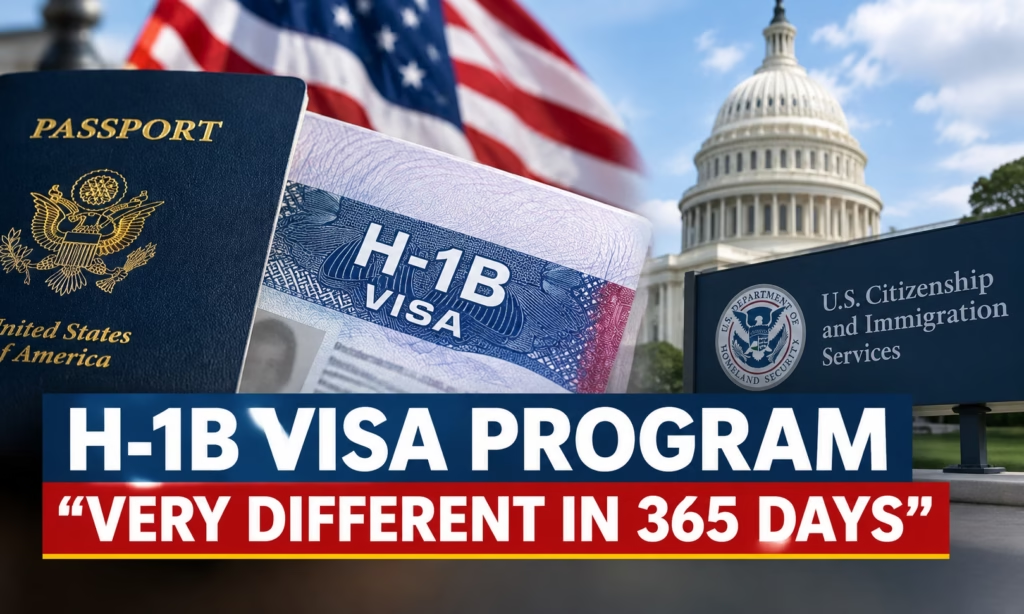
The H-1B visa program is heading for a structural overhaul, according to the federal official leading the investigation into it. “I think that the foreign labor visa program is going to look very different 365 days from now than it does today,” Labor Department Inspector General Anthony D’Esposito said in an interview posted September 26, 2026, as his office widens a nationwide fraud crackdown spanning subpoenas, executed search warrants and suspended corporate visa processing. D’Esposito was direct about the scale of the effort: “This is not a paperwork accounting issue, that this is real,” he said, adding that investigators are “laying out our case” using significant federal resources. We’ll be updating this article monthly.
The warning is not abstract. The Office of Inspector General has already suspended visa applications tied to Cognizant and Cloudera pending investigation, and field agents visiting Dallas-area corporate addresses linked to hundreds of approved H-1B petitions reportedly found locked doors, darkened rooms and little sign of active business, the kind of finding investigators say supports shell-company and visa-mill allegations. The enforcement surge runs alongside real policy changes: a presidential executive order requiring agencies to check whether H-1B-petitioning employers have recently laid off similarly situated American workers, a $100,000 fee on certain new offshore petitions, and entry restrictions on some overseas H-1B recipients extended through September 2027. Below is exactly what is being investigated, which companies are named, what employers and workers should know, and where to check the program’s official status.
What Did the Labor Department Inspector General Say About H-1B?
| Detail | Information |
|---|---|
| Official | Anthony D’Esposito, Inspector General, US Department of Labor |
| Key quote | “The foreign labor visa program is going to look very different 365 days from now than it does today” |
| Interview date | Posted September 26, 2026, by commentator Benny Johnson |
| Scope claimed | Foreign-labor fraud, worker exploitation, and potential human trafficking, not just paperwork issues |
| Enforcement actions taken so far | Dozens of federal subpoenas, executed search warrants across multiple states, suspended visa processing for named companies |
| Companies named | Cognizant and Cloudera (visa processing suspended); Infosys and TCS (heightened scrutiny, LCA audits) |
| Related probe | September 22, 2026: OIG also announced scrutiny of colleges allegedly exploiting J-1 exchange visas |
D’Esposito’s public statements have leaned on blunt, viral-style language. In a September 19, 2026 social media post, his office wrote: “A secure border means locking every door, including the H-1B back door. Fake employers. Sham jobs. Visa mills. Worker exploitation. The loopholes are closing. The raids are real. The handcuffs are ready.” Three days later, a follow-up post extended the same enforcement posture to J-1 exchange visas used by colleges and universities.
Why Some SSI Recipients Get Two Payments in October 2026?
$2400 Social Security Increase: What the Proposed $200 Monthly Boost Really Means
Social Security Payment Dates October 2026: Full Schedule By Birthday, SSI Quirk and COLA Update
Express Entry Reform 2026: FSW, FST and CEC Merger Into One Federal High-Skilled Class
Which Companies Are Under Investigation?
The expanded probe has concentrated on global IT service providers, enterprise software firms, and third-party staffing agencies that place contracted workers at external client sites, a business model investigators say is especially prone to the kinds of fraud they are pursuing.
| Company | Type | Status |
|---|---|---|
| Cognizant | Global IT services and outsourcing | Visa applications suspended pending investigation |
| Cloudera | Enterprise software | Visa application processing temporarily halted during criminal inquiry |
| Infosys | Global IT services and outsourcing | Heightened scrutiny, including LCA audits and third-party placement review |
| TCS (Tata Consultancy Services) | Global IT services and outsourcing | Heightened scrutiny, including LCA audits and third-party placement review |
| Unnamed Dallas-area entities | Smaller staffing and shell operations | Search warrants executed after field visits found signs of inactive business addresses |
None of the named companies have been convicted of a crime, and suspended visa processing is not the same as a formal fraud finding. Cognizant has previously faced separate legal scrutiny; a federal jury found the company discriminated against non-Indian workers in an earlier H-1B-related case, a reminder that IT outsourcing firms have drawn regulatory and legal attention from multiple directions in recent years, not only this current probe.
It is also worth distinguishing between the different types of scrutiny these companies face. A suspended visa application, as reported for Cognizant and Cloudera, means new petitions are on hold while investigators review specific concerns; it does not mean existing employees have lost their status. An LCA audit, the type reported for Infosys and TCS, is a document-and-compliance review that examines whether filed paperwork accurately reflects actual employment conditions, a step short of a criminal investigation. Search warrants, by contrast, indicate investigators believe they have probable cause to seek physical evidence of a suspected crime, the most serious level of scrutiny described in current reporting, and have so far been reported at smaller, unnamed entities rather than the major firms listed above.
What Specific Fraud Is Being Investigated?
- Shell operations: Registered corporate addresses tied to approved H-1B petitions found with no visible business activity during field visits
- Benching: Employers keeping H-1B workers on payroll without assigning actual work or paying required wages between client placements
- Multi-petition lottery fraud: Related entities submitting multiple registrations for the same worker to improperly increase lottery odds
- Kickback schemes: Workers allegedly required to pay part of their wages back to staffing agencies or recruiters
- LCA violations: Labor Condition Applications that misstate wages, work location, or job duties at third-party client sites
- Layoff-linked petitions: Employers seeking H-1B workers shortly after laying off similarly situated American employees, now specifically flagged under a presidential executive order
$100000 Social Security Benefits Per Year: How Married Couples Actually Reach It in 2026
Medicare Part D Premium 2027 New Rates Announced, How Much Will You Pay?
2027 Social Security COLA Forecast: Latest 3.6% Estimate and How Much Retirees Could Get
US New Visa Restrictions Targeting Commercial Birth Tourism Networks
Supreme Court Voter Database Ruling: What Changes for American Voters Now
H-1B Employer Risk Screener
H-1B Employer Risk Screener
Enter an employer’s public H-1B filing record to get an informational risk read before you apply or accept an offer.
1Employer & filing volume
2Wage & dependency profile
3Compliance flags
Breakdown
What to check next
Policy Changes Running Alongside the Enforcement Push
| Policy | Detail |
|---|---|
| Layoff-screening executive order | Federal agencies must assess whether H-1B petitioning employers recently laid off similarly situated American workers |
| $100,000 offshore petition fee | Applies to certain new H-1B petitions for workers outside the US; extended through September 21, 2027 |
| Extended entry restrictions | Entry restrictions on specific overseas H-1B recipients extended through September 2027 |
| H-1B registrations, current fiscal year | Down roughly 25% year over year, with eligible filings down further, amid the broader enforcement climate |
| Prior enforcement wave | “Project Firewall” launched at least 175 investigations into H-1B program abuse before this latest expansion |
Registration declines alone do not prove the crackdown is working as intended; falling application numbers could also reflect broader hesitancy toward US immigration policy, employer cost concerns tied to the new fees, or general economic caution, alongside any genuine reduction in fraudulent filings.
Key Dates in the 2026 H-1B Enforcement Timeline
| Date | Event |
|---|---|
| September 2025 | Presidential proclamation introduces the $100,000 fee on certain new offshore H-1B petitions |
| November 2025 | Labor Department announces 175 investigations under “Project Firewall” |
| September 18, 2026 | H-1B $100,000 fee and related entry restrictions extended through September 21, 2027 |
| September 19, 2026 | OIG publicly escalates rhetoric around H-1B enforcement on social media |
| September 22, 2026 | OIG announces parallel scrutiny of colleges allegedly exploiting J-1 visas |
| September 26, 2026 | Inspector General D’Esposito warns the program will look “very different” within a year |
| Ongoing | Visa processing suspended for Cognizant and Cloudera; audits continue at Infosys and TCS |
Why IT Outsourcing Firms Face the Sharpest Scrutiny
Global IT services companies and third-party staffing agencies operate on a business model that investigators say creates unusually high fraud risk: these firms sponsor H-1B workers directly, then place them at separate client companies’ worksites, sometimes for months or years at a time, rather than employing them at a single, fixed location the way a typical direct employer would. That structure means the sponsoring company’s registered corporate address, the address listed on the LCA and visa petition, may bear little resemblance to where the worker actually reports each day, which is precisely the mismatch field agents say they found during the Dallas-area site visits.
This business model is not inherently fraudulent; placing skilled workers at client sites is a long-established, lawful staffing practice used across the IT industry. But it does create more opportunities for the specific violations investigators are targeting: benching workers between client assignments without pay, filing LCAs that do not reflect actual work locations, and structuring related corporate entities to submit multiple lottery registrations for the same worker. Because outsourcing and staffing firms represent a large share of overall H-1B petition volume, even a modest fraud rate within that segment can account for a disproportionate share of the violations investigators uncover industry-wide.
What This Means for Current H-1B Workers and Applicants
Nothing in current law has changed for individual H-1B holders solely because of these investigations. Visa status, work authorization and petition validity remain governed by existing regulations unless and until specific enforcement action affects an individual case, such as an employer’s petition being formally revoked. Still, immigration attorneys generally advise H-1B workers at outsourcing or third-party placement firms to keep detailed personal records of assignments, pay stubs and work locations, since that documentation is the clearest way to demonstrate compliance if an employer comes under scrutiny.
Workers who believe they are experiencing benching, wage violations or kickback demands can report these issues directly to the Department of Labor without it being treated as evidence against their own status; these enforcement tools are explicitly aimed at identifying abusive employers, not penalizing the workers they employ.
Social Security COLA 2027 by State: These 10 States Could See the Biggest Dollar Increase
H-1B Visa Fraud Crackdown: What Workers and Employers Must Know
Full Social Security at 60: Who Qualifies Under the New Blue Collar Bill
How to Apply for or Renew an H-1B Visa Under Current Rules
- Confirm your employer’s petition is filed accurately, with an LCA that matches your actual job duties, wage and work location.
- Complete the H-1B registration during the annual lottery window, typically in March, if you are a new applicant subject to the cap.
- If selected, your employer files Form I-129 with US Citizenship and Immigration Services, including required fees.
- Attend a consular interview if applying from abroad, and be prepared to accurately describe your job duties and employer relationship.
- Track your petition status through USCIS’s official case status tool using your receipt number.
H-1B Processing Time and Fees in 2026
| Item | 2026 detail |
|---|---|
| Annual registration period | Typically March, ahead of the October 1 fiscal year start |
| Standard processing time | Several months for standard processing; premium processing available for an additional fee for faster review |
| Offshore petition fee (new rule) | $100,000 for certain new petitions filed for workers outside the US |
| Annual cap | 85,000 new visas, including the 20,000 reserved for advanced-degree holders, with some cap-exempt exceptions |
| FY2026 registration volume | Down about 25% year over year, with eligible filings down further |
How Employers Are Responding to the Crackdown
Companies named or facing heightened scrutiny have generally responded by tightening internal compliance rather than publicly disputing the investigations. Industry attorneys report that outsourcing and staffing firms have accelerated internal audits of their own LCA filings, worksite documentation and benching practices in anticipation of federal review, since demonstrating proactive compliance can matter significantly if a company later faces a formal inquiry. Some firms have also begun requiring more frequent written confirmation from client companies about actual work assignments and locations, reducing the gap between what a petition states and where a worker actually reports.
The US Chamber of Commerce and several industry groups have previously challenged related H-1B enforcement measures, including the $100,000 offshore fee, arguing that broad enforcement actions risk penalizing legitimate employers alongside genuine bad actors and could disrupt the flow of skilled workers into sectors like healthcare and technology that rely heavily on the program. Lawmakers with significant H-1B-dependent constituencies have raised similar concerns about the enforcement approach’s breadth, even while generally supporting efforts to root out genuine fraud.
Official Resources on H-1B Enforcement and Applications
| Resource | Use it for | Link |
|---|---|---|
| USCIS H-1B program page | Eligibility, registration and petition process | uscis.gov H-1B program |
| USCIS case status | Login, registration and tracking a filed petition by receipt number | egov.uscis.gov/casestatus |
| Report H-1B fraud or abuse | Submitting a tip about suspected employer violations | uscis.gov/report-fraud |
| Department of Labor OIG | Official statements and enforcement updates on the crackdown | oig.dol.gov |
| DOL wage and hour complaints | Reporting benching, wage violations or kickback demands | dol.gov wage complaints |
| Labor Condition Application search | Checking a filed LCA’s wage and location details | flag.dol.gov |
| Visa Fraud Tip Portal | Reporting suspected visa fraud to the State Department | travel.state.gov/reportvisafraud |
FAQs About the H-1B Visa Crackdown
Why does the H-1B visa program look like it could change dramatically?
Labor Department Inspector General Anthony D’Esposito said in a September 26, 2026 interview that the foreign labor visa program will look ‘very different’ within a year, citing an expanding fraud investigation involving subpoenas, search warrants and suspended visa processing at multiple companies.
Which companies have had H-1B visa processing suspended?
The Office of Inspector General has suspended visa applications tied to Cognizant and Cloudera pending investigation, while Infosys and TCS face heightened scrutiny including Labor Condition Application audits and review of third-party client placements.
What kind of H-1B fraud is being investigated?
Investigators are examining shell company operations, benching workers without pay, multi-petition lottery fraud, wage kickback schemes, Labor Condition Application violations, and petitions filed shortly after employers laid off similarly situated American workers.
Has H-1B enforcement affected visa application numbers?
H-1B registrations for the current fiscal year are down about 25% year over year, with eligible filings down even further, though the decline may also reflect broader immigration policy changes, new fees, and general economic caution, not only fraud enforcement.
Does H-1B fraud investigation affect individual workers’ visa status?
Not automatically. Current law and individual visa status remain unchanged unless specific enforcement action affects a particular case, such as an employer’s petition being formally revoked. Workers who report employer violations are not treated as targets themselves.
What is the $100,000 H-1B fee and is it still in effect?
It is a fee introduced by presidential proclamation in September 2025 applying to certain new H-1B petitions for workers outside the United States. The fee and related entry restrictions were extended through September 21, 2027, as of a September 18, 2026 announcement.
What is ‘benching’ in the H-1B visa context?
Benching refers to an employer keeping an H-1B worker on payroll without assigning actual work or paying the full required wage between client placements, a practice investigators have specifically named as a target of the current fraud crackdown.
What is Project Firewall for H-1B enforcement?
Project Firewall is an earlier federal initiative, launched around November 2025, that opened at least 175 investigations into companies allegedly exploiting the H-1B visa program, preceding the broader crackdown described in this update.
How many H-1B visas are issued each year?
The annual cap is 85,000 new visas, including 20,000 reserved for advanced-degree holders, though certain cap-exempt employers such as universities and nonprofit research institutions can sponsor H-1B workers outside that limit.
Can an H-1B worker report employer fraud without risking their own status?
Yes. The Department of Labor’s wage and hour complaint process and USCIS fraud reporting tools are designed to identify abusive employer practices, and reporting genuine violations is not treated as evidence against the reporting worker’s own immigration status.
What happened with Cognizant and H-1B visas before this crackdown?
Cognizant has faced separate legal scrutiny in the past; a federal jury previously found the company discriminated against non-Indian workers in an H-1B-related employment case, distinct from the current visa processing suspension tied to the 2026 fraud investigation.
Conclusion: A Program in Flux, Not Yet Finalized
The H-1B visa program could look very different in 365 days, according to the federal official leading the current investigation, but exactly what changes remain to be seen. What is confirmed now is a genuine, expanding enforcement effort: subpoenas, search warrants, suspended visa processing at named companies, and policy changes layered on top, including layoff screening and extended fees. Use the risk screener above if you are concerned about your own employer’s practices, keep thorough personal documentation, and report genuine violations through official Department of Labor and USCIS channels rather than informal sources. We will refresh this guide every month as the investigation and any resulting regulatory changes develop.
2027 COLA: How Much Will Your Social Security Check Increase?
Social Security October 2026 Payments: Why SSI Gets Two Checks?
$255 Social Security Death Benefit: Who Actually Qualifies and How to Apply?
Social Security Cuts by State 2032: Which States Face the Biggest Economic Impact
States That Tax Social Security Benefits in 2026: Full List, Income Limits and Free Calculator