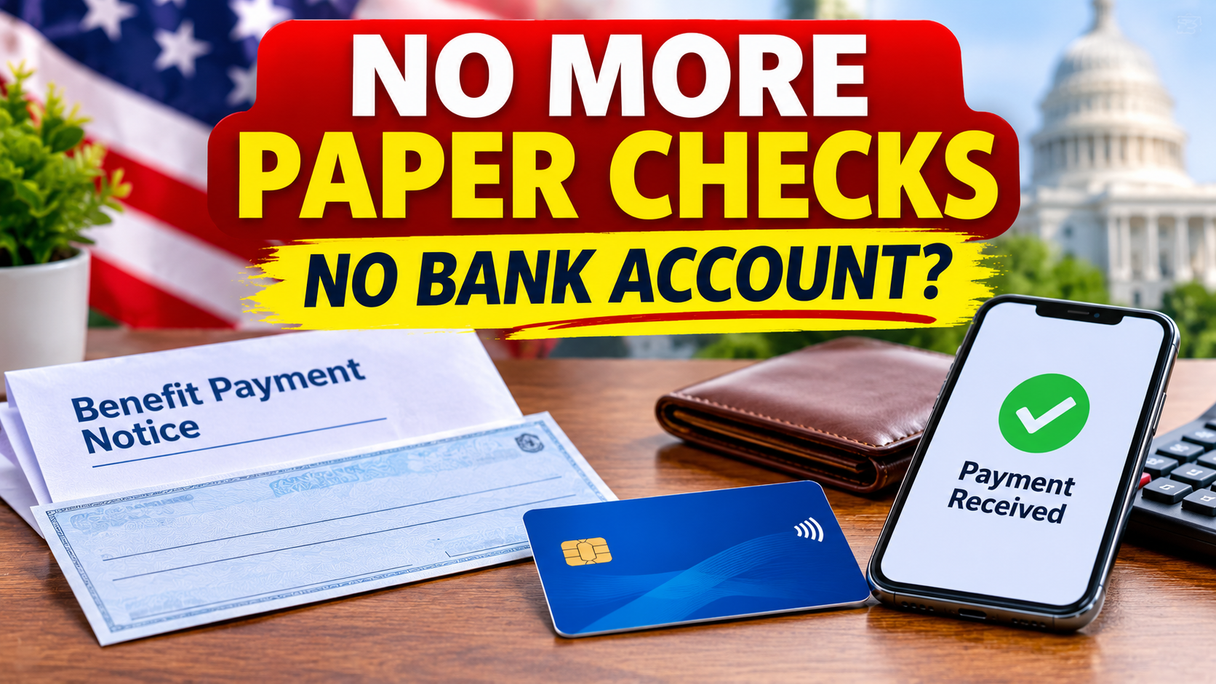
No More Paper Checks: If a government check has been landing in your mailbox for years, that routine is on its way out. Since September 30, 2025, the U.S. Treasury has been phasing out paper checks for federal payments, including Social Security, Supplemental Security Income (SSI), veterans’ benefits and IRS tax refunds. For most people this changed nothing, because most people already get paid electronically. For the smaller group who never opened a bank account, or who simply like seeing a check in the mail, it’s a real adjustment. Here’s what changed, what the government says you can do about it, and the steps worth taking now, before a payment goes missing.
Reason Behind this Decision
On March 25, 2025, President Trump signed Executive Order 14247, “Modernizing Payments To and From America’s Bank Account.” It told the Treasury Secretary to stop issuing paper checks for federal disbursements starting September 30, 2025, “to the extent permitted by law.” That covers benefits, vendor payments, payments between agencies and tax refunds. The order also says payments to the government should move online over time, though it set no firm deadline for that side.
The official reasons are fraud, cost and reliability. Treasury says its checks are about 16 times more likely to be lost, stolen, returned undeliverable or altered than an electronic payment. Anyone who has had mail stolen out of a box knows that isn’t abstract. In an April 2026 proposed rule, Treasury also said printing a check now costs an average of $3.07, roughly 20 times the cost of an ACH electronic payment.
Keep the scale in mind, though. According to that same document, about 97% of the more than 1.3 billion payments Treasury sends each year already go out electronically. Even so, Treasury still printed 40.9 million checks in fiscal year 2025. That’s a lot of households.
What it means for the programs you use
Social Security and SSI. The Social Security Administration (SSA) says more than 99% of beneficiaries already get direct deposit. Still, nearly 400,000 people were getting paper checks in September 2025, down from about 456,000 the previous March. Many of them are older or disabled, which is exactly why the transition deserves care.
One point matters a great deal: nobody is switched automatically. City officials in Boston, among others, have warned that people who still get paper checks will not be moved to direct deposit or a debit card on their own. If you do nothing, you’re counting on an exception or a mistake, and neither is a plan.
Veterans’ benefits and other programs. The VA, the Labor Department’s coal mine workers’ program and other paying agencies are covered by the same push. If any federal benefit reaches you by mail, check with the agency that pays it.
Tax refunds. The IRS began phasing out paper refund checks on September 30, 2025, so the 2026 filing season was the first with electronic delivery as the default. In the 2025 season the IRS issued more than 93.5 million individual refunds, and about 93% went by direct deposit. A Treasury Inspector General for Tax Administration report, covered in July 2026, found about 39.2 million returns this season included a direct deposit account, up 2.1 million from the year before.
What if you file without banking details? Under IRS guidance, you get a notice asking for direct deposit information or for you to claim an exception. If you don’t respond and nothing else is wrong with the return, the refund can still go out as a paper check, but only after about six weeks. The IRS says direct deposit refunds typically arrive within about 21 days. So paper isn’t just discouraged. It’s slower.
Customs refunds. U.S. Customs and Border Protection moved to all-electronic refunds on February 6, 2026, with waivers possible under the same Treasury rules. The pattern is spreading agency by agency.
What isn’t affected. State and local checks, like state unemployment or a city refund, follow their own rules. This federal change doesn’t touch them.
Your realistic options if you don’t have a bank account
You have three paths. One of them may suit you better than you’d guess.
1. Open a bank or credit union account
Treasury’s own materials point people without accounts to the FDIC’s GetBanked site and MyCreditUnion.gov to find an insured institution. An account gives you federal deposit insurance, direct deposit and bill pay, plus a debit card if you want one.
Plenty of people avoid banks over overdraft fees, minimum balances or a bad past experience. Those are fair worries. Before you sign anything, ask what the account costs in a normal month, whether there’s an overdraft charge, and whether federal deposits come in without a fee.
If you do open one, set up direct deposit through your my Social Security account at ssa.gov, through Treasury’s Go Direct site (GoDirect.gov), or by asking your bank to send the details. Keep your routing and account numbers handy and double-check them. One wrong digit is a common reason a deposit stalls.
2. Use a Direct Express card
This is the Treasury-sponsored prepaid debit card made for federal benefit recipients without bank accounts. Your payment lands on the card on payment day, and you can use it for purchases, bills and ATM cash. No bank account needed. Treasury’s guidance says that if you do have a bank account, use direct deposit instead, but for everyone else this is the intended route.
To sign up, call the Electronic Payment Solution Center at 800-967-6857 (weekdays, 9 a.m. to 7 p.m. Eastern), call the Direct Express line at 1-800-333-1795, or visit usdirectexpress.com. About 3.4 million Americans already use it.
A transition is underway, so pay attention to your mail. Treasury’s Bureau of the Fiscal Service chose Fifth Third Bank as the new financial agent, replacing Comerica, which had run Direct Express since 2008. The five-year agreement began September 9, 2025. According to an SSA notice, new enrollments go through Fifth Third starting May 2026, and existing cardholders are being moved in stages, with replacement cards arriving through 2026 and into 2027.
What should you do? Keep using your current Comerica card as usual until a new one shows up. Don’t throw it away. Expect a mailed notice first, and activate the new card only by following the instructions that come with it. Fifth Third has said it plans to add things like virtual cards and cardless ATM access. I’d call those promises until you can see them on your own account.
3. Ask for a paper check waiver
Exceptions exist, but they’re tight. Under current rules, Treasury will consider a waiver if electronic payment would be a hardship because you can’t manage an account or a Direct Express card due to a mental impairment, or because you live somewhere that lacks the infrastructure for electronic transactions. To ask, call the Treasury waiver line at 1-855-290-1545 and request an application. Social Security beneficiaries can also call SSA at 1-800-772-1213 for help, though SSA doesn’t decide waivers itself.
Two practical notes. First, being unbanked on its own isn’t a guaranteed ticket to a waiver, since Treasury expects Direct Express to fill that gap. Second, don’t wait on an answer with nothing in place. Boston’s guidance suggests enrolling in an electronic option while a waiver request is pending, so a delay doesn’t leave you without money.
A rule change worth watching
In April 2026, the Fiscal Service published a proposed rule in the Federal Register that would rewrite the waiver system. Comments were due June 15, 2026. I couldn’t find a final version as of today, so treat all of this as proposed, not settled.
The proposal would:
- Move hardship waiver decisions to the paying agency. Instead of Treasury, SSA or the VA would handle your request under Treasury guidance.
- Keep two individual hardship grounds: inability to manage an account because of a mental impairment, and living where electronic transfers aren’t supported.
- Drop the old age-based waiver for people born before May 1, 1921, who would now be over 104.
- Add an agency waiver for Indian land that lacks the infrastructure for electronic transfers, a response to feedback from tribal communities.
- Count prepaid cards and digital wallets as electronic payment, if they meet Treasury requirements.
- Remove a provision letting Treasury redirect payments to a Treasury-sponsored account for people who hadn’t picked one. Treasury said moving certified payments without the payee’s consent isn’t a workable approach.
Notice what isn’t on the individual list: “I don’t have a bank account.” That backs up the practical advice. For the unbanked, the destination is an account or a Direct Express card, not a permanent exception.
What to do this week
If you still get paper checks, or you’re helping someone who does, here’s a sensible order.
- Find out how you’re enrolled. Check your latest payment notice or call the paying agency. SSA’s number is 1-800-772-1213.
- Pick your route. If you can open an account, that gives you the most control. If you can’t or won’t, sign up for Direct Express.
- Enroll before the money is due. Switching takes time, and you don’t want your next payment stuck in the gap.
- Gather your documents. Photo ID, Social Security number and mailing address. For direct deposit, you’ll need routing and account numbers from a check or your bank.
- Plan for ID checks. Some changes, like updating deposit details, can require proof of identity. If you can’t use your online my Social Security account, you may need to visit a local SSA office.
- If you think you qualify for a waiver, apply now, and keep an electronic backup in place.
- For taxes, put your banking details on the return. If you use a prepaid card or digital wallet for your refund, make sure it can actually accept an IRS deposit, and enter the numbers carefully.
- Help someone who can’t do this alone. Older relatives, people with disabilities and anyone uneasy with technology may need a hand. If you’re a representative payee, the set-up and any waiver request fall to you.
Scam Alert
Big confusing changes attract scammers. The “your payments will stop unless you act now” call or text is a classic. Real agencies don’t threaten to cut off benefits unless you hand over your Social Security number, bank account number, debit card number or PIN.
The safest habit is simple: don’t respond to unsolicited messages. Hang up, then contact the agency, Go Direct, your bank or Direct Express using numbers you already know are real, like those on official notices or the back of your card. A direct deposit can also be hijacked if a scammer reroutes your payment, and you may not notice until the money doesn’t arrive. Check your account on payment day and report anything odd right away. And benefits should only go into an account that belongs to you or your authorized representative payee, never a stranger’s, no matter how official they sound.
Paying the government is changing too
This article is mostly about money coming from Washington, but the executive order also pushes payments to the government online. Treasury’s guidance says there’s no set deadline for that side, but over time the government is expected to stop accepting paper checks and money orders, with limited exceptions. If you mail checks for taxes or fees, look at what electronic option the relevant agency offers, and confirm the details on its own website.
Overview
It’s fair to feel two things at once. Electronic payments are faster, cheaper and harder to steal, and Treasury says its 2025 request for public comment drew 248 responses showing broad agreement on those advantages.
But the same commenters raised real concerns: account fees, ID requirements, digital literacy among seniors, rural and tribal communities with weak infrastructure, banking deserts, and worries about privacy and fraud. Treasury itself acknowledged in the proposed rule that more time is needed to resolve remaining policy and technical limitations. “Just use direct deposit” isn’t helpful if there’s nowhere convenient to open an account.
That’s why Direct Express matters more than it might seem, and why the handoff to Fifth Third is a genuine consumer issue. If you’re one of the 3.4 million cardholders, read your mail carefully.
Paper federal checks aren’t coming back as a normal option. For most unbanked Americans the question isn’t whether to switch but how. A bank or credit union account gives you the most control. Direct Express is a legitimate Treasury-backed alternative that needs no account. A paper-check waiver is possible but narrow, discretionary and may soon be handled by individual agencies.
Don’t wait for a check that isn’t coming. Pick your route, enroll, keep your information current and guard your account details. And if you know someone who still opens an envelope every month, call them this week.