Proof of Canadian Citizenship Certificate Wait Time: The wait for a proof of Canadian citizenship certificate has gotten significantly worse in just the past few weeks, and anyone applying right now needs to reset their expectations. As of July 2026, Immigration, Refugees and Citizenship Canada (IRCC) says new applicants should expect to wait 19 months for a decision, up sharply from 15 months just one month earlier. The queue itself has ballooned to roughly 100,000 applications, according to IRCC’s own processing time data, meaning tens of thousands more people are waiting in line than official figures showed even a month ago. We’ll be updating this article monthly so you always have the current, accurate wait time instead of an outdated number.
If you’ve seen headlines citing a 15-month wait and an 82,000-person queue, that information reflects where things stood in June, not where they stand now. The backlog for citizenship certificates has been growing so fast that figures published just four to six weeks apart have already become outdated. This piece breaks down exactly what’s driving the surge, what IRCC’s own newly released data shows, and what applicants can realistically expect if they file today.
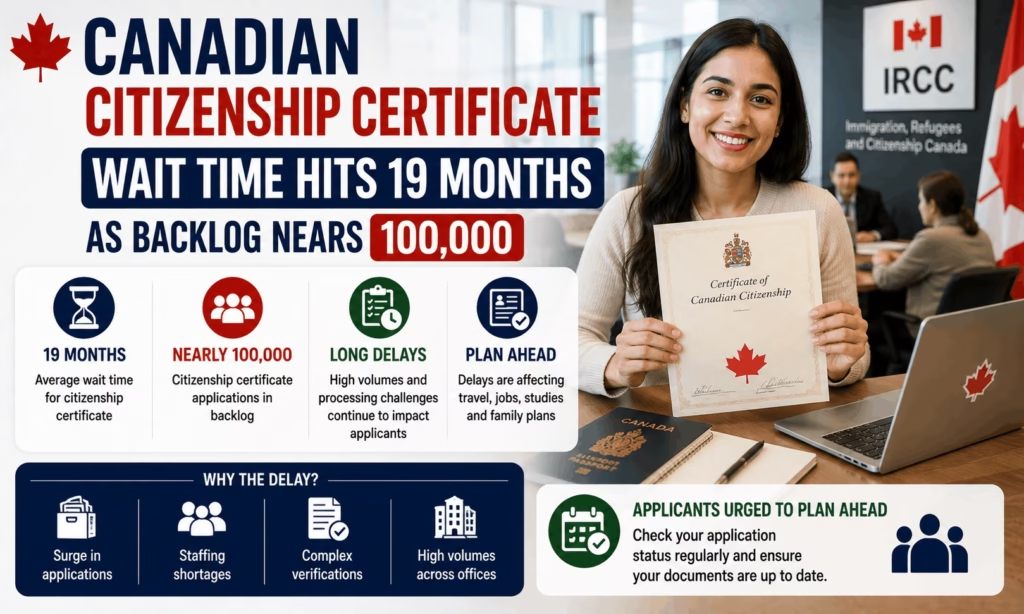
Canadian Citizenship Certificate Wait Time Overview
| Detail | Latest Figure |
|---|---|
| Current estimated wait time (as of July 2026) | 19 months |
| Wait time one month earlier (June 2026) | 15 months |
| Wait time before Bill C-3 (November 2025) | Approximately 9 months |
| Applications waiting in queue | Approximately 100,000 |
| Applications not yet finalized (IRCC data, as of May 31, 2026) | 82,020 |
| Certificates issued, January 1 to May 31, 2026 | 28,940 |
| Applications received, January 1, 2025 to March 31, 2026 | 113,435 |
| Applications processed in that same period | 78,565 |
| Law driving the surge | Bill C-3, in effect since December 15, 2025 |
| Application fee | CA$75 per applicant |
What Changed: The Latest Update on Canada’s Citizenship Backlog
This is the update most existing coverage hasn’t caught up to yet. IRCC released new inventory data on July 21, 2026, showing 82,020 proof of citizenship applications still sitting unfinalized as of the end of May, against only 28,940 certificates actually issued between January and May combined. That’s nearly three applications waiting for every one that gets finished. By the time IRCC’s processing time estimate was next updated in July, the number had already climbed past 82,000 toward the 100,000 mark, and the quoted wait time jumped to 19 months.
NDP immigration critic Jenny Kwan has publicly pushed IRCC to release more detailed backlog breakdowns, arguing Canadians deserve clearer visibility into how bad the delay has actually gotten. Meanwhile, IRCC has said only that it is “monitoring application trends and volumes” and adjusting operations “as efficiently as possible,” without committing to a specific plan to bring the backlog back down.
Why Is the Wait Time Growing So Fast?
The short answer is one piece of legislation: Bill C-3. Before it took effect on December 15, 2025, Canada’s citizenship law included a so-called “first-generation limit,” which cut off citizenship by descent after just one generation born outside Canada. Bill C-3 removed that limit, opening citizenship eligibility to potentially millions of people born abroad to a Canadian parent, regardless of how many generations back that connection goes, as long as certain conditions are met.
The change has had an outsized effect on one group in particular: Americans with French-Canadian ancestry. Between the mid-1800s and early 1900s, roughly 900,000 French Canadians left Quebec and the Maritimes for New England, drawn by jobs in the region’s textile mills. Their descendants, many still carrying recognizably French surnames, are now discovering they may qualify for Canadian citizenship, and archives across the country are feeling the effect. Quebec’s Bibliothèque et Archives nationales du Québec reported a roughly 3,000% jump in vital record requests in a single month compared to the year before, and Prince Edward Island’s archives have reported running months behind on their own record requests.
Missouri SNAP Food Ban Delayed: What’s Banned & Latest Status
Hawaii SNAP Soda Ban Delayed to 2027: What Will Be Banned & Status
Florida SNAP Junk Food Ban 2026: What’s Banned, Court Update, EBT Rules & Latest Status
Nevada SNAP Food Ban: What’s Banned & Start Date Explained
Proof of Citizenship vs. Citizenship Grant: Why the Numbers Get Confused
A lot of the online confusion around this topic comes from mixing up two very different IRCC queues. A citizenship grant application is for permanent residents becoming Canadian citizens for the very first time, a process with its own backlog of more than 326,000 applications, more than four times larger than the citizenship certificate queue. A proof of citizenship application, by contrast, is for people who are already citizens, whether by birth, descent, or an earlier grant, and simply need a physical certificate to prove it.
These two categories are tracked completely separately by IRCC, and news headlines don’t always make that distinction clear. The 19-month wait and the roughly 100,000-person queue discussed in this article refer specifically to proof of citizenship, not the separate and much larger citizenship grant backlog.
A Temporary Pause That Added to the Confusion
In June 2026, IRCC quietly paused the finalization of some Bill C-3 citizenship certificate files while it reviewed approximately 6,500 certificates that had already been issued under the new descent rules. That internal review wrapped up on June 30, 2026, and normal finalization work resumed shortly after. IRCC has said this was a quality assurance step tied to the new eligibility rules, not a sign that already-approved certificates were being revoked, but the pause did contribute to processing slowdowns during that window, layering on top of the broader volume surge.
What This Means If You’re Applying Now
If you’re planning to submit a proof of citizenship application, the most important thing to understand is that IRCC’s processing time estimate is based on the size of the queue at the moment you check it, not a fixed promise. Because new applicants are continuing to join the line every week, often faster than IRCC can process existing files, waiting to apply generally does not make your eventual wait shorter. Someone who files today joins the queue behind everyone who has already applied, and the estimate itself may climb again by the time your file is actually reviewed.
For applicants relying on French-Canadian, Acadian, or other multi-generational ancestry records, it’s also worth starting the documentation process early. You’ll typically need a continuous, certified paper trail connecting you back to your Canadian ancestor, birth or baptismal records, marriage certificates, and citizenship or passport proof for the Canadian-born relative in the chain. Provincial archives are experiencing their own backlogs because of this same surge in demand, so ordering vital records early can meaningfully shorten your overall timeline even if IRCC’s own processing time doesn’t improve.
What You’ll Need to Apply
A proof of citizenship application (form CIT 0001) generally requires your own foreign birth certificate, your Canadian parent’s proof of citizenship, and, for anyone born on or after December 15, 2025, evidence that the Canadian-born parent spent at least 1,095 days physically present in Canada before your birth. Applicants also need two passport-style photos, a copy of government-issued photo ID, and the CA$75 fee per person, including for children. Applications can be filed either online through the IRCC portal or by mail.
How to Check Your Application Status
Once your application has been submitted and you’ve received an Acknowledgement of Receipt (AOR), you can track its progress in one of two ways depending on how you applied:
- Online applicants can log into their IRCC secure account portal to view real-time status updates, which generally move through stages such as “Received,” “In Process,” “Decision Made,” and “Certificate Mailed.”
- Paper applicants receive an acknowledgement letter by mail four to eight weeks after mailing their application, and can check status afterward by phone using their client number.
Canada Grocery Rebate 2026 Full Schedule: Confirmed Payment Dates, Amounts & Status Check!
Official Canada Citizenship Resources
| Purpose | Official Link |
|---|---|
| Apply Online for a Citizenship Certificate (CIT 0001) | canada.ca/en/immigration-refugees-citizenship/services/application/application-forms-guides/guide-0001-online-application-citizenship-certificate-adults-minors-proof-citizenship-section-3.html |
| Check Application Status | canada.ca/en/immigration-refugees-citizenship/services/application/check-status.html |
| IRCC Current Processing Times | canada.ca/en/immigration-refugees-citizenship/services/application/check-processing-times.html |
| IRCC Secure Account Login | canada.ca (IRCC Portal, via “Sign In”) |
| IRCC General Enquiries Phone Line | 1-888-242-2100 |
| Bill C-3 Citizenship by Descent Information | canada.ca/en/immigration-refugees-citizenship/services/canadian-citizenship/become-canadian-citizen/citizenship-descent |
FAQs
How long does it take to get proof of Canadian citizenship in 2026?
As of July 2026, IRCC estimates roughly 19 months for a decision on a proof of citizenship application, though this figure changes monthly as the queue grows.
Why has the Canadian citizenship certificate backlog gotten so much worse?
Bill C-3, which took effect December 15, 2025, removed the first-generation limit on citizenship by descent, making millions of people, most of them Americans with a Canadian parent or grandparent, newly eligible to apply for proof of their citizenship.
Is the citizenship grant backlog the same as the proof of citizenship backlog?
No. They’re tracked separately. Citizenship grants, for permanent residents becoming citizens for the first time, have a backlog of more than 326,000 applications. Proof of citizenship, for people who are already citizens, has a separate backlog of roughly 82,000 to 100,000 depending on the most recent count.
Will applying sooner get me a shorter wait time?
Generally, yes, relative to waiting longer. Since IRCC processes applications in the order received and the queue keeps growing, filing earlier typically means fewer people ahead of you than if you wait, even though the overall estimated wait time may still increase before your file is reviewed.
Does the wait time apply to people applying from outside Canada and the U.S.?
Applicants mailing documents from outside Canada and the United States should generally add an extra three to four months on top of the standard estimate to account for international mail processing time.
What documents do I need if my Canadian ancestor’s records are missing?
IRCC has updated its guidance to allow alternative forms of evidence when an ancestor’s original birth certificate can’t be located, though applicants are still expected to request official records from the relevant registrar first and document their efforts if those records genuinely can’t be obtained.
Conclusion
The proof of Canadian citizenship wait time has moved fast this year, climbing from roughly nine months before Bill C-3 to 15 months in June and now 19 months as of the latest July 2026 data, with the queue approaching 100,000 applications. The driving force is clear: Bill C-3’s removal of the first-generation descent limit has opened eligibility to a huge new pool of applicants, particularly Americans with French-Canadian roots, faster than IRCC has been able to process the resulting surge. If you’re planning to apply, the most useful steps right now are starting your documentation early, applying as soon as your paperwork is ready, and checking IRCC’s official processing time page directly rather than relying on older figures still circulating online. This article will continue to be reviewed and updated monthly as IRCC releases new backlog and processing time data.
No SSI Payment in August 2026: SSI August 2026 “no payment” confusion Fact-Checked
State-by-State SNAP Food Ban 2026: What’s Banned, Status Update
Arkansas SNAP Junk Food Ban 2026: What’s Banned, Court Update, EBT Rules & Latest Status
Canada Immigration Absorption Index 2026: What the Numbers Show