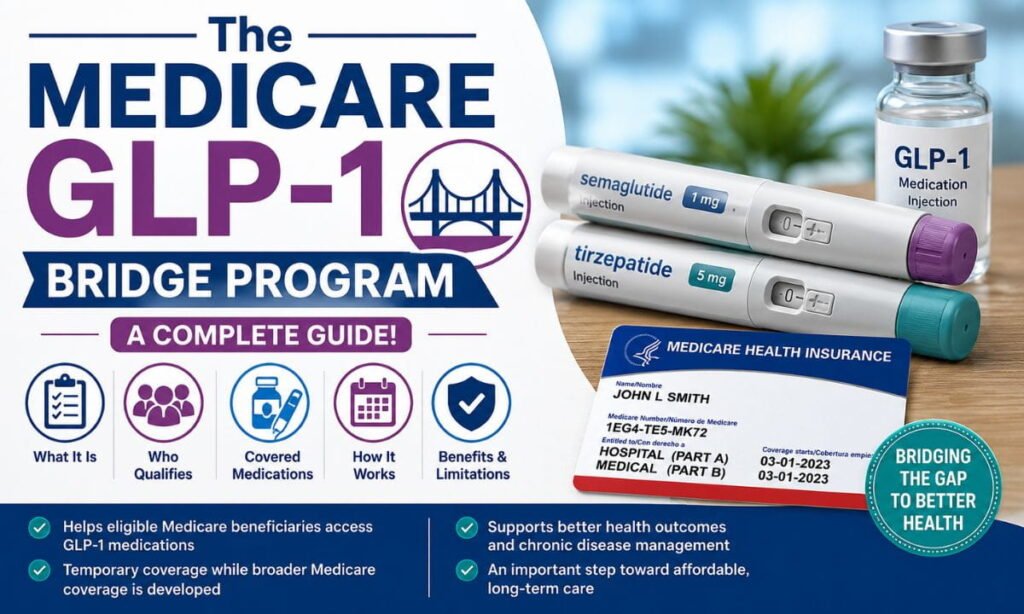
The Medicare GLP-1 Bridge Program: For the first time in its history, Medicare is paying for a weight-loss drug. On July 1, 2026, the Centers for Medicare & Medicaid Services (CMS) launched the Medicare GLP-1 Bridge Program, a temporary demonstration program that gives eligible Medicare Part D beneficiaries access to certain GLP-1 medications — Wegovy, Zepbound, and Foundayo — for a flat $50 monthly copay. The Medicare GLP-1 Bridge Program represents a major shift for a federal insurance system that has long been barred by statute from covering medications prescribed purely for weight loss.
This article (Medicare GLP-1 Bridge Program) explains where the Medicare GLP-1 Bridge Program came from, exactly who qualifies, how the process works from the doctor’s office to the pharmacy counter, what it costs, what its limitations are, and what may happen when it expires at the end of 2027.
Why Medicare Historically Didn’t Cover Weight-Loss Drugs?
Under federal law, Medicare Part D plans are prohibited from covering medications when they are prescribed for weight loss, along with several other categories of “excluded” drugs (such as fertility drugs and drugs for cosmetic purposes). This exclusion has applied even to drugs that are FDA-approved for multiple purposes. GLP-1 receptor agonists — a class of medications that include semaglutide (Wegovy, Ozempic), tirzepatide (Zepbound, Mounjaro), and orforglipron (Foundayo) — are a prime example: the same molecule can be approved for type 2 diabetes, cardiovascular risk reduction, obstructive sleep apnea, or weight management, but Part D could only pay for it when the diagnosis was one of the “covered” indications, not obesity itself.
As GLP-1 drugs became dramatically more popular for weight management in the early-to-mid 2020s, this created an unusual situation: a person with type 2 diabetes could get semaglutide covered by their Part D plan, while a person prescribed the identical drug purely to lose weight had no Medicare coverage at all and faced full retail prices often exceeding $1,000 per month. Changing this outright would require an act of Congress, since the exclusion is written into the statute governing Part D. CMS could not simply expand coverage through regulation.
Instead, CMS used its authority to run “demonstration projects” — pilot programs intended to test whether new payment or delivery approaches improve the efficiency of the Medicare GLP-1 Bridge Program — to create a bridge around the statutory exclusion, funding coverage outside of the normal Part D benefit structure entirely.
Legal Authority and Origins of the Medicare GLP-1 Bridge Program
The Medicare GLP-1 Bridge Program under Section 402(a)(1)(A) of the Social Security Amendments of 1967, as extended to Part D by section 1860D-42(b) of the Social Security Act. This provision authorizes the Secretary of Health and Human Services to run demonstration projects testing whether changes in payment or reimbursement methods would increase the efficiency and economy of Medicare-covered health services.
The Medicare GLP-1 Bridge Program was originally conceived as a short, six-month stopgap. CMS’s initial plan paired the Bridge with a longer-term, more permanent-feeling initiative called BALANCE (Better Approaches to Lifestyle and Nutrition for Comprehensive hEalth), under which Part D plan sponsors could voluntarily opt in to cover GLP-1s for weight loss starting in January 2027, with insurers absorbing more of the financial risk over time.
That plan hit a snag. Under the original design, not enough insurers signed on to BALANCE by CMS’s April 2026 deadline — reportedly because independent analysis suggested the model would cost insurers billions of dollars in its first year alone. Rather than let coverage lapse, CMS announced in May 2026 that it would delay the Part D portion of BALANCE indefinitely and instead extend the Medicare GLP-1 Bridge Program itself from a 6-month pilot to an 18-month one, now running from July 1, 2026, through December 31, 2027. The extension gives CMS more time to collect utilization data that it can eventually share with Part D plan sponsors to inform any future, permanent coverage model.
Medicare GLP-1 Bridge Program Timeline
| Date | Milestone |
| Early 2026 | CMS previews a two-phase plan: a short-term Bridge followed by BALANCE in January 2027 |
| April 2026 | Insurer opt-in deadline for BALANCE’s Part D component passes with insufficient participation |
| May 6, 2026 | CMS formally announces the Bridge, confirms the $50 copay, and extends the end date to December 31, 2027; BALANCE’s Part D piece is delayed indefinitely |
| April 6, 2026 (retroactive note) | CMS updates covered-drug list to add Foundayo following its FDA approval, and clarifies only the KwikPen formulation of Zepbound is included |
| June 11, 2026 | CMS issues formal guidance memorandum to Part D plans on Medicare GLP-1 Bridge Program expectations and FAQs |
| June 26, 2026 | CMS releases prior-authorization and clinical-documentation guidance for physicians |
| July 1, 2026 | Medicare GLP-1 Bridge Program officially launches nationwide; prior authorizations begin processing |
| December 31, 2027 | Scheduled end date of the demonstration |
What the Medicare GLP-1 Bridge Program Covers?
At present, only three brand-name products are eligible for the $50 Bridge copay when prescribed solely for weight management:
- Wegovy (semaglutide) — both injectable and tablet formulations
- Zepbound (tirzepatide) — KwikPen® formulation only; the single-dose vial and single-dose pen formulations of Zepbound are not included
Foundayo (orforglipron, made by Eli Lilly) — all formulations, added after its FDA approval
Notably absent: Ozempic and Mounjaro. These drugs remain available through standard Part D coverage, but only when prescribed for their Part D-approved indications (primarily type 2 diabetes), not for weight loss. If a patient is already receiving a GLP-1 through Part D for a covered medical reason, nothing changes for them — they continue getting that drug through their existing Part D benefit, at whatever cost-sharing their plan normally charges, which may be higher or lower than the Bridge’s $50 rate.
A critical structural detail: the Medicare GLP-1 Bridge Program is entirely separate from the normal Part D benefit and payment flow. Part D plan sponsors do not have to opt in, do not carry any financial risk for Bridge-covered prescriptions, and are not involved in adjudicating these claims at all. Instead, CMS designated a single central processor — Humana, leveraging the same administrative infrastructure it already uses for the Limited Income Newly Eligible Transition (LI NET) program — to handle all prior authorizations, claims adjudication, and pharmacy payments nationwide.
Who Is Eligible?
Eligibility for the Bridge involves two separate layers: (1) the type of Medicare plan a person is enrolled in, and (2) clinical criteria related to body mass index (BMI) and health conditions.
5.1 Eligible Plan Types
To qualify, a beneficiary must be enrolled, in calendar year 2026, in one of the following:
- A standalone Medicare Part D Prescription Drug Plan (PDP)
- A Medicare Advantage coordinated care plan that includes drug coverage (HMO, HMO-POS, or Local/Regional PPO plans with Part D — i.e., MA-PD plans)
- A Special Needs Plan (SNP)
- An employer/union Group Waiver Plan (EGWP)
- The Limited Income Newly Eligible Transition (LI NET) program
Beneficiaries in the following plan types are not eligible unless they are also separately enrolled in a standalone PDP:
- Private fee-for-service plans
- Section 1876 cost contract plans
- Section 1833 health care prepayment plans
- PACE (Program of All-Inclusive Care for the Elderly) organizations
- Fallback plans
- Religious fraternal benefit plans
Dually-eligible beneficiaries (those with both Medicare and Medicaid) who are enrolled in an eligible Part D plan type and meet the clinical criteria can access the Bridge as well — though notably, as discussed below, the Extra Help / Low-Income Subsidy (LIS) program cannot be used to further reduce the $50 copay.
TRICARE for Life beneficiaries occupy a gray area: the Bridge only applies to people with Medicare Part D drug coverage, so someone with TRICARE for Life but no separate Part D enrollment may not have access, and coordination between the two forms of coverage should be evaluated case by case.
5.2 Clinical Eligibility Criteria
A prescribing provider must submit a prior authorization attesting that the patient meets both of the following:
- The GLP-1 is being prescribed to reduce excess body weight and maintain weight reduction, in combination with ongoing lifestyle modification (structured nutrition and physical activity), consistent with the drug’s FDA-approved label; and
- The patient meets at least one of three BMI-based tiers:
Tier 1 — BMI ≥ 35: Qualifies on its own with no additional diagnosis required.
Tier 2 — BMI ≥ 30, with at least one of:
- Heart failure with preserved ejection fraction (diastolic heart failure)
- Uncontrolled hypertension (systolic blood pressure above 140 mmHg or diastolic above 90 mmHg despite treatment with two antihypertensive medications)
- Chronic kidney disease, stage 3a or above
Tier 3 — BMI ≥ 27, with at least one of:
- Prediabetes (per American Diabetes Association criteria)
- Previous myocardial infarction (heart attack)
- Previous stroke
- Symptomatic peripheral artery disease
Patients must be at least 18 years old.
5.3 The BMI “Grandfathering” Rule
One of the more beneficiary-friendly design features: eligibility is assessed based on the patient’s BMI at the time they first initiated GLP-1 therapy — not their current BMI. This matters enormously for people who have already lost significant weight on these drugs. For example, if a beneficiary started semaglutide in 2024 at a BMI of 37 and now, in 2026, has a BMI of 34 after losing weight, their provider attests to the original qualifying BMI of 37, and the patient remains eligible. This protects long-term users from being disqualified precisely because the treatment worked.
5.4 Who Is Explicitly Excluded?
Beneficiaries with any of the following diagnoses are ineligible for the Bridge — not because they can’t get the drug, but because they’re supposed to get it through standard Part D coverage instead, since these are already Part D-covered indications:
- Type 2 diabetes
- Moderate to severe obstructive sleep apnea (OSA)
- Noncirrhotic metabolic dysfunction-associated steatohepatitis (MASH, formerly known as NASH), with moderate to advanced liver fibrosis
- Reduction of major adverse cardiovascular events in patients with established cardiovascular disease (a Part D-covered indication for some GLP-1s)
If a patient has one of these diagnoses, their provider must route the prior authorization to the patient’s regular Part D plan, not the Bridge — even if the patient also happens to meet the Bridge’s BMI/weight-loss criteria.
6. Cost to Beneficiaries
The headline feature of the Medicare GLP-1 Bridge Program is a flat $50 copayment per monthly supply (28 or 30 days, depending on the drug), regardless of the beneficiary’s income level or dosage. This is designed to offer predictability: unlike typical drug pricing, the copay does not increase as a patient’s dose is titrated upward over time, something that matters because most patients require higher doses to maintain weight loss.
However, there are several important caveats:
- The $50 copay does not count toward a beneficiary’s Part D deductible or their annual out-of-pocket maximum ($2,100 in 2026).
- It will not appear on the Part D Explanation of Benefits (EOB) or Medicare Summary Notice (MSN), since it’s processed outside the normal Part D claims system.
- These drugs are not eligible for the Medicare Prescription Payment Plan, meaning beneficiaries cannot spread the $50 cost across multiple months.
- Beneficiaries who receive Extra Help (the Low-Income Subsidy) cannot use that subsidy to reduce the $50 Bridge copay — Extra Help only applies within the standard Part D benefit structure, not to Bridge claims.
- Manufacturer coupons and third-party discount programs (including direct-to-consumer discount platforms) cannot be applied to Bridge claims; the Bridge is the sole primary payer and does not coordinate benefits with any other payer.
Health policy analysts have noted that while $50 is a bargain compared to list prices or even many commercial cash-pay discount programs, it can still represent a meaningful burden for beneficiaries living on fixed, low incomes — particularly since Extra Help protections don’t extend to this copay.
7. How the Prior Authorization Process Actually Works
The Bridge’s approval process is structured differently from a typical insurance prior authorization, and this has been a significant point of confusion for both patients and providers.
Step 1 — Prescription is written. If a patient meets the eligibility and clinical criteria, their clinician writes a prescription for one of the three covered drugs and sends it to a participating pharmacy.
Step 2 — The pharmacy runs a claim, which is intentionally denied. Before any prior authorization can even be submitted, the pharmacy must first electronically transmit the claim to the Bridge’s designated billing channel (BIN 028918, PCN MEDDGLP1BR) and receive a formal rejection. This “intentional denial” is a required, built-in step of the workflow — not a sign that the patient is ineligible. It essentially unlocks the system so that the prior authorization submission becomes possible.
Step 3 — The provider submits the prior authorization. The prior authorization request is a form containing patient identifying information (name, Medicare Beneficiary Identifier, date of birth), the prescriber’s information (name, NPI, tax ID), the requested drug, and twelve yes/no clinical questions. The first several questions screen for Part D-excluded diagnoses (sleep apnea, MASH, type 2 diabetes, cardiovascular risk reduction); if any apply, the request must go to the patient’s Part D plan instead. The remaining questions establish BMI range at initiation and the presence of qualifying comorbid conditions (prediabetes, prior heart attack or stroke, peripheral artery disease, heart failure, uncontrolled hypertension, chronic kidney disease stage 3a+).
Only a prescribing clinician — not the patient — can complete and submit this form, and it must be submitted in full; incomplete forms are rejected. The clinician effectively attests, under penalty of law, that the information is accurate, and CMS has indicated it will cross-check submissions against existing Medicare data.
Step 4 — Humana reviews and decides. As the central processor, Humana processes the request. Given the anticipated volume — CMS and outside analysts estimate roughly 4 million Medicare beneficiaries could be eligible — some processing delays have been expected, especially in the early weeks after launch.
Step 5 — Approval and dispensing. If approved, both the beneficiary and the prescriber receive a confirmation letter, the pharmacy re-runs the claim (which now processes successfully), and the patient pays the $50 copay at pickup.
Once approved, the prior authorization is valid — including for refills and dose changes — through December 31, 2027, unless the patient switches to a different covered GLP-1 drug, which would trigger a new authorization requirement.
Common Reasons for Delays or Denials
Industry guidance points to a handful of recurring mistakes that slow the process down:
- Submitting the prior authorization before the pharmacy’s initial claim has actually been denied
- Reporting the patient’s current BMI instead of their BMI at the time therapy was initiated
- Mistakenly routing patients with Part D-eligible diagnoses (sleep apnea, MASH, diabetes, cardiovascular disease) to the Bridge instead of their Part D plan
- Leaving required fields on the form incomplete
8. Role of Pharmacies and Providers
Pharmacies do not need to formally opt in to participate in the Bridge, but they do need to route claims correctly. The central processor reimburses pharmacies at no less than wholesale acquisition cost, minus the patient’s $50 copay, plus a dispensing fee and applicable sales tax. Paper claims and direct member reimbursements are not accepted — everything must be submitted electronically via the NCPDP Telecommunication Standard. Because this is a new, separate payer relationship distinct from a patient’s usual Part D pharmacy benefit manager, pharmacy staff have been advised to expect a learning curve and to guide prescribers through the unfamiliar workflow in the early months.
Providers/prescribers carry the bulk of the administrative burden, since only they can submit the prior authorization, and it must be based on adequately documented BMI and clinical history in the patient’s chart. CMS and provider organizations, including the American Medical Association, have emphasized that all prior authorizations are processed retrospectively — that is, after the prescription has already been written — so physicians should be prepared to document BMI, diagnosis, and relevant comorbidities at the time of prescribing, for use later in the prior authorization request. A dedicated Bridge call center (855-273-0102, Monday–Friday, 8 a.m.–7 p.m. ET) is available to help prescribers with prior authorization questions or status checks.
9. Comparison With the Now-Delayed BALANCE Model
It’s useful to understand what the Bridge is not. BALANCE was designed as the more durable, longer-term successor: a model in which individual Part D plan sponsors would voluntarily opt in and gradually absorb more financial risk for covering GLP-1s for weight loss, potentially building permanent coverage infrastructure into the standard Part D benefit. Because BALANCE requires insurers to accept real financial exposure, and because early actuarial analysis suggested the model could cost insurers billions of dollars in its first year, insurer participation fell short of what CMS needed by the April 2026 deadline.
Rather than proceed with an under-subscribed program, CMS shelved BALANCE’s Part D component indefinitely and instead stretched the stopgap Bridge program from 6 months to 18 months. This buys time for CMS to gather real-world utilization data — how many beneficiaries enroll, how they use the drugs, what it costs — that could eventually be used to design a more actuarially sound long-term model and bring insurers back to the table. But as of this writing, CMS has given no concrete timeline for when, or whether, a permanent successor to the Bridge will materialize.
10. Criticism, Trade-offs, and Open Questions
Health policy experts and patient advocates have flagged several concerns:
The “coverage cliff.” Because the Bridge is a temporary demonstration with no statutory backing, coverage is guaranteed only through December 31, 2027. Clinicians have voiced concern that patients who succeed on these medications during the Bridge period could lose access when it ends, unless Congress acts or a new program takes its place. Physicians have pointed out that no other chronic condition in Medicare is treated this way — with an effective medication offered temporarily and then potentially withdrawn.
Weight regain risk. Most clinical research shows that many patients who discontinue GLP-1 therapy regain a substantial portion of the weight they lost. A time-limited program raises the stakes of any future lapse in coverage.
The Extra Help gap. Because Low-Income Subsidy protections don’t apply to Bridge copays, and the $50 fee can’t be spread out using the Prescription Payment Plan, some advocates argue the flat fee — while lower than list price — can still be a real barrier for beneficiaries on very limited incomes, such as those relying solely on Social Security.
Cost to the Medicare GLP-1 Bridge Program. Because the Bridge heavily subsidizes these expensive medications directly (rather than shifting risk to private insurers, as BALANCE would have), extending it to 18 months is expected to be costly for the federal government. Estimates for GLP-1 obesity coverage more broadly have put projected long-term spending in the tens of billions of dollars, underscoring why CMS has structured this as a temporary, data-gathering demonstration rather than a permanent entitlement.
No guarantee of what comes next. Advocacy organizations note that permanent, comprehensive Medicare coverage of obesity medications would ultimately require an act of Congress to remove the statutory exclusion altogether — something the Medicare GLP-1 Bridge Program does not, and cannot, accomplish on its own.
Practical Guidance: What Beneficiaries Should Do
If you have Medicare Part D coverage and think you might be eligible:
- Talk to your doctor first. Only a prescribing clinician can initiate the process; there is no separate signup or enrollment form for patients to complete themselves.
- Know your BMI history. If you’re already on a GLP-1, your eligibility is based on your BMI when you started the medication, not your BMI today — bring records or be prepared to discuss this with your provider.
- Confirm your diagnosis category. If your GLP-1 was prescribed for diabetes, sleep apnea, MASH, or cardiovascular risk reduction, you should keep using your regular Part D plan, not the Bridge — you’re likely already covered, possibly at a different cost.
- Expect the “denial-then-approval” process. If your pharmacy tells you your claim was denied before a prior authorization has been submitted, this is often a normal, required step in the workflow, not necessarily a sign that you don’t qualify.
- Check plan type. If you’re unsure whether your specific Medicare plan (PDP, Medicare Advantage, SNP, cost plan, PACE, etc.) is eligible, call 1-800-MEDICARE (1-800-633-4227; TTY 1-877-486-2048) or your State Health Insurance Assistance Program (SHIP), reachable via ship help lines listed at shiphelp.org.
- Don’t expect Extra Help to lower the $50 copay, and don’t expect to finance it through the Medicare Prescription Payment Plan.
- Watch for CMS updates, since the drug list, guidance documents, and operational details have already been revised multiple times since the Medicare GLP-1 Bridge Program was first announced (for example, Foundayo was added to the covered list only after its FDA approval in spring 2026).
This article draws on official CMS program pages and fact sheets (cms.gov/medicare/coverage/prescription-drug-coverage/medicare-glp-1-bridge and related provider, pharmacy, and Part D plan guidance pages), the official CMS press release announcing the $50 monthly pricing, Medicare.gov’s consumer-facing “Weight loss drugs” coverage page, CMS’s official prior authorization request form, reporting from NPR and the American Journal of Managed Care, guidance summaries from the Medicare Rights Center, and industry analysis from Pharmacy Times and other clinical publications.
Because CMS has updated program details multiple times since the initial announcement (including drug list changes and the extension from 6 to 18 months), beneficiaries and providers should always confirm current details directly at cms.gov or by calling 1-800-MEDICARE, since further changes are possible as the demonstration progresses.
This article is for general informational purposes only and does not constitute medical, legal, or insurance advice. Individual eligibility, coverage determinations, and program rules are ultimately decided by CMS, the central claims processor, and applicable law. Beneficiaries should consult their own healthcare provider and Medicare plan for guidance specific to their situation.
FAQ’s on Medicare GLP-1 Bridge Program
What is The Medicare GLP-1 Bridge Program?
The Medicare GLP-1 Bridge Program is a proposed or transitional initiative aimed at improving access to GLP-1 medications for eligible Medicare beneficiaries while broader coverage policies are being developed.
Which GLP-1 medications might be included?
Depending on eligibility and coverage rules, medications such as Ozempic, Wegovy, Mounjaro, and Zepbound could be included.
Who can qualify for the Medicare GLP-1 Bridge Program?
Eligibility generally depends on Medicare coverage, medical necessity, and specific requirements set by the Medicare GLP-1 Bridge Program or insurer.
Does Medicare cover GLP-1 medications for weight loss?
Coverage varies based on the specific medication, its approved use, and current Medicare policies. Not all GLP-1 medications prescribed for weight loss are automatically covered.