Social Security COLA Scams: Every October, millions of retirees and people with disabilities get good news. Every October, scammers get it too. When the Social Security Administration (SSA) announced the 2027 cost-of-living adjustment, the fraudsters were already waiting. The number is real, and so is the money. But the “urgent” letters, texts and phone calls that follow it are often not. If you or someone you love collects Social Security or Supplemental Security Income (SSI), this is worth ten minutes of your time.
What’s actually happening with the 2027 COLA
On October 14, 2026, the SSA announced a 3.6 percent benefit increase for 2027, which works out to an average of $75 more per month for retirement benefits. Nearly 72 million Social Security beneficiaries will see it starting in January 2027. Counting SSI recipients, the agency puts the total at about 76 million Americans. For comparison, last year’s increase was 2.8 percent.
Two details from the official announcement matter a lot for spotting Fakes.
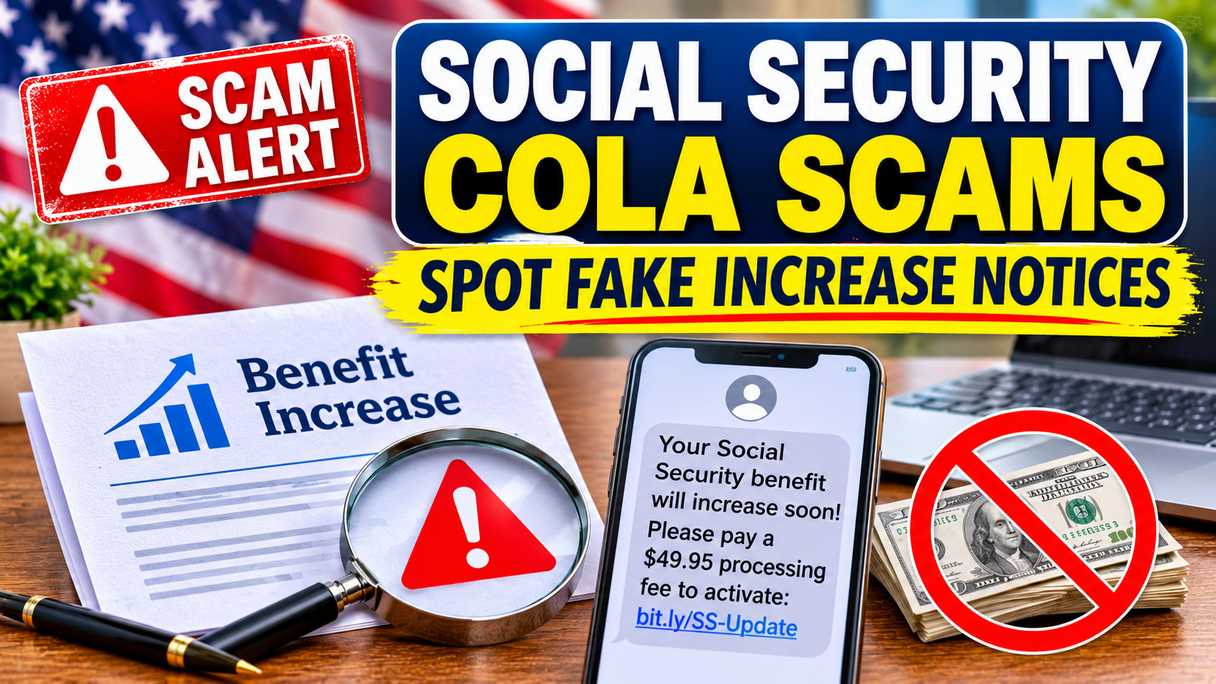
First, you don’t have to do anything to get the raise. The SSA’s own scam alert says it plainly: beneficiaries do not need to register, apply, or otherwise activate the benefit increase, because the COLA is automatic. That one sentence defeats the single most common COLA scam. If a message tells you to “activate,” “confirm,” “claim” or “unlock” your increase, it’s not from the SSA.
Second, the SSA has told you how and when your real notice will arrive. Personalized COLA notices go into the Message Center of your online my Social Security account starting in late November 2026. People without an online account get their notice by mail in December. Those are the only two routes. Not a text, not a cold call, not a link in an email.
If you’re enrolled in Medicare, there’s a related piece. The SSA says your 2027 benefit amount, after any Medicare deductions, will show up in that same Message Center in late November. CMS has also announced the standard Part B premium. It rises from $202.90 to $209.40 a month in 2027, an increase of $6.50, and the Part B deductible goes to $292. That means your net increase will be a little smaller than 3.6 percent of your gross benefit. Scammers love this confusion, because a real notice with unfamiliar numbers makes people more willing to believe a fake one.
Why scammers love COLA season
Impostors don’t need to be clever. They need to be early and believable. Right after the announcement, millions of people are expecting some kind of communication about their benefits, so a message that says “your increase is ready” feels natural. It’s what AARP calls an emotional trigger. The scam works because it offers good news and then asks for a small favor.
This isn’t new. According to AARP, the COLA scam first surfaced in late 2021 after the SSA announced a 5.9 percent adjustment for 2022, the biggest jump in four decades. It has come back every fall since, and it keeps changing shape.
The bigger backdrop is ugly. The SSA’s Office of the Inspector General (OIG) joined the FTC’s National Consumer Protection Week for the 7th annual Slam the Scam Day on March 5, 2026, specifically to warn about government impersonation fraud aimed at older adults. One advocacy summary of the SSA’s own figures reports more than 330,000 government-impersonation complaints in 2025, up roughly 25 percent from the year before. Whatever the exact number turns out to be when final tallies come in, the direction is clear.
The five versions you’re most likely to see
1. The “activate your increase” letter
This one arrives in the mailbox and looks official. It has what appears to be SSA letterhead, a reference number, maybe a signature. It says your COLA has been approved but must be activated, usually by calling a toll-free number or scanning a QR code.
The OIG has been blunt about this one: the COLA is automatic for all beneficiaries and doesn’t require activation. The real SSA does mail a notice, but it informs you of your new amount. It doesn’t ask you to call a number to receive it.
The scam letters have gotten bolder. The SSA also warned about a variation printed on fake U.S. Supreme Court letterhead, complete with forged signatures from two justices. If a benefits letter comes from a court, it’s already wrong.
2. The text message with a link
Texts are the fastest way for scammers to reach you, and also the cheapest. A typical one says something like: “Your 2027 COLA increase is pending. Verify your account here.” The link leads to a clone of the SSA’s login page that captures your username, password and often a code sent to your phone.
Don’t tap it. One consumer-protection write-up on these campaigns gave sound advice. The real SSA doesn’t text you a link out of the blue, and the way to check your notice is to type ssa.gov/myaccount yourself rather than following a link from a message you weren’t expecting. If you’ve never asked the SSA to text you, any text claiming to be from it should be treated as fraud until proven otherwise.
3. The “your Social Security statement is ready” email
Early in 2026 this scam surged. On February 20, 2026, the OIG warned about fraudulent emails claiming a Social Security statement is ready to download, now using the names and photographs of real SSA employees pulled from public directories, and sometimes attaching fake government ID badges.
That’s what makes this one nasty. The email can look polished and feel personal. It might even name a real person who really does work for the agency. The tell is what happens next: you’re asked to download a file or click a button. That file may install malware, or the button may send you to a credential-stealing site. A scammer using a real employee’s name is still a scammer.
4. The phone call (and the fake transfer)
The phone call hasn’t gone away, because it still works. Someone claiming to be from the SSA says your benefits will be increased, suspended, or “flagged” unless you confirm your Social Security number, bank account or date of birth.
A newer twist is the fake call transfer. The SSA recently warned about scammers who impersonate a retailer or another government agency, then falsely claim to transfer you to the SSA. By the time the “SSA agent” comes on the line, you’ve been lulled by the first, believable call. The agency has also cautioned against trusting caller ID, since scammers can spoof legitimate numbers, including the SSA’s own.
5. The “refund” or “bonus” payment
Every few years a rumor spreads that Social Security recipients are owed a one-time $600 or $1,000 payment alongside the COLA. Some versions circulated in early 2026 as emails promising a $600 increase. They’re all the same bait. A genuine COLA doesn’t come with a lump sum, a fee, or a processing charge. If you’re asked to pay anything to receive money, you’re being robbed, not rewarded.
The red flags that work every time
Scam tactics evolve, but the underlying tells barely change. The SSA and the OIG have boiled them down to four main warning signs, and they apply no matter what the message looks like:
- Pretending to be from a government agency. Scammers use official-sounding names, titles, even real employee names.
- Urgency or threats. You’re told you’ll lose benefits, be arrested, or miss out on your increase unless you act now.
- Requests for payment in unusual forms. Gift cards, wire transfers, cryptocurrency, cash sent through the mail, or handing money to a courier. The SSA will never ask for these.
- Pressure to keep it secret or to act immediately. A real agency gives you time and a way to verify.
I’d add one more from experience: anything that asks for your full Social Security number in an incoming message. The SSA has your number. It doesn’t need you to read it back to a stranger who called you.
A few smaller clues are useful for emails. Look at the sender’s address. A legitimate SSA email almost always ends in .gov, so a sender at Gmail or any non-.gov domain is most likely a scam. Generic greetings like “Dear Beneficiary” are another giveaway, since the real SSA uses your legal name. And poor grammar, odd spacing or a slightly-off logo can all be signs, although well-made fakes won’t have them. Don’t rely on typos alone to keep you safe.
What the SSA will and won’t do
It helps to hold a clear picture of how the real agency operates. The SSA will send you a COLA notice, online and by mail, as described above. It sometimes calls people, usually when you’ve already contacted them or have a pending claim or issue, and then it’ll generally tell you what the call is about. It won’t threaten arrest or legal action over your benefits. It won’t suspend your Social Security number, because that isn’t a thing the agency does. It won’t ask for payment by gift card, cryptocurrency, wire or cash. It won’t promise a bigger benefit in exchange for money or personal information. And it won’t text you a link and ask you to log in.
In the SSA’s own words about the 2027 increase, its services are free of charge. Nobody legitimate will ask you to pay for your COLA.
If you get a suspicious message: what to do
The best response is usually the boring one.
Stop and don’t engage. Don’t call the number in the letter, don’t tap the link, don’t scan the QR code, don’t reply to the text. Even “STOP” replies can confirm your number is live.
Verify on your own terms. Type ssa.gov/myaccount into your browser and look at your Message Center. If there’s really a notice for you, it’ll be there. You can also call the SSA’s main number, 1-800-772-1213, using a number you looked up yourself rather than one printed on the suspicious letter or given on a call.
Hang up and call back. If someone phoned you, end the call. Even if they sound professional, even if they know part of your Social Security number. Call the agency back yourself. This is the single most effective habit you can build.
Talk to someone. Scammers rely on isolation. A five-minute conversation with a relative, a friend or a neighbor often breaks the spell. If you’re helping a parent or grandparent, make sure they know it’s okay to say “let me check and call you back.”
If you already clicked, called or paid
It happens to smart, careful people, so skip the shame and move quickly. The sooner you act, the more you can limit the damage.
- If you shared financial information, call your bank or card issuer right away and ask them to flag the account. If you paid with a gift card, contact the card company immediately. If you sent a wire or payment app transfer, contact the sender’s institution at once. Money is sometimes recoverable in the first hours or days, and rarely later.
- If you shared your Social Security number, consider placing a free credit freeze with all three credit bureaus (Equifax, Experian and TransUnion), and check your credit reports at AnnualCreditReport.com. You can also set up a free account at identitytheft.gov to get a personalized recovery plan from the FTC.
- If you gave out your my Social Security login, change your password immediately and review your account for any changes to your direct deposit or contact details. Direct deposit hijacking is a real tactic.
- If you clicked a link or opened a file, run a security scan on your device and change passwords for important accounts, starting with your email and bank.
- Report it. Reports feed investigations and help warn others. Visit ssa.gov/scam to report suspected Social Security-related scams, or call the SSA OIG Fraud Hotline at 1-800-269-0271. The hotline operates Monday through Friday, 10 a.m. to 2 p.m. Eastern. You can also file with the FTC at ReportFraud.ftc.gov. If you’re 60 or older, AARP’s Fraud Watch Network Helpline (877-908-3360) offers free guidance.
A note on helping an older relative
If you’re the adult child, grandchild or caregiver, the instinct to lecture is strong, and it backfires. People who’ve been scammed often feel embarrassed and stop telling anyone, which is exactly what the criminals want.
What helps more is a calm, practical routine. Agree in advance that nobody acts on a money or benefits request until they’ve talked to a second person. Show them how to log in to their my Social Security account together, so they know what a real notice looks like and where it lives. Consider setting up a free account on their behalf, with their permission, so that no one else can create one using their information. And remind them that the real agency won’t be offended if they hang up and verify. If anything, that’s what it hopes they’ll do.
Looking ahead to December and January
Expect the scam traffic to rise as the real notices go out. Late November is when online notices appear, December is when mailed notices land, and January is when the higher payments start. At each stage, scammers will try to slip in a lookalike.
Here’s the simple way to keep it straight. Your real notice appears in your my Social Security account or comes by mail. It tells you your new amount and any deductions. It doesn’t ask you to call, click, scan, pay or “confirm.” If a message wants any of those things, the increase isn’t the point. Your information and your money are. The 3.6 percent raise is real, and you’ve earned every dollar of it. Make sure it’s the only thing that reaches you this winter.