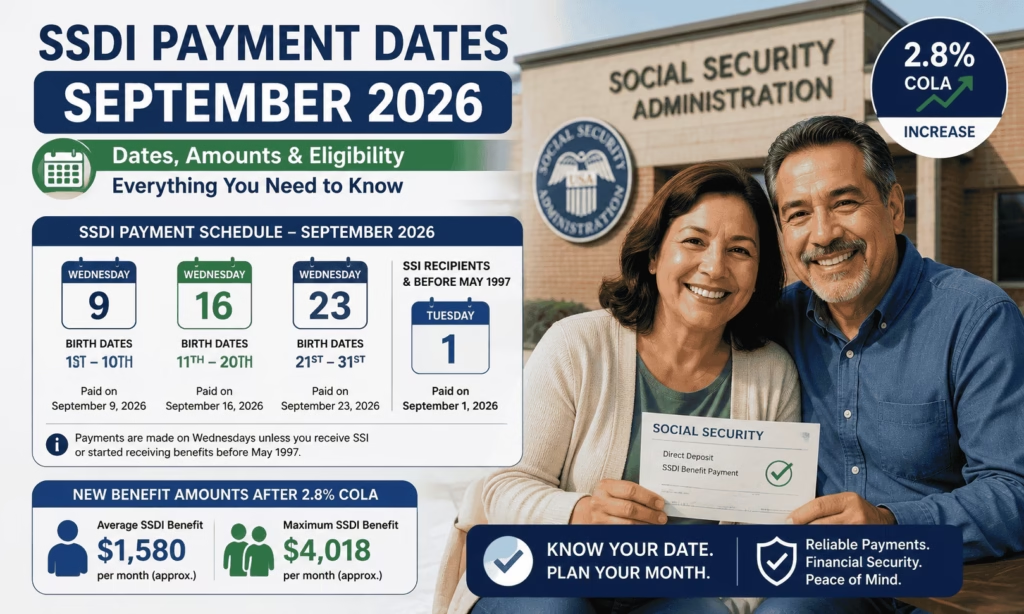
SSDI Payment Dates September 2026: Millions of Americans receiving Social Security Disability Insurance are watching their calendars closely this month, with four separate payment dates spread across September 2026 depending on benefit type and birth date. The Social Security Administration has confirmed that Supplemental Security Income arrives first, on September 1, followed by a combined payment on September 3 for people who receive both SSI and Social Security, and then three separate Wednesday deposits on September 9, September 16, and September 23 for most SSDI, retirement, and survivor beneficiaries based on their date of birth. This is not a new or special payment. It reflects the standard rotating schedule the agency has used for years, now carrying the higher amounts set by the 2.8 percent cost of living adjustment that took effect at the start of 2026.
For someone relying on a fixed disability check to cover rent, medication, or groceries, missing a scheduled date or misunderstanding which group they fall into can create real financial stress. This article lays out the exact September 2026 payment dates, explains why your specific date depends on your birthday, and breaks down how much you can expect after this year’s benefit increase. We’ll be updating this article monthly as the Social Security Administration confirms new payment dates and benefit figures.
Latest SSDI Payment Schedule Update
The Social Security Administration assigns payment dates months in advance, and the September 2026 calendar follows the same structure used throughout the year. Supplemental Security Income recipients are paid on September 1, since the first of the month falls on a weekday this year. Anyone receiving both SSI and a Social Security benefit, including SSDI, receives their SSI portion on the first and their Social Security portion separately on September 3. Everyone else on SSDI, retirement, or survivor benefits is paid on one of three Wednesdays that month, determined entirely by their date of birth.
This rotating birthday based system has been in place since 1997 and was designed to spread the Social Security Administration’s payment processing load evenly across the month rather than issuing tens of millions of deposits on a single day. It has nothing to do with benefit amount, disability severity, or how long someone has been receiving payments. The only exception applies to a small group who started collecting benefits before May 1997, who continue to be paid on the third of every month regardless of birthday.
SSDI Payment Dates September 2026 Key Highlights
| Payment Date | Who Receives It |
|---|---|
| Tuesday, September 1 | Supplemental Security Income (SSI) recipients only |
| Thursday, September 3 | People who receive both SSI and Social Security or SSDI, and anyone who started benefits before May 1997 |
| Wednesday, September 9 | SSDI, retirement, and survivor beneficiaries born between the 1st and 10th of their birth month |
| Wednesday, September 16 | SSDI, retirement, and survivor beneficiaries born between the 11th and 20th of their birth month |
| Wednesday, September 23 | SSDI, retirement, and survivor beneficiaries born between the 21st and 31st of their birth month |
Why Your Payment Date Depends on Your Birthday?
The Social Security Administration splits the majority of SSDI, retirement, and survivor beneficiaries into three groups based solely on the day of the month they were born, not the year. If you were born between the 1st and the 10th of your birth month, your payment arrives on the second Wednesday of every month. If your birthday falls between the 11th and the 20th, you are paid on the third Wednesday. If you were born between the 21st and the 31st, your payment lands on the fourth Wednesday.
This same rule applies every month of the year, so once you know which group you fall into, you can predict your payment date for the rest of 2026 without needing to look it up again each time. The Social Security Administration publishes the full calendar for the entire year in advance, and it rarely deviates from this structure except when a scheduled date falls on a federal holiday, in which case the payment typically moves to the preceding business day.
Why September Payments Look Different From Other Months?
Unlike a few other months in 2026, September does not involve any missed or doubled up payments for SSI recipients. Because September 1 falls on a weekday this year, SSI payments go out as normal at the start of the month. In months where the first of the month lands on a weekend, the Social Security Administration issues the payment on the last business day of the prior month instead, which occasionally results in a month with no separate SSI deposit followed by a month with two.
It is also worth noting that the September payment calendar does not represent a bonus payment, a special disability check, or an extra Social Security deposit of any kind. Some confusion tends to circulate online every year around this time suggesting a special payment is being issued. In reality, September payments are simply the regular monthly benefit, calculated using each person’s individual work history and benefit formula, delivered on the standard rotating schedule.
H-1B Crackdown Employer Warning Now Covers OPT, PERM and J-1 Hiring Practices
Meta Safety Changes on Instagram and Facebook: What Teens and Parents Need to Know Right Now
How Much SSDI Pays After the 2026 Cost of Living Adjustment?
Every SSDI and Social Security payment issued in 2026, including the September deposits, reflects the 2.8 percent cost of living adjustment that the Social Security Administration confirmed for the year. This adjustment is calculated using the Consumer Price Index for Urban Wage Earners and Clerical Workers, comparing the third quarter of the prior year against the same quarter the year before, and it applies automatically to nearly every Social Security and SSI recipient without requiring any action from the beneficiary.
For SSDI specifically, the average monthly payment rose from approximately 1,586 dollars in 2025 to approximately 1,630 dollars in 2026, an increase of about 44 dollars a month. The maximum possible SSDI benefit for someone with a long, high earning work history climbed from 4,018 dollars to 4,152 dollars a month. Most recipients receive an amount closer to the average than the maximum, since SSDI is calculated based on an individual’s lifetime average earnings before their disability began, rather than a flat rate applied to everyone.
SSI Payment Amounts Compared to SSDI
Supplemental Security Income, which is a separate needs based program from SSDI, also increased under the same cost of living adjustment. The maximum federal SSI payment for an individual rose from 967 dollars to 994 dollars a month, while the maximum for an eligible couple rose from 1,450 dollars to 1,491 dollars a month. Unlike SSDI, which is based on a worker’s prior earnings and work credits, SSI eligibility depends on strict income and resource limits and does not require a work history, which is why the two programs use entirely different maximum amounts and payment calculations.
Some individuals qualify for both programs simultaneously, typically when their SSDI benefit alone falls below the SSI income threshold. In these combined cases, the person receives their SSI portion on the first of the month and their SSDI or Social Security portion separately on the third, rather than both amounts arriving in a single deposit.
Who Qualifies for SSDI Payments?
Eligibility for Social Security Disability Insurance depends on two main requirements: a qualifying disability and sufficient work credits. Applicants must have a medical condition that meets the Social Security Administration’s definition of disability, generally a condition expected to last at least 12 months or result in death, and must be unable to engage in substantial gainful activity because of that condition. For 2026, the substantial gainful activity limit is set at 1,690 dollars a month for non blind individuals and 2,830 dollars a month for individuals who are blind.
Work credits are earned through paying Social Security taxes on wages or self employment income over the years, and the number of credits required varies depending on the age at which the disability began. Generally, younger workers need fewer credits than older workers, since the requirement is tied to having worked a certain proportion of the years between age 22 and the age of disability onset. Someone who has not accumulated enough recent work credits may not qualify for SSDI even if their medical condition would otherwise meet the disability standard, though they may still be eligible for SSI depending on income and resources.
H-1B FY2027 Cap Reached: What Happens Next for Applicants?
H-1B Visa Ban Texas Schools: Abbott Wants Exactly Zero Foreign Workers, What Indians Should Know
How to Apply for SSDI?
Applying for Social Security Disability Insurance requires submitting detailed medical and work history documentation, since the Social Security Administration uses this information to determine both medical eligibility and the benefit amount.
Steps to apply for SSDI
- Gather medical records, including diagnosis dates, treatment history, and statements from treating physicians that document how your condition limits your ability to work.
- Collect work history details, including employer names, job duties, and dates of employment for the past 15 years.
- Apply online through the Social Security Administration’s website, by phone, or in person at a local Social Security office.
- Complete the Adult Disability Report, which asks detailed questions about your condition, medications, and daily limitations.
- Respond promptly to any follow up requests from the Disability Determination Services office reviewing your case, including requests for additional medical exams.
- Track your application status online or by contacting the Social Security Administration directly.
CPP, OAS & GIS September 2026 Payment: New Amounts, 1.2% Increase & Full Payment Details
CalFresh Payment September 2026: Here’s When Your Food Stamps Will Be Loaded
Processing Time and Payment Schedule for New Applicants
Initial SSDI applications typically take three to five months to process, though the exact timeline varies significantly by state and by the complexity of the medical evidence involved. Applications that are initially denied, which happens to a large share of first time applicants, can take considerably longer if the case proceeds through reconsideration and, if necessary, a hearing before an administrative law judge, a process that can add a year or more in some regions with heavy hearing office backlogs.
Once approved, new SSDI recipients are assigned to the same birthday based payment schedule described above, unless they also receive SSI, in which case they follow the first and third of the month schedule instead. Approved applicants may also receive back pay covering the period between their established disability onset date and their approval date, subject to a mandatory five month waiting period from the onset of disability before payments begin. Back pay is calculated using the benefit rates in effect for each month owed, so back pay covering 2026 months reflects the updated 2026 payment amounts.
What to Do If Your Payment Is Late
If a scheduled SSDI payment does not appear in your account on the expected date, the Social Security Administration generally advises waiting three additional business days before taking further action, since bank processing delays can occasionally push a deposit back by a day or two. If the payment still has not arrived after that window, beneficiaries should contact the Social Security Administration directly or check their My Social Security online account, which shows payment history and any pending issues with a specific deposit.
Common causes of a delayed or missing payment include a recent change in direct deposit banking information that has not yet been fully processed, a temporary suspension of benefits pending a review, or an administrative error that the agency can typically resolve once flagged. Beneficiaries who recently moved, changed banks, or reported a change in income or living arrangements should confirm that information was updated correctly, since outdated records are a frequent cause of payment disruptions.
Official Resources for SSDI Beneficiaries
| Resource | Purpose | Link |
|---|---|---|
| Social Security Administration Official Site | Main portal for benefit information and applications | https://www.ssa.gov |
| my Social Security Account Login | Check payment history, update direct deposit, and view benefit statements | https://www.ssa.gov/myaccount/ |
| SSDI Application Portal | Apply online for disability benefits | https://www.ssa.gov/apply/disability |
| Full 2026 Payment Schedule | Complete list of Social Security and SSI payment dates for the year | https://www.ssa.gov/pubs/EN-05-10031.pdf |
| Disability Benefits Overview | Eligibility rules and program details for SSDI | https://www.ssa.gov/benefits/disability/ |
| Social Security Office Locator | Find a local Social Security office for in person appointments | https://secure.ssa.gov/ICON/main.jsp |
Beneficiaries should confirm their exact payment date and current benefit amount through their my Social Security account, since individual circumstances can affect timing and amounts shown in general schedules.
Canada Pension Plan Payment September 2026: Who Will Receive CPP Benefits and How Much?
OAS Payment Increase September 2026: Confirmed Amounts, Payment Date, and the Annual GIS Reset !
FAQs
When will I get my SSDI payment in September 2026?
It depends on your birth date. SSDI recipients born between the 1st and 10th are paid September 9, those born between the 11th and 20th are paid September 16, and those born between the 21st and 31st are paid September 23. People who also receive SSI are paid on September 3 instead.
Why do SSDI payments come on different days for different people?
The Social Security Administration spreads payments across three Wednesdays each month based on birth date to avoid processing tens of millions of deposits on a single day, a system that has been in place since 1997.
How much is the average SSDI payment in 2026?
The average monthly SSDI payment in 2026 is approximately 1,630 dollars, up from about 1,586 dollars in 2025, following a 2.8 percent cost of living adjustment.
What is the maximum SSDI payment for 2026?
The maximum possible SSDI benefit in 2026 is 4,152 dollars a month, though most recipients receive an amount closer to the average based on their individual earnings history.
Is there a special or extra SSDI payment in September 2026?
No. September payments follow the same standard schedule and formula used every month. There is no separate bonus or additional disability payment issued in September.
What is the difference between SSDI and SSI payment dates?
SSI is paid on the first of the month, while SSDI generally follows the birthday based Wednesday schedule, unless a recipient receives both benefits, in which case SSDI or Social Security is paid on the third.
How long does it take to get approved for SSDI?
Initial applications typically take three to five months, though denied applications that go through appeal or a hearing can take a year or longer depending on the state and local office workload.
Conclusion
Knowing exactly when your SSDI payment will arrive in September 2026 comes down to understanding which group you fall into: SSI recipients on the 1st, combined SSI and Social Security recipients on the 3rd, and everyone else on one of three Wednesdays tied to their birth date. With the 2.8 percent cost of living adjustment now reflected in every 2026 payment, the average SSDI check has climbed to roughly 1,630 dollars a month, though individual amounts vary widely based on lifetime earnings. Beneficiaries who are unsure of their exact payment date or amount should check their my Social Security account directly rather than relying on general schedules, particularly if they have recently changed banks, moved, or started receiving a new type of benefit. As the Social Security Administration releases updated guidance or schedule adjustments, this article will continue to reflect the latest confirmed payment dates and benefit figures.