TANF Cash Assistance July 2026: Temporary Assistance for Needy Families (TANF) — the federal-state cash aid program many people still call “welfare” — continues to send monthly deposits to millions of low-income families with children throughout July 2026. But unlike a Social Security check, there is no single national TANF payday.
TANF Cash Assistance July 2026 is a federal block grant that each state, territory, and tribal government administers on its own, so the deposit date, the card system, and even the program’s name change depending on where a recipient lives. This guide walks through how the July 2026 schedule actually works, what’s new this month, and how to track down your exact deposit date.
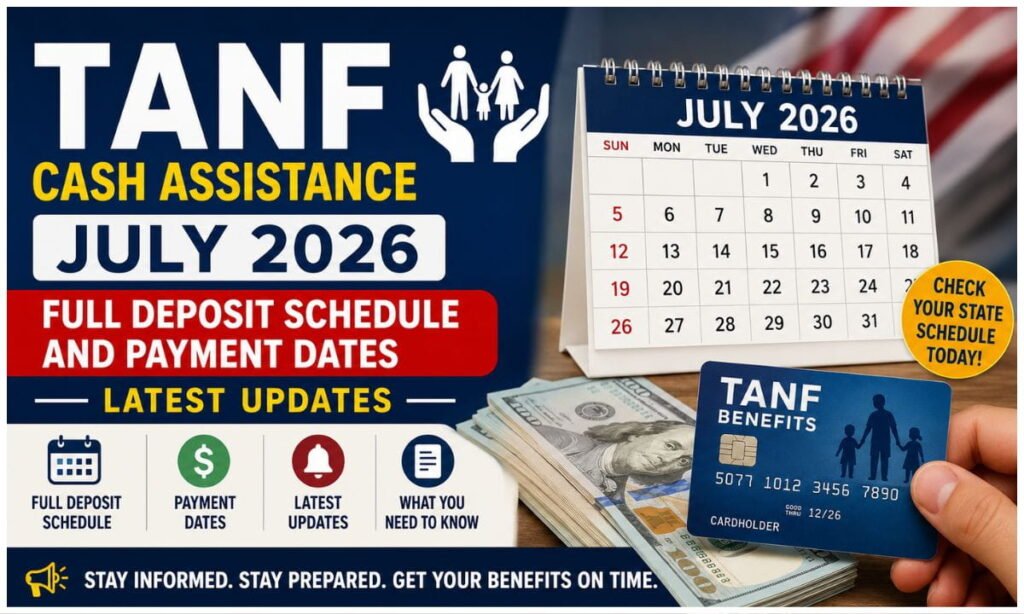
TANF Cash Assistance July 2026
The most important thing to understand before looking for “the” July TANF Cash Assistance date is that TANF isn’t run out of Washington the way Social Security or SSI payments are. Congress funds TANF as a block grant — currently a bit over $16 billion a year split among the states, DC, and tribal programs — and each state then designs its own version of the program: its own income limits, its own benefit amounts, its own work requirements, and its own payment calendar.
That’s why California’s cash aid program is called CalWORKs, Massachusetts calls its program TAFDC, and dozens of other states use their own acronyms entirely. There is no printed federal “TANF payment schedule” the way there is for SNAP or SSI, because the Administration for Children and Families (ACF), which oversees TANF at the federal level, does not set deposit dates — states do.
How States Typically Schedule July Deposits?
Even though every state runs things differently, most states rely on one of a few common methods to stagger deposits across the month so their systems (and recipients’ EBT cash cards) aren’t all hit on the same day:
- First-of-the-month deposits. A number of states, including Oregon, load TANF benefits on the 1st of each month. If the 1st falls on a weekend or holiday, the deposit typically shifts to the next business day.
- Case-number-based schedules. States like Pennsylvania spread deposits across a window — commonly somewhere between the 2nd and the 27th of the month — based on the last digit or two of a recipient’s case number.
- Social Security number or last-name based schedules. Some states, North Carolina among them, assign deposit days according to the last digit of the recipient’s Social Security number or alphabetically by last name.
- Fixed monthly dates with rolling adjustments. Many states settle on a specific day (say, the 3rd or the 5th) but roll the deposit backward to the preceding business day whenever that date lands on a weekend or federal holiday.
Because of this patchwork, two families in neighboring states — or even two families in the same state with different case numbers — can have completely different July deposit dates.
The July 4th Holiday Wrinkle
July 2026 has one scheduling quirk worth flagging: Independence Day, July 4, falls on a Saturday this year, and the holiday is observed on Friday, July 3. States that process deposits only on business days will generally move any payment that would normally land on July 3, 4, or 5 to the preceding business day — meaning many recipients could see funds appear a day or two earlier than usual. State human services call centers and local offices are also typically closed over the observed holiday, so if there’s a problem with a TANF Cash Assistance July 2026 scheduled around that weekend, most recipients won’t be able to get it resolved until offices reopen — usually the following Monday, July 6.
If your expected TANF Cash Assistance date falls on or near July 3–5, it’s worth checking your card balance a day early (July 2 or 3) to see whether your state processed the payment ahead of schedule, and checking again on July 6 if nothing has shown up by then.
What’s New for TANF in 2026?
A few developments are shaping the program this year:
- Funding extended through the end of 2026. Congress renewed TANF’s block grant funding through December 31, 2026, as part of a broader appropriations package, keeping the $16.4 billion state family assistance grant flowing to the 50 states, DC, and tribal programs at its long-standing level.
- Some states are tightening long-term benefits. A handful of jurisdictions are adjusting how they handle cases that have been open for years. The District of Columbia, for example, has announced that starting in October 2026 it will begin stepping down benefits for households that have received assistance for 60 months or more, aligning more closely with the federal five-year lifetime limit, alongside a hardship-extension process for certain families.
- Interaction with SNAP. TANF cash counts as unearned income for SNAP purposes, so a change in your TANF amount can affect your food benefits. Families receiving both should expect their SNAP caseworker to factor in any TANF adjustment during recertification.
Typical Monthly Benefit Amounts
TANF Cash Assistance July 2026 levels vary enormously by state and have not been adjusted for inflation in decades, which is part of why the caseload and the value of the benefit have both shrunk over time. For a family of three with no other income, maximum monthly amounts in 2026 range roughly from about $170 in Mississippi up toward $900 or more in higher-cost states like California, with a national median somewhere around $500. A few examples reported for 2026:
- Alabama: around $215/month for a family of three..
- Florida: roughly $300–$400/month
- California (CalWORKs): among the highest in the country, reflecting the state’s higher cost of living.
Actual TANF Cash Assistance amounts depend on household size, income, and state-specific deductions, so these figures are general reference points rather than guarantees.
Work Requirements and Time Limits Still Apply
Regardless of when the deposit lands, TANF remains time-limited and work-conditioned. Federal law caps TANF-funded cash assistance at 60 months over a recipient’s lifetime, though states can set shorter limits or approve hardship extensions for a portion of their caseload.
Adult recipients are generally required to participate in qualifying work activities — commonly 30 hours a week for a single parent with a child over age 6, or 20 hours a week if the child is younger — which can include employment, job search, vocational training, or approved community service. Missing these requirements without an approved exemption can lead to a reduction or suspension of the monthly cash payment.
How to Find Your Exact TANF Cash Assistance Deposit Date?
Since there’s no universal schedule, the most reliable ways to pin down your specific date are:
- Your state’s TANF or EBT online portal. Most states let recipients log in to check their case status, balance, and next scheduled deposit.
- The phone number on the back of your EBT card. This connects to an automated line that reports your balance and recent deposit history.
- Your award or recertification letter. States are required to specify your payment date in official correspondence.
- Your local TANF/human services office. If you can’t find your date online, a call or visit to your county or state office can confirm it — just keep in mind office closures around the July 3–4 holiday weekend.
What if Your TANF Cash Assistance Is Late?
Before assuming something has gone wrong, confirm that your individually assigned date has actually passed (not just that July 1 or July 4 has come and gone), and check your balance through your state’s app, portal, or the number on your card. Common causes of a delayed or reduced payment include an incomplete recertification, a recent change in household income or size, or a processing backlog around the holiday.
If your balance still hasn’t updated a few business days after your expected date, contact your state TANF office directly — waiting until the office reopens after the July 4th holiday weekend is the practical move if your date fell during that window.
Where to Verify Official Information?
Because TANF is administered state by state, the most authoritative source for your specific payment date is your own state’s human services or TANF agency, not a national database. For general federal program information, the Administration for Children and Families’ Office of Family Assistance (acf.hhs.gov/ofa) is the official federal resource, while USA.gov’s welfare benefits page offers a starting point for locating your state’s specific office and program name. Given how much variation exists between states — and how often policy details shift year to year — it’s worth confirming details directly with your state agency before making financial plans around an expected deposit date.
This article reflects publicly available information as of July 2026. TANF rules, benefit amounts, and payment schedules are set individually by each state and can change; always verify your specific details with your state’s TANF or human services agency.
Top Searched FAQ’s on TANF Cash Assistance July 2026
When will the TANF Cash Assistance payment be deposited in July 2026?
There is no single TANF payment schedule across the country. TANF is administered by each U.S. state, territory, and tribal government, so deposit dates vary. Most states issue TANF Cash Assistance benefits for July 2026 during the first half of the month, while others follow schedules based on case numbers, Social Security numbers, or last names.
Why do TANF Cash Assistance payment dates vary by state?
Although TANF receives federal funding, each state manages its own program, including eligibility rules, benefit amounts, and payment schedules. This means that residents of different states may receive their July 2026 deposit on different dates.
How can I check my July 2026 TANF payment date?
You can verify your TANF Cash Assistance Pay Date by: Logging into your state’s benefits portal. Checking your EBT or benefit card account. Contacting your local TANF office. Reviewing notices sent by your state’s human services agency.
What should I do if I haven’t received my TANF Cash Assistance payment?
First, check your benefit account or EBT balance. If the TANF Cash Assistance has not been received after your state’s scheduled deposit date, contact your local TANF office or human services agency to report the issue and request an update.