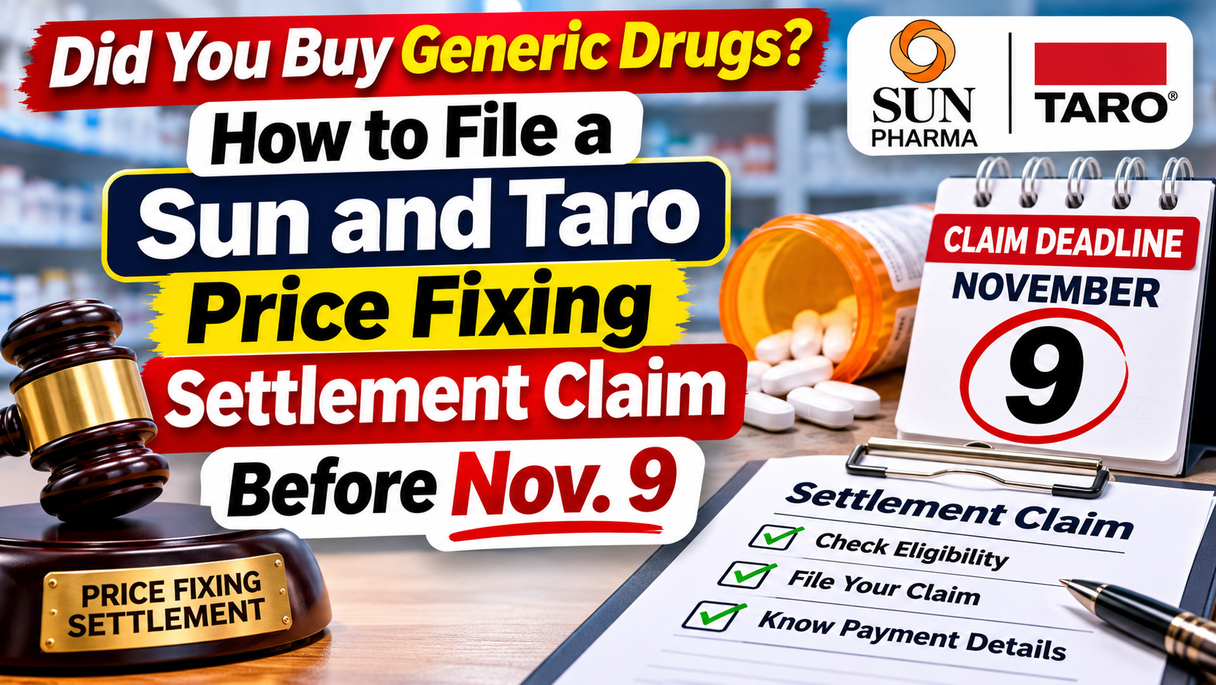
Sun and Taro Price Fixing Settlement Claim 2026: If you filled a prescription for a generic drug at any point between 2009 and 2019, there’s a fair chance you’re owed a little money. The deadline to ask for it is Monday, Nov. 9, 2026. That’s nine days from today.
The money comes from a group of class action settlements that grew out of years of allegations that generic drug makers quietly coordinated to keep prices up. Sun Pharmaceutical Industries and its subsidiary Taro Pharmaceuticals U.S.A. agreed to pay $200 million of it. Sandoz and Fougera put in $275 million, and Apotex and Heritage added roughly $58 million, which brings the combined total to $533 million.
Here’s the part a lot of people miss. You don’t file a separate claim for each company. One end-payer claim covers all three settlements, it costs nothing, and you don’t need a lawyer to do it. What you do need is a few records, a little patience, and about half an hour that you can find before Monday.
This guide walks through who qualifies, what to gather, how to file, and what to watch out for. It’s based on the court-authorized notices, the official settlement website, and recent reporting, and I’ve flagged the places where sources disagree.
Highlight
- Deadline: Nov. 9, 2026. File online or mail a paper form postmarked by that date.
- Who can claim: consumers and third-party payers (insurers, self-funded employer plans) that paid for or reimbursed certain generic drugs between May 1, 2009 and Dec. 31, 2019.
- Where to file: GenericDrugsEndPayerSettlement.com, or call 1-877-316-0171.
- Cost: free. The court notice says you don’t need to sign up with a claims recovery firm or hire another law firm.
- Payout: a pro rata share of the net fund, based on how much you spent on the named drugs. Nobody can tell you the exact figure yet.
What the lawsuit says happened
The case is formally called In re Generic Pharmaceuticals Pricing Antitrust Litigation, MDL No. 2724, and it’s being handled by Judge Cynthia Rufe in the U.S. District Court for the Eastern District of Pennsylvania. It bundles together more than 20 separate lawsuits, the first of which was filed in 2016, according to Fierce Pharma.
The plaintiffs claim that generic manufacturers agreed to fix and stabilize prices, rig bids and divide up customers and markets for certain drugs. The result, they say, was that prices for some very ordinary medications climbed far above what competition would have allowed. In 2019, 44 states sued about 20 companies. Connecticut’s attorney general at the time, William Tong, called it the largest cartel case in U.S. history.
The criminal side of this story is real, too. Taro agreed in 2020 to pay a total of $419 million so the Justice Department would drop two criminal conspiracy charges, and Fierce Pharma reports that seven companies in all admitted to criminal wrongdoing. Sandoz also resolved federal criminal charges in 2020.
The civil litigation is split by who bought the drugs. Direct purchasers, meaning wholesalers and pharmacies that bought straight from manufacturers, are one group. Sun and Taro had already settled with them for a combined $85 million. The people and plans at the other end of the chain, who paid for the pills at the pharmacy counter or reimbursed those costs, are called end payers. That’s the group this article is about.
Trump Account $1000 Claim: Who Qualifies and Why Most Parents Still Have Not?
$1600 Property Tax Credit 2026: Fact Check, Eligibility, Dates and How to Apply?
The Sun and Taro deal
Sun Pharma told investors in a 2025 stock-exchange filing that its U.S. subsidiaries, Sun Pharmaceutical Industries, Inc. and Taro Pharmaceuticals U.S.A., Inc., had signed an agreement with the end purchaser plaintiffs. The companies would pay $200 million in total in exchange for a full release of the claims in the End Purchaser Action. The filing noted the amount could shrink if too many class members opted out, and that the agreement was reached without any admission of wrongdoing.
The court preliminarily approved the deal, and the official notice went out in early October 2025. Judge Rufe held a fairness hearing on Jan. 15, 2026. On Jan. 23, 2026, she granted final approval, Bloomberg Law reported, finding that the discovery, the expense and the likely length of continued litigation all favored settling.
Two things are worth keeping straight. First, Sun and Taro still deny doing anything wrong. They settled to avoid the cost and uncertainty of going to trial. Second, this settlement only resolves the end-payer class’s claims against those two companies. It doesn’t touch the separate claims brought by state attorneys general, a point I’ll come back to below.
The notice also laid out where the $200 million is expected to go before anyone gets paid. Notice and administration costs could take up to $750,000. Class counsel asked, subject to court approval, for attorneys’ fees of up to one-third of the fund plus interest, along with litigation expenses and service awards for the class representatives of up to $500,000 in total. Whatever the court allowed comes out first, and the rest goes to people who file valid claims.
One claim form, three settlements
The Sun/Taro money isn’t being handed out on its own. Class counsel, the Philadelphia firm Fine, Kaplan and Black, combined three now-final end-payer settlements into a single claims process run by the administrator, A.B. Data.
| Settlement | Amount | Final approval |
|---|---|---|
| Sandoz / Fougera | $275 million | September 26, 2025 |
| Sun / Taro | $200 million | January 23, 2026 |
| Apotex / Heritage | about $58 million combined | Late 2025 |
| Total | $533 million |
The dates and the Apotex/Heritage figure come from the claim-tracking site OpenClassActions, so treat the late-2025 date as approximate. The $533 million total matches the court notice that class counsel circulated on July 10, 2026, when claim forms officially opened.
In practice that means you don’t hunt for a “Sun/Taro form.” You file the end-payer claim, list the named generics you paid for, and that one filing is how you claim from all three. Several summary sites repeat the same point: there is no separate Sandoz form, and there is no separate Sun/Taro form either.
Who qualifies
You’re likely a class member if you meet all of these:
- You indirectly purchased, paid for or reimbursed some or all of the price of one or more of the “Named Generic Drugs.”
- The drugs were for personal use, not resale.
- The purchase happened between May 1, 2009 and Dec. 31, 2019.
- It happened in one of the 50 states (except Indiana and Ohio), the District of Columbia, Puerto Rico or the U.S. Virgin Islands.
There are two kinds of class members. Consumers are people who bought a covered generic at a retail or mail-order pharmacy, whether they paid the full price or just a copay or deductible. Third-party payers are insurers, health plans and self-funded employer plans that reimbursed some of those costs. If you had a mixed bag of purchases, only the eligible ones count.
The list of covered drugs is long. Reporting on the settlements names albuterol, amphetamines, azithromycin, gabapentin and levothyroxine among them, and CBS Pittsburgh’s coverage of the related state program also mentions cipro and prednisone, though that list may not match this one exactly. The forms span tablets, creams, ointments and injectables. Don’t rely on memory. The full list is posted in the notice section of the settlement website, and it only takes a couple of minutes to compare it against your old prescriptions.
Who is left out
The class definition excludes several groups, even if they otherwise fit:
- Federal government entities, and state government entities (cities, counties and other local governments with self-funded drug plans are the exception)
- Medicaid agencies, private Medicaid managed care organizations, and consumers whose Medicaid coverage paid for their purchases
- Fully insured employers on fully insured plans
- Pharmacy benefit managers
- The defendants’ officers, directors, employees and affiliates, plus the judges on the case and their immediate families
- Anyone who bought only for resale or directly from the defendants
A quick note for Indiana and Ohio residents. The class language is about where the purchase was made, so a prescription you filled in another state may still count. Read the long-form notice on the official site before you decide.
How to file claim check step by step process
- Check the drug list. Open the settlement site, find the Named Generic Drugs list in the notice section, and mark every medication you or your family took between 2009 and 2019.
- Go to the official site. The address is GenericDrugsEndPayerSettlement.com. Pick the consumer claim path, or the third-party payer path if you’re filing for a plan.
- List your drugs and what you paid. The consumer form has you choose each drug from a drop-down list and enter the total you paid out of pocket for it from May 1, 2009 through Dec. 31, 2019. Only list named generics you actually bought in that window.
- Finish it in one sitting. The site warns that you can’t save a partly completed online form and come back later. Once you hit submit, you can’t change it online.
- Choose how you want to be paid. Claim Depot’s summary lists Zelle, PayPal, Venmo, a paper check or direct deposit as options. Check what the live form offers.
- Submit and keep proof that you did. Take a screenshot or save the confirmation page.
You’ll be signing under penalty of perjury, so file only if you honestly think you qualify. Submitting a bad claim also eats into the share available for people who do.
22% Social Security Cut: What It Means for Your Monthly Check
$3000 Stimulus Payment 2026: Full Fact-Check & Current Status!
Trump $5000 Dividend Check: Latest Update on Cost, Eligibility and Payment Date
Filing by mail
You can print the paper consumer claim form from the settlement website, fill it out and mail it. It has to be postmarked no later than Nov. 9. Send it to:
In re: Generic Pharmaceuticals Pricing Antitrust Litigation, End-Payer Settlement c/o A.B. Data Ltd. P.O. Box 173118 Milwaukee, WI 53217
If you’d rather talk to a person, the administrator’s number is 1-877-316-0171 and the email is info@GenericDrugsEndPayerSettlement.com.
My honest advice is to file online, and soon. Today is Saturday, and the clock is short. If you wait for the mail option, you’re depending on a post office counter and a postmark on the very last day.
What records to gather
This is where people tend to stall, because nobody keeps pharmacy receipts from 2011. Take a breath. The official consumer claim page tells you to keep records of all your named-generic purchases and says the claims administrator may ask for supporting documents after you submit. It doesn’t tell you to upload a stack of receipts with the form.
Sources do disagree here. Claim Depot’s summary and a few other claim sites say documentation is required, and the Sandoz write-up from Top Class Actions lists details such as pharmacy name, purchase date and prescription number. My read is that the official site is the authority, and that the safe move is to collect what you can and file an honest estimate rather than skip the claim. If your form asks for more, supply it.
Places to look for the numbers:
- Your pharmacies. Ask each one you’ve used, local and mail order, for a year-by-year prescription history. Most can print it.
- Your insurer or pharmacy benefit manager. Express Scripts, Optum and Caremark can give you a list of past claims, often called an explanation of benefits (EOB).
- HSA and FSA records. Reimbursement statements often show the drug and the amount.
- Old pill bottles and labels. The label shows the drug, quantity and date. Pair it with the price you usually paid.
- Bank and credit card statements. Search for pharmacy merchants by year. If a total mixes in toothpaste and brand-name drugs, estimate the generic share from a few months you remember well.
- Discount card apps and store programs. If you used a low-price generic list, multiply the listed price by your fills.
The methods above come from a consumer estimating guide published for the state attorneys general settlement, not this one, but the arithmetic works the same way. A few ground rules from that guide are worth borrowing. Count only the amounts labeled “you paid” or “patient responsibility.” Leave out brand-name drugs and anything not on the covered list. Count each fill once, even if it shows up on both a receipt and a bank statement. And write down your assumptions so you can defend them later.
Third-party payers have a heavier lift. Claim Depot says plans may need to supply National Drug Code numbers, fill dates and amounts paid, so if you’re filing for an employer plan, loop in whoever manages its claims data now.
How much you might get
There’s no honest dollar figure to give you, and anyone who offers one is guessing. Here’s how the math works.
The $200 million Sun/Taro fund, like the other two, is a single pool. The court-approved costs come out first: administration, attorneys’ fees, litigation expenses and service awards. What’s left is the net fund. The administrator then divides it pro rata, meaning your payment is proportional to what you spent on the named drugs compared with what everyone else who filed a valid claim spent. Spend twice as much and your share is about twice as big.
Two things swing the outcome that nobody controls. One is how many valid claims come in. Settlements like this often draw participation well below what the class could theoretically support, which tends to raise the average payment. The other is how much of your spending the administrator accepts after review.
For a person who took one inexpensive generic for a few years, I’d expect a modest check. For someone on several covered drugs for a decade, or for a plan that reimbursed thousands of fills, it could be meaningful. Treat it as found money and not a windfall.
As for timing, the administrator says it will distribute payments after it has processed all claims. No payout date has been announced, so don’t count on seeing anything before the new year at the earliest. That’s my reading of the timeline, not a promise from the court.
Don’t confuse this with the state attorneys general program
There’s a second, separate way to get generic-drug money, and it’s easy to mix up with the first. The state attorneys general program, run through AGGenericDrugs.com, comes from enforcement lawsuits that a group of state and territorial attorneys general, led by Connecticut, brought in federal court in Connecticut. It has its own money, its own website, its own claim form and its own deadline: March 8, 2027.
According to ClassAction.org, consumers in that program choose between two options. Option 1 pays an equal share per settlement and only requires you to certify that you bought covered generics during the relevant period. Option 2 pays a share based on your estimated total out-of-pocket spending, and the administrator may later ask for documentation to back up your estimate. The state notice says no receipts are needed to submit the form. ClassAction.org also notes that consumers in Alabama, Arkansas, Hawaii and Texas aren’t covered by that particular program, so read the eligibility language if you live in one of them.
The key point is that the two programs don’t replace each other. If you qualify for both, each needs its own claim on its own site, and the federal end-payer deadline arrives first. Sandoz also announced a separate settlement with 43 states in August 2026, per Reuters headlines, so the state-side picture is still moving. Check AGGenericDrugs.com for how and when that money reaches consumers.
So here’s the order of operations I’d follow: file the end-payer claim now, then register or file at the state site before the spring deadline. One claim doesn’t file the other.
Scams, lookalike sites and common mistakes
Whenever a big settlement is in the news, a pile of sites show up in search results promising to “help” you claim. Some are harmless publishers. Some are lead-generation operations. A few exist to collect your personal information. A Pittsburgh CBS station warned its viewers about exactly this when the Pennsylvania attorney general’s office began urging people to file, telling them to use only the official settlement site.
A few rules keep you safe:
- Use the official address. For this claim, it’s GenericDrugsEndPayerSettlement.com. Type it yourself rather than clicking an ad.
- Never pay to file. The court notice says you don’t need a claims recovery firm or another lawyer. Filing is free.
- Remember who is not the administrator. Claim Depot, Top Class Actions and similar sites say outright that they don’t process claims.
- Be wary of anyone who asks for a Social Security number or bank login. Ask yourself whether the form really needs it before you type it.
And the mistakes I’d watch for on the form itself:
- Counting brand-name drugs, or generics that aren’t on the covered list.
- Counting the same fill twice because it appears on both a receipt and a bank statement.
- Leaving out years. The class period runs 11 years, from May 2009 through December 2019.
- Assuming Medicaid-covered purchases count. They don’t.
- Mixing up the two programs and thinking one filing covers both.
- Waiting until the last day, then discovering the site is slow or the form needs a record you don’t have.
FAQ’s
Do I have to be a Sun or Taro customer?
No. You never dealt with the companies directly. End payers are, by definition, people and plans that paid further down the chain, at the pharmacy.
Is this an admission that Sun and Taro broke the law?
No. The settlement was reached without any admission of wrongdoing, and the companies deny the allegations.
I already got a notice in the mail. Do I still need to file?
Yes. The notice tells you about the settlement. You still have to submit a claim to be paid.
Can I still opt out or object?
Those windows closed before final approval. The point now is whether you claim.
What if I miss Nov. 9?
The notice sets that as the cutoff, and I wouldn’t count on an extension. If you’re close, file online today.
Who do I call with questions?
The administrator, A.B. Data, at 1-877-316-0171, or info@GenericDrugsEndPayerSettlement.com.
For most people this is a low-effort, low-risk claim with a small-to-moderate payoff, and the effort is front-loaded into pulling together your pharmacy history. Check the drug list, estimate your spending honestly, file at the official site, and don’t pay anyone to do it for you. Then put March 8, 2027 on your calendar for the state program.
This article is general information, not legal advice. Details and deadlines can change, so confirm them on the official site before you file.