
The Trump $1 million voter fraud reward was announced on Monday, October 26, eight days before the November 3 midterms, and almost every practical detail is still missing. In a Truth Social post, President Donald Trump wrote that anyone reporting voter fraud in past elections or the upcoming midterms would be paid $1,000,000, and he told reporters the money would come upon the arrest and conviction of the people responsible. The White House has not said who would fund it, which agency would verify claims, or how anyone could submit a tip, and it declined to offer more details when asked. We’ll be updating this article monthly.
That gap matters because the offer lands in a week when election officials are already fielding rumors, lawsuits and scams. The Justice Department has sued Alaska over how it certifies a Senate race, it sued California this month over voter rolls, and Trump separately unveiled a $25 million fraud whistleblower program on October 20. A UCLA election law expert told one outlet he does not take Trump at his word that the reward will be paid. This article lays out the exact wording, what is and is not known about the money, how the offer compares with a 2020 Texas fund that did pay out, what the data says about proven voter fraud, and where to report an actual problem at the polls. A free tool below routes you to the right office.
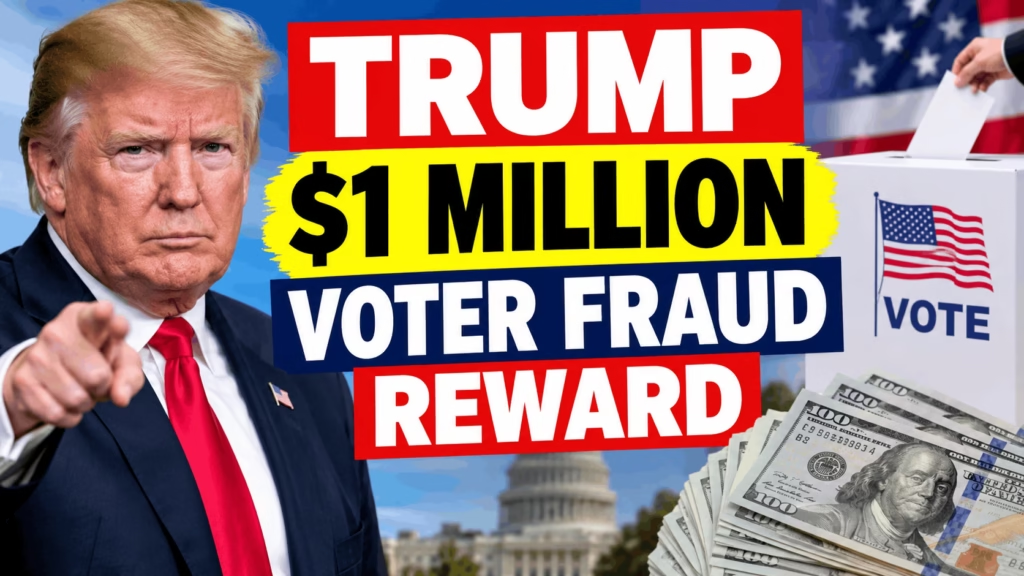
Trump $1 Million Voter Fraud Reward Key Facts and Dates
| Item | Detail |
|---|---|
| Announced | Monday, October 26, on Truth Social, then repeated to reporters aboard Air Force One |
| Amount | $1,000,000 |
| Condition | Payment upon the arrest and conviction of those responsible for the fraud, per Trump |
| Covers | Fraud in past elections or the 2026 midterms |
| Funding source | Not stated |
| How to submit a tip | Not stated |
| Who decides | Not stated |
| Election Day | Tuesday, November 3 |
| Related program | Fraud Whistleblower Incentive Program, announced October 20 |
What Trump Actually Said About the $1 Million Reward?
The post, as quoted by outlets including Time News and the Washington Sun, reads: “Anybody reporting Voter Fraud in the past Elections, or the upcoming 2026 Midterm Election, will be paid $1,000,000.” ABC News quoted the payment language as “upon the arrest and conviction of those that created the Fraud.”
Two features of that wording shape everything that follows. First, the reward is tied to a conviction, not to a tip or an arrest, and a conviction can take months or years. Second, the post says nothing about who is eligible, whether the tip has to be original, whether it has to be filed with a particular agency, or what happens if several people report the same case.
The offer was repeated in remarks on Air Force One as Trump traveled to a Mississippi campaign rally. The White House directed questions back to the post and did not provide additional information, ABC News and the Washington Sun both reported.
Who Would Pay the $1 Million Voter Fraud Reward?
Nobody has said. ABC News wrote that it is not clear where the money would come from. The Washington Sun reported that the Republican led Congress has not authorized funding for a rewards program of this kind and suggested one is unlikely to be authorized if Democrats win either chamber. We could not verify that prediction, and it is the outlet’s assessment, not a fact about what will happen.
Three possibilities exist in principle: a federal program funded by Congress, a payment from an administration account, or private or campaign money. The reporting we reviewed does not say which is intended. Until the White House or the Justice Department publishes terms, anyone who tells you they can process a claim is not speaking for the government.
For comparison, the administration’s separate Fraud Whistleblower Incentive Program, announced on October 20, was described as a $25 million program administered by the Justice Department, and the only official page cited in coverage is justice.gov/fraud/whistleblower. That program is aimed at federal government fraud, not voter fraud, and Trump said he would be the arbiter of whether someone qualifies.
Related Programs and Pledges
| Date | Announcement | What is known |
|---|---|---|
| October 15 | Justice Department sues California over voter rolls | Seeks to check rolls against a list of about 20,000 people it suspects are noncitizen voters, and the case is under review by the 9th Circuit |
| October 20 | Fraud Whistleblower Incentive Program | Described as $25 million, 1 percent commission on fraud uncovered, Trump as arbiter, Justice Department administers |
| October 22 | Justice Department sues Alaska | Seeks to block certification of a Senate result if the incumbent does not win |
| October 26 | $1 million voter fraud reward | No funding, process or agency specified |
| October 26 | Floated $5,000 payment to adult citizens | Contingent on Republicans keeping both chambers, would cost more than $1 trillion and needs congressional approval, according to Time News |
The Washington Sun also reported that the Justice Department recently started a pilot offering up to $30,000 for tips on financial misconduct in certain federal programs. We could not confirm that figure from a second source.
What Experts and Officials Are Saying?
Richard Hasen, a UCLA law professor who studies elections, told the Washington Sun: “I don’t take him at his word that he would actually do this.” He predicted that within six months Trump would describe the announcement as hyperbole, and said elections have small, isolated instances of fraud each cycle. He characterized the announcement as part of a broader effort to create distrust in the election system. Those are Hasen’s interpretations, not established facts.
Time News reported that Democratic attorneys general and election officials have criticized the bounties and other oversight moves as federal overreach meant to undermine confidence in election integrity. California Attorney General Rob Bonta accused federal officials of politicizing the law against noncitizen voting. We did not find a statement from Republican election officials specifically on the reward.
Supporters of tougher voter integrity rules argue that more reporting and more prosecutions deter cheating and build confidence. That is the argument behind the SAVE America Act, which Trump is pushing. It would require voter ID at the ballot box and proof of citizenship to register. The House passed it earlier this year, and it has failed in the Senate multiple times, ABC News reported.
How Common Is Voter Fraud?
The disagreement is over scale, and both sides cite real numbers.
| Source | What it says |
|---|---|
| Heritage Foundation database, via Time News | 557 proven fraud cases nationwide from 2016 to 2025 |
| White House post, via Time News | 48 foreigners charged with illegally voting or registering to vote |
| Brennan Center report, cited by Raw Story | Evidence has not established that fraud is widespread in U.S. elections |
| Washington Sun | Audits and legal challenges after the 2020 election failed to substantiate widespread misconduct |
| Election officials and experts, via Time News | Safeguards routinely catch large scale ballot tampering, though isolated offenses do occur |
Both things can be true: proven cases exist, and they are a very small share of the votes cast in a decade of elections. The Heritage database is a catalogue of proven cases, which is a different thing from a measure of undetected fraud, and nobody can count what has not been detected. That uncertainty is exactly why supporters want stronger verification and critics fear the claims are used to cast doubt on results.
The offer is also being read against a backdrop of statements. The Washington Sun, citing The New York Times, reported that Trump has cast doubt on U.S. election systems on roughly 70 percent of his days in office in his second term. That is a count of statements, not a finding about elections.
The Texas Precedent: What Happened to Dan Patrick’s $1 Million Fund
The closest comparison is a fund Texas Lieutenant Governor Dan Patrick announced on November 10, 2020. CBS News reported he would pay up to $1 million from his campaign account to reward people who report voter fraud anywhere in the country, with tips going to local law enforcement and a minimum payment of $25,000 for information leading to an arrest and final conviction.
It did pay out once that we could confirm. Raw Story, citing the Dallas Morning News, reported that the first payout, $25,000 in 2021, went to Eric Frank, a Pennsylvania poll worker whose tip led to the conviction of a Republican who voted twice. Frank told the outlet the program “kind of blew up in their face,” which is his own assessment. Time News described the voter as having cast ballots under his own and his son’s names, which fits a double voting case.
Three lessons stand out. The Texas fund had a named funding source, a reporting channel and a floor per payment, which the new offer lacks. The payout came roughly a year after the announcement, because it followed a conviction. And the case that qualified was an individual double voting offense, not a large scheme.
What Counts as Voter Fraud and What Does Not?
The phrase gets used loosely, which makes any tip program harder to judge. Voter fraud, in the sense prosecutors use, means a deliberate illegal act: voting twice, voting while ineligible, registering falsely, or tampering with ballots. An honest mistake is something else. A voter who moves and is still on two rolls, a clerical error that puts the wrong name on a list, or a ballot rejected for a missing signature may look suspicious in a social media post, but none of those is a crime unless someone acted on purpose.
That difference is why the conviction requirement in Trump’s post matters. A reward that depends on a conviction would, as described, pay only when a prosecutor can prove intent and a court agrees. It would not pay for a rumor, a screenshot or a suspicion. It also means a good tip is specific: who, where, when, and what document or record shows it. Election offices and law enforcement say the same thing in their own guidance, and the FBI’s October 15 notice asks tipsters to include names, screenshots and the name of any company or website involved.
One more caution about the numbers in this story. Outlets describe the Texas fund differently. CBS News reported at the time that Patrick would pay up to $1 million from his campaign account with a minimum of $25,000 per qualifying tip, while a recent summary in Time News described it as a $25,000 reward. The earlier CBS report is the more detailed account of the fund’s terms, and the $25,000 figure matches the one payout we could confirm.
How to Report Voter Fraud?
There is no claim process for the $1 million. For real problems, these are the channels cited in recent coverage and FBI guidance.
| Situation | Where to report |
|---|---|
| Violence or immediate threat | Call 911 first |
| Voter intimidation or possible violation of federal voting rights | Justice Department Civil Rights Division, 800-253-3931, or civilrights.justice.gov |
| False information about when, where or how to vote | FBI at tips.fbi.gov, plus the platform’s reporting tool |
| Offer of money for your vote | FBI at tips.fbi.gov or your local FBI field office |
| Suspected illegal campaign contributions or election scams | FBI at tips.fbi.gov and check the committee on the FEC website |
| Problem at your polling place | Poll workers and your local election office |
The Civil Rights Division number and the advice to call 911 first come from Justice Department material from the 2022 cycle, and we could not find a 2026 version, so confirm them on justice.gov before relying on them. The FBI guidance is from a public service announcement dated October 15, 2026, which says falsely stating when, where or how to vote is a federal election crime and that people should never accept money in exchange for voting for a candidate. The FBI also separately warned that scammers are exploiting the midterms to run several fraud schemes.
Trump Voter Fraud Reward: Is There an Application, Processing Time or Payment Schedule?
Readers keep asking for these three things, so here is the plain answer for each.
How to apply: nothing has been published. There is no form, website or phone number for the reward. If someone offers to file a claim for you, asks for a fee, or asks for your Social Security number to process the reward, treat it as a scam.
Processing time: not stated. Under the terms Trump described, the reward would follow an arrest and a conviction, and prosecutions take a long time. The Texas precedent paid roughly a year after the fund was announced.
Payment schedule: not stated. There is no payout calendar, no amount per tip and no information about whether the full $1 million would go to one person or be split.
Free Election Problem Router: Where Should I Report This?
Choose what you saw and the tool shows where to send it, plus a countdown to Election Day. It does not file anything for you and it does not handle the $1 million reward, because no channel exists for it.
Election Problem Router
Find where to report a problem you saw. This tool does not file reports and does not cover the $1 million reward, because no claim channel has been announced.
| First step | |
| Report to | |
| Include |
Based on FBI guidance dated October 15, 2026 and Justice Department election material from the 2022 cycle. The Civil Rights Division number and the advice to call 911 first come from 2022 material, so confirm them on justice.gov. Never pay anyone to report a problem or to claim a reward. If someone is in danger, call 911.
Midterm Week Watch List
| What to watch | Why it matters |
|---|---|
| Whether the White House publishes terms | Funding, agency and claim process are all missing |
| Alaska certification lawsuit | A court could rule or dismiss it before or after Election Day |
| California voter roll case | Under review by the 9th Circuit |
| Early voting turnout | Many states are already voting |
| Ranked choice counting in Alaska | Could take weeks to produce a winner |
| New FBI or DOJ guidance | Reporting channels may be updated for 2026 |
Official Links: Voting, Election Help and Reporting
| Purpose | Official source |
|---|---|
| Register or check your registration | https://vote.gov |
| FBI tips | https://tips.fbi.gov |
| Justice Department Civil Rights Division complaints | https://civilrights.justice.gov |
| Justice Department whistleblower program | https://www.justice.gov/fraud/whistleblower |
| Election Assistance Commission | https://www.eac.gov |
| Federal Election Commission | https://www.fec.gov |
| USA.gov voting information | https://www.usa.gov/voting |
| Your state election office | Search your state name and secretary of state elections |
FAQs About the Trump $1 Million Voter Fraud Reward
What is the Trump $1 million voter fraud reward?
An offer Trump announced on October 26 to pay $1,000,000 to anyone who reports voter fraud, in past elections or the 2026 midterms, that leads to an arrest and conviction.
Is the reward real?
The offer was posted by Trump and repeated to reporters, but no funding, process or agency has been announced, and one election law expert said he does not take Trump at his word that it will be paid.
How do I claim it?
There is no claim process. The White House has not published a form, website or phone number.
Who would pay?
Not stated. Congress has not authorized funding, according to the Washington Sun.
When would someone be paid?
Under Trump’s description, after an arrest and conviction.
Has a voter fraud reward been paid before?
Yes. A Texas fund announced in 2020 paid $25,000 in 2021 to a Pennsylvania poll worker, according to Raw Story citing the Dallas Morning News.
Where do I report voter fraud?
Local election officials, the FBI at tips.fbi.gov, and 911 for threats. Voting rights violations go to the Civil Rights Division.
Is the Fraud Whistleblower Incentive Program the same thing?
No. That is a separate $25 million program for federal government fraud, announced October 20.
Did Trump offer $1 million for voter fraud?
Yes, in a Truth Social post on October 26.
How much is the voter fraud reward?
$1,000,000, payable upon arrest and conviction, according to Trump’s post.
Is voter fraud common in the United States?
Proven cases exist, but they are rare. The Heritage Foundation database lists 557 proven cases from 2016 to 2025.
What is the SAVE America Act?
A bill Trump is pushing that would require voter ID at the ballot box and proof of citizenship to register. It passed the House and has failed in the Senate multiple times.
When is the 2026 midterm election?
Tuesday, November 3.
Who has received a voter fraud reward before?
Eric Frank, a Pennsylvania poll worker, received $25,000 from Dan Patrick’s Texas fund in 2021, according to Raw Story.
What is the penalty for voter fraud?
It depends on the offense and the state. The reward in Trump’s post depends on a conviction, but the post does not describe penalties.
Can I report election fraud anonymously?
Many tip lines accept anonymous reports, but the sources we reviewed did not say whether the reward would. Check with the agency you contact.
Conclusion
The Trump $1 million voter fraud reward is, for now, an announcement without a mechanism. The post gives an amount and a condition, and the reporting we reviewed found no funding source, claim process or agency. History offers one comparison, a Texas fund that did pay $25,000 about a year after it launched, and the data shows proven voter fraud is rare even as supporters and critics disagree about what that proves.
For voters, the practical advice is unchanged. Confirm your registration and polling place, report threats and false voting information to the right office, and ignore anyone who says they can help you claim the reward. If the White House publishes terms, we will update this guide. Check back for our next update, because we revise this guide every month.