Trump Renames AI to Super Intelligence: President Donald Trump signed an executive order on Tuesday that tells the federal government to stop using the term “artificial intelligence” and to say Super Intelligence, or SI, instead. The order came just hours after a White House meeting and luncheon with leading technology executives, and it caps a rebranding push Trump began about a week and a half ago in a speech at the United Nations General Assembly. Trump renames AI to Super Intelligence across the executive branch, covering official correspondence, public communications, websites, reports, and policy documents, and it tells agencies to no longer acknowledge the old terms “artificial intelligence” and “AI” in any applicable setting. The move is real policy, not a joke or a rumor, and it is already drawing sharp questions about what it actually changes.
The order does not say what many readers will assume. It defines Super Intelligence by pointing back to the existing legal definition of artificial intelligence in federal law, so it is a new label for the same technology, not a claim that machines have passed human intelligence. It also comes with a voluntary agreement signed by top AI executives, a 60 day task for the White House science adviser, and open questions about whether companies will use the new name. Below you will find the key dates, what the order requires, who was in the room, what the accord promises, how critics and supporters see it, and a free calculator that previews the wording change in any document. We will be updating this article monthly.
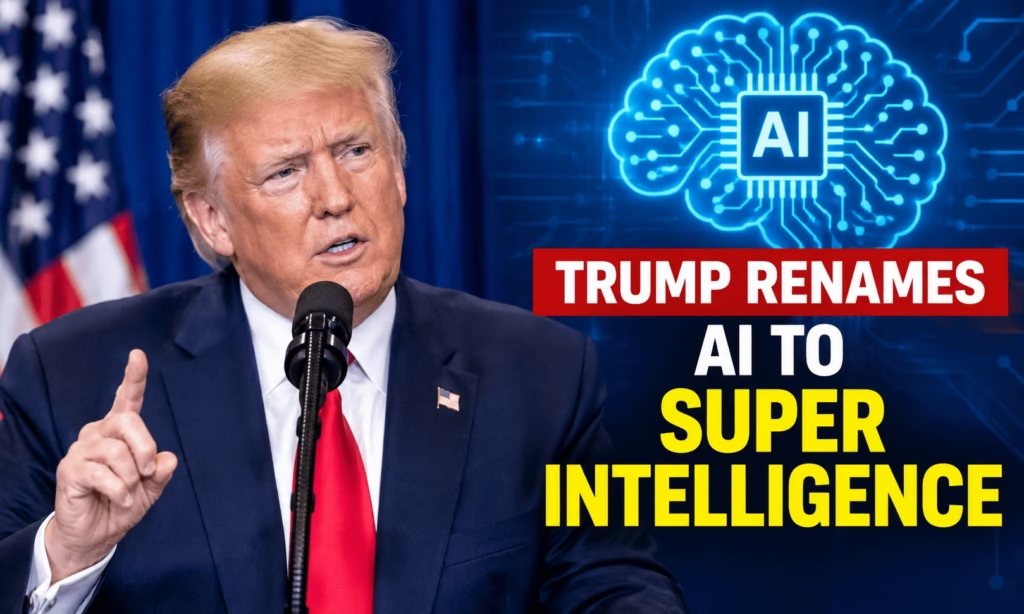
Trump Renames AI to Super Intelligence Key Highlights and Dates
| Item | Latest detail |
|---|---|
| Order signed | Tuesday, September 29, 2026 |
| New official terms | Super Intelligence and SI |
| Terms agencies are told to drop | Artificial intelligence and AI |
| Who the order covers | The executive branch, in non-statutory materials |
| Related agreement | White House Accord on Super Intelligence, signed after the summit |
| Is the accord legally binding | No, it is voluntary, though Trump called it morally binding |
| Task for the White House science adviser | Develop a federal definition of SI and recommend more actions within 60 days |
| Approximate deadline for that task | Late November 2026 |
| First public announcement of the rebrand | Trump’s speech at the United Nations General Assembly, the week before |
| Legal definition the order relies on | Section 9401(3) of Title 15, United States Code |
| Meeting participants named in reports | Leaders from Anthropic, Google, Nvidia, Meta, OpenAI, and Elon Musk |
What the Executive Order Actually Says?
The order directs agencies to use Super Intelligence and SI in official correspondence, public messages, websites, reports, policy documents, and other materials that are not written into statute. That last limit matters. Laws passed by Congress still use the old term, and the order does not rewrite them.
Trump’s stated reasoning is that the word artificial makes the technology sound fake, and that Super Intelligence better reflects its promise and fast improving abilities. The text argues that modern systems are increasingly amplifying human ingenuity and opening new forms of creativity, and it describes the start of a new era.
The order also instructs the Assistant to the President for Science and Technology, a job currently held by Michael Kratsios according to reporting, to develop a federal definition of SI and to recommend any other executive actions needed to carry out the change. Gizmodo reports the deadline for a legislative proposal is 60 days, and that any new definition could modify, expand, or replace the current terms.
Why the Name Does Not Mean Machines Are Smarter Than People
Here is the detail that has surprised many readers. In everyday tech talk, superintelligence means a system that goes beyond human intelligence. The order does not use it that way. It defines Super Intelligence as the technologies and systems covered by the term artificial intelligence in the existing federal statute.
That statute describes an artificial intelligence system as a machine based system that can, for a set of human defined goals, make predictions, recommendations, or decisions that influence real or virtual environments. Nothing in that definition requires the system to exceed human ability. In practical terms, the order relabels the same category of software that agencies already use for things like chatbots, fraud detection, and image analysis.
Language experts note that the word superintelligence is old. Merriam-Webster traces it back to 1822, when it referred to intelligence greater than humanity’s. AI executives use it today for a more advanced subcategory of AI, as OpenAI’s Sam Altman did last year when he wrote that humanity is close to building digital superintelligence, even though his company had already been selling AI products for years. The gap between the ordinary meaning and Trump’s meaning is a big reason critics call the rename confusing.
The White House Meeting: Who Was in the Room
Trump hosted a luncheon and meeting with technology leaders before signing the order. Reports name these participants.
| Participant | Company or role |
|---|---|
| Dario Amodei | CEO of Anthropic |
| Sundar Pichai | CEO of Google |
| Jensen Huang | President and CEO of Nvidia |
| Mark Zuckerberg | CEO of Meta |
| Greg Brockman | President of OpenAI |
| Elon Musk | Tech entrepreneur and owner of xAI and SpaceX |
At a photo opportunity afterward, a reporter shouted a question about AI safety. Trump did not answer directly. He said the name had officially been changed, that it should now be called SI, and he turned to Jensen Huang, who nodded. He described the executives as among the smartest people in the world at what they do. The exchange left the impression that Trump believes the executives agreed to adopt the term, although companies have not all confirmed that.
Trump also said companies agreed to work more closely with the communities that host data centers so the facilities bring more financial benefit to residents. He argued that areas with data centers have become wealthier and have seen lower taxes, a claim that local officials and researchers have debated elsewhere. Asked about a possible initial public offering and about safety concerns, he said a statement summarizing the meeting would be released.
The White House Accord on Super Intelligence
After the summit, the executives signed a document called the White House Accord on Super Intelligence. Trump posted a copy on Truth Social. According to reports, the accord says the industry will put robust internal controls around the development and use of the technology and will work to ensure that models do not hack or access technical systems in unintended ways.
House Speaker Mike Johnson described it as a statement of principles and standards, with voluntary commitments from industry that set expectations. In his summary, it means strong internal controls and layers of internal and external review. Meta’s Mark Zuckerberg wrote on X that he sees it as a significant positive step, since leaders of every major American lab committed to internal controls and multiple layers of audits and reviews, which he said should give people more confidence that the technology will work as intended.
The accord is not a law and carries no penalties. Trump called it morally binding and said the executives viewed it almost like a separate constitution. That language is rhetorical, not legal. Fox Business notes that Trump has opposed imposing formal guardrails on the technology, which fits the voluntary design. Supporters of the approach argue it keeps the United States competitive with China and lets companies move quickly. Critics argue that voluntary pledges are hard to verify and easy to walk back.
How the Rebrand Got Here
The change did not appear overnight. Trump raised it in his United Nations General Assembly speech, where he said official documents would use the new term. He floated several possible names in recent weeks before settling on Super Intelligence. Associated Press reporting says he has already directed diplomats to use it, and the White House has said Chinese President Xi Jinping agreed to use the term, a claim Gizmodo notes is difficult to verify because Xi does not speak English publicly.
At a separate event on Tuesday launching America.gov, Trump said the administration would use the abbreviation SI. The site also includes a chatbot, which tech press outlets tested and found produced odd responses to unusual prompts. The rebrand fits a broader message. Trump has said whoever wins in this field, which he now calls SI, wins overall, tying the name to competition with China.
Some coverage frames the timing around domestic politics. The Independent and Yahoo reported that the rebrand appears aimed at improving public opinion on the technology and easing concerns about its risks ahead of the midterm elections. That is an interpretation, not a stated motive, and the White House frames the change as accuracy, not image.
Reaction: Supporters, Critics, and Silence From Companies
Supporters see the change as a bold statement of national ambition. They argue the word artificial suggests something fake or lesser, and that a confident name signals American leadership in the field. Some also see the accord as a practical step, since it puts commitments from every major lab on one page.
Critics raise four points. First, the new name could confuse the public, since superintelligence already has a specific meaning in the field. Second, replacing a familiar term may make government documents harder to search and compare with past research. Third, the branding could be read as downplaying risks, at a time when safety advocates want stronger oversight. Fourth, voluntary commitments do not replace enforceable rules.
Company reactions are so far mixed and mostly quiet. Meta told Gizmodo that Zuckerberg has used the word superintelligence publicly for some time, including in a letter, product descriptions, and the name of Meta Superintelligence Labs. That statement stops short of promising to drop the term AI, and Zuckerberg’s own letter uses AI dozens of times. Gizmodo also asked Anthropic, OpenAI, SpaceX, Nvidia, and Google about their plans and had not received replies by publication. Trump has no legal power over how private companies speak, so any change in corporate language would be voluntary.
What Changes for Agencies, Contractors, and Businesses
For federal agencies, the answer is direct: update your language. For everyone else, very little is required. Use these steps to work through it.
- Federal employees should check the order text on the White House website and follow any guidance from their agency’s communications or legal office.
- Update public facing materials, including websites, reports, press releases, and policy documents, to use Super Intelligence or SI in place of AI where the order applies.
- Leave statutory and legal citations alone. The order covers non-statutory materials, so the names of laws, regulations, and formal program titles may need to stay as written until Congress or counsel says otherwise.
- Federal contractors should ask their contracting officers whether deliverables and reports need the new wording, since agencies may pass down requirements.
- Private companies and the public are not covered. There is no penalty for saying artificial intelligence.
- Watch for definitions. The science adviser’s proposal could change the meaning of the new term, so keep track of updates.
The calculator later in this article helps with steps two and three by previewing the wording change in any text you paste.
Timeline and What Happens Next
The clock is short. The order sets a 60 day period for the science adviser to propose a federal definition and any further steps, which lands around November 28.
| Date | Event |
|---|---|
| Week before September 29 | Trump announces the rebrand at the United Nations General Assembly |
| September 29 | Executive order signed and White House Accord on Super Intelligence signed |
| Around November 28 | Deadline for the science adviser’s definition and recommendations |
| Ongoing | Agencies revise websites, reports, and public materials |
| Not yet scheduled | Congressional action on any statutory definition |
Several outcomes are possible. The definition could stay tied to the current statutory language and remain a pure relabel. It could be widened or narrowed. Congress could weigh in, though nothing has been scheduled. Companies could adopt, ignore, or partly adopt the term. And the accord could lead to follow up reporting, audits, or new pledges, though none have been announced.
Cost, Funding, and Payments: Does the Rename Change Any Money?
As reported, the order does not create new funding, payments, or benefits. It is a communications and naming directive. Agencies will likely absorb the work of updating websites and documents within existing budgets, though no cost estimate has been published.
Existing contracts and laws are not automatically changed. A program funded under a statute that uses the term artificial intelligence keeps that legal name. If a contract or grant lists deliverables that mention AI, the parties would need to follow contract rules to change the wording. Anyone with a federal contract or grant should read the order and ask their agency contact before making changes.
Will the Public or Businesses Be Forced to Use the New Name?
No. The order applies to the executive branch. It does not regulate private speech, company names, product names, or news coverage. Businesses and news outlets can keep using artificial intelligence, and many will. What may shift over time is search behavior and government terminology, which could gradually spread the new term if agencies use it consistently.
Use the AI to SI Wording Checker
Paste any text into the tool below and it will count uses of “AI” and “artificial intelligence,” preview the same text with “SI” and “Super Intelligence,” and show how many days remain until the definition deadline.
AI to SI Wording Checker
Formatting aid only, not legal advice. The order covers non-statutory federal materials, so legal citations and formal program names may need to stay unchanged. Check with your agency contact or counsel.
Social Security COLA 2027: How Much More Will You Get in January?
Official Resources and Links
| Resource | What it covers | Link |
|---|---|---|
| White House presidential actions | The executive order text | https://www.whitehouse.gov/presidential-actions/ |
| Order page as reported | Inaugurating the Era of Super Intelligence | https://www.whitehouse.gov/presidential-actions/2026/09/inaugurating-the-era-of-super-intelligence/ |
| Federal Register | Official publication of executive orders | https://www.federalregister.gov |
| Legal definition of artificial intelligence | 15 U.S.C. 9401 | https://www.law.cornell.edu/uscode/text/15/9401 |
| White House Office of Science and Technology Policy | The office tasked with the definition | https://www.whitehouse.gov/ostp/ |
| America.gov | Site launched with the announcement | https://www.america.gov |
| Congress.gov | Track any legislation on the definition | https://www.congress.gov |
FAQs About Trump Renames AI to Super Intelligence
Did Trump officially rename AI to Super Intelligence?
Yes, for the executive branch. He signed an executive order on September 29, 2026, telling agencies to use Super Intelligence and SI instead of artificial intelligence and AI.
Does the order change the law?
No. It applies to non-statutory materials such as correspondence, websites, and reports. Laws passed by Congress still use the old term.
What does Super Intelligence mean in the order?
It refers to the technologies covered by the existing federal definition of artificial intelligence. It does not claim the systems are smarter than humans.
Who attended the White House meeting?
Reports name leaders from Anthropic, Google, Nvidia, Meta, and OpenAI, along with Elon Musk.
What is the White House Accord on Super Intelligence?
It is a voluntary agreement signed by the executives. It commits the industry to internal controls, audits, and reviews, and to ensuring models do not access systems in unintended ways.
Is the accord legally binding?
No. Trump called it morally binding, but it carries no legal penalties.
Do companies have to use the new name?
No. The order covers the federal executive branch. Private companies can use whatever terms they like.
What is the 60 day task?
The White House science adviser must develop a federal definition of SI and recommend any further actions, with a deadline around late November.
Will this affect my business?
Not directly, unless you work with a federal agency that asks for the new wording in deliverables.
Has any company agreed to adopt the term?
Meta said its CEO has used the word superintelligence for some time. Other companies had not responded to press questions at the time of reporting.
Why did Trump rename artificial intelligence?
He says the word artificial makes the technology sound fake, and that Super Intelligence better reflects its power and promise. Critics see a political and branding motive.
What is SI in AI?
SI stands for Super Intelligence, the abbreviation the executive order tells agencies to use in place of AI.
Is superintelligence the same as artificial general intelligence?
No. In tech usage, superintelligence means a system beyond human ability, while artificial general intelligence means human level ability across tasks. The order uses Super Intelligence as a label for all AI.
Can the president change a word for the whole country?
He can direct the executive branch’s language. He cannot regulate private speech or change laws by order.
What did the AI CEOs promise?
They signed a voluntary accord to use internal controls and layers of audits and reviews, and to ensure models do not hack systems in unintended ways.
Will Google, Meta, and OpenAI change their names or products?
No announcements have been made. Meta already uses the word superintelligence in some product and lab names.
Conclusion
The order to rename artificial intelligence as Super Intelligence is official for the federal government, and it has real effects on how agencies write and speak. It does not change laws, does not bind private companies, and does not claim machines have surpassed people. It relabels an existing category of technology and pairs the change with a voluntary industry accord that promises internal controls and reviews. The next major date is the 60 day deadline for a federal definition, around late November, which could either keep the term a simple label or give it a broader legal meaning. If you work with a federal agency, read the order and check with your contact. If you follow the technology, watch how companies respond and whether the voluntary accord turns into anything enforceable.
Social Security COLA Buying Power: Will the Raise Beat Inflation?
What Happens If Alberta Votes Yes? Inside Canada’s October 19 Independence Referendum