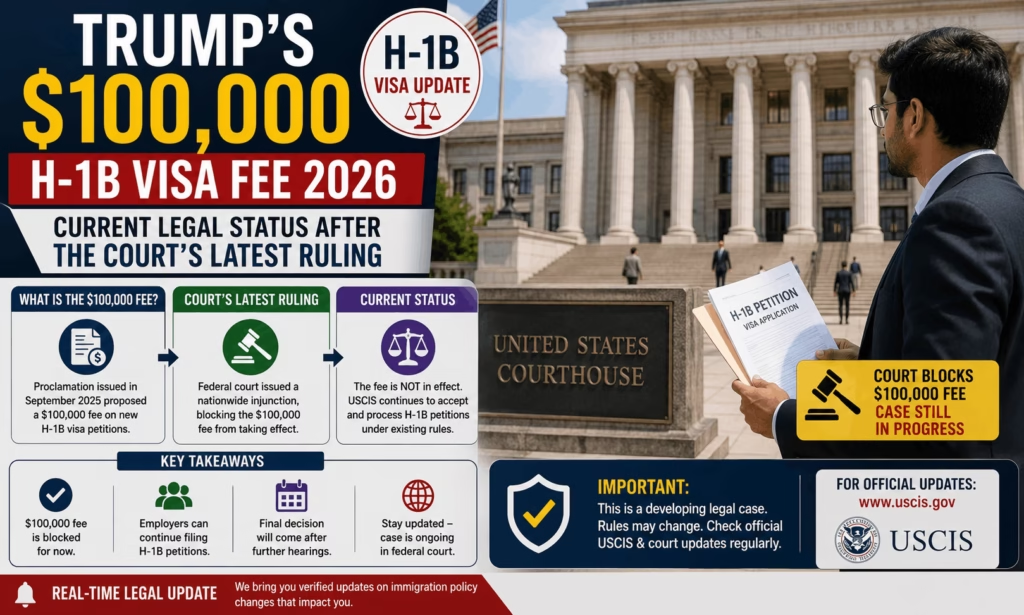
The $100,000 H-1B visa fee is not currently in effect, but that status could still change again, and understanding exactly why requires tracking a genuinely fast-moving legal fight across three separate federal courts. President Trump’s Presidential Proclamation, signed September 19, 2025, imposed a $100,000 fee on employers filing new H-1B petitions requiring consular processing abroad. A coalition of 20 state attorneys general sued in Massachusetts, and on June 8, 2026, U.S. District Judge Leo T. Sorokin vacated the fee nationwide, ruling it functioned as an unconstitutional tax the executive branch had no authority to impose. The government appealed and briefly won a temporary administrative pause, but as of July 24, 2026, the First Circuit Court of Appeals denied the government’s request to reinstate the fee during that appeal, meaning the $100,000 requirement is once again not enforceable, at least for now. We’ll be updating this article monthly as the First Circuit’s full appeal, and two other pending lawsuits, continue to develop.
This guide walks through exactly what the fee was, why courts in different parts of the country reached opposite conclusions about its legality, what the current, verified status actually means for employers and applicants today, and why this fight is genuinely not over despite the recent, favorable ruling for challengers. Every date and detail here is sourced directly from the court orders themselves and immigration law firms tracking the litigation in real time, not secondhand summaries.
Trump’s $100,000 H-1B Visa Fee 2026 Key Highlights
| Fee amount | $100,000 on qualifying new H-1B petitions |
| Legal basis | Presidential Proclamation, signed September 19, 2025 |
| Who it applied to | New H-1B petitions requiring consular processing (visa stamping abroad), not change-of-status petitions for those already in the U.S. |
| Typical prior H-1B employer cost | Roughly $2,000 to $5,000, depending on company size |
| Lawsuit that succeeded (so far) | 20 state attorneys general, filed in Massachusetts |
| Massachusetts ruling | Vacated nationwide on June 8, 2026 by Judge Leo T. Sorokin |
| Government’s response | Appealed and sought a stay; granted a temporary administrative stay on June 12, 2026 |
| First Circuit ruling on the stay | Denied the government’s stay request, as of July 24, 2026 |
| Current status (as of this update) | Fee is not currently in effect |
| Competing ruling | U.S. District Court, D.C. upheld the fee’s legality on December 24, 2025 (Chamber of Commerce case) |
| Third pending lawsuit | Filed in San Francisco by religious groups and labor organizations |
| Risk of further escalation | Possible Supreme Court review, given the conflicting circuit-level rulings |
What Was Trump’s $100,000 H-1B Fee?
On September 19, 2025, President Trump signed a Presidential Proclamation imposing a $100,000 fee on employers filing certain new H-1B visa petitions, specifically those requiring consular processing, meaning the foreign worker needed to obtain their visa stamp at a U.S. consulate abroad before entering the country in H-1B status. This is distinct from change-of-status petitions, filed for individuals already lawfully present in the U.S. in another visa category, which were not subject to this specific fee. Before this proclamation, employers sponsoring H-1B workers typically paid between $2,000 and $5,000 in total government filing fees, depending on company size and other factors, making the new $100,000 requirement a dramatic, order-of-magnitude increase. The administration framed the fee as a way to discourage employers from using the H-1B program in place of hiring American workers.
2027 Social Security COLA Forecast: Latest Estimate, Medicare Offset & What Retirees Can Expect
Why Did Employers and States Sue Over the Fee?
The core legal argument, raised across multiple lawsuits, was that the $100,000 fee effectively functioned as a tax, and under the U.S. Constitution and the Immigration and Nationality Act (INA), only Congress, not the executive branch, holds the authority to impose a tax or fee of this scale in the immigration context. Three separate legal challenges emerged:
- U.S. Chamber of Commerce filed suit in Washington, D.C. federal court (October 17, 2025)
- A coalition of 20 state attorneys general, led by California, filed suit in Massachusetts (January 2026)
- Religious groups and labor organizations filed a third lawsuit in San Francisco federal court
Having three separate cases proceeding in three different federal court systems created a real possibility of conflicting rulings, which is exactly what happened.
What Did the Massachusetts Court Actually Rule?
On June 8, 2026, Judge Leo T. Sorokin of the U.S. District Court for the District of Massachusetts granted summary judgment in favor of the 20 state attorneys general, ruling that the $100,000 fee was unlawful. The court’s reasoning centered on several key findings:
- The fee functioned as an unauthorized tax, which cannot be imposed without clear congressional authorization
- The administration’s implementation exceeded executive authority and violated the Administrative Procedure Act (APA)
- The ruling also cited constitutional separation-of-powers principles, emphasizing that Congress, not the executive branch, holds tax and fee authority in this context
- The court’s reasoning explicitly drew on the logic from the Supreme Court’s recent ruling striking down certain IEEPA tariffs, applying similar constitutional limits on unilateral executive fee-setting authority
This ruling vacated the fee nationwide, not just for the plaintiff states, meaning its immediate effect, before any stay, was to eliminate the $100,000 requirement for all qualifying H-1B petitions across the country.
What Happened With the Government’s Appeal?
The federal government did not accept this outcome quietly. On June 12, 2026, the government asked the district court for a stay pending appeal, essentially requesting permission to keep collecting the fee while the case worked through the appeals process. Judge Sorokin denied the full stay request but granted a limited administrative stay, a temporary, procedural pause of his own ruling, conditioned on the government formally filing its stay motion with the U.S. Court of Appeals for the First Circuit by June 18, 2026. The government met that deadline, filing its formal motion to stay on June 18, 2026, which meant that, for several weeks afterward, USCIS was permitted to continue requiring the $100,000 fee for qualifying petitions while the First Circuit considered the stay request.
What Is the Current Status as of This Update?
This is the most important, and most time-sensitive, part of this story. As of July 24, 2026, the First Circuit Court of Appeals denied the government’s motion to stay, stating plainly: “We deny the motion.” Because the appellate court declined to restore the fee during the appeal, the underlying district court judgment vacating the fee remains in effect, meaning the $100,000 H-1B payment requirement is not currently enforceable. It’s critical to understand what this ruling is not: it is an interim decision on the stay request only, the First Circuit has not yet issued a final ruling on the full merits of the government’s appeal. This is a favorable development for challengers, but not necessarily the final word on this litigation.
Why Is There a Conflicting Ruling in Washington, D.C.?
This is where the legal picture becomes genuinely more complicated than a simple “fee struck down” headline suggests. In the separate Chamber of Commerce lawsuit, the U.S. District Court for the District of Columbia reached the opposite conclusion, upholding the legality of the $100,000 fee on December 24, 2025. The Chamber of Commerce appealed that unfavorable ruling, and the U.S. Court of Appeals for the District of Columbia Circuit agreed to fast-track that appeal in early January 2026. With one federal court system upholding the fee and another vacating it, this creates a genuine circuit split risk, a scenario where different appellate courts could ultimately reach different conclusions on the exact same legal question, which is one of the most common reasons the U.S. Supreme Court agrees to take up a case.
Is There a Third Lawsuit Still Pending Too?
Yes. The San Francisco-based lawsuit, filed by a coalition of religious groups and labor organizations, remains pending separately from both the Massachusetts and D.C. cases. This raises the possibility of three different appellate circuits eventually weighing in on the same fee, further increasing the odds that this issue is ultimately resolved at the Supreme Court level rather than settled definitively at the circuit court stage.
$5280 CRA My Account Breach Claims 2026: How Affected Canadians Could Qualify for Compensation
What Should Employers and H-1B Applicants Do Right Now?
Given how quickly this legal status has changed, and could change again, immigration attorneys tracking this litigation consistently advise a cautious, verify-before-you-file approach:
- Do not assume the fee is permanently gone. The current status reflects an interim appellate ruling on a stay motion, not a final resolution of the underlying appeal
- Check current USCIS and Department of State guidance directly before filing or paying for a qualifying H-1B petition
- Consult immigration counsel regarding any pending or planned H-1B filings that could be affected by this fee, especially those requiring consular processing
- Watch for further First Circuit developments, since the full merits appeal remains open and could still reverse this outcome
- Employers who already paid the fee during the period it was reinstated (mid-June through late July 2026) should consult counsel regarding potential refund eligibility, since the underlying district court ruling that vacated the fee remains legally significant
What Else Changed With H-1B Policy Around the Same Time?
Separately from this fee litigation, USCIS announced on October 29, 2025, that it would apply a new “Weighted Selection Process” for the FY 2027 H-1B visa registration and lottery. This is a distinct policy change from the $100,000 fee fight, but it’s part of the same broader wave of H-1B program adjustments under the current administration, and employers navigating both the fee uncertainty and the new lottery selection process should track each development separately, since they involve different legal mechanisms and different timelines.
Official Resources & Status Check Links
| Resource | Purpose | Official Link |
|---|---|---|
| USCIS – H-1B Specialty Occupations | Official USCIS guidance on H-1B requirements and fees | uscis.gov/working-in-the-united-states/h-1b-specialty-occupations |
| U.S. Department of State – Visa Bulletin & Fees | Consular processing and visa fee information | travel.state.gov |
| U.S. Court of Appeals for the First Circuit | Official case docket and filings for the Massachusetts appeal | ca1.uscourts.gov |
| Federal Register | Full official text of the September 19, 2025 Presidential Proclamation | federalregister.gov |
| USCIS Policy Manual & Alerts | Current USCIS fee guidance and policy updates | uscis.gov/policy-manual |
FAQs
Is the $100,000 H-1B fee currently in effect?
No, as of July 24, 2026, the fee is not currently enforceable, after the First Circuit Court of Appeals denied the government’s request to reinstate it during the appeal.
Is this a final, permanent ruling against the fee?
No, this is an interim decision on a stay request only; the First Circuit has not yet ruled on the full merits of the government’s appeal, and the litigation is ongoing.
Why did one court uphold the fee while another struck it down?
The Massachusetts district court ruled the fee was an unauthorized tax exceeding executive authority, while the Washington, D.C. district court reached the opposite conclusion in a separate lawsuit, creating a circuit split.
Who does the $100,000 fee apply to?
It applies specifically to new H-1B petitions requiring consular processing abroad, not to change-of-status petitions for individuals already in the U.S.
How much did H-1B sponsorship typically cost before this fee?
Roughly $2,000 to $5,000 in total government filing fees, depending on company size and other factors.
Who filed the lawsuit that succeeded in Massachusetts?
A coalition of 20 state attorneys general, led by California, filed the suit that resulted in the fee being vacated.
Could this case go to the Supreme Court?
It’s a real possibility, given the conflicting rulings between the Massachusetts and Washington, D.C. courts, and a third pending case in San Francisco.
Should employers pay the $100,000 fee right now?
As of this update, the fee is not currently enforceable, but employers should verify current USCIS and Department of State guidance directly and consult immigration counsel before making filing decisions.
What if I already paid the $100,000 fee during the period it was reinstated?
Consult immigration counsel regarding potential refund eligibility, since the underlying district court ruling vacating the fee remains legally significant.
What is the Weighted Selection Process, and is it related to this fee fight?
It’s a separate H-1B policy change for the FY 2027 registration and lottery, announced by USCIS in October 2025, distinct from the $100,000 fee litigation but part of the same broader wave of H-1B program changes.
Conclusion
The $100,000 H-1B visa fee saga is a clear example of why “struck down” and “resolved” are not the same thing in ongoing federal litigation. As of this update, the fee is not currently in effect, following the First Circuit’s July 24, 2026 denial of the government’s stay request, but the underlying appeal remains open, a competing ruling upholding the fee exists in Washington, D.C., and a third lawsuit is still pending in San Francisco. Given the very real possibility of conflicting appellate outcomes and eventual Supreme Court review, employers and H-1B applicants should treat the current, favorable status as exactly that, current, rather than final, and continue checking official USCIS and Department of State guidance before making any filing decisions tied to this fee.
Also Read
Canada Immigration Language Test Scrutiny 2026: IRCC’s New Fraud Verification Rules Explained
Free TSA PreCheck 2026: Who Actually Qualifies for No-Cost or Reimbursed Enrollment
Social Security Changes 2026: New Rules, COLA Increase & What Changed This Year
Stimulus Check 2026: Fact-Checking Every Viral Payment Claim (Tracker)