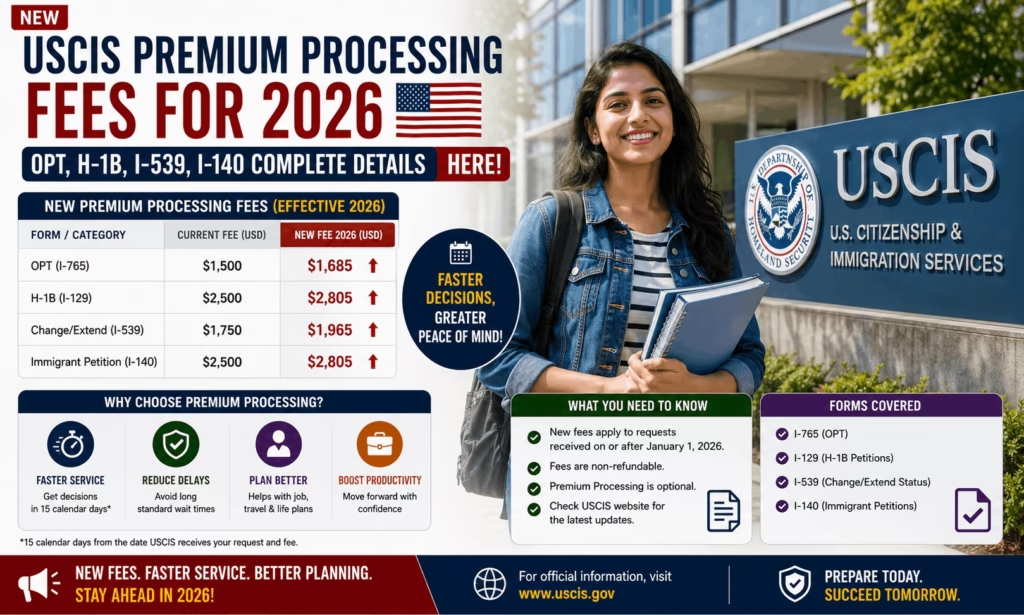
USCIS Premium Processing Fees 2026 increased for the first time since 2024, and the change is confirmed directly through a Department of Homeland Security final rule published in the Federal Register. Effective March 1, 2026, the premium processing fee for Form I-129 (covering H-1B, L-1, O-1, TN, E-3, and other nonimmigrant worker classifications) and Form I-140 (employment-based immigrant petitions) rose from $2,805 to $2,965. The fee for eligible Form I-539 applications (F-1, F-2, J-1, J-2, M-1, M-2 change or extension of status) rose from $1,965 to $2,075, and the fee for eligible Form I-765 applications, including OPT and STEM OPT work authorization requests, along with certain H-2B and R-1 petitions, rose from $1,685 to $1,780. This adjustment reflects inflation from June 2023 through June 2025, calculated under the biennial review authority Congress granted USCIS through the Emergency Stopgap USCIS Stabilization Act. We’ll be updating this article monthly as USCIS releases further guidance and as ongoing litigation over separate H-1B related fees continues to develop.
This guide gives you the complete, verified 2026 premium processing fee table, the guaranteed processing timeframes tied to each form type, exactly which classifications are covered, and an important clarification many people search for but rarely get a straight answer on: how this fee increase is completely separate from the unrelated $100,000 H-1B proclamation fee, which remains tied up in active federal litigation as of this writing.
Are the USCIS Premium Processing Fee Increases Real?
Yes, fully confirmed. This is not a rumor or a proposed rule; it’s a final rule published by the Department of Homeland Security in the Federal Register on January 12, 2026, with an effective date of March 1, 2026. USCIS confirmed the same information directly on its own official alerts page. Any Form I-907 (Request for Premium Processing Service) postmarked on or after March 1, 2026, must include the new fee amount, or USCIS will reject the request.
USCIS Premium Processing Fees 2026: Full Comparison Table
| Form Type | Covered Classifications | Old Fee | New Fee (Effective March 1, 2026) |
|---|---|---|---|
| Form I-129 | H-1B, L-1A, L-1B, O-1, O-2, TN-1, TN-2, E-1, E-2, E-3, H-3, P-1, P-1S, P-2, P-2S, P-3, P-3S, Q-1 | $2,805 | $2,965 |
| Form I-140 | EB-1, EB-2 (including National Interest Waiver), EB-3 | $2,805 | $2,965 |
| Form I-539 | Change or extension of status to F-1, F-2, J-1, J-2, M-1, M-2 | $1,965 | $2,075 |
| Form I-765 | F-1 students seeking OPT or STEM OPT work authorization extensions | $1,685 | $1,780 |
| Form I-129 | H-2B and R-1 classifications | $1,685 | $1,780 |
Why the Fees Increased: The Legal Basis
The fee adjustment is authorized under the Emergency Stopgap USCIS Stabilization Act, part of the Continuing Appropriations Act, 2021, which gave USCIS ongoing authority to adjust premium processing fees for inflation on a biennial (every two years) basis. This specific increase reflects the Consumer Price Index for All Urban Consumers (CPI-U) change from June 2023 through June 2025. According to DHS’s own estimate in the Federal Register, the increase is projected to generate roughly $77.1 million in additional annual transfer payments, with a specific estimated $21.7 million per year attributable to Form I-140 alone. DHS states the additional revenue will fund premium processing operations, reduce adjudication backlogs, and support broader USCIS adjudication and naturalization services.
Guaranteed Processing Timeframes by Form Type
Premium processing guarantees USCIS will take action within a set number of business days, or refund the fee. The 2026 timeframes remain:
| Form/Classification | Guaranteed Processing Time |
|---|---|
| Form I-140, EB-2 National Interest Waiver (NIW) petitions | 45 business days |
| Form I-765, F-1 students seeking OPT or STEM OPT extensions | 30 business days |
| Form I-539, change of status to F-1, F-2, M-1, M-2, J-1, or J-2 (once all prerequisites, including biometrics, are met) | 30 business days |
| All other eligible classifications (including H-1B, TN, most I-129 and I-140 categories) | 15 business days |
Important: if USCIS issues a Request for Evidence (RFE) or a Notice of Intent to Deny during this window, the processing clock pauses and restarts only once USCIS receives your response.
Does Premium Processing Guarantee Approval?
No. Premium processing only guarantees a timely response, meaning an approval, a denial, an RFE, or a notice of intent to deny within the guaranteed window. It does not guarantee your petition or application will be approved. Premium processing is also entirely optional; you can file the standard, non-premium version of any eligible form at the regular filing fee.
Key Dates and Figures at a Glance
| Date/Figure | Detail |
|---|---|
| January 9, 2026 | USCIS and DHS publicly announce the fee increase |
| January 12, 2026 | Final rule published in the Federal Register |
| March 1, 2026 | Effective date; new fees required for requests postmarked on or after this date |
| $2,965 | New fee for Form I-129 (H-1B, L-1, O-1, TN, E-3, etc.) and Form I-140 |
| $2,075 | New fee for eligible Form I-539 applications |
| $1,780 | New fee for eligible Form I-765 (OPT/STEM OPT) and I-129 H-2B/R-1 petitions |
| ~$77.1 million | DHS estimated annual increase in transfer payments from this rule |
Important Correction: This Is Not the Same as the $100,000 H-1B Fee
This is the single most important clarification for anyone researching H-1B costs in 2026: the premium processing fee increase described above is a completely separate matter from the much larger, more controversial $100,000 H-1B supplementary fee, and confusing the two could lead to serious cost miscalculations.
- The $100,000 fee originates from Presidential Proclamation 10973, titled “Restriction on Entry of Certain Nonimmigrant Workers,” signed September 19, 2025, and effective September 21, 2025.
- It applies specifically to new H-1B petitions filed for beneficiaries outside the United States who do not hold a valid H-1B visa, or beneficiaries whose petition requires consular, port of entry, or pre-flight processing.
- It generally does not apply to change-of-status petitions filed for someone already inside the U.S. (such as an F-1 student changing to H-1B status), nor to timely filed extensions or amendments for existing H-1B holders.
- Current legal status: on June 8, 2026, a federal judge in Massachusetts ruled the $100,000 fee unlawful and vacated it, but the same court temporarily stayed (paused) that ruling on June 12, 2026, meaning USCIS is currently still collecting the fee for qualifying consular-processed petitions while the government’s appeal proceeds. The government formally moved to stay the order for the duration of the appeal on June 18, 2026.
- This fee is unrelated to premium processing and is paid separately, on top of standard filing and any premium processing fees.
How Employers and Applicants Should Budget for 2026
Given both changes, here is a realistic combined cost picture for a typical new H-1B petition requiring premium processing and subject to the $100,000 proclamation fee (consular processing scenario):
- Base H-1B filing fees (varies by employer size and classification)
- $2,965 premium processing fee, if requested
- $100,000 proclamation fee, currently still being collected pending appeal, if the beneficiary is outside the U.S. without a valid H-1B visa
- Additional $4,000 fee under Public Law 114-113 for H-1B dependent employers with 50+ U.S. employees where more than half hold H-1B or L-1 status
Employers filing change-of-status petitions for beneficiaries already inside the U.S. generally avoid the $100,000 fee entirely, making the premium processing increase described in this article the primary relevant cost change for that group.
How to File for Premium Processing in 2026
- File Form I-907 (Request for Premium Processing Service) along with, or after, your underlying petition or application.
- Ensure your payment reflects the correct new fee for requests postmarked March 1, 2026, or later; requests submitted with the old fee amount will be rejected.
- Confirm your specific classification is actually eligible for premium processing; not all visa categories qualify (for example, premium processing is not currently available for certain dependent classifications like E-1/E-2 dependents, E-3 dependents, O-3, P-4, and R-2).
- Check current processing times and any updates directly through the official USCIS Premium Processing Service page.
Common Points of Confusion to Avoid
- Don’t confuse the premium processing fee increase with the $100,000 H-1B proclamation fee. They come from entirely different legal authorities and apply to different situations.
- Premium processing does not guarantee approval, only a timely decision or update within the guaranteed window.
- The RFE clock reset rule means a case can take significantly longer than the guaranteed window if USCIS requests additional evidence.
- The $100,000 fee’s legal status is actively changing due to ongoing litigation; confirm current enforcement status before assuming it either definitely applies or definitely doesn’t in your specific case.
Conclusion
The USCIS Premium Processing Fees 2026 increase is fully confirmed and already in effect as of March 1, 2026, raising costs to $2,965 for Form I-129 and I-140 petitions, $2,075 for eligible Form I-539 applications, and $1,780 for eligible Form I-765 (OPT/STEM OPT) requests and certain I-129 H-2B/R-1 petitions, under DHS’s biennial inflation adjustment authority. The guaranteed processing windows (15, 30, or 45 business days depending on form type) remain unchanged. Separately, and this distinction matters enormously for anyone budgeting for H-1B costs, the unrelated $100,000 H-1B proclamation fee remains a live legal issue, currently still being collected for qualifying consular-processed petitions while a federal appeals court reviews a June 2026 ruling that found it unlawful. Always verify current fee amounts and enforcement status directly through USCIS.gov before filing, since both figures and legal rulings in this area have changed multiple times within a single year.
FAQs
When did USCIS premium processing fees increase in 2026?
The new fees took effect March 1, 2026, for any Form I-907 request postmarked on or after that date.
How much is premium processing for H-1B in 2026?
$2,965, up from $2,805, for Form I-129 petitions including H-1B, L-1, O-1, TN, and E-3 classifications.
How much is premium processing for OPT and STEM OPT in 2026?
$1,780, up from $1,685, for eligible Form I-765 applications.
How much is premium processing for a change of status (I-539) in 2026?
$2,075, up from $1,965, for eligible F-1, F-2, J-1, J-2, M-1, and M-2 change or extension of status applications.
How much is premium processing for Form I-140 in 2026?
$2,965, the same increased rate as Form I-129, covering EB-1, EB-2 (including NIW), and EB-3 classifications.
Is the $100,000 H-1B fee the same as the premium processing fee increase?
No. They are entirely separate. The $100,000 fee comes from a September 2025 presidential proclamation targeting certain new H-1B petitions requiring consular processing, while the premium processing fee increase is a routine, biennial inflation adjustment under a different law.
Is the $100,000 H-1B fee still being collected?
As of this writing, yes, for qualifying petitions, despite a June 8, 2026 federal court ruling against it, because the same court paused its own ruling on June 12, 2026 while the government appeals.
Does premium processing guarantee my petition will be approved?
No. It only guarantees a decision or update (approval, denial, RFE, or notice of intent to deny) within the specified timeframe, not a favorable outcome.
What happens if I pay the old premium processing fee after March 1, 2026?
USCIS will reject the request; you must resubmit with the correct, current fee amount.
How often do USCIS premium processing fees get adjusted?
Every two years (biennially), based on inflation data, under authority granted by the Emergency Stopgap USCIS Stabilization Act.
People Also Ask
Why did USCIS raise premium processing fees in 2026? To account for inflation between June 2023 and June 2025, under a law that requires USCIS to review and adjust these fees every two years.
Does the H-1B $100,000 fee apply to OPT or F-1 to H-1B change of status? Generally no. USCIS guidance confirms the $100,000 fee does not apply to timely filed change-of-status petitions for beneficiaries already in the U.S., including F-1 to H-1B transitions.
What is the current status of the $100,000 H-1B fee lawsuit? A federal judge vacated the fee on June 8, 2026, but paused that ruling on June 12, 2026, so the fee remains in effect for qualifying petitions while the government’s appeal proceeds.
How long does premium processing take for H-1B petitions in 2026? 15 business days for most classifications, though the clock pauses and restarts if USCIS issues a Request for Evidence.
Official Resources
| Resource | Purpose | Official Link |
|---|---|---|
| USCIS, Premium Processing Service | Official current fees, eligible forms, and Form I-907 | https://www.uscis.gov/forms/all-forms/premium-processing-service |
| USCIS Alert, Fee Increase Announcement | Official March 1, 2026 fee increase notice | https://www.uscis.gov/newsroom/alerts/uscis-to-increase-premium-processing-fees |
| Federal Register, Adjustment to Premium Processing Fees | Full final rule text and DHS cost estimates | https://www.federalregister.gov/documents/2026/01/12/2026-00321/adjustment-to-premium-processing-fees |
| USCIS Case Status Online | Check the status of a pending petition or application | https://egov.uscis.gov/casestatus/landing.do |
| USCIS, H-1B Proclamation Guidance | Official information on the separate $100,000 fee | https://www.uscis.gov/working-in-the-united-states/h-1b-specialty-occupations |