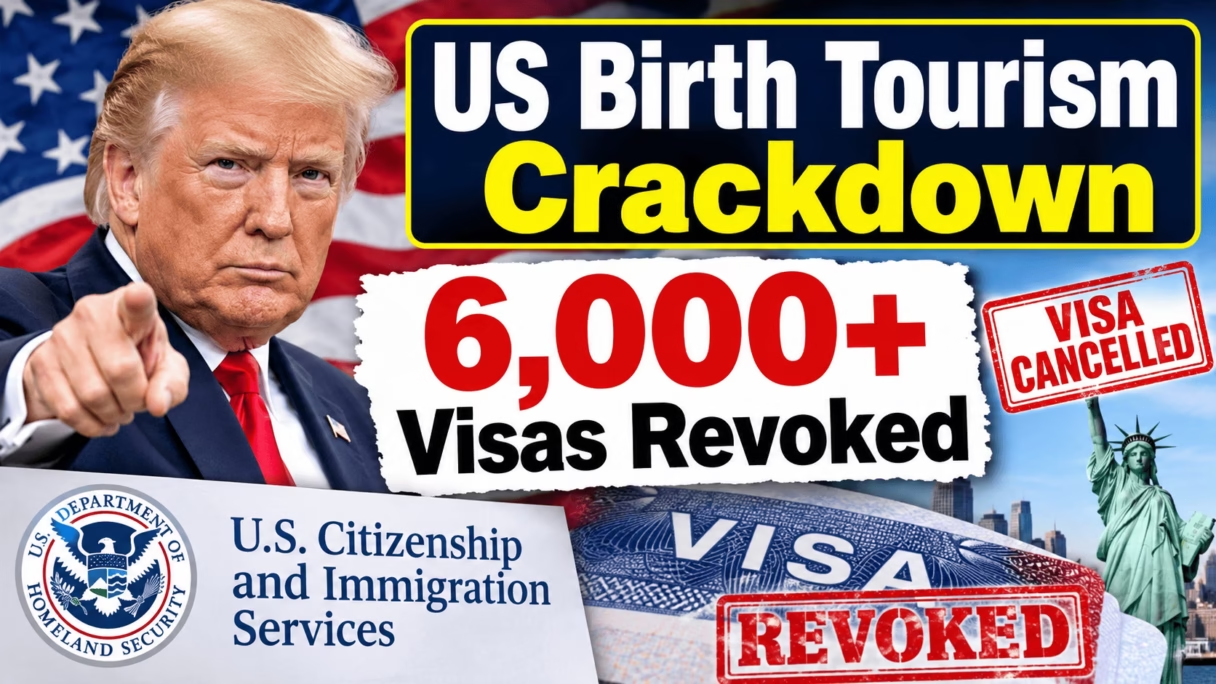
US Birth Tourism Crackdown: The State Department says its Birth Tourism Prevention Task Force has revoked more than 6,000 visas from people who engaged in or helped arrange birth tourism, up from more than 4,000 on October 31 and more than 600 when the task force launched on August 12. Pregnancy alone does not bar a visitor visa, but officers can refuse one when the main purpose of the trip is giving birth to obtain US citizenship for the child, and lying about it can mean permanent ineligibility.
The State Department announced on Thursday, November 12, 2026, that the US birth tourism crackdown has now led to the revocation of more than 6,000 visas. The post, published on the official account of the Birth Tourism Prevention Task Force, said the group is “identifying and holding accountable everyone involved in this illicit practice.” The number has grown fast. The task force reported more than 600 revocations when it launched on August 12, passed 4,000 in an October 31 update, and has now crossed 6,000. All three figures are floors, not exact counts, and the department has not released a country breakdown for the latest total. A revocation is an administrative action. It does not on its own mean a person was deported or charged with a crime. We’ll be updating this article monthly as new numbers, court rulings and guidance arrive.
The announcement lands in the middle of a wider immigration overhaul that has made consular offices stricter about why people say they are visiting. Since August, the administration has combined an executive order on birth tourism, a September visa restriction policy aimed at agencies and brokers, and a global review of past visa files. Pregnant visitors are not banned, but the margin for vague answers on a visa application has shrunk. Anyone planning a trip, or waiting on a visa decision, should understand what the rules actually say, what is still unclear, and where the official guidance lives. Below you will find the timeline, the legal basis, what happens after a revocation, a step by step guide to applying correctly, fees and wait times, and every official link in one table.
US Birth Tourism Crackdown Key Highlights
| Item | Latest detail |
|---|---|
| Latest revocation total | More than 6,000 visas, announced November 12, 2026 |
| Earlier totals | More than 4,000 on October 31, more than 600 on August 12 |
| Agency | State Department Birth Tourism Prevention Task Force, working with the Department of Homeland Security |
| Who is covered | People who engaged in birth tourism and people who facilitated it |
| Nationality data | Not released for the 6,000 figure. An October thread reportedly said more than 700 revoked visas belonged to Chinese nationals |
| What revocation means | Loss of the visa. It is not by itself a deportation order or a conviction |
| Does pregnancy bar a visa | No. Purpose of travel is what officers examine |
| Biggest risk for applicants | A finding of misrepresentation, which can mean permanent ineligibility |
Birth Tourism Visa Revocations Timeline: What Happened and When
The pace of action since the summer helps explain why this is landing so hard now.
| Date | Event |
|---|---|
| January 2020 | State Department rule lets consular officers deny B visas when the primary purpose is giving birth to obtain citizenship |
| June 2026 | US embassy operation in West Africa reportedly dismantles a network involving more than 100 foreign nationals |
| August 6, 2026 | Executive order titled Ending Birth Tourism signed, according to a legal explainer that cites its Federal Register publication on August 11 |
| August 12, 2026 | Birth Tourism Prevention Task Force announced, with more than 600 revocations reported at launch |
| September 2, 2026 | A federal judge in Maryland blocks a separate birthright citizenship order |
| September 23, 2026 | Secretary of State Marco Rubio announces a visa restriction policy for people who engage in or facilitate birth tourism |
| October 31, 2026 | Task force reports more than 4,000 revocations |
| November 12, 2026 | Task force reports more than 6,000 revocations |
What the State Department Actually Said on November 12
The announcement was short. The task force said it had revoked more than 6,000 visas “from foreigners who engaged in or facilitated birth tourism” and repeated that it is holding “everyone involved in this illicit practice” accountable. It did not publish a list of countries, did not say how many of the revoked visa holders were travelers and how many were facilitators, and did not say whether any were removed from the United States or referred for prosecution.
That gap matters. News outlets from the United States, India, Nigeria and Latin America all carried the same figure, but none had access to the underlying data, and several of the early write-ups relied on a social media post rather than a written release. When you read a headline that links the 6,000 number to a specific country, check whether the outlet is quoting the department or inferring from older numbers. The only nationality figure tied to the campaign so far is the October thread, which reportedly cited more than 700 Chinese nationals among the revocations at that time.
The department also said it generally revokes a visa when the holder may be ineligible. People who misrepresent their purpose of travel may be permanently ineligible. That line is boilerplate in immigration law, but it takes on weight in this context, because the review reportedly covers visa and travel files going back several years.
Who the Task Force Is Targeting
The September policy named the groups the administration wants to reach, and the task force language follows it.
| Group | Examples cited |
|---|---|
| Commercial operators | Owners, operators and managers of agencies that market US childbirth packages |
| Visa intermediaries | Brokers and consultants who coach applicants to give false answers or hide the real reason for travel |
| Medical providers abroad | Clinics or doctors who knowingly help arrange travel for delivery |
| Travelers | Visitors who entered, or tried to enter, mainly to give birth and obtain citizenship for the child |
| Certain family members | Relatives of people covered by the policy, in circumstances that have not been fully defined publicly |
Officials have said these networks advertise to foreign customers and charge tens of thousands of dollars per package. Secretary Rubio said in August that American citizenship is not for sale, and the policy announced on September 23 relies on a section of the Immigration and Nationality Act that governs foreign policy based inadmissibility. The department did not single out any one country in the policy itself.
Can Pregnant Women Still Get a US Tourist Visa?
Yes, in principle. Pregnancy is not a ground of refusal on its own, and the State Department has said that traveling to the United States while pregnant is not prohibited. What officers evaluate is the purpose of the trip, the timing and the honesty of the application.
Under the 2020 rule, a consular officer can refuse a B-1 or B-2 visa when there is reason to believe the applicant’s primary purpose is to give birth in the United States to obtain citizenship for the child. The rule creates a rebuttable presumption in cases where an officer believes the applicant will give birth during the stay, which means the applicant gets a chance to show a different, genuine temporary purpose.
Reported indicators that draw extra attention include:
- Late stage pregnancy or travel close to the due date
- Ties to agencies that sell maternity packages
- Weak ties to the home country, such as no job, property or school obligations
- Vague travel plans or answers that change during the interview
- Online posts suggesting a plan to deliver in the United States
- Expensive US medical bookings without a clear reason
Medical travel is not automatically banned. Applicants who need care that is not available at home should expect to document it: a letter from a US provider, a cost estimate, and proof they can pay all bills without public funds. A false statement about the reason for travel is a separate and more serious problem than the trip itself.
The Legal Basis: Executive Order, Visa Policy and Existing Law
Several layers now sit on top of each other, and they do different things.
| Layer | What it does |
|---|---|
| January 2020 State Department rule | Lets officers deny B visas when the main purpose is birth and citizenship |
| Executive order Ending Birth Tourism | Directs the State and Homeland Security secretaries to prevent visas and entry for birth tourism, revoke visas, act against facilitators, and update guidance. It allows case by case exceptions on humanitarian or national interest grounds |
| September 23 visa restriction policy | Targets people who knowingly engage in or facilitate commercial birth tourism, and certain family members |
| Section 212(a)(6)(C)(i) of the INA | Makes willful misrepresentation to obtain a visa or entry a permanent ground of inadmissibility, regardless of the new policy |
One point deserves care. The order and the policy work through visa and entry authority. They do not change who is a citizen at birth. Whether a child born in the United States is a citizen is governed by the Constitution, federal statute and court rulings, and that fight is happening in a separate set of cases.
Numbering and scope of the August orders have been reported inconsistently. One legal explainer calls the birth tourism order Executive Order 14419 and says it was published in the Federal Register on August 11. A separate analysis of the court fight refers to the second birthright citizenship order as Executive Order 14418. If you need the exact text, open the Federal Register directly rather than relying on a summary.
The Court Fight: What the Injunction Does and Does Not Cover
On September 2, a federal judge in Maryland granted a classwide preliminary injunction against the administration’s second birthright citizenship order, calling it almost certainly unconstitutional as applied to the certified class. The class covers children born in the United States after February 19, 2025, to mothers who were unlawfully or temporarily present, where the father was neither a citizen nor a permanent resident at birth.
Reports differ on whether that injunction reaches the birth tourism provisions. One analysis says the birth tourism order is not covered and that implementing guidance has not been published, so officers lack a published standard for judging a traveler’s purpose. Another legal explainer says the injunction’s coverage of consular visa practice is not established. The practical answer, for now, is that visa revocations and the September restriction policy have continued while the litigation plays out. The injunction is preliminary and can be appealed, so the picture could change.
Separately, the Department of Homeland Security issued an interim final rule in early September that changes how certain children of foreign government employees are treated for birthright citizenship. It is a different issue from visitor visas and should not be confused with the revocation campaign.
What Happens After a US Visa Is Revoked
A revoked visa cannot be used to enter. If you are abroad, you would need to apply again, and the earlier revocation will be part of your record. If you are in the United States when a visa is revoked, the revocation does not automatically end your authorized stay, because your permission to stay is tied to your I-94 record. Removal, if it comes, follows a separate process.
The more serious consequence is a misrepresentation finding. Under section 212(a)(6)(C)(i), a person found to have willfully misrepresented a material fact to get a visa or admission is permanently inadmissible unless a waiver is granted, and waivers are discretionary and often difficult. That is why the State Department warning about permanent ineligibility is the part of the announcement that immigration lawyers are stressing.
Practical points for anyone who receives a revocation notice:
- Read the notice carefully and note the stated ground.
- Do not travel on the revoked visa.
- Keep copies of everything you submitted in earlier applications.
- Speak to a licensed US immigration attorney before reapplying or answering questions from officials.
- If you were not involved in birth tourism, gather evidence of your actual purpose of travel and your ties to your home country.
Visa holders who travel under the Visa Waiver Program should assume the same scrutiny can apply at the border, because customs officers can still question travelers and deny entry even when a document was valid.
How to Apply for a US Visitor Visa Without Raising Red Flags?
This is not a way around the rules. It is a plain checklist for honest applicants whose trip, pregnant or not, has a real temporary purpose.
- Confirm the visa category. Tourism, family visits and short medical care normally fall under B-2, business trips under B-1.
- Complete the DS-160 online application at ceac.state.gov and answer every question truthfully, including questions about pregnancy or medical treatment when asked.
- Pay the application fee and schedule your interview at the US embassy or consulate that serves you.
- Prepare proof of your purpose, your return plans and your ties at home: employer letters, property records, school enrollment, return tickets and a realistic itinerary.
- If the trip includes medical care, bring a letter from the US provider that agrees to treat you, a cost estimate and proof of funds.
- Answer interview questions consistently with your application. A mismatch is a bigger problem than an unusual plan.
- If your visa is approved, remember that it does not guarantee entry. A customs officer makes the final decision at the airport.
Free help is available. Official consular websites list the steps for each country, and the department has said it accepts reports of visa fraud through an online tip portal. Applicants should be wary of anyone who promises a guaranteed visa, offers a package that includes delivery in the United States, or asks them to hide a pregnancy.
Processing Time for Visitor Visas and Visa Revocation Decisions
There is no single processing time, because waits for visitor visa interviews vary by country and consulate. Appointment wait times are posted on the State Department travel website and change often. Plan well ahead of your trip, and do not book nonrefundable flights or hotels until your visa is approved. Travel industry reports have already pointed to cases where visas were revoked after bookings were made, leaving prepaid costs at risk.
After an interview, a decision is often communicated the same day, though some applications go into administrative processing for additional review. Revocation decisions have no published timetable. The task force says it uses data from multiple agencies to review travel histories, so some cases may be flagged long after a visa was issued.
Visa Fees and Payment Schedule
The standard application fee for a B-1 or B-2 visa has been reported as 185 dollars, paid before the interview. Reports also refer to a separate 250 dollar visa integrity fee that is described as pending or not yet fully implemented, and the status has been described differently by different sources, so check the State Department fee page before you pay.
| Payment | When it is due | Notes |
|---|---|---|
| Visa application fee | Before the interview is scheduled | Non refundable if the visa is refused |
| Possible visa integrity fee | Check current rules | Reported as pending. Confirm on the official fee page |
| Medical care in the United States | Before or at treatment | Applicants may need to show proof they can pay the full cost |
| Reciprocity or issuance fees | After approval, in some countries | Depends on nationality |
Do not pay anyone other than the official payment channel listed on the State Department site or your consulate. Fixers who offer to guarantee approval are exactly the type of intermediary the new policy is aimed at.
Why the Crackdown Matters Beyond Birth Tourism
Three effects stand out. First, ordinary travelers should expect tougher questioning about what they plan to do in the United States, and answers that sound rehearsed can hurt. Second, travel agencies, clinics and consultants overseas face real risk if they market anything resembling a delivery package, and some have already been named in operations like the June action reported in West Africa. Third, the legal ground is moving. Court rulings, agency guidance and enforcement numbers have all changed within a few weeks, which is why a monthly update schedule makes sense.
Critics, including some legal analysts and migrant rights groups, argue that broad reviews of past visa files risk catching people who traveled for legitimate reasons. Supporters argue that commercial networks exploit the visa system and should be shut down. The record so far does not settle that debate, because the department has not published the criteria it used to identify revoked visa holders.
A note for readers following other immigration news: the Dates for Filing chart that USCIS used for November green card applications inside the United States is a separate matter that appeared in some of the same coverage. It does not change who qualifies for a green card and is unrelated to birth tourism enforcement.
Official US Birth Tourism and Visa Resources
| Resource | What you can do | Link |
|---|---|---|
| State Department task force announcement | Read the August release creating the task force | https://www.state.gov/releases/office-of-the-spokesperson/2026/08/state-department-establishes-task-force-to-end-birth-tourism |
| State Department visa restriction policy | Read the September policy on facilitators | https://www.state.gov/releases/office-of-the-spokesman/2026/09/protecting-the-sanctity-of-u-s-citizenshipa-new-visa-restriction-policy-for-those-who-engage-in-or-facilitate-birth-tourism |
| Travel.state.gov visa page | Visa types, fees, wait times, interview steps | https://travel.state.gov |
| DS-160 application | Complete the online nonimmigrant visa form | https://ceac.state.gov/genniv/ |
| Check visa application status | Track your DS-160 or visa case | https://ceac.state.gov/CEAC/ |
| Visa appointment wait times | Estimated interview waits by post | https://travel.state.gov |
| Federal Register | Search executive orders and rules by number | https://www.federalregister.gov |
| USCIS Dates for Filing charts | Green card filing eligibility by month | https://www.uscis.gov/green-card/green-card-processes-and-procedures/visa-availability-priority-dates/adjustment-of-status-filing-charts-from-the-visa-bulletin |
| CBP ESTA | Visa Waiver Program travel authorization | https://esta.cbp.dhs.gov |
| Department of Homeland Security | Enforcement and policy updates | https://www.dhs.gov |
Two of the State Department links above were taken from reporting that cited them. We could not open them directly while writing, so confirm they load and match the description before relying on them.
FAQs About the US Birth Tourism Crackdown
How many visas has the US revoked for birth tourism?
The State Department said on November 12, 2026, that its task force has revoked more than 6,000 visas. That is a floor, not an exact count.
Is it illegal to give birth in the United States as a tourist?
Giving birth is not itself a crime. The issue is obtaining a visa for the main purpose of delivering to get citizenship for a child, which is not a permissible use of a B visa, and misrepresenting your plans.
Does the crackdown change birthright citizenship?
No. The executive order and the visa policy act through visa and entry rules. Citizenship at birth is being fought over separately in court.
Can I still visit the United States while pregnant?
Yes, but officers will look closely at the timing and the purpose of your trip, and you must answer questions honestly.
Which countries are affected?
The department has not released a country breakdown for the 6,000 figure. An October thread reportedly cited more than 700 Chinese nationals.
What should I do if my visa was revoked?
Do not travel on it, keep your records, and consult a licensed US immigration attorney before reapplying.
Where can I report visa fraud?
The State Department has launched an online tip portal for visa fraud reports, accessible through its official website.
What is birth tourism?
It means entering the United States on a nonimmigrant visa to give birth, or helping someone else do so, so that the child may obtain US citizenship.
Can a pregnant woman be denied a US visa?
Pregnancy alone is not a reason for denial. A denial can happen if the officer believes the main purpose of travel is giving birth to obtain citizenship, or if the applicant has not been honest.
Is birth tourism legal in the US?
Birth tourism is not a permitted purpose for a B-1 or B-2 visa. Visiting for a different, genuine purpose while pregnant is allowed.
Are US visas being revoked in 2026?
Yes. Birth tourism is one reason, and the task force has reported more than 6,000 revocations. Visas are also revoked for other grounds under separate programs.
What happens if I lie on a US visa application?
A willful misrepresentation of a material fact can make you permanently ineligible for a visa or entry, unless a waiver is approved.
Will a US visa be revoked after I book flights?
It can be. Revocations can happen after a visa was issued, so avoid nonrefundable bookings until you have your visa and understand your plans are firm.
Does a US visa guarantee entry?
No. A customs officer makes the final decision at the port of entry and can question travelers even when the visa is valid.
Can a child born in the US to tourist parents get citizenship?
Under existing law, children born on US soil generally receive citizenship, with limited exceptions. Courts are reviewing the administration’s attempts to narrow that, and the visa crackdown does not change the rule itself.
Conclusion
The US birth tourism crackdown has moved from an executive order to a running tally of more than 6,000 revoked visas in about three months, and the department says the work is continuing. The facts are clearer than the debate. Pregnancy does not bar a visitor visa, but the purpose of the trip, the evidence behind it and the honesty of the application now carry more weight. The biggest unknowns are the scope of the court rulings, the criteria used to flag past visa holders and what further penalties revoked holders may face.
If you are planning travel, answer every question truthfully, keep documents that show your real purpose and ties, avoid any agency that sells delivery packages, and check official sources before you pay or book. We’ll continue refreshing this guide each month with the latest numbers.