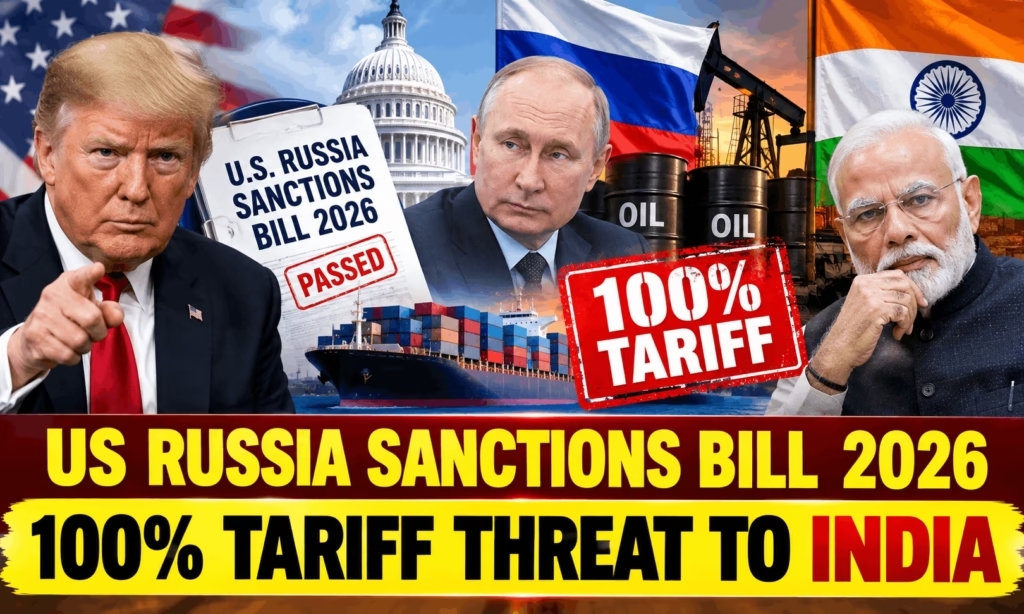
US Russia sanctions bill 100 percent tariff on India: Washington DC, September 16: The US House of Representatives has moved a sweeping Russia sanctions package to a final floor vote this week, and the legislation carries a provision that could hand President Donald Trump the authority to slap a 100% tariff on India over its continued purchase of Russian crude oil. The bill, known as the Lindsey O. Graham Sanctioning Russia and Iran Act of 2026, cleared the Senate by an overwhelming 86-11 margin last month and has now been advanced by the House Rules Committee for a vote that lawmakers and trade watchers on both sides of the Atlantic are calling one of the most consequential foreign policy votes of the year. If it clears the House and is signed into law, it would mark the second major tariff shock for Indian exporters within thirteen months, after the 50% tariff regime that took effect in 2025. We’ll be updating this article monthly as the bill moves through Congress and, if enacted, as the White House decides whether to actually invoke the new tariff authority.
For India, the timing could hardly be more sensitive. New Delhi has spent the past year trying to negotiate a bilateral trade agreement with Washington while simultaneously defending its right to buy discounted Russian crude to keep domestic fuel prices in check. An amendment pushed by Democratic Congressman Steny Hoyer had sought to explicitly name India, China, Turkiye, Azerbaijan, Hungary, Slovakia, the UAE, Singapore, Kazakhstan and Kyrgyzstan as countries automatically eligible for the tariff once the law takes effect. That amendment was rejected 3-7 by the House Rules Committee on September 14, meaning the final bill text does not single out India by name. Instead, the underlying Senate language covers any country that ranks among the five largest importers of Russian-origin crude oil or natural gas, a group that currently includes both India and China. This distinction matters enormously for how the tariff would actually be applied, and it is explained in detail below.
Key Highlights: US Russia Sanctions Bill and the India Tariff Threat
| Detail | Information |
|---|---|
| Bill name | Lindsey O. Graham Sanctioning Russia and Iran Act of 2026 |
| Bill numbers | S. 5025 (Senate) and H.R. 5334 (House) |
| Senate vote | Passed 86-11 on August 7, 2026 |
| House Rules Committee | Advanced the bill on September 14-15, 2026 |
| House floor vote | Scheduled for the week of September 15-17, 2026 |
| Maximum secondary tariff | Up to 100% on top buyers of Russian oil and gas |
| Direct tariff on Russian goods | Up to 500% ad valorem |
| Countries in scope | Five largest importers of Russian crude or gas by volume, which currently include India and China |
| Hoyer amendment naming India | Rejected 3-7 by House Rules Committee |
| Existing US tariff on India | 50% (25% baseline plus 25% Russia-linked penalty since August 2025) |
| Sponsor | Originally Sen. Lindsey Graham (R-SC), continued by Sen. Richard Blumenthal (D-CT) after Graham’s death |
| Next step if House passes | Returns to Senate for concurrence, then to President Trump for signature |
How We Got Here?
The story of this bill stretches back to April 2025, when Senator Lindsey Graham and Senator Richard Blumenthal first introduced legislation aimed at squeezing Russia’s war economy by targeting the countries that buy its oil. The original draft proposed a punishing 500% tariff on any nation purchasing Russian energy, a figure so extreme that even its authors described it as a maximum ceiling meant to force negotiation rather than a number expected to be used in full. The Sanctioning Russia Act of 2025 was designed to impose both primary and secondary sanctions on Russia and on countries buying Russian oil, gas, uranium and related products, with Graham noting that China and India together account for roughly 70% of Russian oil and gas exports.
Graham passed away suddenly on July 11, 2026, shortly after returning from a visit to Ukraine. Colleagues renamed the bill in his honor and revised it on July 14, 2026, adding new Iran-related provisions requested by President Trump. The Senate then took up the renamed Lindsey O. Graham Sanctioning Russia and Iran Act of 2026 and passed it on August 7, 2026 by an 86-11 vote. Senator Blumenthal, who had worked closely with Graham on the bill before his death, said afterward that Graham would be proud of what the Senate had accomplished.
From there, the bill sat with the House through most of August while lawmakers were away on recess. Because House members are expected to spend most of the rest of September and October campaigning in their home districts ahead of the midterms, this week’s vote is widely seen as the last realistic window for the House to act on the measure this year.
Medicaid Work Requirements 2026: New Rule Rollout, State Start Dates and Who Is Exempt
ABLE Account Eligibility 2026: Who Qualifies Now, New Age Limit and Calculator
What the Bill Actually Says About Tariffs
This is where a lot of confusion has crept into headlines, so it is worth breaking down precisely what the legislation does and does not do.
The Senate-passed text does not mention India, China or any other country by name in its tariff section. Instead, the Senate version refers generally to the five largest importers of Russian oil and gas by volume. Section 113 of the bill covers countries that continue making new purchases of Russian-origin crude oil or natural gas and rank among the five largest importers of such energy by volume during the preceding twelve months, along with the top five countries identified as facilitating Russian sanctions evasion.
Crucially, the bill does not automatically trigger a 100% tariff the moment it becomes law. It gives the US Trade Representative discretion to set tariff rates anywhere between above zero and 100%, depending on whether a covered country is taking meaningful steps to increase, reduce, or stop its purchases of Russian oil or gas. In other words, the tariff rate is a sliding scale controlled by the executive branch, not a fixed penalty written into the statute.
Separately, an amendment offered by Congressman Steny Hoyer and Congresswoman Marcy Kaptur would have gone further by naming ten specific countries as initially eligible for the secondary tariff the day the bill becomes law. That list included India, China, Turkiye, Azerbaijan, Hungary, Slovakia, the UAE, Singapore, Kazakhstan and Kyrgyzstan. The House Rules Committee rejected that amendment by a 3-7 vote on September 14, 2026, and a separate amendment that would have stripped out the broad secondary tariff provision entirely was also defeated 3-7.
The amendment as debated would not by itself have imposed a 100% tariff on India. It would only have identified India as a country eligible for such duties if the legislation passes and the President later chooses to exercise the authority the bill provides. That eligibility versus automatic imposition distinction is the single most important nuance in this entire story.
The bill also carries a much steeper direct penalty aimed squarely at Moscow. Beyond the secondary tariffs on buyer nations, the legislation would raise the duty rate on all goods imported directly from Russia into the United States to as much as 500% ad valorem. The House Rules Committee version also allows Trump to raise the tariff rate to 500% on Russian-origin goods and on countries that knowingly trade in Russian-origin uranium and petroleum products, in addition to the broader sanctions package targeting Vladimir Putin and Russian financial institutions.
Countries That Could Be Affected
| Country | Why it appears in the debate |
|---|---|
| India | Among the top buyers of Russian seaborne crude oil |
| China | Largest single buyer of Russian crude and gas |
| Turkiye | Significant importer of Russian energy and refined products |
| Azerbaijan | Named in the rejected Hoyer amendment |
| Hungary | European Union member still importing Russian energy |
| Slovak Republic | European Union member still importing Russian energy |
| United Arab Emirates | Named as a possible sanctions-evasion facilitator |
| Singapore | Named as a possible sanctions-evasion facilitator |
| Kazakhstan | Named in the rejected Hoyer amendment |
| Kyrgyz Republic | Named as a possible sanctions-evasion facilitator |
Why India Is Especially Exposed
India’s position in this debate is shaped by three years of steadily rising Russian oil purchases. India is currently the largest single importer of Russian crude, sourcing roughly 40% of its oil supply through Russian tankers, a shift that began after Russia’s oil exports to Europe collapsed following the 2022 invasion of Ukraine and Moscow began offering steep discounts to Indian and Chinese refiners.
That dependence has already come at a cost. In August 2025, the White House imposed an additional 25% tariff on Indian imports on top of an existing 25% baseline rate, bringing the total tariff on Indian goods entering the United States to 50%, explicitly citing India’s continued purchases of Russian oil as the justification. Trump had warned before that increase that India was, in his words, fueling the war machine, and said he was not going to be happy if the purchases continued.
Despite the pressure, Indian refiners did not immediately scale back. Reports at the time indicated that Indian refiners were expected to raise their Russian oil purchases by 150,000 to 300,000 barrels per day in the following month, an increase of 10 to 20% from the prior month. More recently, the economics have shifted somewhat. India’s Russian oil imports have been trending lower as state refiners paused purchases over shrinking discounts, and trade data shows the price gap between Russian Urals crude and international benchmark Brent has narrowed to around $2.50 a barrel, compared with a $20 to $25 discount when the war began. India still imports more than 85% of its total oil requirement to feed a refining capacity of 5.2 million barrels per day, and officials familiar with the matter say New Delhi is unlikely to abandon Russian crude entirely because of the energy security calculus involved.
The Indian government has repeatedly stressed that its energy purchasing decisions are driven by market conditions rather than politics. Ministry of External Affairs spokesperson Randhir Jaiswal told reporters the government is closely following developments on the proposed legislation and that India’s position on energy sourcing remains guided by the evolving dynamics of the global market and the need to secure affordable energy for the country’s 1.4 billion people. On the trade deal front, the MEA has also pushed back on remarks attributed to US Commerce Secretary Howard Lutnick suggesting a bilateral trade agreement stalled because Prime Minister Narendra Modi did not personally call President Trump, calling that characterization inaccurate and noting the two leaders have spoken by phone eight times so far this year.
SNAP Benefits October 2026 Increase: New Amounts, Eligibility and Calculator
PROMISE Act Social Security Deadline: What the September 17 Trigger Actually Means for Your Benefits
Timeline of Key Dates
| Date | Development |
|---|---|
| April 1, 2025 | Original Sanctioning Russia Act introduced in the Senate as S. 1241 |
| August 6, 2025 | White House announces additional 25% tariff on India, raising total to 50% |
| August 27, 2025 | Higher India tariff rate takes effect |
| July 11, 2026 | Senator Lindsey Graham passes away |
| July 14, 2026 | Bill revised, renamed in Graham’s honor, Iran provisions added |
| July 16, 2026 | Revised Senate bill formally introduced as S. 5025 |
| August 7, 2026 | Senate passes bill 86-11 |
| August 10, 2026 | Companion House bill H.R. 10076 introduced |
| September 11, 2026 | House Rules Committee schedules consideration |
| September 14, 2026 | Rules Committee advances bill, rejects amendments naming India and rejects amendment stripping tariff authority |
| September 15-17, 2026 | Full House floor vote expected |
| After House passage | Bill returns to Senate for concurrence on any changes, then to President for signature |
What Happens Next
Passage in the House is not guaranteed simply because the Senate vote was so lopsided. Several senior Democratic lawmakers have raised concerns that the bill dramatically expands presidential tariff authority and could ultimately be used against long-standing US allies rather than only against Russia’s adversarial partners. Representatives Gregory Meeks, Richard Neal and Don Beyer issued a joint statement arguing that the President already has ample authority to sanction those funding Russia’s war effort and renewed their call for him to use existing powers rather than expanding new ones.
If the House passes the bill in its current form, and if the House version differs from what the Senate approved in August, the legislation would need to go back to the Senate for a final concurrence vote before heading to President Trump’s desk. Once signed, the tariff authority would not activate automatically. The US Trade Representative would still need to determine, country by country, whether the criteria are met and what rate within the 0 to 100% range to apply, factoring in whether that country is actively reducing its Russian energy purchases.
Processing Timeline: How Long Until Any Tariff Could Actually Apply
Even in the fastest-moving scenario, several steps stand between this week’s House vote and any real tariff hitting Indian exports.
- House floor passage this week, if it happens.
- Reconciliation with the Senate text if the two chambers passed different versions.
- Presidential signature, which the White House has signaled openness to given Trump’s earlier public support for the concept.
- A determination period during which the US Trade Representative reviews import data to confirm which countries meet the five-largest-importer threshold.
- A formal notice or proclamation setting the actual tariff percentage for each affected country, which the bill allows to be adjusted based on behavior.
Trade analysts following the bill note that this process could realistically take weeks to months after enactment, giving India a window to continue diplomatic engagement, adjust import volumes, or seek a waiver.
Impact on Indian Trade and Industry
A tariff in the 50 to 100% range on top of existing duties would land hardest on India’s labor-intensive export sectors that rely heavily on the US market, including textiles, gems and jewellery, leather goods, shrimp and seafood, and engineering goods. Exporters in these categories have already reported order cancellations and shrinking margins since the 50% tariff took effect in 2025. A jump toward 100% would make many of these categories commercially unviable for American buyers, potentially pushing sourcing toward competitors such as Vietnam, Bangladesh and Indonesia that face lower US tariff rates.
At the same time, energy economists point out that India’s overall oil import bill benefits from Russian discounts, and a sudden halt could push global crude prices higher for everyone, including the United States, if Indian and Chinese demand shifted abruptly back toward Gulf and West African suppliers.
2027 Social Security Benefits Changes: COLA Increase, Possible Cuts, and New Bills
Stimulus Check 2026: Fact-Checking Every Viral Payment Claim (Tracker)
Official Resources and Where to Track Updates
| Resource | What it provides | Official link |
|---|---|---|
| US Congress bill tracker (H.R. 5334) | Full bill text, amendments, vote records | congress.gov/bill/119th-congress/house-bill/5334 |
| US Congress bill tracker (S. 5025) | Senate version, sponsor details, status | congress.gov/bill/119th-congress/senate-bill/5025 |
| GovTrack bill summary | Plain-language tracking and prognosis | govtrack.us/congress/bills/119/hr5334 |
| Office of the US Trade Representative | Tariff notices and proclamations once issued | ustr.gov |
| The White House | Executive orders and official statements | whitehouse.gov |
| Ministry of External Affairs, Government of India | India’s official statements on the bill | mea.gov.in |
| Ministry of Commerce and Industry, Government of India | Trade policy response and exporter advisories | commerce.gov.in |
| Directorate General of Foreign Trade | Export guidance for Indian businesses | dgft.gov.in |
Conclusion
The Russia sanctions bill making its way through the House this week is one of the most closely watched pieces of legislation in Washington this year, and its potential to authorize a 100% tariff on India has made it front-page news in New Delhi as much as in Washington. What is clear right now is that the Senate has already passed the measure by a wide bipartisan margin, and the House is expected to vote within days. What remains uncertain is whether India will actually be named or targeted once the President has this authority in hand, since the law as written gives the administration discretion over both which countries qualify and what rate to apply. For Indian exporters, policymakers and everyday consumers who could feel the ripple effects through fuel prices or trade disruptions, the coming weeks of Senate concurrence, presidential action and USTR rulemaking will determine whether this becomes another tariff shock or remains a diplomatic pressure tool that is never fully activated. This article will be updated monthly as the bill’s status, any presidential proclamation, and India’s response develop further.
FAQs
What is the Lindsey O. Graham Sanctioning Russia and Iran Act of 2026?
It is a bipartisan bill that imposes sanctions on Russian leadership, its energy sector and vessels involved in evading existing sanctions, while also giving the US President authority to impose tariffs of up to 100% on the largest buyers of Russian oil and gas, and up to 500% on goods imported directly from Russia.
Has the US actually imposed a 100% tariff on India yet?
No. As of this week, the bill has passed the Senate and is going through a House vote, but even after it becomes law the tariff rate on any specific country, including India, would be set later by the US Trade Representative based on that country’s oil and gas purchasing behavior.
Why is India specifically mentioned in news about this bill?
India is currently the largest single importer of Russian seaborne crude oil, which places it among the group of countries the bill’s secondary tariff provision targets. A separate amendment that would have named India directly was rejected by the House Rules Committee on September 14, 2026.
Does India already face a US tariff over Russian oil purchases?
Yes. In August 2025 the United States raised tariffs on Indian goods to a combined 50%, made up of a 25% baseline tariff plus an additional 25% penalty tied to India’s continued Russian oil imports.
What products from India would be hit hardest if a higher tariff is applied?
Export-heavy, labor-intensive sectors such as textiles, garments, gems and jewellery, leather goods, seafood and engineering goods are considered most vulnerable, since they rely heavily on price-sensitive American buyers.
Will India stop buying Russian oil to avoid the tariff?
Indian officials have consistently said energy sourcing decisions are guided by market dynamics and the country’s energy security needs rather than external pressure. Import volumes have fluctuated based on discount levels rather than political pressure alone.
When will the House vote on the bill?
The House Rules Committee advanced the bill on September 14 and 15, 2026, and a full floor vote was expected during the week of September 15 to 17, 2026.
What happens after the House votes?
If the House passes a version that differs from the Senate’s August 7, 2026 text, the bill goes back to the Senate for a concurrence vote before it can be sent to President Trump for his signature.
Can President Trump choose not to use this tariff authority even if the bill becomes law?
Yes. The legislation grants discretionary authority rather than mandating an automatic tariff, meaning the President and the US Trade Representative can decide whether, when and at what rate to apply the tariff to any qualifying country.
Where can I check the official status of this bill?
The most reliable sources are the official congress.gov bill tracker pages for H.R. 5334 and S. 5025, along with statements from the Office of the US Trade Representative and India’s Ministry of External Affairs.
Trump $5000 Dividend Check: Latest Update on Cost, Eligibility and Payment Date