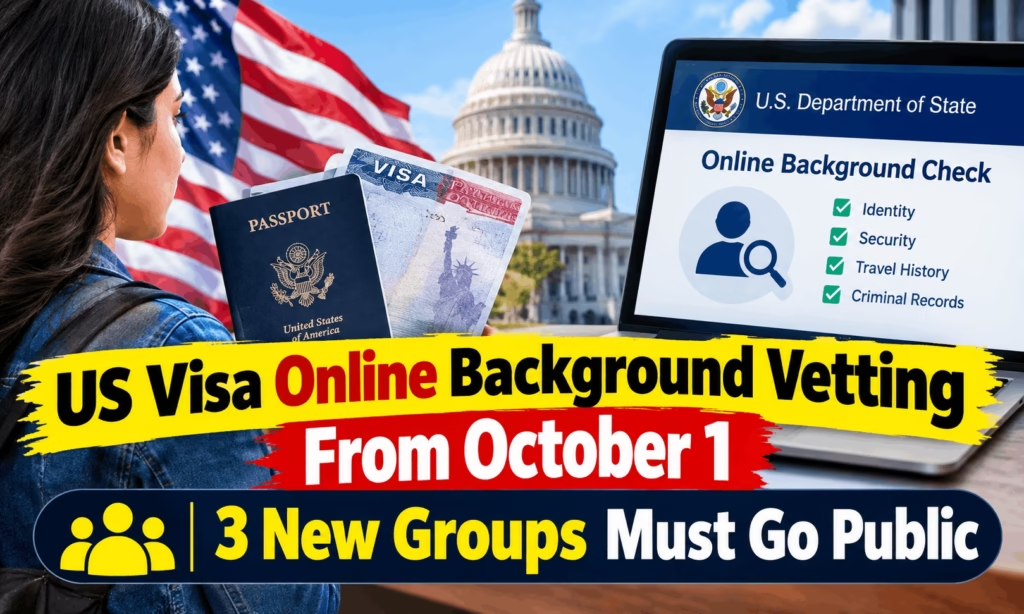
US Visa Online Background Vetting From October 1: The US Department of State announced on September 18, 2026 that it will broaden its online presence review from October 1, 2026 to cover applicants for I (foreign media), TN (USMCA professionals) and TD (USMCA dependents) visas. US visa online background vetting now reaches journalists, Canadian and Mexican professionals and their families. Those applicants are being told to set the privacy settings on every social media profile to public or open. The change is a new step in the visa process for people who have mostly moved through it without this kind of scrutiny.
The rule is short, but its effects are wide. A reporter heading to the US for an assignment, an engineer moving under USMCA rules, or a spouse joining a TN worker may now need a full review of their online history before an interview. Officials say the goal is to spot public safety or national security risks before entry is granted. Lawyers warn about interview delays and more 221(g) notices. This article covers who is affected, what to do before October 1, and where to check official information. We’ll be updating this article monthly.
US Visa Online Background Vetting Key Dates and Highlights
| Detail | Latest information |
|---|---|
| Announcement date | September 18, 2026 |
| Effective date | October 1, 2026 |
| New visa groups | I (foreign media), TN (USMCA professionals), TD (TN dependents) |
| Main instruction | Set all social media profiles to public or open |
| Issuing agency | US Department of State |
| Earlier expansions | June 2025 (F, M, J), December 15, 2025 (H-1B, H-4), March 30, 2026 (A-3, C-3 domestic workers, G-5, H-3, K, Q, R, S, T, U and others) |
| Related news | H-1B $100,000 employer fee reported as extended to September 2027 |
Medicare and ACA Open Enrollment 2027 Dates: Full Calendar, Deadlines and What’s Changing
Medicare 2027 Part D Premium: What’s Confirmed, What’s Still Coming and How Much You Could Pay
Social Security Payroll Tax Rate 2027: How Much Could It Rise?
What Is Changing From October 1?
Beginning October 1, consular officers will apply the online presence review to three more nonimmigrant visa classes. The earlier round on March 30, 2026 added A-3, C-3 domestic workers, G-5, H-3, K-1, K-2, K-3, Q, R-1, R-2, S, T and U, on top of the H-1B and student and exchange categories already covered. The three new groups make the program one of the widest digital screening efforts in modern consular practice.
The practical instruction has not changed. Applicants should not hide, delete or lock down accounts. Officers can only review what they can see, so a private profile may invite questions. Some consulates continue to process visas regardless of privacy settings, but employers and applicants should watch for 221(g) notices tied to social media reviews.
Who Is Covered: I, TN and TD Visa Applicants Explained
I visa: foreign media representatives
I visas are for foreign journalists, reporters and film crews who enter the US for news gathering or media work on behalf of overseas organizations. For this group the change carries more weight than for most. Journalists have public profiles by profession, but they also post opinions, share sources’ work and comment on politics in ways that can look sensitive out of context. A newsroom that sends staff to the US should ask each reporter to audit their accounts before applying.
TN visa: USMCA professionals
TN visas are for qualified Canadian and Mexican citizens who perform specialized professional services under the USMCA. Canadians usually apply for TN status at a port of entry and do not need a visa stamp, so the vetting rule is most likely to affect Mexican applicants who go through a US consulate, and any Canadian who applies through a consular route. Check the embassy pages listed below for how your own case is handled before you assume the rule does or does not apply to you.
TD visa: spouses and children of TN workers
TD visas are for spouses and unmarried minor children who accompany TN holders. Families should remember that dependents are covered too. A parent may check their own profile carefully and forget that a teenager’s public account will also be reviewed. Set aside time for every family member.
Visa Categories Already Under Online Presence Review
The State Department list before October 1 is long. It includes A-3, C-3 domestic workers and G-5; students in F-1, M-1, F-2 and M-2; temporary workers in H-1B and H-3 and their H-4 dependents; exchange visitors in J-1 and J-2; fiancé(e)s and dependents in K-1, K-2 and K-3; Q cultural exchange; R-1 and R-2 religious workers; and S, T and U.
| Group | Visa classes | Status from October 1, 2026 |
|---|---|---|
| Students | F-1, M-1, F-2, M-2 | Already covered |
| Exchange visitors | J-1, J-2 | Already covered |
| Skilled workers | H-1B, H-3, H-4 | Already covered |
| Fiancé(e)s | K-1, K-2, K-3 | Already covered |
| Cultural and religious | Q, R-1, R-2 | Already covered |
| Domestic and official | A-3, C-3, G-5 | Already covered |
| Protected witnesses and victims | S, T, U | Already covered |
| Media | I | New |
| USMCA professionals | TN | New |
| USMCA dependents | TD | New |
How the Rule Reached This Point: Background
The program started with students. Under guidance that applied from June 18, 2025 to F, M and J applicants, consulates asked people to set profiles to public. The next big step came for skilled workers. The State Department announced that H-1B and H-4 applicants would face the review starting December 15, 2025, and law firms reported rescheduled interviews and delays at consulates, including in India.
The March 2026 expansion brought in the smaller categories. The September 18 announcement is the fourth stage. Each step has followed the same pattern: a short notice, a date about two weeks away, and a public-setting instruction. Applicants should expect further expansions and treat online hygiene as permanent.
What Does Public or Open Actually Mean?
Public means anyone can view your posts, photos, comments and profile details without logging in or being your connection. On LinkedIn, that includes your work history and headline. On Instagram and X, it includes captions, replies and tagged photos. Some platforms have layered settings, so check each one.
Consular officers may review public posts, photos and comments, biographical details such as education and work history, and the groups, pages and accounts a person follows. Because of that, the details in your profile should match your DS-160. If your LinkedIn says you worked at one company until 2024 and your form says 2023, expect a question.
Social Security COLA 2027 Officially Announcement: New Payment Amounts Revealed
Medicare Part D Premium 2027 New Rates Announced, How Much Will You Pay?
SNAP Payment Dates October 2026: Full EBT Deposit Schedule by State
What Officers Are Reported to Look For
Universities and lawyers have described the concerns in similar terms. Officers may look for language that suggests hostile attitudes toward the US, links to or endorsement of groups the US considers terrorist organizations, signs of unlawful activity, and threatening or harassing posts. The official announcement stresses that every visa decision is treated as a national security decision.
None of this means an ordinary opinion will sink an application. It does mean that sarcasm, old jokes and reposted content can be read literally by a stranger. Read your feed the way a stranger would.
How to Apply for I, TN and TD Visas After October 1
The core process stays the same, with one added preparation step. Here is a plain sequence.
- Audit your accounts. List every platform you have used in the past five years, since the DS-160 asks for social media identifiers. Include professional networks.
- Set profiles to public. Do this before you submit the form, not the night before the interview.
- Complete the DS-160 at the official site. Use exactly the same names, dates and job titles you use online.
- Pay the visa application fee through the official process and book your interview through the embassy’s scheduling system. Keep the confirmation page.
- Prepare supporting documents. For TN and TD cases that means the job offer, proof of professional credentials and family relationship papers. Media applicants should carry their employer’s assignment letter.
- Attend the interview and answer questions about your profiles plainly and truthfully.
Do not delete posts or accounts in a rush. Removing content after you have listed the account can look like concealment. If something is inaccurate or outdated, correct it and keep a note of what you changed.
Processing Time for I, TN and TD Visas
The State Department has not published a fixed processing time for the new online presence review. Wait times depend on the consulate, the season and whether your case needs extra checks. Three patterns have been reported by law firms across the categories already covered: longer waits for appointment slots, rescheduled interviews, and 221(g) notices linked to social media reviews.
A 221(g) notice means the officer needs more information or time before deciding. It is not a denial. Many applicants are asked to submit documents and wait. Plan for delays by applying earlier than you think you need to, especially for a fixed project start date or assignment. Check the wait-time tool on the official travel site for your embassy, since it changes often.
Payment Schedule: Visa Fees and When to Pay
Visa fees are paid in advance and vary by class, so confirm the current figure on the official fee page before you pay. In general, the sequence is as follows.
| Step | When it happens | What to keep |
|---|---|---|
| DS-160 submission | First, before scheduling | Confirmation barcode page |
| Application fee payment | Before or during appointment booking, depending on the embassy | Payment receipt |
| Interview | On the appointment date | Passport, receipt, confirmation |
| Any reciprocity or issuance charges | After approval, in some nationalities | Written notice from the embassy |
Only pay through the official channels shown on travel.state.gov and your embassy site. Scam payment pages copy the look of official ones. Fees are generally not refundable if the vetting slows or denies your case, so pay only when your documents are ready.
Impact on Journalists and Media Organizations
Press groups have long raised concerns about surveillance and chilling effects on reporting. The new rule means a reporter’s public commentary can now be read by a consular officer. Editors should prepare a short guide: which accounts are personal and which are professional, what to keep public, and what to do if asked about a past post.
Reporters should also know that being public is an instruction, not a content test. A profile full of accurate professional work is a strength. Newsrooms may also want legal advice for staff with sensitive coverage histories, especially those who have reported on conflict or politics.
Replace Social Security Card Online for Free: Who Qualifies, Steps, Limits and How Long It Takes
BC PWD Payment September 23: New Deposit Amount And Dates
Social Security COLA and Medicare: How Much Will You Really Get?
Impact on Canadian and Mexican Professionals and Employers
TN status is a major route for engineers, accountants, scientists and other professionals who work in the US under a treaty. Employers who use TN staff should tell them about the change now. HR teams can build a short checklist so that no one is surprised at an interview.
For companies that already sponsor H-1B workers, the pattern is familiar. Employers have been warned to expect more denials and delays since the H-1B and H-4 review began. There is also policy news beyond social media. Reports say the administration has extended the $100,000 fee on new H-1B employer petitions until September 2027 and tightened job-replacement rules. Separately, a federal court has postponed the effective date of a final rule that would limit the duration of status for F, J and I nonimmigrants. Both items affect planning even though they are separate from the vetting rule.
Common Mistakes to Avoid Before Your Interview
Applicants tend to get into trouble in a few predictable ways. The first is leaving accounts off the DS-160. Everything you list can be checked, and an omission looks worse than a mild post. The second is mismatched details, such as a job title that differs between the form, the resume and the profile. The third is last-minute clean-up that removes large amounts of content. The fourth is treating a private setting as a shield. The instruction is to make profiles public, and a locked account can trigger extra review.
A fifth mistake is ignoring family accounts. TD applicants are minors in many cases, and their profiles count. Finally, do not rely on social media forums for legal advice. Rules differ by consulate and by case, so speak to an immigration attorney if your history is complicated.
Official Resources and Links
| Resource | Purpose | Link |
|---|---|---|
| State Department announcement on expanded screening and vetting | Official notice and category list | travel.state.gov/content/travel/en/News/visas-news/announcement-of-expanded-screening-and-vetting-for-visa-applicants.html |
| Travel.State.Gov | Visa types, fees, wait times, scheduling | travel.state.gov |
| DS-160 online application | Fill in, save and submit the visa form | ceac.state.gov/genniv |
| CEAC status check | Check your application status | ceac.state.gov/ceacstattracker/status.aspx |
| US Embassy Canada | Local guidance for Canadian applicants | ca.usembassy.gov |
| US Embassy Mexico | Local guidance for Mexican applicants | mx.usembassy.gov |
| US Customs and Border Protection | Port of entry rules for TN status | cbp.gov |
Registration and login are handled inside the DS-160 and embassy scheduling portals linked from travel.state.gov. Use links from that site rather than search advertisements.
FAQs
When does the new US visa online background vetting start?
It starts on October 1, 2026, after the State Department’s announcement on September 18, 2026.
Which visa categories are added to online presence review?
I visas for foreign media, TN visas for USMCA professionals, and TD visas for their spouses and children.
Do I have to make my social media public?
Applicants in these categories are instructed to set profiles to public or open so officers can review them.
Can I delete my accounts instead?
Deleting or hiding accounts is not recommended. Accounts you listed on your form can still be checked, and sudden removal may raise questions.
Does this apply to Canadians who apply for TN status at the border?
The announcement concerns visa applicants who go through consular vetting. Canadians who apply at a port of entry should check official CBP and embassy guidance for how the rule applies to them.
What is a 221(g) notice?
It is a notice that a consular officer needs more information or time before a decision. It is not a refusal.
Will processing take longer?
There is no official figure. Law firms report longer waits and reschedules in categories already under review, so build in extra time.
What is online presence review for US visas?
It is a screening step where consular officers look at an applicant’s public social media and online information as part of the visa decision.
Which visas require public social media profiles?
Students, exchange visitors, H-1B and H-4 applicants, K visa applicants and several smaller categories already do, and I, TN and TD are added from October 1.
Can a US visa be denied because of social media?
Officers can consider online content when deciding whether an applicant is eligible. Posts that suggest threats, support for terrorism or unlawful plans are the stated concerns.
How far back do consulates look at social media?
The DS-160 asks for identifiers used over the past five years, so review that period.
Is a TN visa different from TN status?
For Canadians, TN status is usually granted at the border without a visa stamp. Mexicans apply for a TN visa at a consulate first.
What should journalists do before applying for an I visa?
Audit all accounts, keep profiles public, match employment details to the form, and carry an assignment letter from the employer.
Conclusion
US visa online background vetting is now part of the path for journalists, USMCA professionals and their families. The date is October 1, 2026, the instruction is to make profiles public, and the wider trend points toward more screening, not less. The practical response is calm preparation: audit your accounts, match them to your DS-160, apply early, pay only through official channels and keep records of every step. Applicants with complex histories should get advice from a qualified immigration lawyer. Rules can change on short notice, so check travel.state.gov and your embassy website before you file.
Note: I did not use horizontal lines inside the article itself, so remove the separators above when you paste it. The word count is close to 3,000 with the tables included. If you want it longer, I can extend the sections on journalists, TN employers and the interview checklist. The exact fee amounts, TN border rules for Canadians and current wait times should be checked on official pages just before you publish, because I could not confirm them from the sources I found.
Social Security Changes September 2026: SSA Announces Major Update for Retirees and Beneficiaries