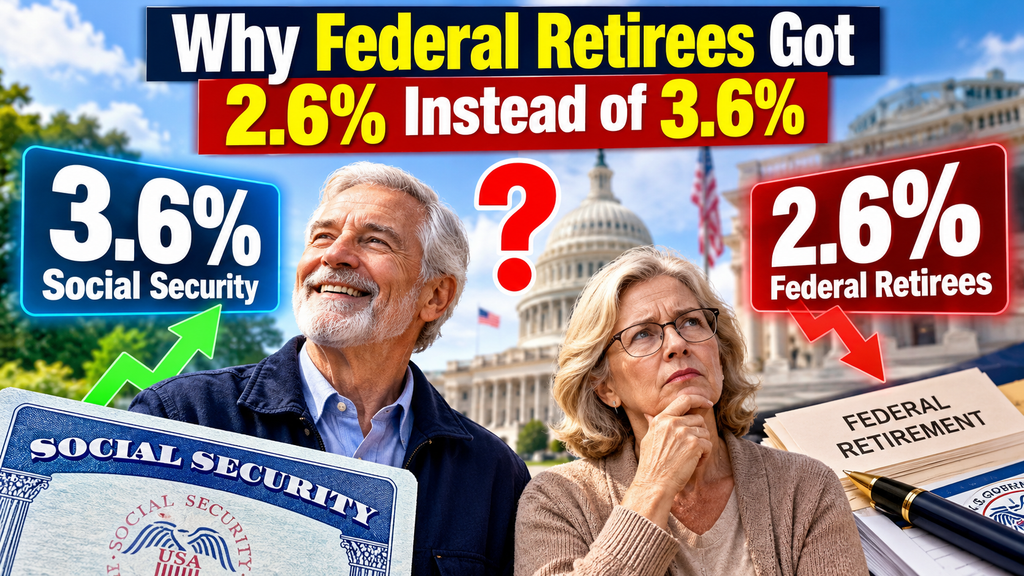
Why Federal Retirees Got 2.6% Instead of 3.6%: If you opened the news on October 14 and saw that Social Security benefits were going up 3.6% next year, you probably felt a small lift. After a spring inflation spike and a gas pump that seemed to climb every other week, a 3.6% cost-of-living adjustment is the largest in four years. Then, if you happen to be a federal retiree under the Federal Employees Retirement System, you scrolled a little further and saw a different number attached to your name: 2.6%.
That isn’t a typo, and it isn’t a mistake at the Office of Personnel Management. It’s the result of a formula that Congress wrote into law decades ago, one that retired federal employees have nicknamed the “diet COLA.” It shows up when inflation runs hot, and this year it did. Here’s what happened, who it affects, what it costs, and whether anything is likely to change.
Highlight
The Social Security Administration announced on October 14, 2026 that benefits for roughly 76 million Americans would rise 3.6% beginning in January. That figure comes from the Consumer Price Index for Urban Wage Earners and Clerical Workers, known as CPI-W, which the Bureau of Labor Statistics publishes every month. SSA compares the average CPI-W for July, August and September of this year to the same three months last year. The difference, rounded to the nearest tenth of a percent, is the COLA.
Retirees under the old Civil Service Retirement System, or CSRS, get that number as is. So do Social Security recipients, military retirees and people receiving VA disability compensation. FERS retirees do not. Under the law that governs their annuities (5 U.S.C. 8462), the COLA is trimmed whenever inflation climbs past 2%:
- If CPI-W rises 2% or less, FERS retirees get the full increase.
- If it rises between 2% and 3%, FERS retirees get a flat 2%.
- If it rises more than 3%, FERS retirees get the CPI-W increase minus one percentage point.
This year the CPI-W increase was 3.6%. Subtract one point and you get 2.6%. That’s the whole mystery. There’s no agency judgment involved, no budget decision made this fall. The calculation was set long ago and it simply ran.
The Congressional Research Service lays out the same math in its explainer on federal annuity COLAs, noting that the third-quarter CPI-W rose 3.6% from 2025 to 2026, so CSRS gets 3.6% and FERS gets 2.6% beginning in January 2027.
How inflation got us to 3.6%
It helps to remember how recently this looked like a different story. The 2026 COLA was 2.8% for Social Security and CSRS, and just 2.0% for FERS, since 2.8% sits in the middle band where the FERS COLA is a flat 2%.
Earlier this year, forecasts for 2027 looked tame. Through the summer, trackers kept landing somewhere around 3.0% to 3.1%, which would have meant a FERS COLA of about 2.0% to 2.1%. Then prices moved. ABC News, citing the Social Security Administration’s announcement and the latest inflation data, tied the jump to a surge in prices after the outbreak of the Iran war in the spring. By August, the CPI-W was running 3.5% above the year before, after a 3.4% reading for July. September pushed things higher still: the Bureau of Labor Statistics reported that gasoline jumped 9.1% in the month and accounted for more than half of the overall monthly increase.
The Senior Citizens League, which publishes a closely watched projection every month, had settled on 3.5% after the August data. AARP’s forecast was 3.6%. When the September report came out on October 14, the final number was 3.6%, and SSA put out its announcement the same day.
For the average Social Security retiree, SSA says that works out to about $75 more per month, taking the average retired-worker benefit from $2,095 to $2,170. The agency also raised the taxable maximum for payroll taxes from $184,500 to $192,300 and lifted the earnings limits for beneficiaries who work before full retirement age. Commissioner Frank Bisignano called it a step toward “greater financial stability” for beneficiaries.
Notice how the gap behaves. In 2026 it was 0.8 points. This year it’s a full point, and it stays at one point for every COLA above 3%, no matter how high inflation goes.
No SSI Payment November 2026? Here’s Why and When You Get Paid
Who gets 2.6%, who gets 3.6%, and who gets nothing
The headline numbers hide a lot of different situations. Federal retirement is not one thing.
CSRS retirees.
These are the folks who were hired before 1984 and never switched systems. They get 3.6%, regardless of age. CSRS Offset retirees, who paid into Social Security for part of their career, also get the full CSRS rate on their annuity.
FERS retirees age 62 and older
They get 2.6%. FERS covers most federal civilians hired since the start of 1984. The adjustment applies only to the basic annuity.
FERS retirees under 62
Most of them get no COLA at all, which is a rule that surprises a lot of people who retire early. Under the law, non-disabled FERS retirees generally don’t see annuity COLAs until the year they reach 62. There are exceptions: disability retirees and survivor annuitants get COLAs regardless of age, and so do certain special-provision retirees such as law enforcement officers, firefighters and air traffic controllers.
The FERS annuity supplement
The temporary payment that bridges the gap until Social Security kicks in for some early retirees doesn’t receive COLAs. It’s not part of the basic annuity.
Anyone also collecting Social Security
This is the part that gets lost in the shuffle. A FERS retiree who also draws Social Security gets the full 3.6% on the Social Security side. The two checks are adjusted separately, so the haircut applies only to the federal annuity.
The new rates take effect December 1, 2026, but annuities are paid after the month ends, so the first higher payment lands in January 2027. OPM will post the official notices and updated amounts; retirees can check their annuity through the OPM online account. Social Security recipients with a my Social Security account can see their notice in late November, and SSA says anyone who hasn’t opened an account needs to do it by November 18 to get the online notice. Everyone else gets a letter in December.
What the one-point gap costs in real dollars
On any given month, the difference is easy to wave off. On a $2,000 FERS annuity, 2.6% is an extra $52 a month. At 3.6%, it would have been $72. That’s $20 a month, $240 a year. On a $3,000 annuity, the FERS bump is about $78 a month compared with $108 under the full COLA, a difference of $30 a month, or $360 a year. These are before-tax numbers, and you’ll still owe federal income tax on a FERS annuity increase.
| Monthly FERS annuity | Increase at 2.6% | Increase at 3.6% | Monthly gap |
|---|---|---|---|
| $2,000 | $52 | $72 | $20 |
| $3,000 | $78 | $108 | $30 |
| $4,000 | $104 | $144 | $40 |
The part that gets people worked up isn’t the first year. It’s the compounding. COLAs build on each other, because each year’s increase raises the base that next year’s increase applies to. Say a retiree has a $36,000 annual annuity and inflation stays at 3.6% for ten straight years. (That’s an assumption for illustration, not a forecast.) A CSRS retiree would end up around $51,300 a year by the tenth year. A FERS retiree getting 2.6% each year would be at about $46,500. That’s a gap of roughly $4,700 a year, and across the decade the FERS retiree would have received nearly $24,000 less in total.
Federal retiree groups make exactly this argument. A small haircut applied year after year during a period of elevated inflation, they say, adds up to thousands of dollars over the course of a retirement. They’re right about the arithmetic. Whether it’s the right policy is a different conversation, and a fair one to have.
Why the diet COLA exists at all
You can’t really make sense of the 1% haircut without understanding what FERS was supposed to be. When Congress created it in 1986, it didn’t build a single pension and call it done. It built a three-part system: a modest federal pension, Social Security, and the Thrift Savings Plan, with a government match. The pension portion is smaller than the old CSRS formula. A typical FERS retiree earns 1% of their high-three average salary for each year of service, or 1.1% if they retire at 62 or later with at least 20 years.
The reasoning was that FERS retirees would have Social Security, which carries a full COLA, and TSP savings that can keep growing, so the pension alone didn’t need to carry all the inflation protection. In that framing, the diet COLA is one piece of a design that cost the government less than CSRS did while spreading retirement income across several sources.
Supporters of the current rules add that the formula isn’t always a penalty. In low-inflation years, when CPI-W is 2% or less, FERS retirees receive the full COLA, same as everyone else. The cap only matters when prices run hotter.
The other side of the argument is practical. Retirees on fixed incomes feel inflation most in places the CPI-W can undercount, like health care and housing. When inflation is high, they say, that’s exactly when a pension needs to keep up. Cutting the adjustment in those years removes the protection at the moment people need it.
Major changes Health insurance, Medicare Part B,
Federal families are looking at several changes at the same time, and some of them pull in the opposite direction.
Health insurance. On September 30, OPM announced that enrollees in the Federal Employees Health Benefits program will pay an average of 10.9% more toward their share of premiums in 2027. Counting the government’s contribution, total FEHB premiums are rising 9.3%, and Postal Service Health Benefits premiums are rising 6.7%. Retirees pay their FEHB premiums out of their annuity, so for many of them the premium increase will take a real bite out of a 2.6% COLA. Open season is coming, and the plan comparison tools should be out in early November. This is the one place where a few minutes of homework can save real money.
Medicare Part B. For federal retirees on Medicare, the Part B premium is normally deducted from the Social Security check. The official 2027 premium and deductible hadn’t been announced when the major federal workforce outlets published their breakdowns of this year’s COLA, and SSA says Medicare information will be posted on the Medicare website. Until that number is final, nobody knows exactly how much of the 3.6% will show up as take-home pay.
Pay for active employees. This one doesn’t affect retirees directly, but it shapes the mood. On August 26, the president sent Congress an alternative pay plan (House Document 119-189) that holds base and locality pay for most civilian employees at 2026 levels, so no across-the-board raise in 2027. The letter does direct OPM to use its authority to raise pay for law enforcement personnel by 3.8%. Congress could change course, but it hasn’t in comparable years, and the plan typically becomes final when OPM issues the pay tables in December. The COLA is separate from all of this. The pay freeze applies to people still working, not to annuitants.
$200 Extra Social Security Payment: When Is It Being Approved, and Who Can Get It?
Is anything likely to change?
There is a bill that would erase the gap. It’s called the Equal COLA Act, introduced in the House as H.R. 491 and in the Senate as S. 624. It would make the FERS COLA match the CSRS formula, meaning the full CPI-W increase every year with no cap and no tiers. The House bill was introduced in January 2025 by the late Rep. Gerry Connolly, and Rep. James Walkinshaw has since taken over as first sponsor. The Senate version came in February 2025 from Sen. Alex Padilla. Congressional records show the House bill with 86 cosponsors as of August, most of them Democrats, with a few Republicans.
Here’s the honest part. Both bills are still sitting in committee. The House version was referred to Oversight and Government Reform, the Senate version to Homeland Security and Governmental Affairs, and neither has been marked up or scheduled for a vote. Versions of the Equal COLA Act have been introduced in every Congress going back at least to 2019, and none has become law. The expense is the obvious obstacle. Paying every FERS retiree the full COLA adds up to a long-term cost the Congressional Budget Office would have to score, and in an environment where Congress is arguing over how to fund almost everything, that’s a hard sell.
So for the January 2027 payments, the reduction stands. The advocacy groups are still pushing, and they now have a clean number to point at: 2.6% against 3.6%, for the same inflation.
What FERS retirees can do right now
You can’t change the formula, but there are a few practical things worth doing before the year ends. Start with the health plan, because that’s where the biggest controllable cost is. Premiums vary a lot between plans, and the difference between a good fit and a poor one can easily exceed the entire dollar value of the COLA. Compare your current plan against the others when open season starts, and look at the actual 2027 rates for your enrollment type instead of going by the average.
Next, check your OPM account in the new year to confirm the new annuity amount and make sure the COLA was applied the way you expect. If you retired recently, or you’re under 62, check the eligibility rules, because proration and age requirements can change what you get. Think about taxes. The COLA is taxable income, and up to 85% of Social Security benefits can be taxed depending on your combined income, so revisit your withholding.
Finally, if the cap bothers you, tell somebody who can act on it. Cosponsor lists are public, and members of Congress do notice mail on retiree issues. FERS retirees got 2.6% instead of 3.6% because that’s what the law says happens when inflation clears 3%. It’s the same rule that gave them 2.0% in 2026, and it’s the rule that will keep applying to future COLAs unless Congress rewrites it. CSRS retirees, Social Security recipients and military retirees got the full 3.6%.
Whether that’s fair depends on how much you lean on the pension, how much you saved in the TSP, and how much of your budget goes to health care. What’s not in dispute is the arithmetic. One point, every year inflation runs above 3%, adds up. If you’re a FERS retiree, take the 2.6%, watch what the Part B premium and your FEHB plan do to it, and keep an eye on the Equal COLA Act. If you’re still working toward retirement, run your own numbers, and remember the pension is only one leg of the stool.