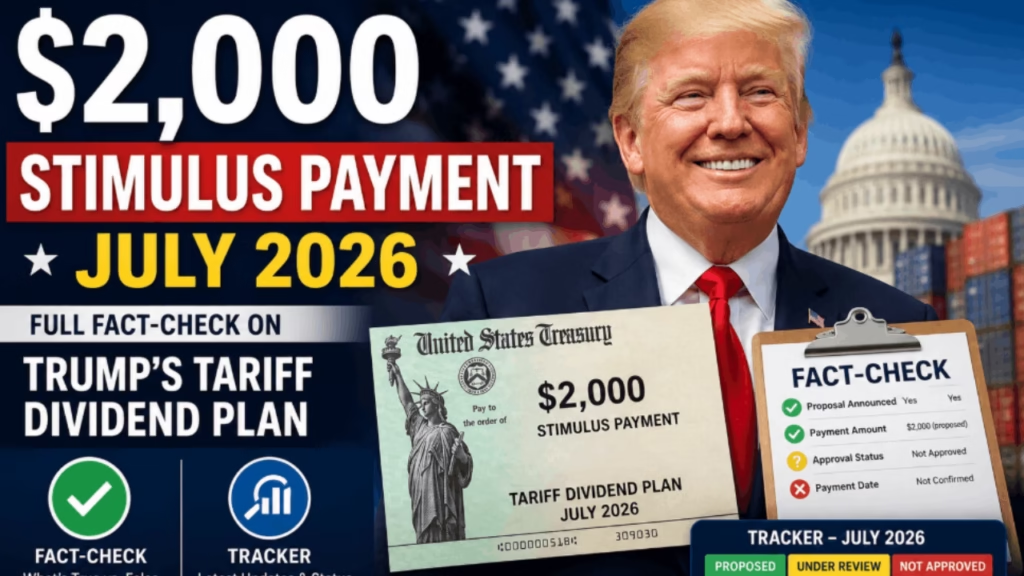
$2000 Stimulus Payment July 2026: If your social media feed, inbox, or text messages have been flooded with claims that a $2,000 stimulus payment is landing in July 2026, you’re seeing one of the most widely circulated financial rumors of the year. Here is the direct, verified answer: as of July 2026, no federal law authorizes a $2,000 stimulus check, no payment schedule has been announced by the IRS or Treasury Department, and no direct deposit of this amount is confirmed. The claim traces back to a real statement from President Trump proposing a “tariff dividend,” but a public proposal is not the same as enacted law, and this fact-check walks through exactly what’s confirmed, what’s still just a proposal, and why the math behind it has run into serious obstacles.
This specific rumor is worth taking seriously precisely because it isn’t pure fabrication it has a real origin point, which is exactly what makes it so effective at spreading and so easy to mistake for confirmed news. Below, we trace the $2,000 stimulus payment claim from its original source through the Supreme Court ruling that upended its funding plan, cover the “direct deposit” variations of this rumor, and explain what would actually need to happen in Congress before any version of this payment could become real.
Is the $2000 Stimulus Payment July 2026 Confirmed?
No. There is currently no federal program authorizing a $2,000 stimulus check for July 2026. No legislation has passed Congress, and no payment schedule has been announced by the Treasury Department or the IRS. The IRS has confirmed that all prior COVID-era Economic Impact Payments the first, second, and third rounds are fully concluded, and there is no fourth round in effect.
Where the $2,000 Stimulus Claim Actually Started
This rumor traces directly to President Trump’s own public statements. In a late-2025 post on Truth Social, he proposed that tariff revenue collected by the federal government should be returned to Americans as a dividend, floating a figure of “at least $2,000 a person.” White House economic adviser Kevin Hassett later said in a December interview that stimulus-style checks “remain a possibility” for 2026, noting that a formal proposal to Congress could follow. Neither of these statements constitutes law. A public proposal and an adviser’s comment about future possibilities are the starting point of a policy conversation not a passed bill, a funded program, or a scheduled payment.
The Supreme Court Ruling That Disrupted the Funding Plan
On February 20, 2026, the Supreme Court struck down the tariffs imposed under the International Emergency Powers Act (IEEPA), ruling them unlawful. This decision directly undercut the funding source behind the proposed tariff dividend, since much of the plan depended on revenue from those exact tariffs. In response, the administration invoked a different legal authority (Section 122 of the Trade Act of 1974) to reimpose a 10% tariff, intended to keep tariff revenue roughly stable for 2026 but that authority is time-limited and doesn’t itself create or fund a consumer payment. The ruling also opened a separate refund process for the businesses and importers who had originally paid the invalidated tariffs, with total refund obligations estimated as high as $175 billion. That refund money goes to importers, not individual households.
Why the $2,000 Figure Doesn’t Add Up Financially
Independent economic analysis has repeatedly flagged a gap between what a nationwide $2,000 payment would cost and what tariff revenue can realistically generate. One widely cited estimate put the cost of such a program between roughly $280 billion and $607 billion depending on eligibility rules, while projected tariff revenue for 2025 and 2026 combined falls well short of that range while policymakers are also counting on tariff revenue to help reduce the federal deficit. Financial analysts tracking the proposal have described the odds of it advancing as very low, citing both this funding shortfall and a lack of sufficient political support in Congress.
“Is a $2,000 Direct Deposit Confirmed?” — Fact-Checking the Direct Deposit Variant
A related wave of posts frames this claim differently, asking whether a “$2,000 direct deposit” is confirmed for 2026. This is the same unconfirmed claim wearing different language. Direct deposit is simply a delivery method the IRS and SSA already use for legitimate payments like tax refunds and Social Security benefits — it is not, on its own, evidence of a new stimulus program. If you’ve received or expect a direct deposit in 2026, it is almost certainly your regular tax refund, Social Security payment, or another already-confirmed benefit — not a new $2,000 stimulus payment.
Real Legislative Proposals Related to This Claim
A small number of actual bills have been introduced in Congress that relate to tariff-driven consumer costs, though none authorize a flat $2,000 payment:
- American Consumer Tariff Rebate Act of 2026 — proposes rebates of roughly $1,020 to $2,040 depending on filing status, funded by an estimated $231.35 billion tied to consumer tariff costs.
- Tariff Refunds for Working Families Act — proposes $1,200 for joint filers earning under $180,000, plus $600 per dependent child.
Both bills have only been introduced — neither has passed a vote in either chamber of Congress, and neither has been signed into law.
What Would Need to Happen for This Payment to Become Real
- A bill authorizing the payment would need to pass a vote in the House of Representatives.
- The same or a reconciled bill would need to pass a vote in the Senate.
- The President would need to sign it into law.
- Congress would need to appropriate funding, and the IRS or Treasury would need to build a distribution mechanism and announce a payment schedule.
As of July 2026, none of the relevant proposals have advanced past the introduction stage.
How to Protect Yourself From $2,000 Stimulus Scams
Because this claim has a genuine origin point, it has proven especially convincing to scammers who repackage it as “confirmed”:
- Verify any payment claim directly on IRS.gov or SSA.gov never through a link in a text message, email, or social media post.
- The IRS and Treasury Department never send unsolicited texts or emails asking you to click a link to “claim” a payment.
- No legitimate government payment requires an upfront fee to be released.
The Real Cost Americans Paid — And Why It Fuels This Rumor
Part of why the $2,000 stimulus payment claim keeps resurfacing is that the underlying grievance is real, even though the proposed fix isn’t confirmed. According to a Senate Joint Economic Committee analysis, U.S. households absorbed an average of roughly $1,725 in tariff-related price increases between February 2025 and January 2026. That real financial pain is exactly what makes a “$2,000 dividend to make up for it” narrative so believable and so shareable even though the payment itself remains unconfirmed.
“Without Congress” — Why That Claim Doesn’t Hold Up Legally
At one point, Trump suggested he could issue the tariff dividend without needing congressional approval. This claim doesn’t match how federal spending law actually works: large-scale direct payments to citizens require an act of Congress, since only Congress holds the constitutional power to appropriate federal funds. A certified financial planner quoted by CNBC described the tariff dividend as “largely aspirational” given the White House’s lack of unilateral authority to issue such payments. This is a separate and additional obstacle on top of the funding shortfall described above.
Real State-Level Rebates vs. the Unconfirmed Federal $2,000 Claim
While no federal $2,000 stimulus check exists, several states have genuinely issued their own rebate or relief programs during 2026, including Pennsylvania, New Jersey, New York, Oregon, Colorado, and California. These are legitimate, state-funded programs with their own eligibility rules entirely separate from, and often confused with, the unconfirmed federal tariff dividend. If you live in one of these states, checking your state’s official revenue department website is worthwhile; assuming a viral national “$2,000 stimulus” post applies to you is not a reliable way to find out.
Full List of $2,000 Stimulus Scam Warning Signs
Because this claim has real origins, it has become an especially effective scam vector. Watch for these signs:
- A text or email claims your $2,000 payment is “ready” — the IRS does not initiate contact this way.
- You’re asked for your Social Security number, bank details, or a fee to “unlock” or “claim” the payment.
- You’re directed to a third-party website instead of IRS.gov or Treasury.gov.
- The message creates artificial urgency, such as “act within 48 hours or forfeit your payment.”
- A social media ad offers to help you “claim” your check for a small processing fee.
If you encounter any of these, don’t click or respond report the message to the IRS directly at phishing@irs.gov.
FAQs
Did Trump actually propose a $2,000 stimulus check?
Yes, he proposed a “tariff dividend” of at least $2,000 per person in a late-2025 social media post. This was a public proposal, not enacted legislation.
How did the Supreme Court ruling affect the $2,000 stimulus plan?
The Court’s February 2026 ruling invalidated the tariffs that were meant to fund the dividend, undercutting the plan’s original financing and triggering a separate refund process for importers, not consumers.
Is a $2,000 direct deposit confirmed for 2026?
No. This is the same unconfirmed stimulus claim described using different wording. Any direct deposit you receive in 2026 is most likely a regular tax refund or existing benefit payment, not a new stimulus check.
Are there any real bills related to this $2,000 claim?
Yes, two related bills — the American Consumer Tariff Rebate Act of 2026 and the Tariff Refunds for Working Families Act — have been introduced in Congress, but neither authorizes a flat $2,000 payment, and neither has passed into law.
How can I tell if a $2,000 stimulus message is a scam?
Treat any unsolicited message urging immediate action to “claim” a $2,000 payment as a scam. Confirm all payment information directly through IRS.gov or SSA.gov before taking any action.
Can Trump issue the $2,000 payment without Congress?
No. Direct federal payments to citizens require an act of Congress, since only Congress has the constitutional authority to appropriate federal funds. The White House cannot authorize this payment unilaterally.
Are any state-level $2,000 rebates real?
Some states, including Pennsylvania, New Jersey, New York, Oregon, Colorado, and California, have issued their own separate rebate or relief programs in 2026. These are legitimate but distinct from the unconfirmed federal $2,000 tariff dividend, and eligibility depends on your state of residence.