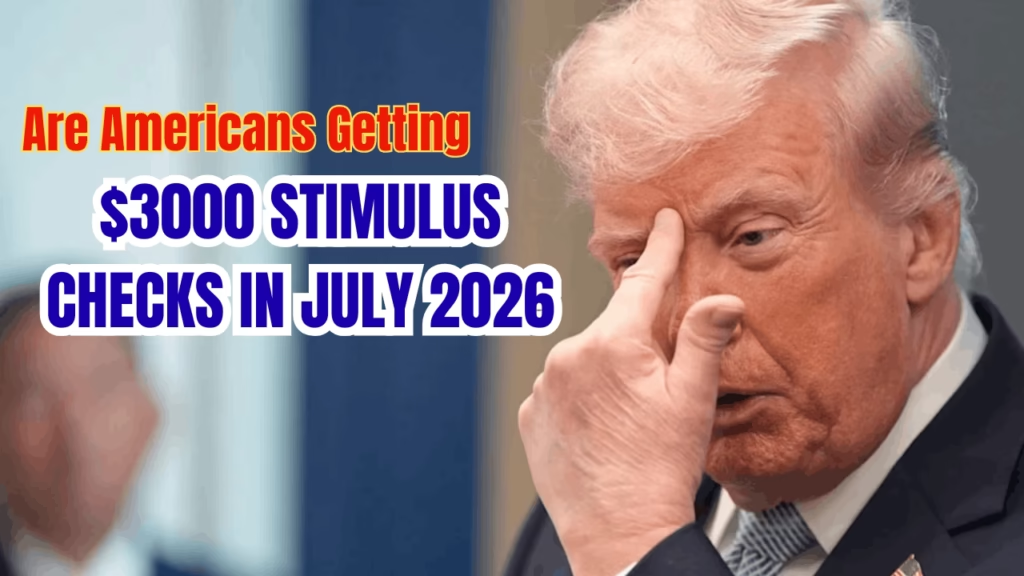
$3000 Stimulus Checks in July 2026: It has been six years since the first round of federal Economic Impact Payments went out during the COVID-19 pandemic, and yet “$3,000 stimulus check” continues trending in search results every single month of 2026. The honest answer for July is straightforward but requires context most headlines skip entirely: no $3,000 stimulus check has been approved, scheduled, or authorized by any branch of the federal government for July 2026. What does exist is a specific piece of proposed legislation that explains exactly where the $3,000 figure comes from, plus several other competing stimulus-style proposals currently sitting in Congress with no final vote, no signed law, and no payment date attached to any of them.
The $3,000 figure traces directly to the “Make Billionaires Pay Their Fair Share Act,” introduced by Senator Bernie Sanders (I-Vt.) and Representative Ro Khanna (D-Calif.), which would establish a 5% annual wealth tax on billionaires and provide an annual $3,000 direct payment to every man, woman, and child in households earning $150,000 or less. This bill has not passed, has not been scheduled for a floor vote, and faces what most political analysts consider insurmountable odds in a Republican-controlled House of Representatives. Below is the complete, verified breakdown of this proposal, the other competing stimulus bills circulating in 2026, and exactly what genuine federal payments if any are actually arriving this July.
Where the $3,000 Figure Actually Comes From
One recent proposal, the “Make Billionaires Pay Their Fair Share Act,” was introduced by Senator Bernie Sanders and Representative Ro Khanna. This legislation would establish a 5% annual wealth tax on the 938 billionaires in the United States and provide an annual $3,000 direct payment to every man, woman, and child in households earning $150,000 or less.
| Bill Detail | Confirmed Information |
|---|---|
| Bill Name | Make Billionaires Pay Their Fair Share Act |
| Sponsors | Sen. Bernie Sanders (I-Vt.) and Rep. Ro Khanna (D-Calif.) |
| Funding Mechanism | 5% annual wealth tax on U.S. billionaires |
| Number of Billionaires Targeted | 938 individuals |
| Proposed Payment | $3,000 annually per person in qualifying households |
| Income Eligibility Threshold | Households earning $150,000 or less |
| Who Counts | Every man, woman, and child in the qualifying household |
| Current Status | Introduced only — no committee vote, no floor vote |
| Likelihood of Passage | Considered very low given Republican House control |
Senator Sanders framed the legislation in a press release, stating: “At a time of unprecedented income and wealth inequality, this legislation demands that the billionaire class in America finally pay their fair share of taxes so that we can create an economy that works for all of us, not just the 1%.” This statement reflects the bill’s political purpose and rationale — but a press release and a bill introduction are not the same as enacted law. There has been no official announcement or legislative action indicating that a stimulus check will be issued under this proposal.
The Competing Stimulus Proposals Currently in Congress
The $3,000 proposal is not circulating in isolation — it is one of at least four distinct stimulus-style bills currently sitting in Congress, none of which have passed. Understanding all of them helps explain why so much confusing, overlapping stimulus content keeps appearing online.
| Bill Name | Sponsor | Introduced | Estimated Payment |
|---|---|---|---|
| Make Billionaires Pay Their Fair Share Act | Sen. Sanders / Rep. Khanna | Recent (2026) | $3,000 per person (households ≤$150K) |
| American Consumer Tariff Rebate Act of 2026 | Rep. Henry Cuellar (D-Texas) | March 9, 2026 | ~$1,020 to $2,040 depending on filing status |
| Tariff Refunds for Working Families Act | Sen. Martin Heinrich (D-N.M.) | March 12, 2026 | $1,200 (joint filers under $180K) + $600/child |
| Trump’s “Tariff Dividend” | Executive proposal (no bill text) | Late 2025 (verbal only) | $2,000 per person (excluding high earners) |
Rep. Henry Cuellar’s American Consumer Tariff Rebate Act of 2026 proposes allocating $231.35 billion an amount estimated by the Congressional Budget Office and the Joint Economic Committee as the cost consumers have borne from tariffs to fund rebate payments for Americans, serving as restitution for consumer costs caused by tariff hikes. None of these four proposals has been combined, reconciled, voted out of committee, or scheduled for floor consideration as of July 2026.
What White House Officials Have Actually Said
Unlike a fringe rumor with no official basis, this topic has genuine traction inside the administration though “traction” does not mean a finalized plan. During a December 21 interview with CBS News’ Face the Nation, White House economic adviser Kevin Hassett said stimulus checks remain a possibility for 2026, stating: “The deficit relative to last year is down by $600 billion and so, in the summer, I wasn’t so sure that there was space for a check like that. But now I’m pretty sure that there is, and so, I would expect that in the new year, the president will bring forth a proposal to Congress to make that happen.”
This is significant because it confirms a sitting White House economic adviser viewed a stimulus payment as fiscally plausible but Hassett’s own language (“would expect… a proposal to Congress”) confirms no actual proposal, bill, or payment mechanism existed at the time of the interview. Hassett also clarified that tariff revenue would be only one potential funding source, and that Congress not the President ultimately decides how federal revenue is spent through the appropriations process.
Why the Supreme Court Ruling Matters to Every Stimulus Proposal
On February 20, 2026, the U.S. Supreme Court struck down Trump’s sweeping tariffs on most countries worldwide as illegal, clearing the way for importers who paid them to seek refunds. This ruling is the single most important legal development affecting every tariff-funded stimulus proposal circulating in 2026, because nearly all of them the $2,000 tariff dividend, the American Consumer Tariff Rebate Act, the Tariff Refunds for Working Families Act depend on tariff revenue as their funding source.
The government had collected more than $130 billion from tariffs by December 2025 and could ultimately be on the hook for refunds totaling $175 billion, according to calculations by the Penn Wharton Budget Model. This means the same pool of tariff revenue that stimulus proposals were counting on as a funding source is now legally obligated to flow back to importers — businesses, not individual consumers substantially undermining the financial foundation for any household stimulus check tied to tariff collections.
A November 2025 analysis from the Tax Foundation estimated a tariff dividend proposal would cost between $279.8 billion and $606.8 billion, depending on how it was structured, while projected tariff revenue for 2026 sat at roughly $207.5 billion far below what would be needed to cover a universal dividend payment even before the Supreme Court ruling reduced the available pool further.
A Note on Trump’s Tax Replacement Claim
During his February 2026 State of the Union address, President Trump stated: “As time goes by, I believe the tariffs paid by foreign countries will, like in the past, substantially replace the modern day system of income tax, taking a great burden off the people that I love.” It’s worth noting clearly: this outcome is considered highly unlikely by tax policy experts, since the federal income tax is established under the 16th Amendment, and the authority to collect and allocate federal revenue rests constitutionally with Congress, not the presidency. No serious legislative proposal exists to replace the income tax system with tariff revenue, and the dollar figures involved are not remotely comparable — tariff revenue in the hundreds of billions cannot replace income tax revenue that exceeds $2 trillion annually.
What Genuinely Concluded: The Last Real Stimulus-Adjacent Payment
For context on what a real, legitimate federal stimulus-style payment actually looked like, it’s worth noting the program has already fully concluded. In 2024, the IRS did send out automatic payments to people who hadn’t claimed the Recovery Rebate Credit on their 2021 returns. Those payments, up to $1,400 per person, were delivered by direct deposit or mail between December 2024 and January 2025. The final opportunity to claim that $1,400 credit was by filing a 2021 tax return by April 15, 2025. That deadline has passed, and no extensions were offered. If you missed this window, there is currently no mechanism to claim it retroactively.
How to Verify Any Future Stimulus Claim Yourself
| Verification Step | Where to Check |
|---|---|
| Check current bill status | Congress.gov — search the bill name directly |
| Check for IRS announcements | IRS.gov/coronavirus/economic-impact-payments |
| Check Treasury announcements | home.treasury.gov |
| Avoid third-party “stimulus tracker” sites | These often repeat outdated or speculative claims without verification |
| Ignore unsolicited texts/emails about “claiming” a payment | Legitimate payments never require pre-payment of a fee |
No $3,000 stimulus check or any other dollar amount has been approved, funded, or scheduled for distribution to Americans in July 2026. The $3,000 figure stems from a single proposed bill (the Make Billionaires Pay Their Fair Share Act) that has not advanced past introduction in Congress, and it exists alongside at least three other competing, equally unenacted stimulus-style proposals. For Americans hoping for genuine relief, the realistic options remain: monitoring official Congress.gov bill tracking for any of the four proposals discussed above, checking state-specific rebate programs that are genuinely active in 2026 (such as those in Colorado, Oregon, New Jersey, and Michigan), and remaining skeptical of any social media claim, text message, or email asserting that a $3,000 payment is “confirmed” or available to “claim” right now.
This article is intended for general informational purposes only and reflects the legislative status of stimulus-related proposals as of July 2026. Congressional bill status changes frequently. Readers should verify current information directly through Congress.gov, IRS.gov, or official Treasury Department communications before making financial decisions based on this information.
FAQs
Is the $3000 direct deposit approved for 2026?
There is no official approval for a $3000 direct deposit. The Internal Revenue Service has not announced any new nationwide payment, and Congress has not passed any such stimulus programme.
Why are people talking about a $3000 payout?
Most viral claims come from:
Misinterpreted tax refunds, Combined advantages like Child Tax Credit or Earned Income Tax Credit, Political proposals(not approved laws). These are often presented deceptively as a “new payment.”
Can anyone still receive $3000 in 2026?
Yes, but not as universal payment. Some persons may receive around $3000 through:
Tax refunds (based on income and deductions), Existing benefits or credits. These depend upon eligibility and are not new schemes.
Is this a stimulus check like Covid-era payments?
No. The last major stimulus checks were issued during the pandemic (2020–2021), and no new incentive has been approved for 2026.
Who actual gets direct deposits from the IRS in 2026?
Direct deposits are mainly issued for: Tax refund after filing returns, Government benefits (if eligible). This follows regular rules and is not flat payments for everyone.
Is there any new IRS payment changes in 2026?
Yes, but they relate to how payments are delivered, not new advantages:
More focus on electronic / direct deposit payments
Refunds may be delayed if bank details are missing or inaccurate.
Is the $3000 direct deposit claim a fraud?
In many cases, yes. Warning signs include:
“Claim now” or urgent messages. Requests for personal/bank details. Unofficial websites and social media posts. The IRS does not ask for sensitive information via random messages.
How can I verify actual payments?
Always check through official resources like – IRS official website, “Where’s My Refund” tool, Government announcements.
Also Read :-
USCIS Premium Processing New Fees For 2026: OPT, H-1B, I-539, I-140 Complete Details HERE!
RBI Grade B Notification 2026 Released, Apply Online till 20th May, Check Full Exam Schedule!
ICAI CA Final Result 2026: Download May Session Exam Scorecard PDF at icai.org