8th Pay Commission Fitment Factor 2.10 Expected: Central government employees and pensioners across India have spent much of 2026 doing the same calculation over and over: taking their current basic pay and multiplying it by whatever fitment factor estimate happens to be circulating that week. Among the range of figures being discussed by analysts and financial experts, a 2.10 fitment factor has emerged as one of the more conservative, fiscally cautious scenarios under consideration for the 8th Pay Commission. This guide breaks down exactly what that multiplier would mean in practice, how the underlying salary hike formula actually works, and where this number fits within the broader range of expert projections currently on the table.
What Is the 8th Pay Commission?
The 8th Central Pay Commission (CPC) was formally constituted by the Government of India through a notification dated November 3, 2025, following the Union Cabinet’s approval of its Terms of Reference on January 16, 2025. The commission’s core mandate is to review pay, pension, and service conditions for central government employees, while keeping fiscal prudence and broader economic conditions firmly in view. Its recommendations are expected to take effect from January 1, 2026, continuing the roughly 10-year cycle that has governed pay commissions since the 4th, 5th, and 6th CPCs.
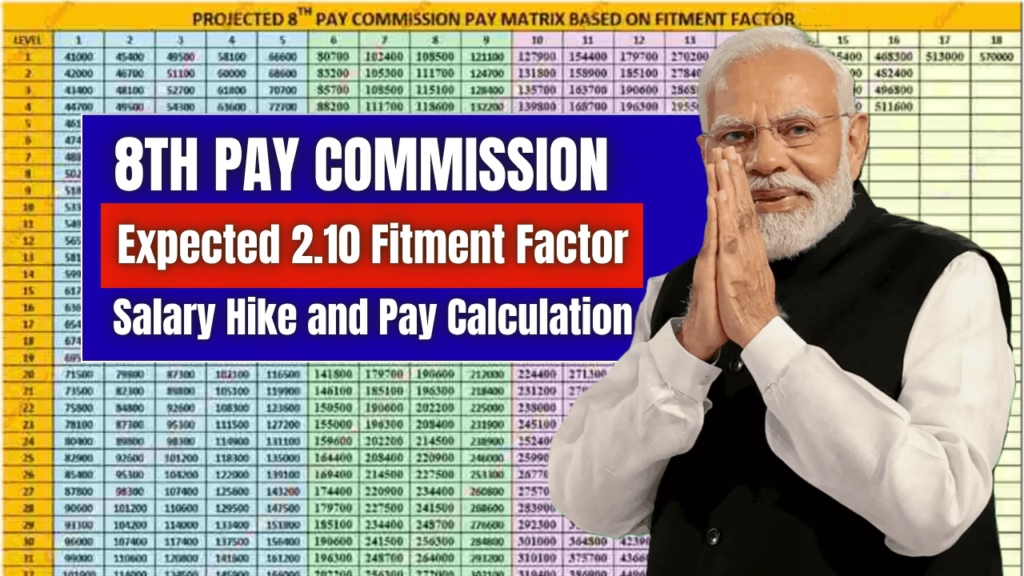
As of mid-2026, the commission remains in an active consultation and data-collection stage. It has not yet finalized the fitment factor, the revised pay matrix, the HRA structure, or the pension revision formula meaning every figure currently circulating, including the 2.10 multiplier discussed in this article, remains a projection rather than a confirmed government decision.
The commission’s public engagement process has been extensive. The dedicated MyGov portal feedback window, featuring an 18-point questionnaire for employees, pensioners, and unions, closed on March 31, 2026. Since then, the commission has continued holding regional stakeholder consultations across the country, including a scheduled session in Lucknow, Uttar Pradesh, on June 22–23, 2026. Separately, the Railway Senior Citizens Welfare Society (RSCWS) has submitted a formal memorandum requesting an increase to the annual increment rate from 3% to 5%, alongside a reduction in the pension commutation restoration period from 15 years to 10–12 years.
Fitment Factor: The Core Salary Hike Formula
Before evaluating what a 2.10 fitment factor would actually deliver, it’s essential to understand the mechanics behind it. The fitment factor is a multiplier applied uniformly to an employee’s existing basic pay, converting it into a revised basic pay under the new pay commission structure. The formula itself is straightforward:
Revised Basic Pay = Current Basic Pay × Fitment Factor
Once the revised basic pay is established, several additional components are layered on top to determine an employee’s total gross salary:
- Dearness Allowance (DA) — a percentage of the revised basic pay, designed to offset inflation
- House Rent Allowance (HRA) — a percentage of revised basic pay that varies by city classification
- Transport Allowance (TA) — based on the employee’s pay level and city category
Total Salary = Revised Basic Pay + DA + HRA + TA + Other Allowances
This structure ensures that a single multiplier drives a proportional, uniform increase across every pay level simultaneously a design philosophy experts describe as both fair (everyone’s base pay rises by the same proportion) and administratively simple (a single number, rather than dozens of individually negotiated rate changes).
Where 2.10 Fits Within the Broader Range of Estimates
Financial analysts and pay-commission trackers have floated a genuinely wide range of potential fitment factor outcomes for the 8th CPC, reflecting just how much uncertainty remains at this stage of consultation. Reported estimates span from a conservative 1.83, up through 2.28, 2.46, 2.6, and 2.86, with some more aggressive union-driven proposals reaching as high as 3.68 to 3.83.
A 2.10 fitment factor sits toward the lower-to-middle end of this range more conservative than the frequently cited 2.28 “widely projected” estimate, but still representing a meaningful increase over current pay levels. For context, the 7th Pay Commission, implemented in 2016, applied a fitment factor of 2.57 meaning a 2.10 multiplier, if ultimately adopted, would represent a noticeably smaller proportional jump than the previous commission delivered.
Why a Lower Fitment Factor Is Plausible
Several structural factors make a more conservative multiplier like 2.10 a realistic scenario worth planning around:
- Fiscal prudence is explicitly written into the commission’s Terms of Reference, meaning the government has signaled from the outset that affordability will weigh heavily on the final number.
- The government has explicitly stated that no proposal to merge Dearness Allowance with basic pay is currently under consideration a decision that, had it gone the other way, would have pushed the effective fitment factor much higher, since merging a DA rate of 58–60% into basic pay before applying the multiplier dramatically inflates the resulting figure.
- Economic conditions and inflation trends at the time of final implementation will directly shape the commission’s ultimate recommendation, and the commission retains flexibility to adjust its approach right up until its report is finalized.
What a 2.10 Fitment Factor Would Mean
To understand the practical impact, consider an employee with a current basic pay of ₹20,000:
| Component | Calculation | Result |
|---|---|---|
| Current Basic Pay | — | ₹20,000 |
| Revised Basic Pay (2.10x) | ₹20,000 × 2.10 | ₹42,000 |
| Dearness Allowance (illustrative, 10%) | ₹42,000 × 10% | ₹4,200 |
| House Rent Allowance (illustrative, 24%) | ₹42,000 × 24% | ₹10,080 |
| Estimated Total Salary (before TA) | Sum of above | ~₹56,280 |
For comparison, applying a more aggressive 2.86x fitment factor to the same ₹20,000 basic pay would instead produce a revised basic pay of ₹57,200 illustrating just how significantly the final number, whatever it turns out to be, will shape actual take-home pay across every government pay level.
Impact on Pensions
The same multiplier logic applies directly to pension revisions. Under the current 7th CPC structure, the minimum pension stands at ₹9,000. Applying a 2.10 fitment factor to that figure would produce a revised minimum pension of approximately ₹18,900 notably more conservative than the ₹20,500 to ₹25,740 range typically cited under the more commonly discussed 2.28 to 2.86 estimates, but still a meaningful increase for retirees relying on fixed pension income.
The DA Factor: A Moving Target Until Implementation
Complicating any fitment factor projection is the fact that Dearness Allowance continues rising in the meantime. The Union Cabinet approved an additional 2% DA and Dearness Relief (DR) increase effective January 1, 2026, lifting the DA rate from 58% to 60% of basic pay/pension. Crucially, DA is expected to continue increasing right up until the new pay structure is actually implemented at which point, Dearness Relief will likely reset to zero, since the new basic pay figure is designed to already incorporate the inflation adjustments DA was compensating for.
Arrears: What Happens If Implementation Is Delayed
Although the 8th CPC’s proposed effective date is January 1, 2026, expert analysis based on historical pay commission patterns suggests actual implementation could realistically slip to 2027 or later. When this happens, the gap period between the proposed effective date and actual implementation is typically paid out as a lump-sum arrears payment back pay calculated as though the revised structure had been in effect the entire time.
Based on patterns from previous commissions, delays of 12 to 18 months could result in arrears amounting to several months of revised salary potentially ₹1 lakh or more for employees at higher pay matrix levels, though the exact figure depends entirely on an individual’s pay level, the final fitment factor, and applicable allowances. It’s worth stressing: arrears are not guaranteed and depend entirely on the actual implementation date ultimately set by the government.
Who Stands to Benefit?
According to widely cited estimates, the 8th Pay Commission could potentially benefit approximately 48.62 lakh central government employees and 67.85 lakh pensioners nationwide making the eventual fitment factor decision one of the most financially consequential government decisions of the year for a substantial share of India’s public sector workforce.
What Employees and Pensioners Should Do Right Now
Given that the fitment factor remains unconfirmed, financial experts recommend the following approach:
- Avoid financial commitments based on the most optimistic projections. A 2.10 fitment factor scenario, while not the headline number most frequently cited, remains a plausible, fiscally conservative outcome worth factoring into your planning.
- Track official consultation updates rather than relying solely on speculative calculators, since the commission’s regional stakeholder meetings and final report will ultimately determine the real number.
- Understand the arrears mechanism, since even a delayed implementation will likely result in retroactive back pay to the January 1, 2026 effective date.
- Factor in the DA reset, recognizing that your current Dearness Allowance will likely be absorbed into the new revised basic pay structure once implementation occurs.
- Consult a financial advisor before making major purchasing or investment decisions tied to anticipated salary increases, given how wide the range of expert estimates remains at this stage.
The 2.10 fitment factor represents one of several plausible scenarios financial experts are weighing as the 8th Pay Commission continues its consultation process throughout 2026. While more conservative than the frequently cited 2.28 to 2.86 range, it remains grounded in the same fiscal prudence mandate explicitly built into the commission’s Terms of Reference and would still deliver a meaningful salary and pension increase to millions of central government employees and retirees once finalized. Until the commission submits its official report, the smartest approach for affected employees and pensioners remains the same: use these projections for planning purposes only, and wait for the official government notification before making any major financial decisions based on a specific multiplier.