$90 Medicare Rebate Payment Status: If you’re on Original Medicare and expected $90 in October but can’t find it, call Social Security at 1-800-772-1213 for payment status and 1-800-MEDICARE (1-800-633-4227) for eligibility.
What the $90 payment actually is
If you spotted an odd $90 deposit in early October, or you’re wondering why a neighbor got one and you didn’t, you’re far from alone. The White House announced the payment on October 2, 2026, and CMS put out a Q&A sheet the next day spelling out the rules. In plain terms, it’s a one-time rebate of $90 per eligible person, meant to offset the October Part B premium.
The money doesn’t come out of the Social Security trust funds, and it isn’t a bonus on your monthly benefit. It comes from the Medicare Improvement Fund, a reserve Congress created in 2008 and stocked with $2 billion to pay for improvements to traditional fee-for-service Medicare. According to the White House fact sheet, nobody had tapped that fund before this year. Whatever you think of the politics around it, that’s the mechanical explanation: an unused reserve, a single payout.
A couple of numbers put it in perspective. The standard Part B premium is $202.90 a month in 2026, up from $185 in 2025. So $90 covers roughly 44 percent of one month’s premium. That’s real money, especially on a fixed income, but it doesn’t change what gets taken out of your Social Security check going forward, and I haven’t found any announcement of a second round.
One more point before we get into the phone numbers, because it shapes everything else in this article: you didn’t have to apply for this. Eligible people are paid automatically, using the bank account or mailing address that Medicare and Social Security already have on file. If somebody tells you that you need to sign up, pay a fee, or “verify” your information to receive it, that’s not how this works. We’ll come back to that.
Who qualified, and who got left out
CMS says about 20.8 million people were eligible. That sounds huge until you learn that roughly 40 million other Part B enrollees weren’t, according to CBS News’ breakdown. The line between the two groups is fairly clear. To get the $90, you had to be:
- Enrolled in Original Medicare Part B
- Living in the United States
- Not receiving premium help from Medicaid
- Not paying an Income-Related Monthly Adjustment Amount, known as IRMAA
That last item catches a lot of people off guard. IRMAA is the surcharge that higher-income beneficiaries pay on top of the standard Part B premium. If you pay it, you were excluded. The same goes if Medicaid already covers your Part B premium, which is how many lower-income seniors have it paid.
The biggest group left out is Medicare Advantage enrollees. Medicare.gov says plainly that people in Medicare Advantage plans aren’t eligible, even though they pay the Part B premium too. That has frustrated plenty of folks, and it’s the most common reason someone who “has Medicare” didn’t see a deposit. People with a foreign address on file with Medicare or Social Security also aren’t covered.
Not sure which bucket you’re in? A few quick checks usually settle it:
- Look at your insurance cards. If you carry a card from a private insurer (Humana, UnitedHealthcare, Aetna and so on) as your main health coverage, you’re probably on Medicare Advantage.
- Check your annual Social Security benefit letter. If your Part B premium is deducted and the amount looks higher than the standard $202.90, you may be paying IRMAA.
- If someone else, such as your state, pays your Part B premium, you’ve likely got Medicaid or a Medicare Savings Program helping out.
If you still can’t tell, don’t guess. The White House and CMS both point people to 1-800-MEDICARE (1-800-633-4227) to check eligibility, and the next sections cover exactly how that call works.
$90 Rebate vs 2027 Part B Increase Calculator: Does the Medicare Rebate Cover Your Premium Hike?
Medicare $90 Rebate for Couples: Does Each Spouse Get Paid for $180 ?
Is the $90 Medicare Rebate Taxable? What to Know Before Filing
When the money was sent, and how it should look
Per CMS’s FAQ, most eligible beneficiaries were supposed to see a direct deposit on or around October 8. The deposit came through the Social Security Administration, which is why so many people assumed it was a Social Security payment. It isn’t. It simply travels through the same pipes.
Somewhere in mid-October, an email or a letter signed by the President was meant to follow the deposit. Treat that as a notice, not a claim form. Medicare also has a page describing the one-time premium rebate letter, and its advice for anyone who gets it is refreshingly short: look for a direct deposit or a check from the U.S. Treasury. That’s it. Nothing to fill out, nothing to mail back.
If you don’t have direct deposit set up with Social Security, you were supposed to get a paper check from the Treasury later in October, mailed to the address Medicare has on file for you. Those checks started arriving after the deposits, so a neighbor who got paid on October 8 while you’re still waiting isn’t necessarily a red flag.
Here’s what to look for so you can spot the real thing:
- Amount: exactly $90, once.
- Description: “Medicare Improvement Fund Payment; $90 Payment to Offset October Premium.” Your bank might shorten that, so search your transactions for “Medicare Improvement Fund” or just “Medicare.”
- Sender: the U.S. Department of the Treasury on paper checks, and the Social Security Administration on direct deposits.
- Separate from your benefit: it shows up as its own line, not folded into your regular monthly Social Security payment.
A quick reality check on timing. It’s November 4 as I write this, so we’re about four weeks past the first deposits. Mail delays happen, and a few people’s information was surely out of date, but by now a paper check should have turned up for most eligible people. I couldn’t find an official cutoff date after which a payment is considered lost, so if you’re past the point of patience, the next section is for you.
How to check your payment status step by step
The official guidance splits this into two phone calls, and mixing them up is the number one way people waste an afternoon. Eligibility questions go to Medicare. Payment status questions go to Social Security. Here’s the order I’d work through it.
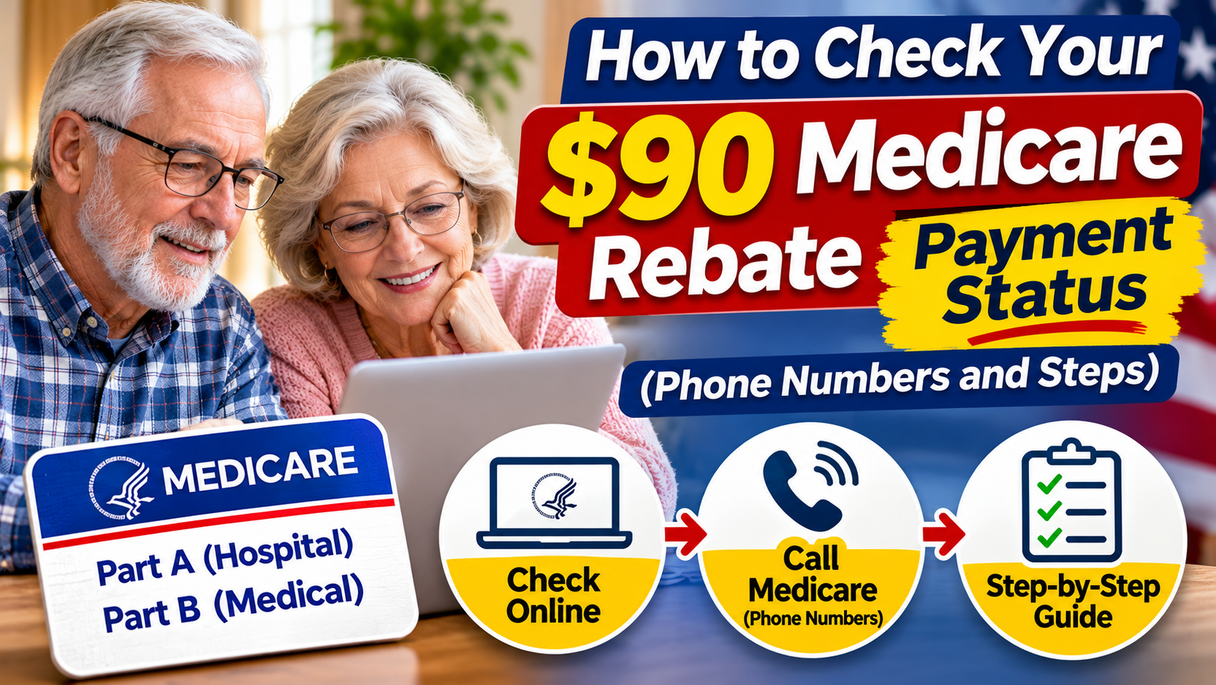
- Make sure you should have gotten it. Call 1-800-MEDICARE (1-800-633-4227). The White House and CMS both say this is the line for checking whether you qualify. If you use a TTY, the number is 1-877-486-2048. Have your Medicare number handy.
- Search your bank account. Look for a $90 deposit labeled “Medicare Improvement Fund.” Check the account where your Social Security benefit lands, not just the one you use most. If you bank on paper statements, check the online view or call your bank.
- Check your mail. Look for the Medicare letter and for a Treasury check. Paper checks can look like junk mail, so open anything from the Treasury before you toss it. Also think about whether Medicare has your current address.
- Call Social Security about payment status. The number is 1-800-772-1213, and CMS says the agency began taking rebate status questions on October 15, 2026. The TTY line is 1-800-325-0778. Have your Social Security number, your address, and your bank details on file ready, because they’ll want to confirm who you are.
- Visit a local office if the phone doesn’t work. Some people just do better in person. Use the office locator at ssa.gov and ask about an appointment first.
A word on timing for the phone call. Social Security’s 800 line generally runs weekdays during business hours, and the agency has long said it’s busiest early in the week and early in the month. If you can wait, later in the week is usually easier. Don’t hang up after a long hold, either. It’s the only official route for status, so it’s worth the patience.
One honest caveat. I looked for an online tool that shows rebate status, such as a line item in your my Social Security account, and couldn’t find any official confirmation that it exists. So treat the phone as the official method. Your online account is still useful for double-checking that the bank details and mailing address Social Security has are correct.
Phone numbers at a glance
| What you need | Who to call | Number |
|---|---|---|
| Eligibility for the $90 | Medicare | 1-800-633-4227 (1-800-MEDICARE) |
| Medicare TTY | Medicare | 1-877-486-2048 |
| Where’s my payment | Social Security | 1-800-772-1213 |
| Social Security TTY | Social Security | 1-800-325-0778 |
| Report suspected fraud | HHS Inspector General | 1-800-447-8477 |
What to do if Payment not received
So you checked your bank, dug through the mail pile, and called Social Security, and you’re still at zero. Before you assume something went wrong, run through the usual suspects.
You’re in an excluded group. This is by far the most common answer. Medicare Advantage, IRMAA, Medicaid premium help, or a foreign address on file all rule you out. Ask the Social Security rep which category they have you in, and if it doesn’t sound right, ask Medicare to review your enrollment record.
Your bank details are out of date. If you closed an account or switched banks and never told Social Security, a deposit can bounce. In that case the agency may need to reissue the money some other way, so ask what happened to it rather than assuming it vanished.
Your address is wrong. Paper checks go to the mailing address Medicare has registered. If you moved in the last couple of years and only updated one agency, the check could be sitting at an old address. Update your address with Social Security and with Medicare, since they’re separate systems.
The check is in the mail, literally. Treasury checks were scheduled for later in October, so late arrivals happen. A month is long, though, so don’t wait indefinitely.
You’re looking in the wrong place. People with more than one bank account often check the wrong one. And some folks with joint accounts or a representative payee never see the notice at all. If someone else manages your money, ask them.
When you do reach someone, take notes. Write down the date and time, the name or ID of the person you spoke with, and what they said. If you get bounced between agencies, those notes save you from starting over. And if the phone route goes nowhere after a couple of tries, your U.S. representative’s or senator’s office has caseworkers who help constituents untangle exactly this kind of federal agency problem. I couldn’t find an official appeal process written specifically for the rebate, so that’s a practical fallback rather than an official step.
One last thing. If a stranger offers to “track down” or “release” your $90 for a fee, walk away. Nobody has to be paid to get this money to you.
Social Security Spousal Benefits 2026: How Much Your Wife Can Get Each Month
Stimulus Check 2026 Fact-Checking Every Viral Payment Claim (Tracker)
Scam alert
Whenever the government sends out money, scammers show up a few days later. This isn’t new. Back when Medicare drug-plan beneficiaries were due $250 rebate checks in 2010, state attorneys general in places like Oregon and South Dakota put out warnings about callers fishing for Social Security and bank account numbers. The script has barely changed. Only the dollar amount did.
With the $90 rebate, here’s what’s true about the real thing:
- It’s automatic. No application, no form, no “activation.”
- It costs nothing to receive. There’s no processing fee and no up-front payment.
- Nobody needs your Medicare number, Social Security number, or online banking login to send it, because the government already has what it needs.
- Medicare and Social Security don’t text you links to claim it.
The Federal Trade Commission says Medicare will not call out of the blue to ask for your Medicare number or personal details, and that real Medicare messages don’t threaten to cancel your coverage unless you act immediately. The FTC’s advice is to treat your Medicare number like a credit card number. Caller ID doesn’t prove anything, either. Scammers can make “Medicare” or an 800 number show up on your screen with cheap software.
So if your phone rings and the caller says they’re from Medicare about your $90, hang up. Then call the numbers in this article yourself. If you want a one-line rule, it’s this: you call them, never the other way around.
Other red flags to watch for include pressure to act today, a request for payment by gift card, wire transfer, or cryptocurrency, and anyone who says a “small fee” is needed to release the money. Every one of those is a scam.
If you already gave information away: call your bank right away, ask about a fraud alert or new account numbers, and report identity theft at IdentityTheft.gov. If you shared your Medicare number, call 1-800-MEDICARE.
Where to report:
- 1-800-MEDICARE (1-800-633-4227)
- The FTC at ReportFraud.ftc.gov
- The HHS Office of Inspector General at oig.hhs.gov or 1-800-447-8477
- Your state’s Senior Medicare Patrol, which helps people spot and report Medicare fraud (the national line is 1-877-808-2468)
Reporting feels pointless sometimes, but those reports are how investigators connect one call center to a thousand victims.
FAQ’s about $90 Medicare Rebate Payment Status
Is the $90 taxable?
I couldn’t find official guidance from the IRS or CMS on how the payment is treated for taxes, and at least one benefits site noted the same gap. Hold on to the deposit record or check stub, and ask a tax preparer or the IRS before you file.
Will I get another one?
Nothing I found says so. CMS describes a single rebate in October 2026, and no follow-up has been announced. If that changes, it’ll show up on Medicare.gov and in the news first.
Does it lower my monthly premium?
No. It’s a one-time offset. The standard Part B premium stays at $202.90 for the rest of 2026.
Did it change my Social Security benefit?
No. The payment is separate from your monthly benefit, and your regular deposit stays the same. If you’re on a means-tested program like SSI or Medicaid and you’re worried about how a one-time payment is counted, I didn’t find official guidance, so ask your caseworker before assuming either way.
A parent or spouse who passed away got a deposit. What now?
Don’t spend it. Call Social Security at 1-800-772-1213 and ask how to handle it. Payments sent in the name of someone who has died are the kind of thing the agency has procedures for, and sorting it out early avoids headaches later.
I’m on Medicare Advantage. Can I still get something?
Not this rebate, according to CMS. But some Advantage plans have their own Part B premium reduction, and we’ll cover that below.
I got $90 and think I shouldn’t have.
It’s worth a call to Social Security or 1-800-MEDICARE before you do anything with it. Payment mistakes get corrected more smoothly when you flag them rather than wait.
Premiums, Open Enrollment and Givebacks
The $90 is nice, but it lands in the middle of a bigger story about what Medicare costs. Juliette Cubanski, who directs Medicare policy at KFF, told reporters the one-time payment may not stretch far against rising health care and everyday costs. She pointed out that Part B premiums are expected to climb by around $79 over the course of 2027, which would swallow most of the $90. CMS normally announces the official premium for the coming year in the fall, so check Medicare.gov for the confirmed figure rather than relying on projections.
Timing matters here, because Medicare’s annual open enrollment period runs October 15 through December 7. If the rebate got you looking at your costs, this is the window to compare plans for 2027.
A few ideas worth a look:
- Part B premium giveback plans. Some Medicare Advantage plans pay part or all of your Part B premium. The reduction can run from pennies to the full premium, though the typical range is more like $10 to $100 a month. KFF found that roughly a third of individual Medicare Advantage plans offered some reduction in 2026, while other counts put it closer to a quarter. Either way, it’s a minority of plans, and availability depends on where you live.
- Medicare Savings Programs. If your income is limited, programs run through your state can pay your Part B premium. Ask your state Medicaid office or call 1-800-MEDICARE. Getting enrolled could also make you ineligible for the $90, but it would save you far more over a year.
- IRMAA appeals. If your income dropped because of retirement or another life event, you can ask Social Security to reconsider your surcharge.
A giveback shouldn’t be the only thing driving a plan choice. Plans with generous premium cuts can come with narrower networks, prior authorization rules, or higher costs when you actually use care. Don’t switch from Original Medicare without understanding what you’re giving up, and be careful about unsolicited calls and ads during enrollment season. The same scammers who chase rebate checks are busy right now.