Payment week has arrived for millions of beneficiaries under the Social Security payment schedule 2026, and September brings a clean, holiday free calendar that most recipients will recognize without any surprises. Supplemental Security Income checks go out first on September 1, the group that started collecting Social Security before May 1997, along with anyone drawing both SSI and Social Security together, gets paid September 3, and the remaining majority of beneficiaries are split across three Wednesdays, September 9, September 16, and September 23, based purely on the day of the month they were born. We will be updating this article monthly as the Social Security Administration finalizes new payment dates, benefit figures, and policy changes.
There is more happening this month than the calendar alone suggests. A key piece of inflation data used to build next year’s raise arrives September 11, and beneficiaries trying to plan a 2027 budget are watching that number closely, even though nothing becomes official until mid October. At the same time, another round of social media posts claiming a hidden bonus check or a new stimulus deposit tied to Social Security has resurfaced, and none of it holds up against what the SSA has actually confirmed. This article walks through the complete, verified September schedule, breaks down the rules that decide your specific payment day, covers eligibility for every major benefit category, and separates what is real from what is not this month.
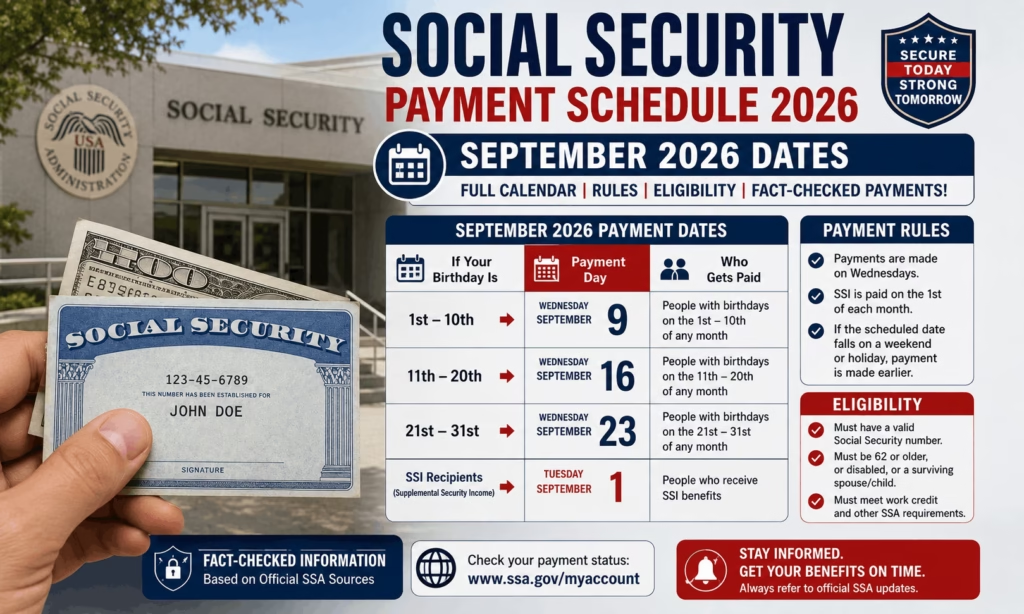
Social Security Payment Schedule September 2026
| Recipient Group | Payment Date | Day |
|---|---|---|
| Supplemental Security Income (SSI) | September 1, 2026 | Tuesday |
| Pre-May 1997 beneficiaries and dual SSI/Social Security recipients | September 3, 2026 | Thursday |
| Born on the 1st through 10th | September 9, 2026 | Wednesday |
| Born on the 11th through 20th | September 16, 2026 | Wednesday |
| Born on the 21st through 31st | September 23, 2026 | Wednesday |
None of September’s dates shift this year, since September 1 lands on a weekday rather than a weekend or federal holiday. That has not been the case in every month of 2026, which is part of why beneficiaries are encouraged to check the official calendar rather than assume the same date applies every month.
The Logic Behind The Staggered Payment System
Social Security does not send tens of millions of payments on a single calendar day, and the system used to spread them out has been in place for years. SSI, which is a separate, needs based program rather than an earned benefit, is always scheduled for the first of the month, shifting only when that date falls on a weekend or holiday. Social Security retirement, survivor, and disability payments are handled differently. Anyone who began receiving benefits before May 1997 is grandfathered onto the 3rd of the month schedule, and that same third of the month date applies to any household where a person receives both SSI and a Social Security benefit at once. Everyone else who started benefits from May 1997 onward is placed into one of three birthday based groups, paid on the second, third, or fourth Wednesday depending on which segment of the month their birthday falls in.
Because this system is based on birth date and not application date, two neighbors who both retired the same week can be paid a full two weeks apart if their birthdays land in different bands. It also explains why a beneficiary receiving both SSI and Social Security should expect two separate deposits close together rather than one combined payment, since the two programs run on entirely different SSA payment tracks even when paid to the same person.
Eligibility For Each Benefit Type
Retirement benefits require a minimum of 40 work credits, roughly 10 years of covered employment, and can begin as early as age 62 at a reduced rate or be delayed to age 70 for a larger monthly amount. Full retirement age currently sits at 67 for anyone turning 62 in 2026, meaning that is the age at which the full, unreduced benefit becomes available.
Social Security Disability Insurance is available to workers with sufficient recent work history who have a medical condition expected to last at least a year or result in death, and the SSA’s disability standard hinges on whether the condition prevents substantial gainful work, not simply whether it prevents the applicant’s prior job specifically.
Survivor benefits are paid to a deceased worker’s spouse, dependent children, and in limited cases a dependent parent, calculated from the deceased worker’s earnings record and adjusted based on the survivor’s age at the time they file.
Supplemental Security Income has nothing to do with a work record. It is funded through general tax revenue rather than the Social Security trust funds and is reserved for people 65 or older, blind, or disabled who meet strict income and resource caps, generally around $2,000 in countable resources for a single applicant and $3,000 for a couple.
Typical Benefit Amounts This Year
| Category | 2026 Average Monthly Payment | 2026 Ceiling |
|---|---|---|
| Retired worker | Roughly $2,071 | $5,181 at age 70, $4,152 at full retirement age, $2,969 at age 62 |
| Survivor (widow/widower) | Roughly $1,575 | Based on the deceased worker’s own earnings history |
| Spousal benefit | Roughly $955 | Up to half of the worker’s full retirement age benefit |
| SSDI | Varies significantly by earnings history | Uses the same benefit formula as retirement |
| SSI, individual | Federal base rate, plus any applicable state add-on | Set annually and unrelated to earnings history |
These are program-wide averages, not a forecast for any single household, since the actual deposit depends on decades of individual earnings, the exact claiming age, and family situation.
SSDI Payment Dates September 2026: Who Gets Paid and When?
Japan Visa Renewal Fee Increase 2026: New Charges From October Explained
What Is Actually New This September
The 2027 Raise Is Getting Closer, But It Is Still A Forecast
The 2026 cost of living adjustment, 2.8 percent, has already been in beneficiaries’ checks since January, lifting the average retired worker’s payment by about $56 a month. Attention has now shifted to 2027. The SSA calculates the annual COLA from the average CPI-W reading across July, August, and September compared with the same three months a year earlier. The July figure, released in mid August, showed prices up 3.4 percent year over year, and outside groups including AARP and The Senior Citizens League have put their early 2027 estimates in the 3.4 to 3.6 percent range, which would be a meaningfully larger raise than 2026 delivered. The August inflation report arrives September 11, and the September number, the last piece of the calculation, will not be published until October 14, the same date the SSA typically confirms the final COLA. Until that October announcement, every 2027 percentage circulating online, no matter the source, remains an estimate rather than a locked figure.
Overpayment Recovery Can Still Take A Large Bite Out Of A Check
A rule change from 2025 continues to shape how the SSA claws back money it says was paid in error, and it remains one of the most consequential issues for current beneficiaries. New Title II overpayments, covering retirement, survivor, and SSDI benefits, are again subject to a much steeper default withholding rate than the temporary 10 percent cap that had briefly been in place, meaning a large share, and in some cases the entirety, of a monthly check can be withheld until the debt is repaid unless the beneficiary takes action. SSI overpayments were never part of that shift and are still capped at a 10 percent monthly withholding rate. Beneficiaries facing a new overpayment notice have real tools available. Submitting a Request for Reconsideration, Form SSA-561, or a waiver request, Form SSA-632, within 10 days of the notice date pauses any withholding while the SSA reviews the case, and filing within 30 days still halts collection during that review. Debts of $2,000 or less can frequently be resolved through a simplified administrative waiver when the beneficiary was not at fault, sometimes without extensive paperwork.
Direct Deposit And Direct Express Are Now The Default
The federal shift away from mailed Social Security checks has continued through 2026. Most new paper checks stopped going out after a federal transition to electronic payments took hold in late 2025, and the SSA has spent much of this year contacting the remaining small share of beneficiaries who still receive a mailed check to move them toward direct deposit or the Direct Express prepaid card. A genuine hardship exception is available through the Treasury for beneficiaries who cannot reasonably use electronic payment because of disability, lack of access to banking, or another documented barrier. Anyone who has not made the switch should confirm their banking information is current, since a mailed check takes considerably longer to arrive and carries a far higher risk of being lost, delayed, or stolen than a direct deposit.
Separating Fact From Rumor This September
Claims of a brand new stimulus payment, a hidden Social Security bonus, or an emergency senior check keep resurfacing across social media, and it is worth stating this clearly. No new federal stimulus payment tied to Social Security has been signed into law or announced by the SSA as of this update. Most of the viral posts trace back to informal political proposals that never became law, misinterpretations of pending legislation, or scam pages built to harvest personal information. A separate and very common source of confusion comes from the payment calendar itself. When SSI’s usual first of the month date lands on a weekend or holiday, the payment simply moves earlier into the prior month, and some online accounts frame that routine shift as a secret bonus rather than what it actually is, the same monthly amount arriving a couple of days ahead of schedule. The SSA and the Treasury never ask for a Social Security number, bank details, or a processing fee by text or email to release a payment, and any message asking for that information should be treated as a scam, not an official notice.
How To Apply For Each Benefit Type
Retirement benefits can be applied for online through your personal my Social Security account, by phone, or at a local field office, and the SSA recommends filing up to four months before the desired start date. SSDI claims involve significantly more documentation, including medical evidence and a detailed work history, and applications can also be started online, by phone, or in person. Survivor benefits generally cannot be completed entirely online and instead require a phone call or an in person appointment, since the SSA needs to verify the death record and the applicant’s relationship to the deceased worker. SSI applications can often be started online for adults, though most cases still require a follow up phone or in person interview to confirm income and resource details before a decision is issued.
SSA Strategic Plan FY2026-2030: New Goals, Wait Times & Service Targets
SSA Ticket to Work Program: How Disability Beneficiaries Can Return to Work Without Losing Benefits
Processing Time By Program
Retirement applications that are complete and filed close to the intended start date typically process within a few weeks when submitted online with the required documents already attached. SSDI decisions take much longer given the SSA’s ongoing case backlog, with initial determinations currently averaging roughly six months, and cases that are denied and escalated to a hearing can stretch past a year from filing to final resolution. Survivor claims tend to move faster than SSDI, often within four to six weeks once the death certificate and supporting paperwork are verified. SSI claims involving disability follow a timeline similar to SSDI because both route through the same state Disability Determination Services process, while SSI claims based only on age or blindness with straightforward paperwork typically move faster.
Full Schedule Through The Rest Of 2026
| Month | SSI | Pre-1997 / Dual Beneficiaries | Born 1-10 | Born 11-20 | Born 21-31 |
|---|---|---|---|---|---|
| September | September 1 | September 3 | September 9 | September 16 | September 23 |
| October | October 1 | October 3 | October 14 | October 21 | October 28 |
| November | October 30 | November 3 | November 10 | November 18 | November 25 |
| December | December 1 | December 3 | December 9 | December 16 | December 23 |
The November SSI date falls on October 30 because November 1 lands on a Sunday, and the usual second Wednesday moves a day earlier, to November 10, because Veterans Day falls on November 11 that week.
Official Social Security Links
| What You Need | Official Resource |
|---|---|
| Full annual payment calendar (Publication 05-10031) | ssa.gov/pubs/EN-05-10031.pdf |
| Create or sign in to my Social Security account | ssa.gov/myaccount |
| Apply for retirement, disability, or survivor benefits | ssa.gov/benefits |
| Track an application or appeal | ssa.gov/myaccount |
| SSI eligibility and program details | ssa.gov/ssi |
| Overpayment notices, appeals, and waiver forms | ssa.gov/overpayments |
| Enroll in Direct Express | godirect.gov |
| Cost of Living Adjustment updates | ssa.gov/cola |
If A Payment Does Not Show Up
The SSA advises waiting three mailing days past the scheduled date before reporting anything missing, since electronic deposits can occasionally take a day or two to post depending on your financial institution. If the payment is still not there after that window, first confirm your direct deposit details are accurate inside your my Social Security account, since outdated banking information is the single most common reason a payment is delayed or bounced back. If your account information checks out and the payment remains missing, call the SSA at 1-800-772-1213 or visit a local field office. Anyone who suspects a scam or identity theft connected to their benefit should also file a report with the SSA’s Office of the Inspector General.
Everyday Mistakes That Delay A Payment
A short list of avoidable errors accounts for most of the missing or delayed Social Security payments the agency deals with each month. Forgetting to update direct deposit details after switching banks tops the list, since a payment sent to a closed account can take weeks to be reversed and reissued. Not updating a mailing address quickly enough is another frequent problem, especially for beneficiaries who still receive paper correspondence such as an annual COLA notice or a records request in an active SSDI case. SSI recipients face an additional risk, since failing to promptly report a change in income, resources, or living arrangement is one of the leading causes of both delayed payments and future overpayment notices, given that SSI eligibility is reviewed on an ongoing basis rather than fixed once at approval. Keeping banking and contact information current inside your my Social Security account remains the most effective way to avoid all of these issues.
IRCC Tightens Citizenship by Descent: What the New 1,095-Day Presence Test Rules Mean for Applicants
SSI Address Change Service Enhancements: SSA’s New Fast-Track Process Explained
Social Security Payment September 2026: Five Confirmed Dates You Need to Know
A Word On Medicare Premiums And Your Net Deposit
For roughly 70 percent of beneficiaries, the amount that actually lands in the bank each payment date is not the full benefit amount, since the standard Medicare Part B premium is deducted automatically before the deposit goes out. That means a COLA increase and a Medicare premium increase often arrive in the same January adjustment, and the net change to a beneficiary’s check can be smaller than the announced COLA percentage suggests. Beneficiaries enrolled in a Medicare Advantage plan or with an income related monthly adjustment amount, known as IRMAA, may see an even larger deduction, since higher income beneficiaries pay more than the standard Part B premium. Reviewing the annual COLA notice alongside the separate Medicare premium notice each fall gives a clearer picture of the actual deposit to expect starting the following January than looking at the COLA percentage alone.
FAQs
When will I get my Social Security payment in September 2026?
It depends on your benefit type and birthday. SSI arrives September 1, the pre-1997 and dual beneficiary group is paid September 3, and everyone else is paid September 9, 16, or 23 based on their date of birth.
Is there a new stimulus payment for Social Security recipients this year?
No. No federal law authorizing a new stimulus payment tied to Social Security has been passed. Confirm any payment claim directly at ssa.gov rather than through a social media post or forwarded message.
What will the 2027 Social Security COLA actually be?
It has not been finalized. Independent estimates based on July inflation data cluster around 3.4 to 3.6 percent, but the official number will not be announced until October 14, 2026, once the September CPI data is released.
Why is part of my Social Security check being withheld for overpayment?
The SSA reinstated a much stricter default withholding rate for new Title II overpayments starting in 2025, moving away from the temporary 10 percent cap. SSI overpayment withholding is unaffected and remains capped at 10 percent. A hardship waiver or a lower repayment rate can be requested.
Do beneficiaries need to reapply for Social Security every year?
No. Once a claim is approved, payments continue automatically unless you need to report a change such as a new address, a change in marital status, or, for SSI, a change in income or resources.
Has Social Security fully stopped mailing paper checks?
Not completely. Most beneficiaries have shifted to direct deposit or the Direct Express card under the federal move to electronic payments, but a documented hardship waiver remains available through the Treasury for those who cannot use electronic options.
Can someone receive both SSI and Social Security in the same month?
Yes, this is common when a beneficiary’s Social Security benefit falls below the SSI income threshold. In that case, SSI is paid on the 1st and the Social Security portion follows separately on the 3rd.
People Also Ask
How can I find my exact Social Security payment date online?
Log into your my Social Security account at ssa.gov/myaccount, which shows your individual payment history and benefit type directly, rather than relying only on the general public schedule that covers standard rules.
Why do some Social Security recipients get paid on the 3rd instead of a Wednesday?
That fixed date applies only to people who began receiving Social Security before May 1997 and to anyone who receives both SSI and a Social Security benefit. It predates the current birthday based Wednesday system used for newer claimants.
What is the real difference between Social Security and SSI?
Social Security is funded by payroll taxes and tied directly to a worker’s earnings record, while SSI is a needs based program funded from general federal revenue for people 65 or older, blind, or disabled who meet strict income and resource limits, regardless of any work history.
Is Social Security going to run out of money soon?
The program’s trust funds are projected to face a shortfall in the early 2030s that would reduce, not eliminate, scheduled benefits if Congress takes no action, since ongoing payroll tax revenue would still cover the large majority of promised payments. This long term funding question is separate from the monthly payment schedule and does not affect payments being issued on time right now.
Conclusion
September 2026 keeps the Social Security payment schedule clean and predictable, with SSI arriving September 1, the pre-1997 and dual beneficiary group paid September 3, and the birthday based groups following on September 9, 16, and 23. The real story this month sits just beneath the calendar, with a 2027 COLA estimate still awaiting the final piece of inflation data, an overpayment withholding rule that can still take a serious bite out of a monthly check, a continuing shift away from paper checks, and another wave of stimulus rumors that remain unverified by any official source. Checking your specific payment date and any account notices directly through your my Social Security account is still the most reliable way to stay ahead of both genuine program changes and online misinformation. This article will keep being updated monthly as the Social Security Administration confirms new dates, COLA figures, and policy updates.
Canada Study Permit Proof of Funds Requirement Jumps to $23,448 for International Students
BC PNP Entrepreneur Immigration Draw Invites 16 Business Candidates in Latest Round
USCIS Ukraine TPS EAD Extension: Work Permits Automatically Extended Through October 19, 2026
TPS Terminations 2026: Complete Tracker for Somalia, Ethiopia, South Sudan, Syria, Haiti, and Yemen