First Home Savings Account (FHSA) : If you are new to Canada and researching how to save for a down payment, the FHSA Canada 2026 rules are some of the most important numbers to understand before you open any account. The First Home Savings Account lets eligible newcomers contribute up to $8,000 a year, to a lifetime maximum of $40,000, with contributions that are tax-deductible like an RRSP and qualifying withdrawals that are completely tax-free like a TFSA. You do not need to be a Canadian citizen or even a permanent resident to qualify. If you are a Canadian tax resident with a valid Social Insurance Number, meet the age requirements, and have not owned and lived in a home as your principal residence in the current year or the previous four calendar years, you are generally eligible to open one from day one in Canada. Combined with the RRSP Home Buyers’ Plan, which the 2024 federal budget raised to a $60,000 withdrawal limit, a single newcomer buyer can now access up to $100,000 in tax-sheltered down payment savings, and a couple can combine both accounts for up to $200,000. We’ll be updating this article monthly as CRA confirms any changes to contribution limits or eligibility rules.
This article walks through exactly who qualifies for an FHSA as a newcomer, how the annual and lifetime contribution limits work, why the account was left unchanged in the 2026 federal budget despite calls to raise it, how to combine the FHSA with the Home Buyers’ Plan for maximum down payment savings, what counts as a qualifying withdrawal, and the exact steps to open an account as someone recently arrived in Canada. Every figure below reflects confirmed CRA rules and the 2026 federal budget as officially published.
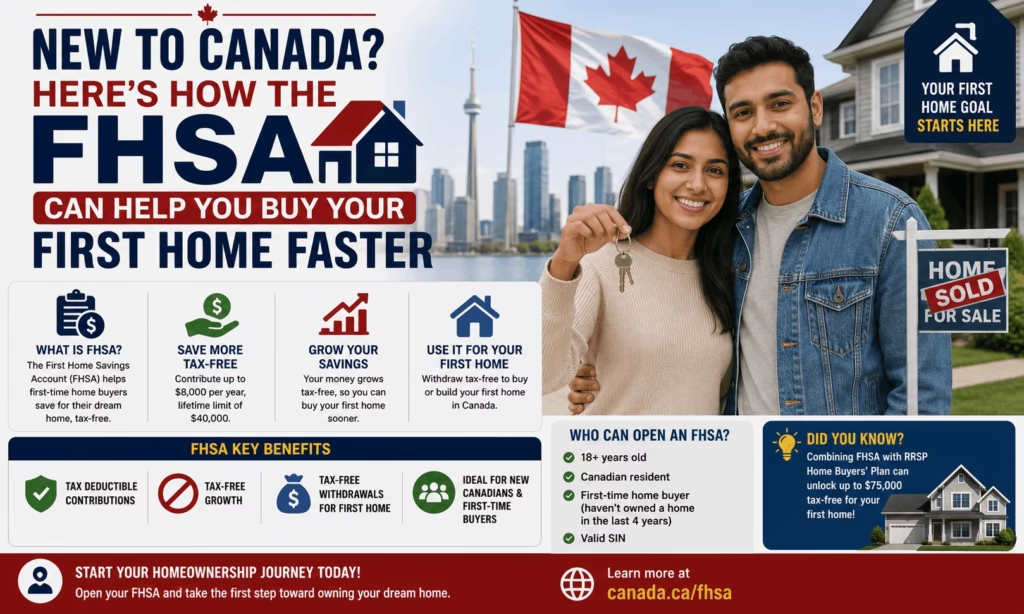
First Home Savings Account (FHSA) Key Highlights
| Detail | Current Figure (2026) |
|---|---|
| Annual FHSA contribution limit | $8,000 |
| Lifetime FHSA contribution limit | $40,000 |
| Maximum single-year carry-forward | $8,000 (unused room accumulates only after account is opened) |
| RRSP Home Buyers’ Plan (HBP) limit | $60,000, set in the 2024 federal budget, unchanged in 2026 |
| Combined FHSA + HBP for a single buyer | Up to $100,000 |
| Combined FHSA + HBP for a couple | Up to $200,000 |
| Minimum age to open (most provinces) | 18 (19 in BC, NB, NL, NS, NT, NU, and YT) |
| Maximum age to open | Must open by the end of the year you turn 71 |
| First-time buyer definition | Have not owned and lived in a home as a principal residence in the current year or the previous 4 calendar years |
| Required identification | Valid Social Insurance Number (SIN), including a temporary SIN in many cases |
| Account holding period before withdrawal | Can withdraw as soon as funds are contributed, no minimum holding period required |
| 2026 federal budget change to FHSA | None, limits remain $8,000 annual and $40,000 lifetime |
| 2026 TFSA annual limit, for comparison | $7,000 |
What the First Home Savings Account FHSA?
The First Home Savings Account, introduced by the federal government in 2023, is a registered savings account designed specifically to help first-time buyers save for a down payment. What makes it distinct from other registered accounts is that it combines two tax advantages that previously existed only separately: contributions are tax-deductible, exactly like an RRSP, while qualifying withdrawals used toward a home purchase are entirely tax-free, exactly like a TFSA.
In practical terms, contributing $8,000 to an FHSA in a given tax year allows that same $8,000 to be claimed as a deduction on your personal income tax return, directly reducing your taxable income for that year. The tax savings scale with your marginal tax rate. For example, someone earning around $80,000 in Ontario, in a combined marginal bracket of roughly 31.5 percent, would save approximately $2,520 in income tax on a full $8,000 contribution, while someone earning around $110,000, in a roughly 43.4 percent bracket, would save approximately $3,472.
£5959 Attendance Allowance Could Boost Your Pension, Check If You Qualify
$1600 Property Tax Credit 2026 Fact Check, Eligibility, Dates & How to Apply
Who Qualifies as a Newcomer?
This is the question most newcomers ask first, and the answer for most people is a qualified yes. According to CRA rules, you do not need Canadian citizenship or even permanent resident status to open an FHSA. What matters is your tax residency status, not your immigration status specifically. If you are a resident of Canada for tax purposes, hold a valid Social Insurance Number, whether permanent or temporary, meet the age requirement for your province, and qualify as a first-time home buyer, you are generally eligible.
In practice, this means many temporary residents, including some work permit holders and international students who are considered tax residents of Canada, may qualify for an FHSA well before they receive permanent resident status. Because FHSA eligibility hinges specifically on tax residency, and tax residency can be a nuanced determination depending on your specific permit and ties to Canada, anyone genuinely unsure of their status should confirm their tax residency situation before opening an account, since this is a tax question distinct from, though related to, your immigration status.
The first-time buyer condition itself is broader than many newcomers assume. You qualify as a first-time buyer if you have not owned and lived in a qualifying home as your principal residence during the current calendar year or any of the four preceding calendar years. This means someone who owned a home years ago, including potentially a home outside Canada in some interpretations of the rule, but has not lived in an owned principal residence for the past four years, may still qualify.
How the Contribution Limits Work?
The FHSA allows contributions of up to $8,000 per year, with a lifetime maximum of $40,000 across the life of the account. Unused contribution room can carry forward to future years, but only after the account has actually been opened, which is why many newcomers are advised to open an FHSA as early as possible, even with a zero balance, simply to start the carry-forward clock running.
Importantly, the maximum carry-forward available in any single year is capped at $8,000, meaning even if you accumulate several years of unused room by opening an account early and not contributing right away, you cannot contribute more than $16,000 in any single calendar year, combining the current year’s $8,000 limit with one prior year of carried-forward room. You cannot simply deposit the full $40,000 lifetime maximum in one lump sum, regardless of how long the account has existed unused.
One additional restriction worth noting is that contributions to a spouse’s or partner’s FHSA are not permitted. Each individual must contribute to their own account, though a couple can each open and contribute to separate FHSAs, effectively doubling the household’s total contribution room to $80,000 combined between two people.
Why the FHSA Limit Did Not Change in the 2026 Budget
Given how significantly housing affordability has featured in recent federal budget cycles, there were public calls ahead of the 2026 federal budget to increase the FHSA’s contribution limits, given that the account’s $8,000 annual and $40,000 lifetime caps have remained unchanged since the program launched in 2023. The 2026 federal budget did not act on those calls, and the FHSA limits remain exactly as they were at launch.
This is worth flagging specifically because it means the real, inflation-adjusted value of the $40,000 lifetime maximum has effectively shrunk somewhat since 2023, which is a reason financial planners commonly cite for newcomers not to delay opening an account or making contributions if a home purchase is realistically on the horizon within the next several years. If a future federal budget does index the FHSA limits to inflation, similar to how the TFSA limit rises in $500 increments, that change would apply going forward rather than retroactively.
Combining the FHSA With the RRSP Home Buyers’ Plan
One of the most effective strategies available to newcomers planning a home purchase is combining the FHSA with the RRSP Home Buyers’ Plan (HBP). The HBP allows first-time buyers to withdraw funds from an RRSP tax-free for a home purchase, provided the amount is repaid to the RRSP over 15 years. The 2024 federal budget raised the HBP withdrawal limit from its previous $35,000 to $60,000, and that higher $60,000 limit remains unchanged in the 2026 budget.
This means a single newcomer buyer can now potentially combine up to $40,000 from an FHSA with up to $60,000 from the HBP, for a maximum combined tax-sheltered down payment contribution of $100,000. For a couple where both partners have their own FHSA and RRSP accounts, that combined potential rises to $200,000 across both accounts. Older articles online still citing a $35,000 HBP limit and a $75,000 combined total are describing figures from before the 2024 budget increase and should be treated as outdated.
Newcomers considering this combined strategy should be aware that RRSP contributions themselves require sufficient RRSP contribution room, which is based on prior years of Canadian employment income, meaning very recent arrivals to Canada may have limited RRSP room even if they have significant savings, since RRSP room accumulates based on Canadian-source earned income reported to the CRA.
Trump’s $100000 H-1B Visa Fee 2026: Current Legal Status After the Court’s Latest Ruling
Canada Immigration Language Test Scrutiny 2026: IRCC’s New Fraud Verification Rules Explained
What Counts as a Qualifying Withdrawal
To make a tax-free qualifying withdrawal from an FHSA, several conditions must be met at the time of withdrawal. You must have a written agreement to purchase or build a qualifying home located in Canada, you must intend to occupy that home as your principal residence within 12 months of acquiring it, and you must maintain Canadian residency up until the time you take possession of the home. You also generally cannot have owned and lived in another qualifying home in the current year or the four preceding years, consistent with the first-time buyer definition used when opening the account.
Unlike some other registered accounts, there is no minimum holding period required before a qualifying withdrawal can be made, meaning funds contributed can, in principle, be withdrawn shortly after being deposited, provided the withdrawal otherwise meets the qualifying conditions.
FHSA vs TFSA vs RRSP for Newcomers
Newcomers weighing their options often ask how the FHSA compares with Canada’s other major registered accounts. The Tax-Free Savings Account (TFSA) has an annual contribution limit of $7,000 for 2026, with withdrawals always tax-free regardless of purpose, but TFSA contributions are not tax-deductible. The RRSP offers a tax deduction on contributions similar to the FHSA, but RRSP withdrawals are generally taxable except under specific programs like the Home Buyers’ Plan, and RRSP contribution room depends on previously reported Canadian earned income.
The FHSA is generally considered the strongest option specifically for a home purchase goal, since it is the only one of the three offering both a contribution deduction and fully tax-free qualifying withdrawals in combination. However, newcomers not planning to buy a home in the near term may still find value in opening an FHSA simply to begin the carry-forward clock, since the account’s tax advantages remain valuable even for those still deciding on their long-term housing plans.
How to Open an FHSA as a Newcomer
Opening an FHSA begins with contacting an FHSA issuer, which can be a bank, credit union, trust company, or insurance company authorized to offer these accounts. Most major Canadian banks offer FHSAs, and newcomers can typically open one through an in-person appointment or, in many cases, through online banking once they have an established account relationship and a valid SIN on file.
Before opening an account, confirm you meet all eligibility conditions simultaneously, being a Canadian tax resident, meeting the age of majority requirement in your province, qualifying as a first-time home buyer, having not yet turned 71, and holding a valid SIN. Newcomers who are uncertain about any of these conditions, particularly tax residency status on a temporary permit, should confirm their situation before opening an account, since eligibility requirements must all be satisfied at the time the account is opened.
Official Resources and Useful Links
| Resource | Purpose | Link |
|---|---|---|
| CRA, First Home Savings Account | Official FHSA rules, eligibility, and contribution limits | canada.ca/en/revenue-agency/services/tax/individuals/topics/first-home-savings-account |
| CRA, Opening Your FHSA | Detailed eligibility requirements for opening an account | canada.ca (First Home Savings Account: Opening your FHSA) |
| CRA My Account (Login) | Check your FHSA contribution room and tax slips | canada.ca (CRA My Account sign-in) |
| CRA, RRSP Home Buyers’ Plan | Official HBP rules, withdrawal limits, and repayment schedule | canada.ca (Home Buyers’ Plan) |
| Department of Finance Canada, Budget 2026 | Full text of the 2026 federal budget | budget.canada.ca |
People Also Ask
Can newcomers to Canada open an FHSA? Yes. Eligibility depends on Canadian tax residency rather than citizenship or permanent resident status, so many newcomers, including some temporary residents with a valid Social Insurance Number, can open an FHSA.
How much can I contribute to an FHSA in 2026? Up to $8,000 per year, to a lifetime maximum of $40,000. The 2026 federal budget left these limits unchanged from when the program launched in 2023.
Can I combine the FHSA with the RRSP Home Buyers’ Plan? Yes. A single buyer can combine up to $40,000 from an FHSA with up to $60,000 from the HBP, for a maximum combined $100,000 in tax-sheltered down payment savings.
Do I need to have lived in Canada for a certain number of years to qualify? No specific residency duration is required. What matters is your current Canadian tax residency status, your age, your SIN, and meeting the first-time home buyer definition.
Is the FHSA better than a TFSA for saving toward a home? For a home purchase specifically, the FHSA is generally considered stronger, since it offers both a tax deduction on contributions and fully tax-free qualifying withdrawals, a combination the TFSA alone does not provide.
FAQs
What is the First Home Savings Account (FHSA) and how does it help newcomers?
The FHSA is a registered Canadian savings account that lets eligible first-time home buyers, including many newcomers, contribute up to $8,000 a year and $40,000 over their lifetime toward a home purchase, with tax-deductible contributions and tax-free qualifying withdrawals.
Do I need permanent residence to open an FHSA?
No. Eligibility is based on Canadian tax residency, not immigration status. Some temporary residents with a valid Social Insurance Number who meet the age and first-time buyer requirements can open an FHSA before obtaining permanent residence.
Did the FHSA contribution limit change in 2026?
No. Despite public calls to raise the limits, the 2026 federal budget kept the FHSA annual limit at $8,000 and the lifetime limit at $40,000, unchanged since the account’s 2023 launch.
How much combined down payment savings can the FHSA and HBP provide together?
A single buyer can access up to $100,000 by combining the FHSA’s $40,000 lifetime limit with the RRSP Home Buyers’ Plan’s $60,000 withdrawal limit, which was raised in the 2024 federal budget. A couple using both accounts can combine up to $200,000.
Can I open an FHSA if I do not plan to buy a home soon?
Yes. Many newcomers open an FHSA early specifically to start the contribution room carry-forward clock, since room only begins accumulating once the account is opened, even if a home purchase is still years away.
What happens if I do not use my FHSA funds for a home purchase?
If you do not make a qualifying withdrawal, you can transfer FHSA funds to an RRSP or RRIF on a tax-deferred basis without affecting your RRSP contribution room, rather than losing the account’s tax advantages entirely.
Conclusion
For newcomers to Canada with a realistic plan to buy a first home, the FHSA remains one of the most valuable tax-advantaged tools available in 2026, combining an upfront tax deduction with fully tax-free qualifying withdrawals in a way no other registered account offers. Eligibility hinges on tax residency and a valid SIN rather than citizenship or permanent resident status, meaning many newcomers can open an account well before completing their immigration journey. While the 2026 federal budget left the FHSA’s $8,000 annual and $40,000 lifetime limits unchanged despite calls for an increase, combining the FHSA with the RRSP Home Buyers’ Plan’s now-$60,000 limit gives a single buyer access to up to $100,000 in tax-sheltered down payment savings, and a couple up to $200,000. This article will be updated monthly as CRA and the federal government confirm any changes to these limits or eligibility rules.
Also Read
Free TSA PreCheck 2026: Who Actually Qualifies for No-Cost or Reimbursed Enrollment
|Fact Check| $2500 CRA CPP OAS Windfall Payment For 2026!
Social Security Changes 2026: New Rules, COLA Increase & What Changed This Year
2027 Social Security COLA Forecast: Latest Estimate, Medicare Offset & What Retirees Can Expect